Falling in Love with Lucca

Why Lucca? That is a question I hear a lot. Why do I keep going back to this one Italian cittadina (small town) every year? Why do I hold a space for myself there, adopting it as my second home, falling more in love with it every time I visit?
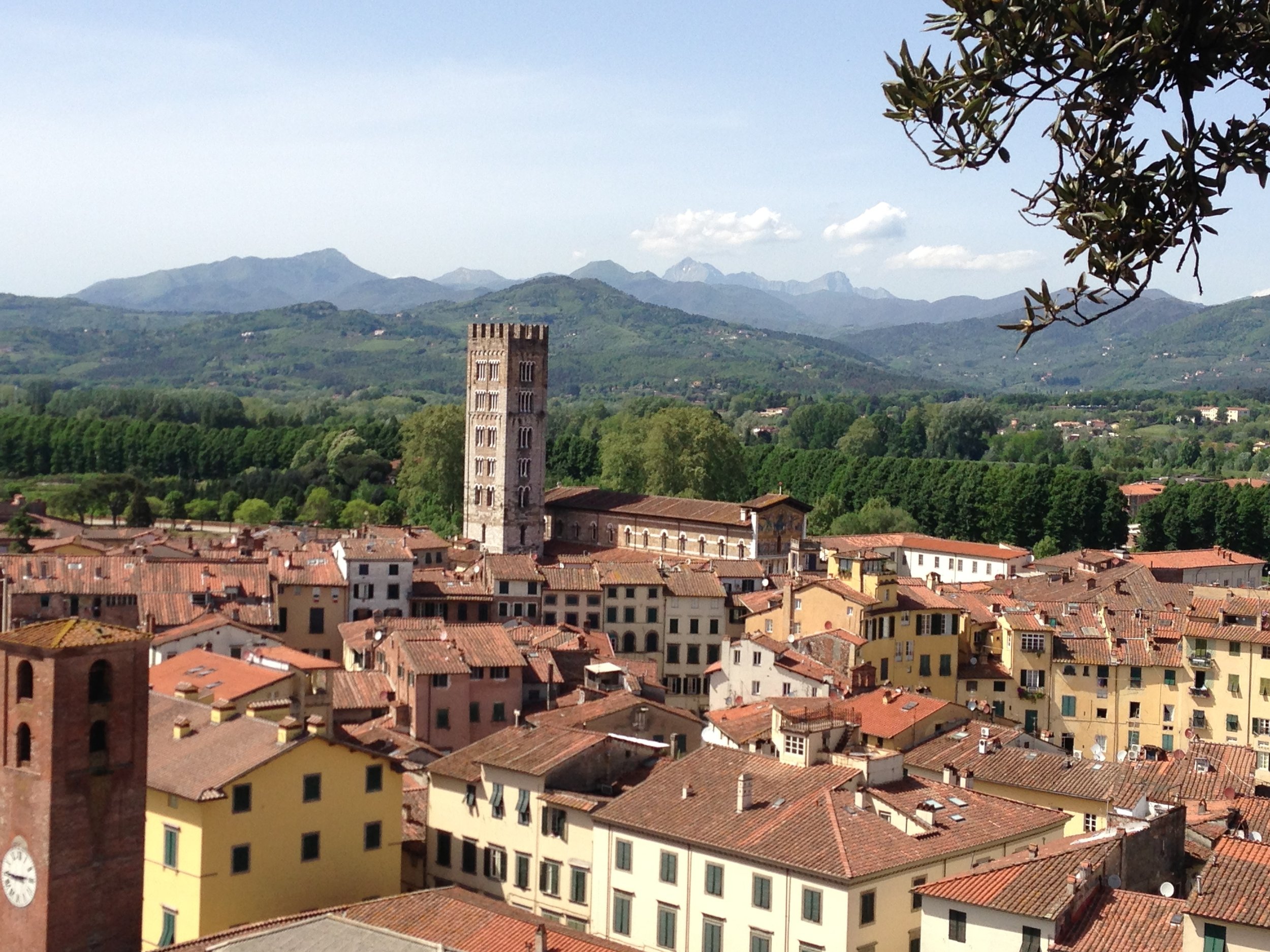
Lucca, as seen from atop the Torre Guinigi.

Lucca, as seen from atop the Torre Guinigi.

Some history: A chance encounter in an Italian train station pointed me toward Lucca. A fellow passenger described a wonderful town surrounded by a wall - a wide park-like wall where people biked, walked and socialized. A town with few tourists and amazing charm. That sounded intriguing and so I put Lucca on my "must-see" list. I had no idea at the time that it would be so many years before I would actually get there.  

The wall that surrounds Lucca.

The wall that surrounds Lucca.

Fast-forward 15 years - by this time I had made several short trips to Italy and I was looking for a different, longer, more authentic experience. I remembered Lucca from that earlier conversation and had also recently seen a TV show filmed there - complete with video of those walls. I also thought it would be fun to spend some time studying the Italian language in Italy and my research led me to Lucca Italian School.  It was definitely time to check out Lucca! 

Lucca's famous tower - the Torre Guinigi - and the characteristic rooftops of Lucca.

Lucca's famous tower - the Torre Guinigi - and the characteristic rooftops of Lucca.

In 2011 I spent four days in Lucca to "try it on for size" and see if it would be a good spot for a future, longer stay. For me, it was love at first sight - and I like to think that Lucca fell a little bit in love with me too for it has certainly welcomed me back with open arms ever since. I knew immediately that I would feel comfortable (and safe) there, even traveling solo. Several things contributed to that instant feeling. For starters, Lucca is small in size. The entire centro storico (central part of the historic city) is contained within the walls, which are about 2.5 miles in circumference. The walls really are the Central Park of Lucca, full of vibrant activity. Lucca is a walkable city, it takes 15 to 20 minutes to walk from one corner of the town to the opposite corner. Every step of the walk takes you past historic buildings, fountains, statues, beautiful churches, and cafes that invite you to linger over a cappuccino. What a combination of sights and experiences! Add in the musical sound of the Italian language, the warmth and friendliness of the people, the enticing scents drifting out of bakeries and restaurants, and the magic of sitting in a piazza for an aperitivo on a warm summer evening. Falling in love with Lucca was easy.

The back of the Basilica of San Frediano as seen from the wall

The back of the Basilica of San Frediano as seen from the wall

I have returned to Lucca each year since that first visit in 2011. I spent a month there in 2012, my first experience with solo travel and with studying the Italian language in Italy. At the time I thought that month would be a once-in-a-lifetime adventure, but I was quickly drawn into the magic of Lucca and found myself planning a next trip well before the current one had ended. With each new visit I have become more enamored. I love studying the language in a place where I hear it spoken all day, every day, all around me (not to mention that Lucca Italian School is an amazing place with amazing teachers - more on that in a future post). I love the solo travel experience and find it absolutely life-changing. I like living car-free, walking everywhere. I've made friends from all over the world with other students at the language school; friends I now connect with routinely throughout the year (thank you Facebook) and in person when we meet in Lucca each year. I feel at home in the shops and restaurants and have made friends there too. I love the serenity of the churches and the excitement of the many festivals. Lucca has truly become a second home for me, a place always in my heart, and I am counting the weeks until I can return. Until then, I will retrace favorite walks in my mind, cook Italian dishes, crank up the volume on some Italian music, and brush up on my language skills.
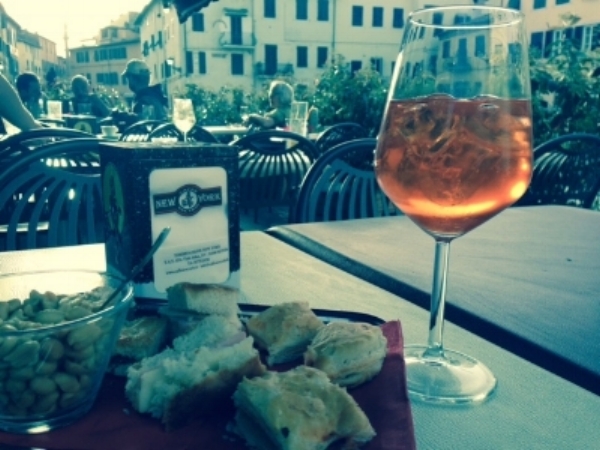
Aperitivo in Piazza San Francesco, Lucca.

Aperitivo in Piazza San Francesco, Lucca.

 I hope that you too will plan a trip to Lucca in the future  - let's meet there for an aperitivo!

                                                                                                                                                          -post by JB

Contacts:      Lucca Italian School    www.luccaitalianschool.com

All That Glitters Is Gold in Monreale, Sicily

The poet Johann Wolfgang von Goethe is quoted as saying, "To have seen Italy without having seen Sicily is not to have seen Italy at all." It took me almost a dozen visits to Italy to finally see Sicily, and I'm actually glad I waited. Goethe may have believed Sicily was "the clue to everything," but I needed the rest of Italy under my belt to appreciate Sicily. (And by "under my belt," I am referring to what I've seen and learned in all my travels to Italy - not the food and wine I've consumed.)


The exterior of the Monreale Cathedral, Sicily, September 2016.

The exterior of the Monreale Cathedral, Sicily, September 2016.

The history in Sicily is nearly mind-boggling: There is archaeological evidence of human activity on the island as far back as 12,000 B.C. Everyone from the Phoenicians to the Greeks to the Romans to the Vandals, Ostrogoths, Normans, Bourbons and others have left their fingerprints on the island that sits in the Mediterranean to the west of the Italian mainland's boot tip. Sicily became part of Italy in 1860, when Italy was unified.

Palermo, Sicily, September 2016.

Palermo, Sicily, September 2016.

Palermo is Sicily's biggest city. Just outside it is a town called Monreale that is home to one of the most stunning cathedrals in all of Italy. The Monreale cathedral is also an Italian national monument. The cathedral was started in the 12th century by William II after the Norman conquest and is considered a great example of Norman architecture. But Norman architecture doesn't hold a candle to the cathedral's interior, almost all of which is covered by glass mosaics on a background of gold. The beauty of the mosaics mixed with the gold stole my breath as I walked into the cathedral.

Monreale Cathedral, Sicily, September 2016.

Monreale Cathedral, Sicily, September 2016.

Mosaic figures of Christ, St. Peter and St. Paul, along with depictions of Old Testament stories, captured not only my attention but my imagination. The work, the time, the talent, the patience needed to complete these masterpieces are unfathomable to me. The gold glistens. The colorful mosaics sparkle.

A mosaic detail, Monreale Cathedral, September 2016.

A mosaic detail, Monreale Cathedral, September 2016.

Once I could pull myself away from inspecting up close the tiny pieces of glass that are pieced together to form pictures, I was able to walk to the roof terraces over the cloisters. From there, the view is over the fertile valley all the way to the Mediterranean. So much manmade beauty inside; so much natural beauty outside. The Monreale Cathedral sums up Italy for me. -post by JG

The view to the Mediterranean Sea from the roof terraces of Monreale Cathedral, Sicily, September 2016.

The view to the Mediterranean Sea from the roof terraces of Monreale Cathedral, Sicily, September 2016.


For information about visiting the cathedral, including hours, see http://www.cattedralemonreale.it

Natural History - Mount Etna

The volcano giveth and the volcano taketh away. That is an extremely abbreviated version of the story of Mount Etna, the extremely large, extremely active and extremely important volcano in eastern Sicily.

I spent eight days in Sicily last September, traveling from Palermo in the northwest to Catania in the east, and being awed by Monreale and Agrigento in between. I'll write more about Monreale and Agrigento in future posts. Today I'll focus on Etna, which looms over the city of Catania.

Mount Etna, September 2016.

Mount Etna, September 2016.

Mount Etna is huge. It is an active volcano - one of the most active in the world, the experts say - and covers more than 450 square miles. It has been growing for about 500,000 years! In the photo above, you can see Etna blowing smoke from one of her mouths. In the foreground is lava rock from an eruption this century. A month before I was there, a new "active pit crater" was seen by one of the volcanologists who keep a very close eye on Etna every day.

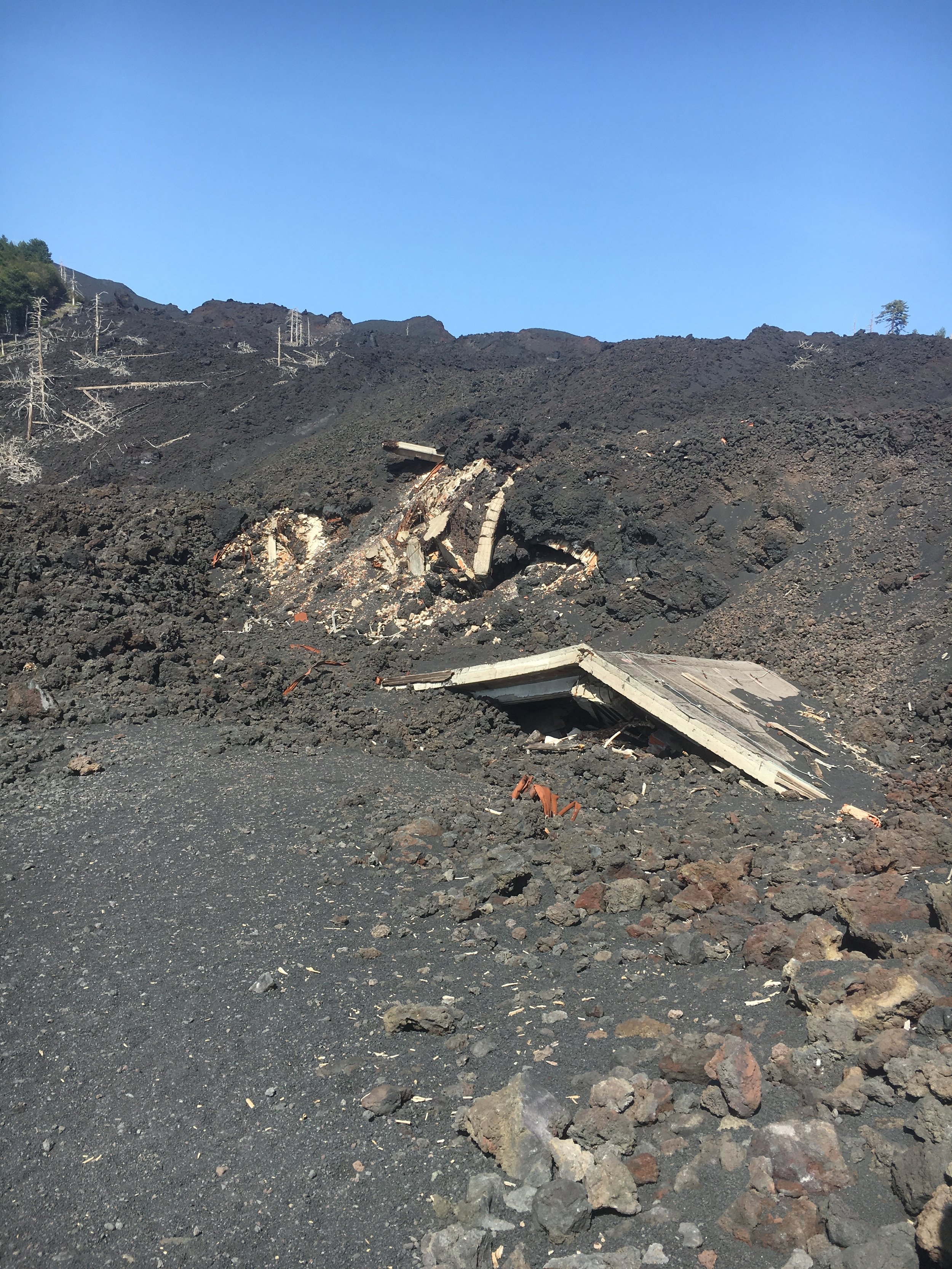
During my recent visit (as part of a tour with the wonderful company Classic Journeys - I'll also blog in the future about whether to visit Italy independently or as part of a tour - I've done both), we hiked Mount Etna. Not to the top - the volcano has an elevation of almost 11,000 feet - but up one section. Along the way, we came across the remains of a hotel buried by lava during the eruption I mentioned earlier. You can see the hotel roof in the photo below. Fortunately, no one died in that eruption. Still, the volcano taketh.

Mount Etna, September 2016.

Mount Etna, September 2016.

We also came across a local man in September who had been gathering porcini from the fertile land for his lunch. About 25 percent of Sicily's population lives on the slopes of Mount Etna. The volcano provides not only the benefit of fertile land to Sicilians but also the benefit of tourism (all we hikers need to eat, use the restroom, buy souvenirs, etc.). The volcano giveth.

A Sicilian man shows off the porcini he gathered from Mount Etna for his lunch, protected on his walk home by a cover of ferns. September 2016.

A Sicilian man shows off the porcini he gathered from Mount Etna for his lunch, protected on his walk home by a cover of ferns. September 2016.

As we hiked up the volcano, it was hard to believe anything could grow on the black expanse we covered. It was even harder to believe that Etna is active nearly every day - not spewing-lava active but churning active (I think of it as a stomach growling).

About two months after walking on Etna, I read this on a website dedicated to volcanoes: "Etna volcano update: Signs of unrest increase." Etna, the site said, "is showing signs of becoming more active again: Over the past few weeks, emissions of gas, steam and sometimes perhaps some dilute ash from the main vent ... have increased. In addition, intermittent weak glow can be detected from the same vent at night."

Volcanologists say the first documented Eta explosion was in 1500 B.C. Its most powerful was in 1669. Its longest in the late 1970s (it lasted for more than a decade), and its latest began in 2007. I hope Etna does not erupt soon but I know it will again, changing forever the landscape that I and my fellow travelers were lucky enough to see and experience in September.       -post by JG


Italy is not just home to active volcanoes. As a documentary shared by an Italian acquaintance in Albuquerque notes, Italy "is a turbulent land, geologically." In the past year, a series of earthquakes has shaken the country. The Apennines region experienced half a dozen tremors from August to October. Hundreds of people died, thousands of others were left homeless and historic buildings were destroyed. Earlier this month, a luxury hotel in the region of Abruzzo was hit by a 120,000-ton avalanche. Twenty-nine people were killed. If you love Italy like I do, and want to help with relief efforts, you can donate to: the Italy Earthquake Relief Fund started by GlobalGiving, the Italian Red Cross, or a rebuilding fund started by the National Italian American Foundation.

Hotel Del Coronado - Not Your Ordinary Beach Vacation

The Hotel Del Coronado (affectionately known as the Hotel Del) is no ordinary hotel. Built in the late 1880s, it is one of the few remaining classic beach resorts in the United States and is listed on the register of National Historic Landmarks. You just don't find wooden buildings of this size, or of this elegance, at the seaside any more. With its red roofs, turrets, balconies and curves, it is truly the grand dame of beach properties.

The Del comes complete with a fascinating history of visits by past presidents and Hollywood legends, the filming of iconic movies (photos abound of Marilyn Monroe during the filming of "Some Like it Hot" in 1958) and its very own ghost (the lovelorn Kate, who died by her own hand in 1892 and still wanders the Del today). The earliest visitors paid less than $3 per day for room and board. I can promise you that today's prices far exceed that amount, making this a luxury destination indeed.

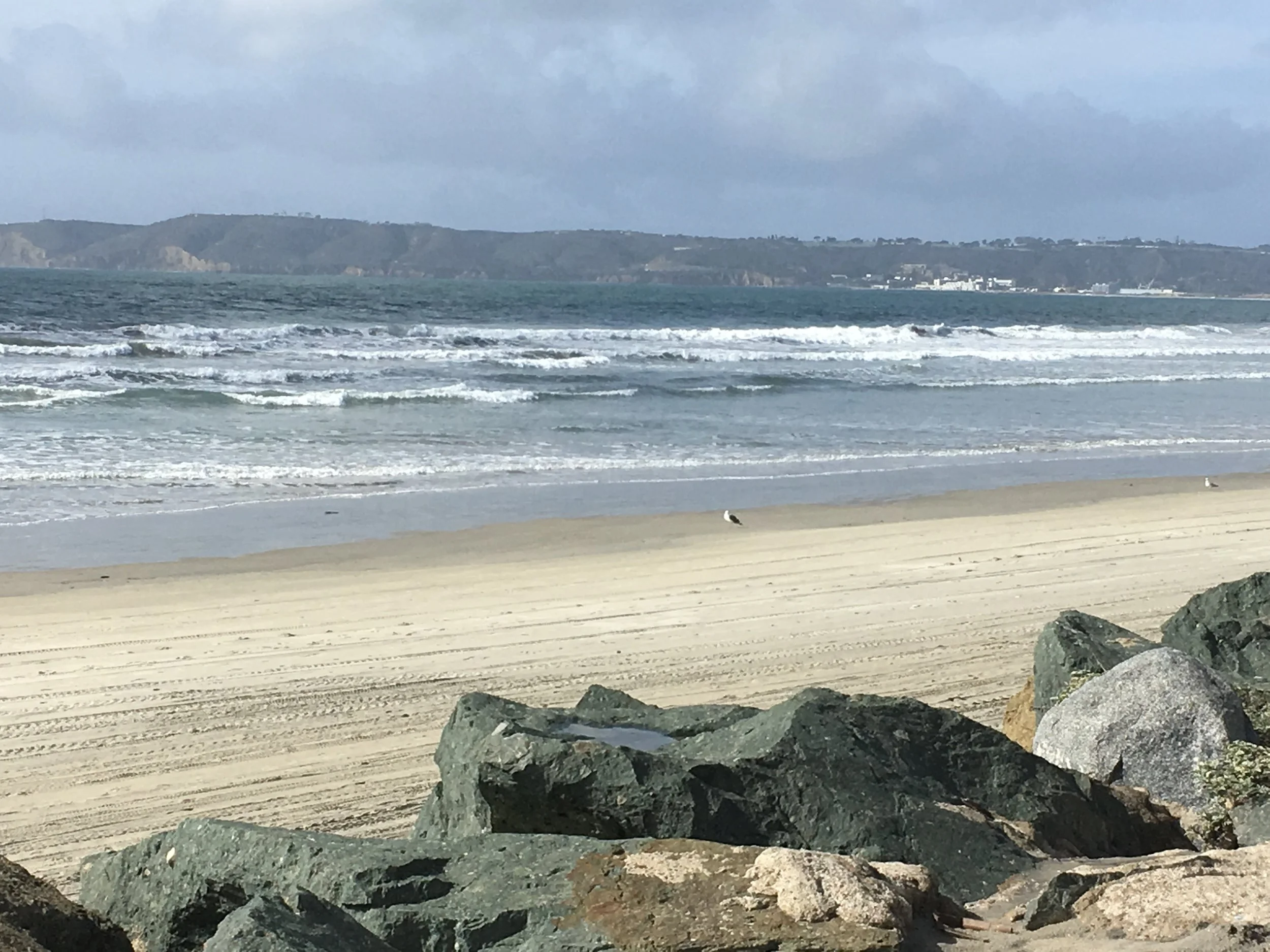
View of the beach from my room - nice to wake up to this view each morning.

View of the beach from my room - nice to wake up to this view each morning.

On top of all this, the Del has long stretches of sandy beach, palm trees, beautiful vegetation, a variety of restaurants, a spa, pools and lots of possibilities for "retail therapy."

Seaside vegetation.

Seaside vegetation.

The main pool at the Hotel Del.

The main pool at the Hotel Del.

I recently had the good fortune of staying here, tagging along with a friend who had a business meeting at the hotel. I had a chance to soak up the history, wander the grounds, explore Coronado Island and, most of all, to enjoy walks along the beach with my toes in the water, listening to the sound of breaking waves and marveling at it all.

IMG_0875.JPG


The sunsets here are spectacular. The sun sinks quickly into the ocean, so mind your weather report when it says that sunset is at 5:08 p.m. because by 5:15, it will be over except for a long lasting post-sunset glow. But oh those few minutes of watching the sun sink into the sea, from the balcony of my room, glass of wine in hand, are magic!

Sunset from the balcony at Hotel Del Coronado.

Sunset from the balcony at Hotel Del Coronado.

Everything about this hotel is special - the setting along a beautiful coastline, the mild temperatures (60 degrees in January), the rooms with balconies overlooking the water, the beautiful wood-paneled main lobby with its unique vintage elevator (complete with a uniformed elevator attendant), the gardens, the attentive staff. There is even a sand castle artist who builds intricate and beautiful chateaux on the beach in front of the hotel.

Sand castle on the beach at Hotel Del.

Sand castle on the beach at Hotel Del.

The only downside I found was that the cost puts a stay here out of reach for so many of us (me included - remember I was a tag-along on this trip). Room rates start at around $400/night soaring up to more than double that. The cost of food is also high (think $36 for a fish taco lunch, a $37 breakfast buffet, $6 for a cup of tea, $6 small scoops of ice cream). Though expensive, the food was really good, especially the extensive breakfast buffet with made-to-order omelets, waffles and pancakes, fruit choices from berries to kiwi and melon, a bagel station complete with lox, pastries galore, and really good coffee (a must for me). 

I did find several good restaurants off the hotel property with much more reasonable prices. Two of my favorites were Clayton's Coffee Shop (a throwback '50s diner where the waitresses wear flowers in their hair, the jukebox plays classic songs and the red chairs swivel at the counter). This is a great place for breakfast or lunch - servings are huge and shareable.  

The counter at Clayton's diner.

The counter at Clayton's diner.

For lunch, happy hour or dinner, I especially liked Brigantine - a great seafood place with fresh fish, an oyster bar and some really good margaritas.

Fish tacos with coleslaw and house-made chips at the Brigantine.

Fish tacos with coleslaw and house-made chips at the Brigantine.

What a treat a few days here were. I never thought of myself as a "California girl" but who knows, maybe I have a little bit of beach in my soul after all.

IMG_3585.JPG

_______________________________

Hotel Del Coronado   hoteldel.com