Two Parts Italy

Exploring Italy, travel, and living a flavorful life

  • Blog
  • About This Blog
  • Start Here
  • Recent Posts
  • Archives by Topic
  • Subscribe
  • Contact me
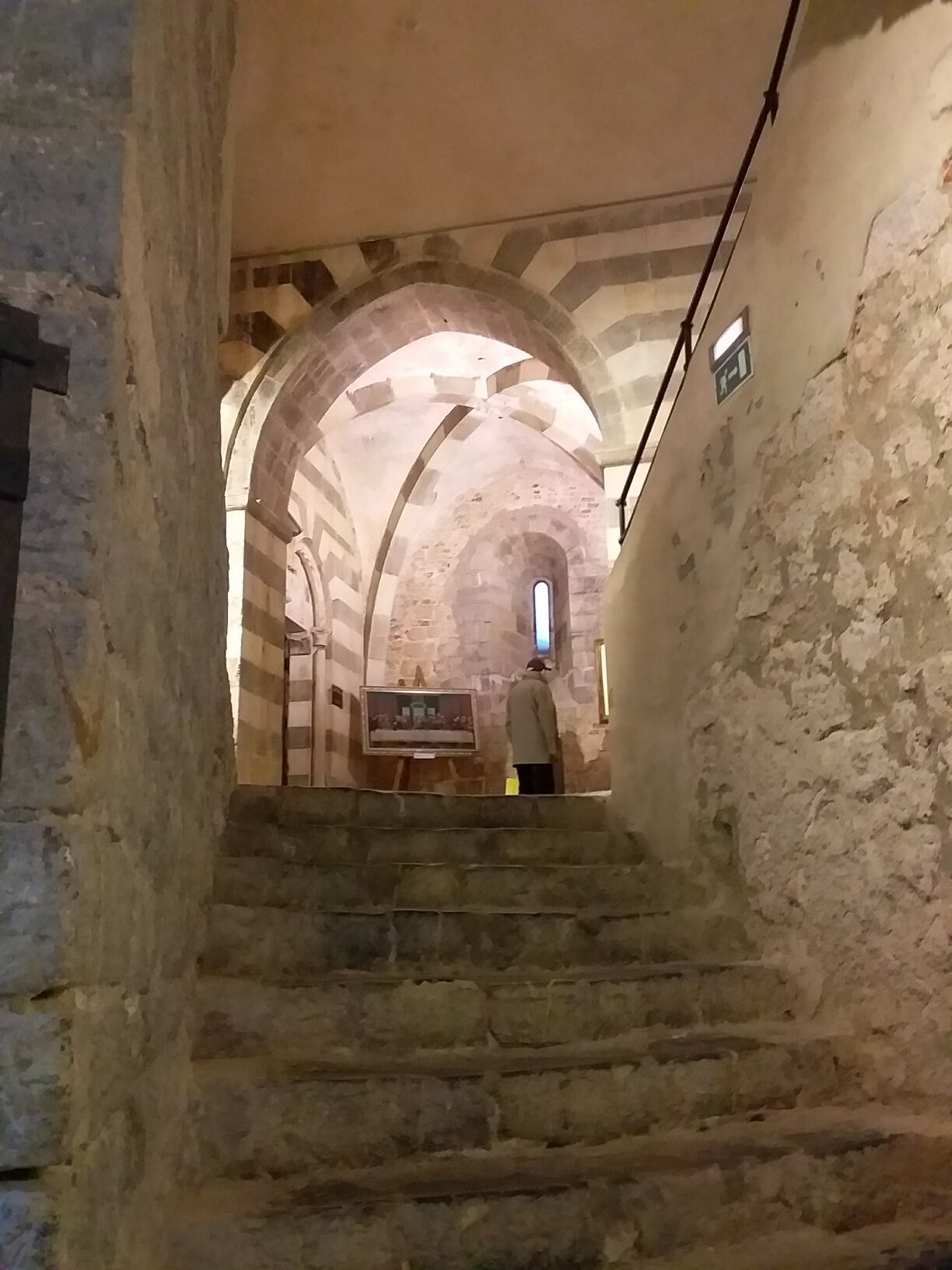
The Santuario Basilica di Montallegro in Rapallo

The Santuario Basilica di Montallegro in Rapallo

Rapallo's Church on the Hill

August 10, 2020 by Judy Giannnettino

The Italian Riviera, home to Sanremo (you might know it if for its annual music festival), the port city of Genova and the incomparable Cinque Terre, is a nature-lover’s paradise. The Ligurian Sea lies to the west, the Alpi and Apennine mountains to the east. In between are cities, towns and villages with history, charm and beauty. One of those is Rapallo.

The sea as seen from the waterfront walk in Rapallo

The sea as seen from the waterfront walk in Rapallo

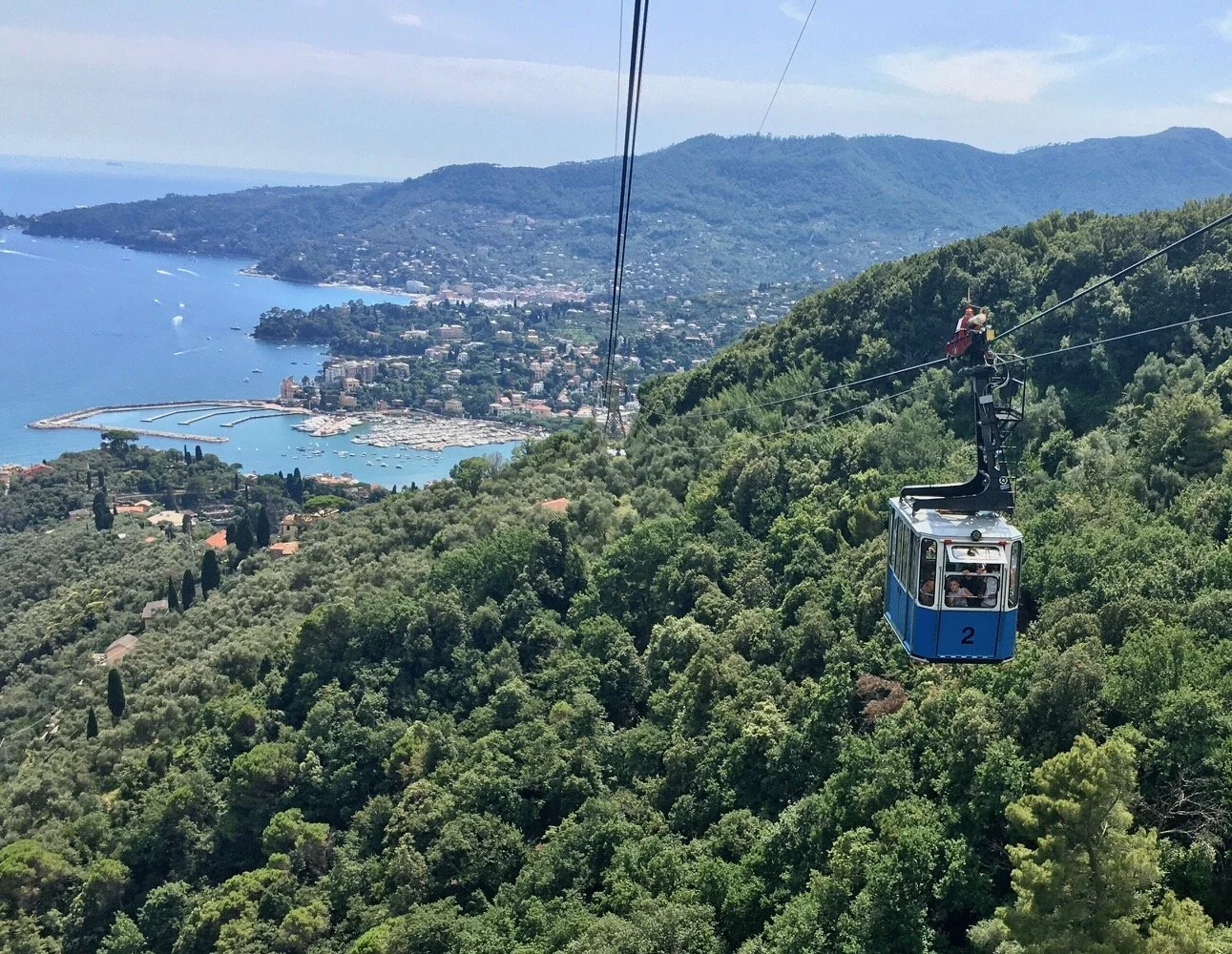
South of Genova (about 30 minutes by car; 55 by train), Rapallo has the added attraction of a funivia (cable car) that carries passengers to the top of a hill not just with panoramic views of the sea and countryside but also with a beautiful and impressive church, the Santuario Basilica di Montallegro. The tram, opened in 1934, is an eight-minute ride with an elevation gain of about 600 meters (1,968 feet). During a recent day trip to Rapallo from Lucca (about a 90-minute drive), a friend and I took the tram after lunch for 8 euros each. I stared with wonder at the intense blue of the sea as we slowly rose over the city, the tiered gardens of residents fortunate enough to have some land and a house (or small villa) on the hillside, and then the lush green treetops as we reached the end of the line.

The altar of the Santuario Basilica di Montallegro

The altar of the Santuario Basilica di Montallegro

At the top, a short uphill walk led us to the church, which rose before us almost like an apparition. It is at the top of a wide stone stairway and its handful of spires jut into the cloudless blue sky. It is a remarkable sight, this massive almost-white church in the middle of a forest, towering above a sea.

Tiered gardens
Tiered gardens
Tram tower
Tram tower
Another tram car
Another tram car
Rising over Rapallo
Rising over Rapallo

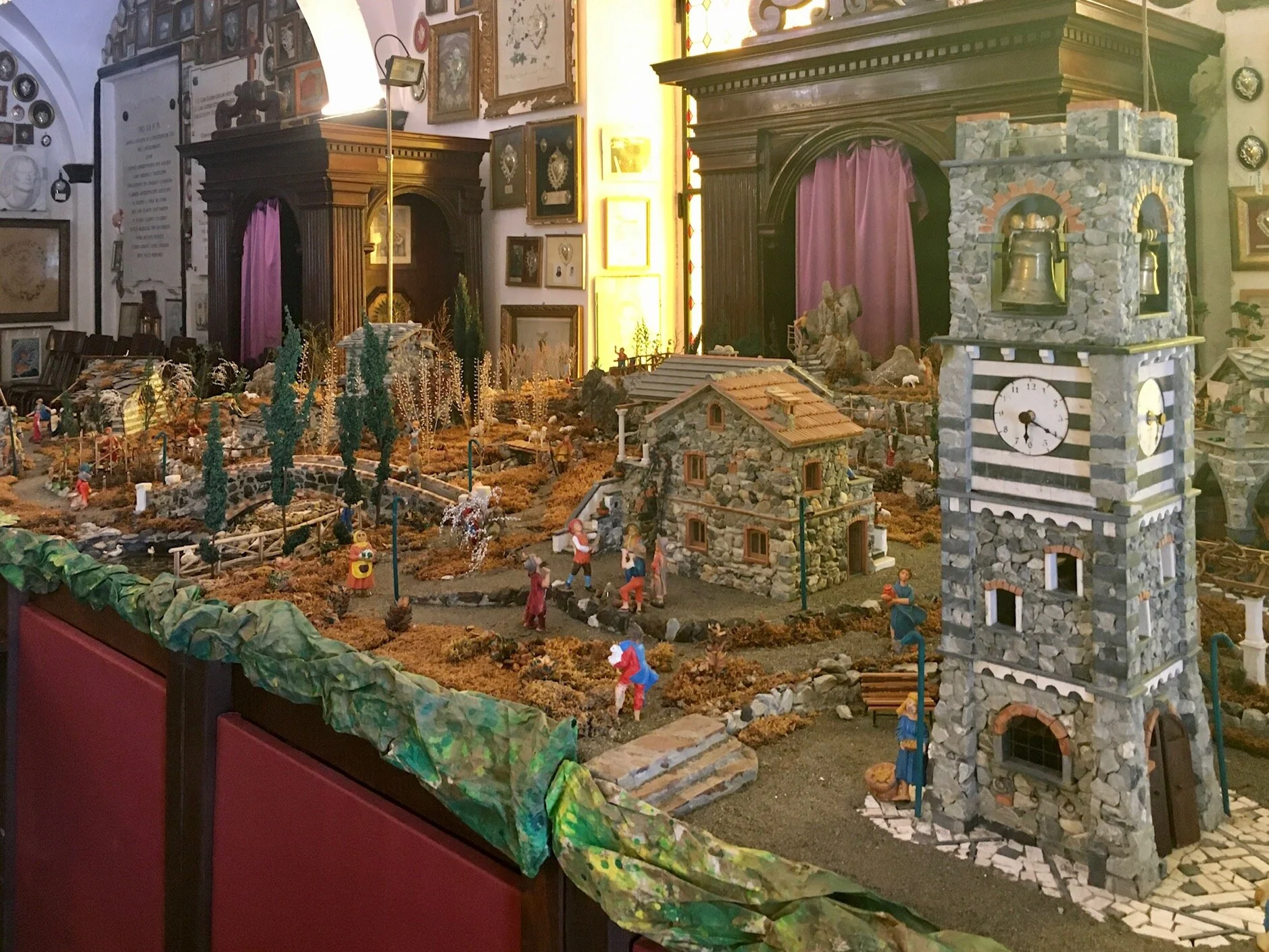
The Santuario Basilica di Montallegro, along with an accompanying shelter for pilgrims, was built in 1558. (Can you imagine hauling the materials needed to construct it up the hill way back then?) The marble façade that we see today was added in 1896. Inside, the altar sits under a frescoed dome. Massive stained-glass windows portray biblical scenes, and around the church are memorials to loved ones. A side chapel hosts a large presepe that includes an entire village with figurines of workers and others, each with an amazing life-like facial expression.

Memorials
Memorials
Presepe
Presepe
Presepe figurines
Presepe figurines
Stained-glass window

Outside the church are vistas in every direction – the city of Rapallo, where about 29,000 people live; the sea and its coves; the tree-covered hills; hiking paths. There are a couple of restaurants and a hotel atop the hill, and while I purchased round-trip tram tickets, you can ride to the top and hike your way down if you prefer.

A walking path outside the church

A walking path outside the church

The tram isn’t the only attraction in Rapallo – there is a castle, other interesting churches, lidos to explore, boat rides to take (perhaps to Portofino or another coastal town), and museums to visit. Those will be for another day – and another blog post.   -post by Judy

A gazebo in Rapallo with a spectacular ceiling and spectacular views

A gazebo in Rapallo with a spectacular ceiling and spectacular views
August 10, 2020 /Judy Giannnettino
Toto, we’re not in Italy anymore. The anything-but-green landscape approaching New Mexico

Toto, we’re not in Italy anymore. The anything-but-green landscape approaching New Mexico

Air Travel in the Age of COVID-19

August 03, 2020 by Judy Giannnettino

I’m writing this post from New Mexico, where I am spending two weeks of self-isolation after arriving from Italy in early July. My travel from Italy to the U.S. took me from Firenze (Florence) to Frankfurt on Air Dolomiti, a regional airline owned by Lufthansa. From Frankfurt it was on to Washington, D.C., on United Airlines. After an overnight stay in Washington, I flew first to Houston and then, finally, to Albuquerque, where my family lives.

Four flights, four airports, two days. Nothing compared to the transatlantic crossing my great-grandfather took from Naples to New York in the late 1800s, but still a stressful journey in the age of COVID-19. So, what is it like traveling by plane these days? Definitely different than previous travel; more stressful, more uncertain. The key words are patience, flexibility, and caution.

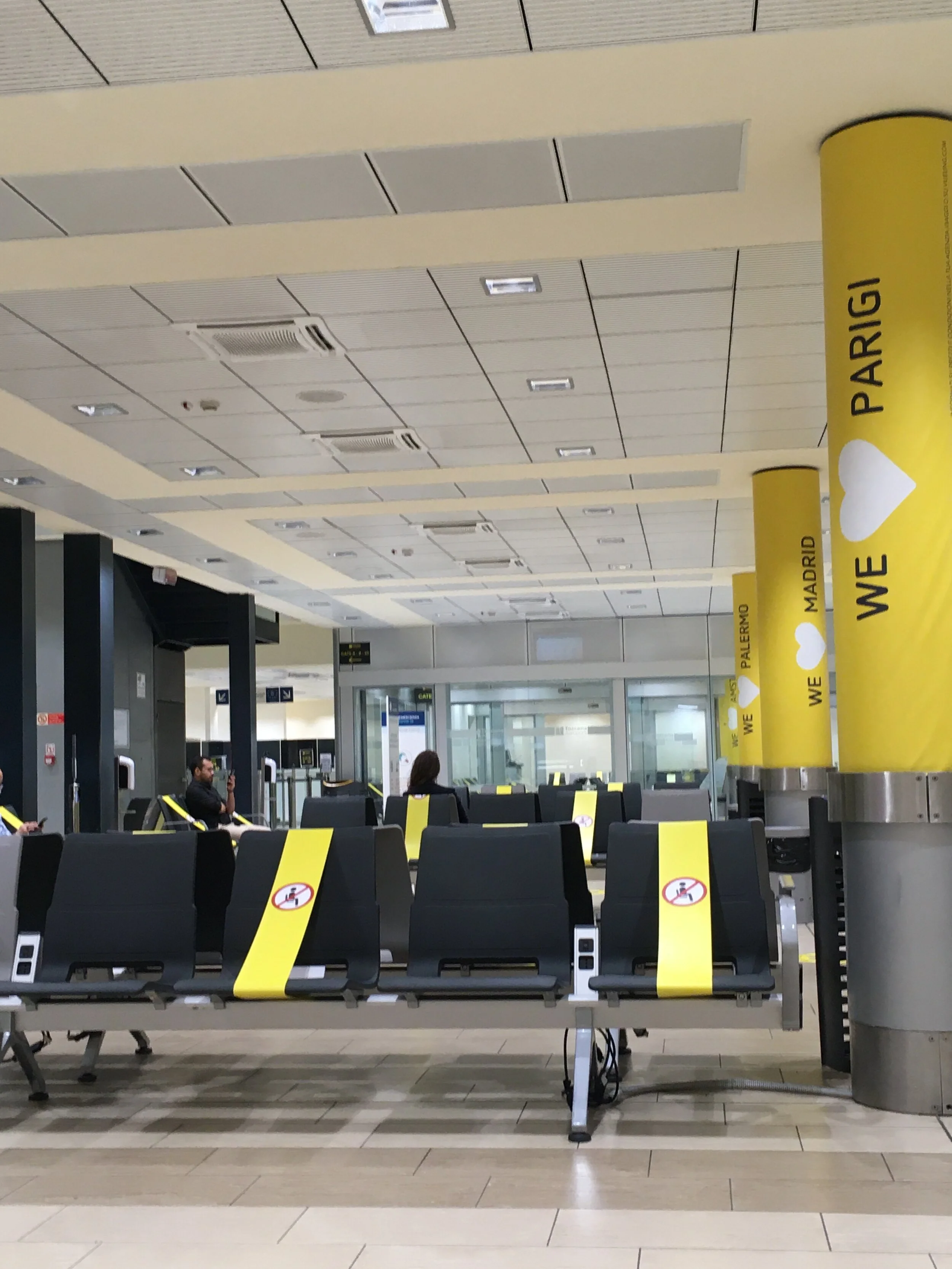
Social distancing markers in the Florence, Italy, airport July 2020

Social distancing markers in the Florence, Italy, airport July 2020

First, patience. Everyone’s travel plans have been upended by the COVID-19 emergency. A number of people living, or visiting for an extended period, in Lucca (where I live) decided to head home for the duration of the problem (little did we know at that time how long a period that would be). Canadians, Americans, Australians, Brits. They left early on, in March. Understandable. I considered a return then but decided to stay in Italy for a number of reasons. One being that I actually felt safest staying put. The government and public response were impressive, the health care in Italy is good, I have lots of support there, and it seemed the safest course to simply shelter in place. Also, hearing about the challenges of travel, with large numbers of people trying to return to their home countries creating long lines and chaos at airports, I definitely did not want to fly when planes were packed and the lines in airports created perfect breeding grounds for the virus. I also feared bringing the virus with me, as there was little in the United States at that point. Little did I know how that would change! Patience became necessary because after that first wave of people left Italy for their home countries, the flights stopped and the opportunity to fly to the U.S. evaporated. Not knowing when (or if) I would be able to return to the U.S. meant developing a lot of patience - not my strength at all!

A nearly deserted Frankfurt airport felt very eerie.

A nearly deserted Frankfurt airport felt very eerie.

Patience was even more important when my first three flight reservations were canceled. The cancellations were due to the lack of flights within Europe. Because there were no direct flights from Italy to the U.S. at that time, I had to first get to Frankfurt and until early July those flights weren’t happening. In fact the airports in Pisa and Firenze were mostly closed until mid-June. My final reservation, on July 2, coincided with the resumption of many flights within Europe and provided the first opportunity to fly. Patience is also needed to adapt to the changes in boarding procedures and limitations on carry-on items. As of July1, Italy had banned all use of the overhead compartments so as to reduce people standing in the aisles and make boarding safer and faster. This meant being limited to only one item that has to fit under the seat. And nothing with wheels! Even my small “underseater” suitcase was not allowed. There was a lot of anxiety in checking items that I’d normally carry aboard and having just the absolute essentials in my shoulder bag (computer, medications, etc) - and it sure made for a heavy shoulder bag! (this ban is set to end by late July according to the most recent decisions). And while Germany has not banned the use of overheads, they also would allow only one carry-on item per passenger. Luckily, my checked luggage arrived without any delays.

Next, flexibility. The normal routes for travel don’t exist at this time. This is especially true to the U.S. where only about 10 airports nationwide are accepting flights arriving from overseas and where many domestic flights have also been suspended. Forget about preferred cities for layovers, efficient flights that get you home in the shortest time possible, lots of choices about routes, and sometimes even your preferred airline. Each of my three canceled itineraries had different routes, included different partner airlines, and had long travel times. In all, it took double my usual travel time to get to New Mexico. Prepare to be patient when landing too - there are extra health forms to be filled out (handed out in fight), temperatures to be taken, and questions answered on arrival. I was impressed with the patience of the passengers and airport staff.

Restaurants with sit-down dining remain mostly closed, this one in Houston.

Restaurants with sit-down dining remain mostly closed, this one in Houston.

Flexibility and patience together help to deal with the realities of current travel in terms of airport and onboard services. Leaving Florence on an early flight, there were few services open in the airport. If you see an open coffee shop, don’t pass it up - there likely isn’t another one! And you may not find an open one at all. I was glad I had a protein bar with me. In Frankfurt, the airport felt nearly deserted until I got to the gate. There were a few more places open, all for take away, no tables available. Once on board, service was also limited. Early in the flight everyone was given a bottle of water. There was no coffee or tea served, no alcohol (that may have changed by the time you read this as the flight attendants said they expected both to return “any time now'“). Meal service was fairly normal.

Caution.There are clearly risks associated with flying but with care they can be minimized. Departing Florence, temperatures were measured and we passed through what looked like a scanner but hit us with a mist. I’m assuming this was a disinfectant of some sort. Masks must be worn and changed every four hours. Never have I seen so many people wiping down their seats, tray tables, arm rests, TV monitors, seat belts - a good strategy. Disinfectant wipes were handed out as we boarded each flight. Social distancing is a goal, but not an in-flight reality, unfortunately. My flight from Florence to Frankfurt was only half full and nearly everyone had an empty seat next to them, which felt reassuring. Not so on the transatlantic leg, which was quite full. But everyone wore their masks except when eating. The biggest caution is about personal responsibility - no one with even the slightest hint of illness, or with a known exposure, should board an airplane.

One week into my self-quarantine I am feeling well, keeping busy, and getting anxious to be able to hug my grandkids (with masks on!). Now, I hope I am able to return to Italy as planned in September! -post by Joanne

Come September, I hope to be back home in Lucca!  Meanwhile, I will stay vigilant while enjoying my family and friends in New Mexico.

Come September, I hope to be back home in Lucca! Meanwhile, I will stay vigilant while enjoying my family and friends in New Mexico.

August 03, 2020 /Judy Giannnettino
Lerici’s harbor and Medieval castle

Lerici’s harbor and Medieval castle

A Day Trip to Lerici

July 27, 2020 by Judy Giannnettino in Italy, Italy travel, Liguria

Summer arrived right on schedule in northern Italy, ushered in by the summer solstice in late June. One day we had warm but not hot, slightly cloudy weather with gentle breezes and the next day arrived 90 degree temperatures, full sun, and that famous Italian summer humidity.  Is there a better way to mark the arrival of summer than a day trip to the Italian coast ?  Not in my book.

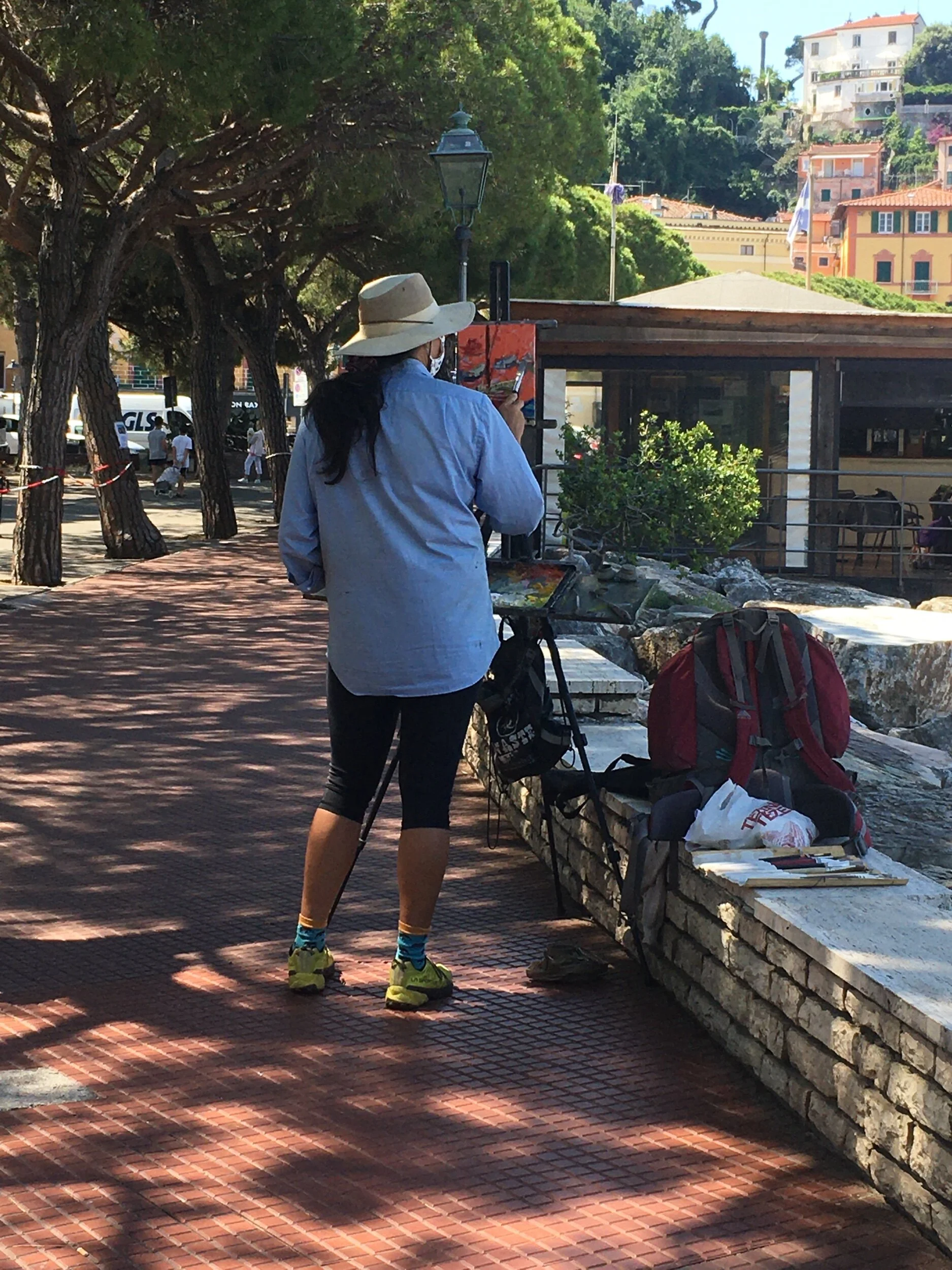
The artist Kat Ring at work in Lerici. See her work at katring.com

The artist Kat Ring at work in Lerici. See her work at katring.com

My “welcome summer” day trip destination was Lerici, in the Italian region of Liguria, about an hour by car from where I live in Lucca. 

Lerici is blessed with an embarrassment of riches. First, location. Lerici sits at the southeastern edge of the Gulf of Poets (Golfo dei Poeti in Italian), so named for the famous poets who spent time there (think Byron, Mary and Percy Shelly, DH Lawrence). It could just as easily have been called the Bay of Artists. A favorite spot for painters, it is common to see easels set up along the bay with artists painting away.  On the day I visited, my favorite local artist from Lucca, Kat (Katarina) Ring, just happened to be painting on the promenade along the harbor.  I can’t wait to see what she created!

Across the bay from Lerici lies Portovenere with its stunning sea views and charming little village. To the northwest, at the top of the bay, lies La Spezia, a port city, transportation hub, and the jumping off place for visits to the Cinque Terre.  All of these places can be reached by commercial tour boat from the harbor in Lerici.

Lerici’s harbor as seen from the castle

Lerici’s harbor as seen from the castle

The harbor here is small and protected, home to many small to medium-size boats. Sitting harbor side, relaxing in a shady spot, and watching the boats bob in the harbor, is a summer joy. 

A private beach in Lerici

A private beach in Lerici

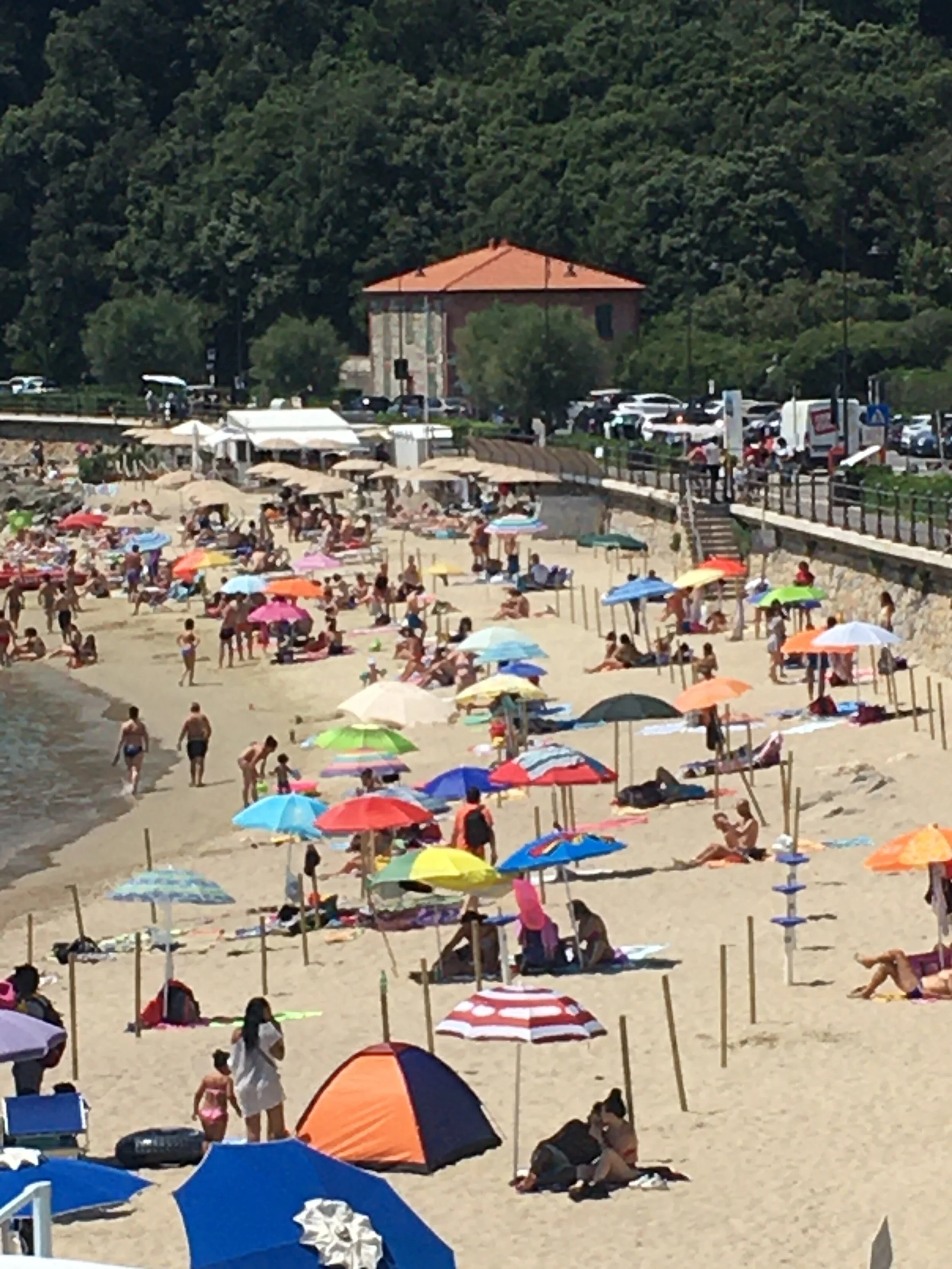
Lerici is also home to long stretches of sandy beach.  As is common in Italian beach towns, there are public swim areas and private swim clubs where the price of admission includes a big umbrella, a clubhouse, and often a bar/restaurant. In both the public and private spaces, colorful umbrellas dot the sand, people (mostly Italians) sunbathe, swim, and play on the beach. This year, poles are set up on the public beaches to mark “social distancing” intervals and the umbrellas at the clubs are similarly spaced.  Closer to the town center the beach becomes rocky, with some parts reserved for local residents. 

Piazza Garibaldi, the town center.

Piazza Garibaldi, the town center.

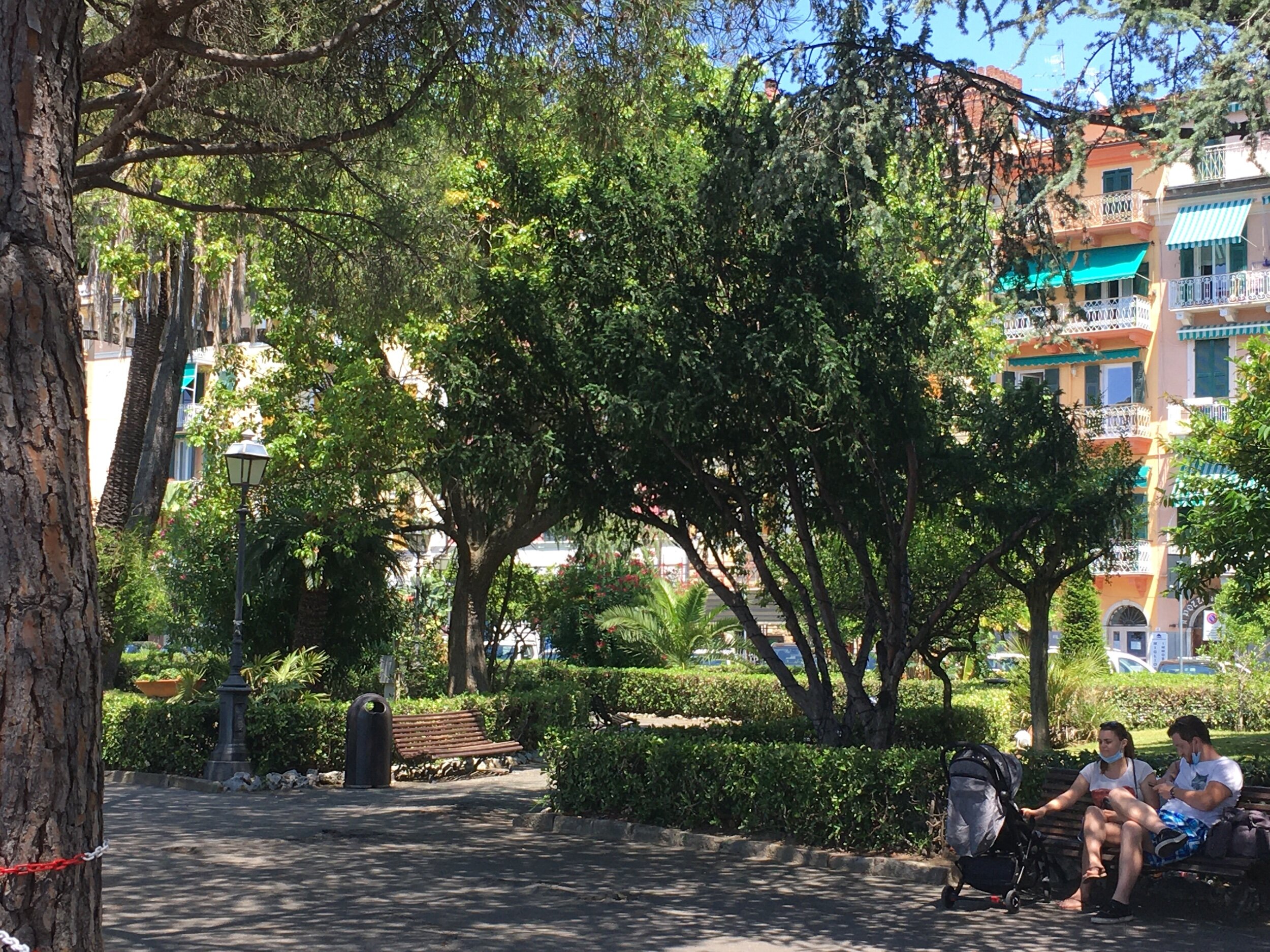
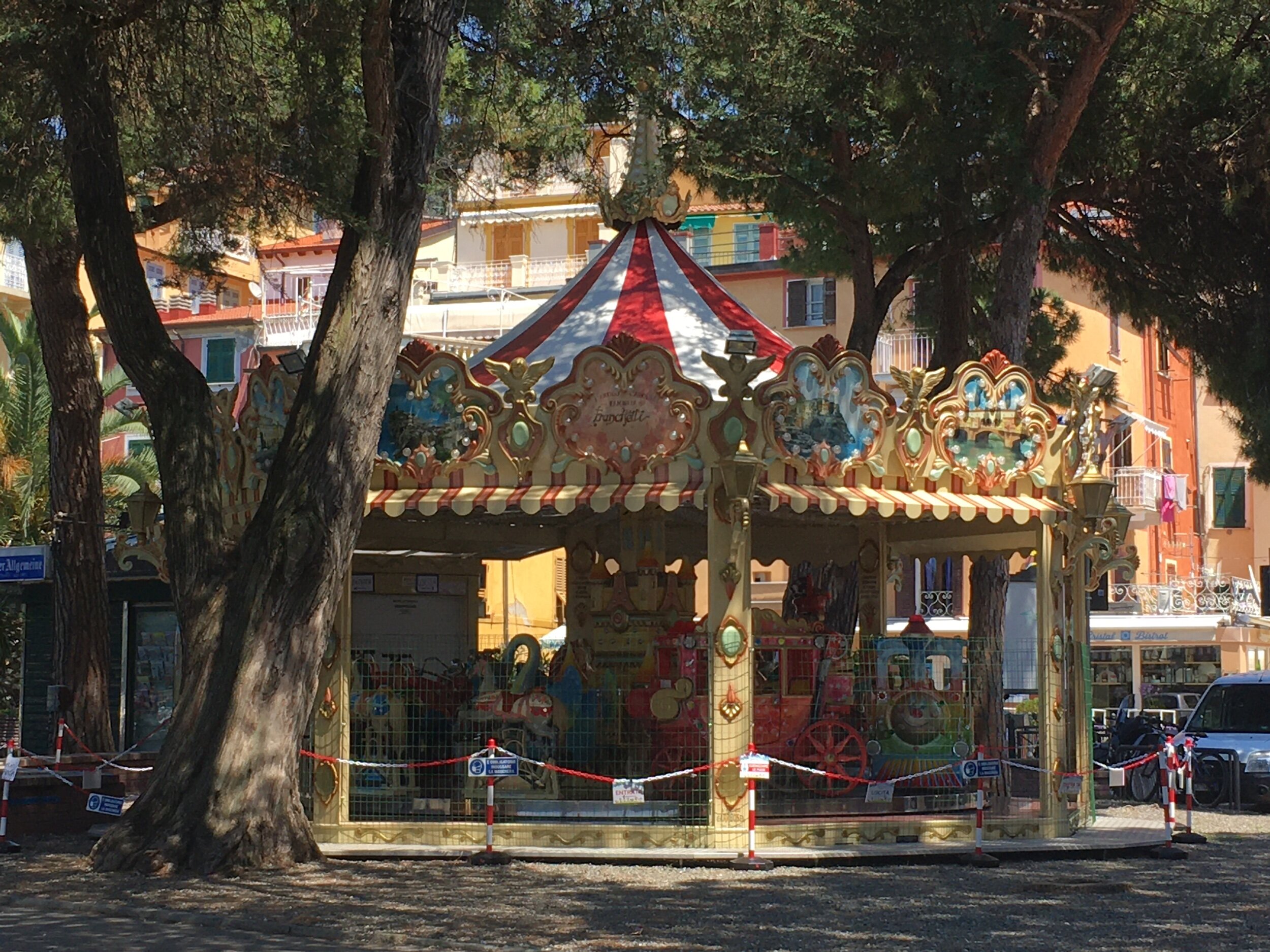
Lerici also has a charming town center set around a fountain and ringed with restaurants and cafes. The church bells ring, the cafes buzz with activity, and the palm trees sway gently in the breeze off the bay. Just off the main piazza, and across the street from the harbor side promenade, is a pretty green space complete with benches and even a carousel for the little ones.

IMG_2659.jpeg
IMG_2657.jpeg

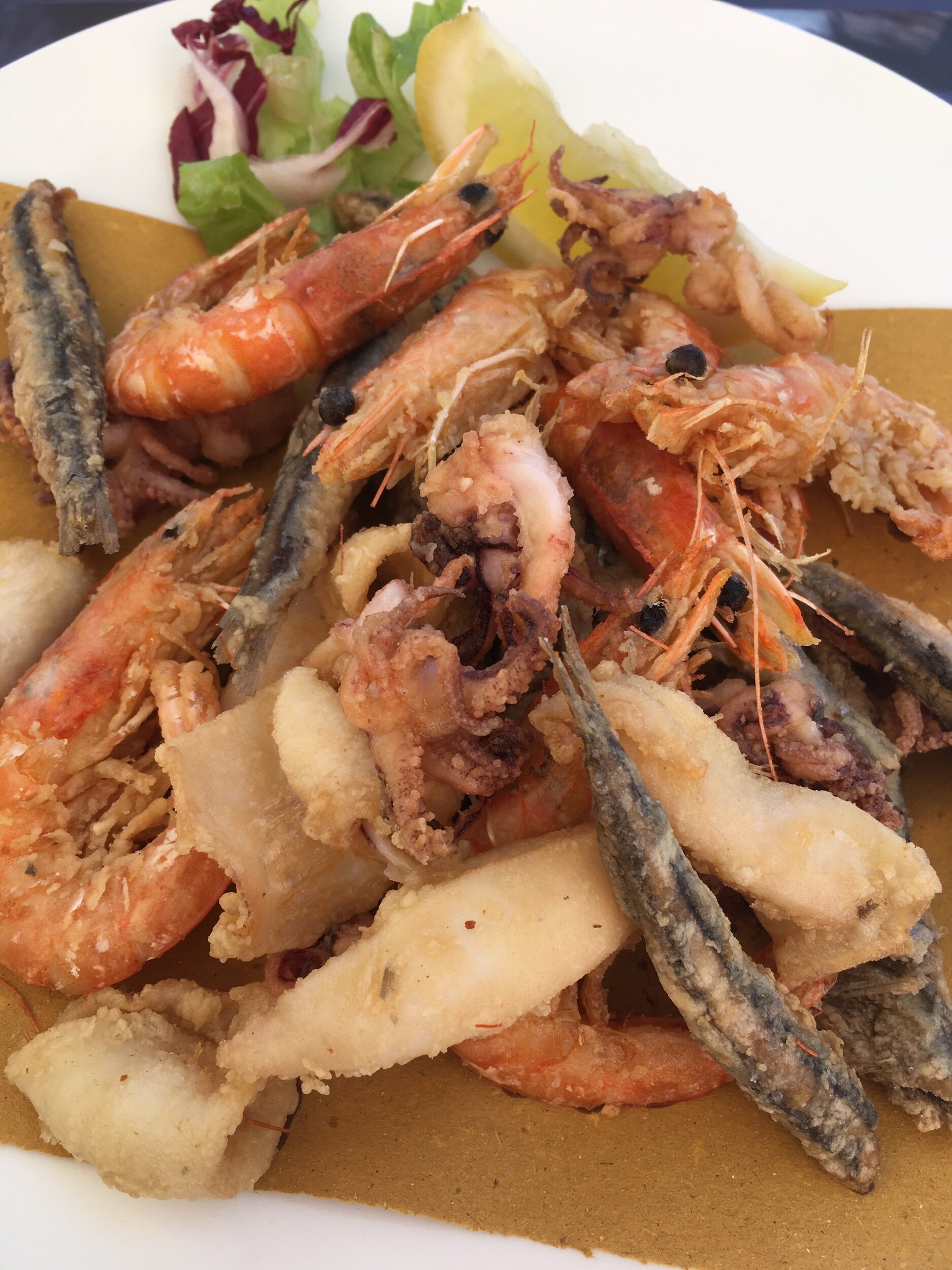
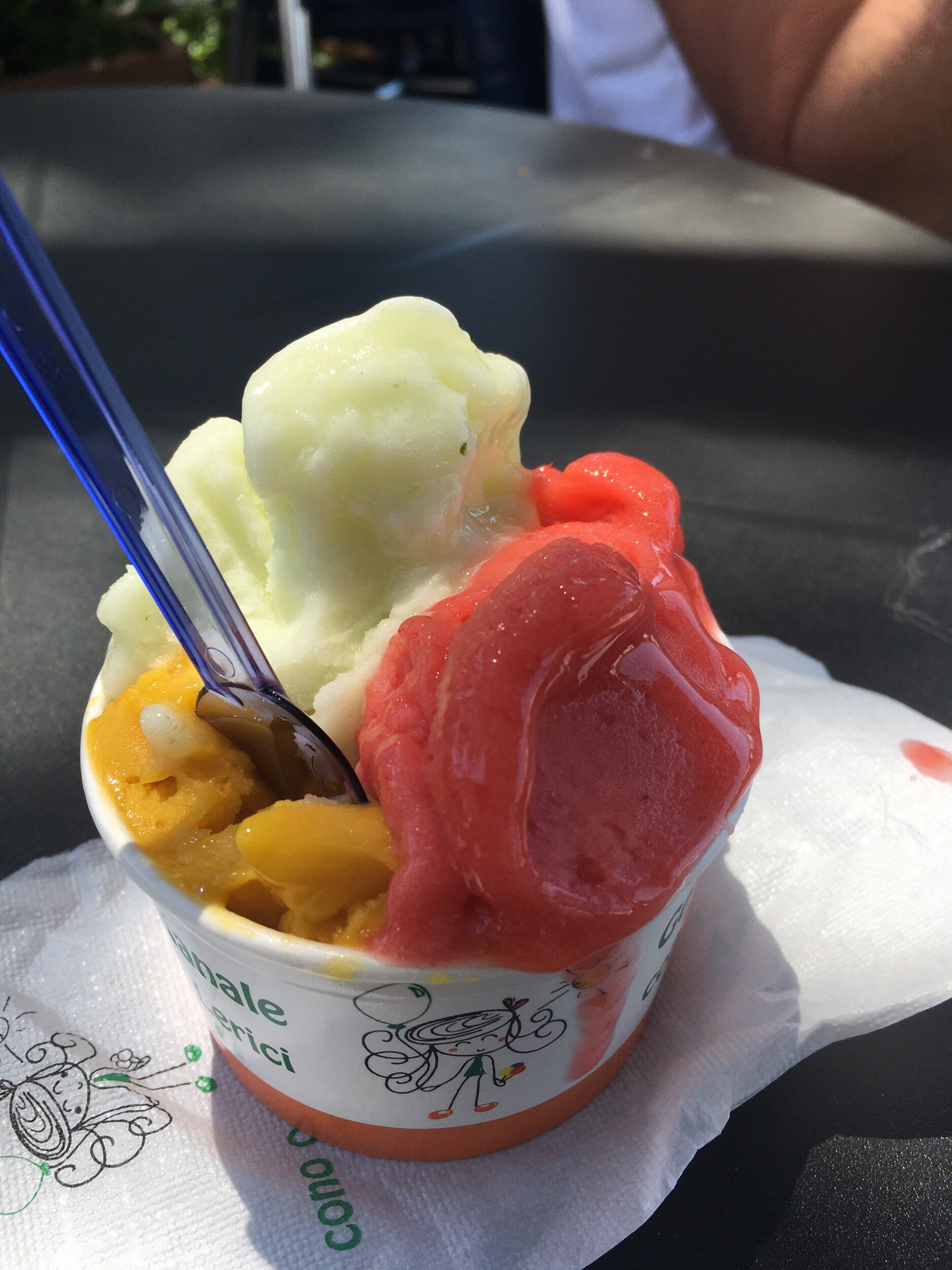
No summer visit to an Italian beach town is complete without two things : a meal of fresh seafood and a really good gelato. There are plenty of seafood spots in Piazza Garibaldi; we wandered into one at random (and I forgot to write down the name! ). My frito misto included the local specialty of fried anchovies, along with the traditional calamari, shrimp, and tiny little bites of octopus. Delicious! And the gelato snob in me was delighted to find really good gelato, too - a combination of mango, strawberry, and a surprisingly delicious lemon-basil.

IMG_2649.jpeg
IMG_2651.jpeg

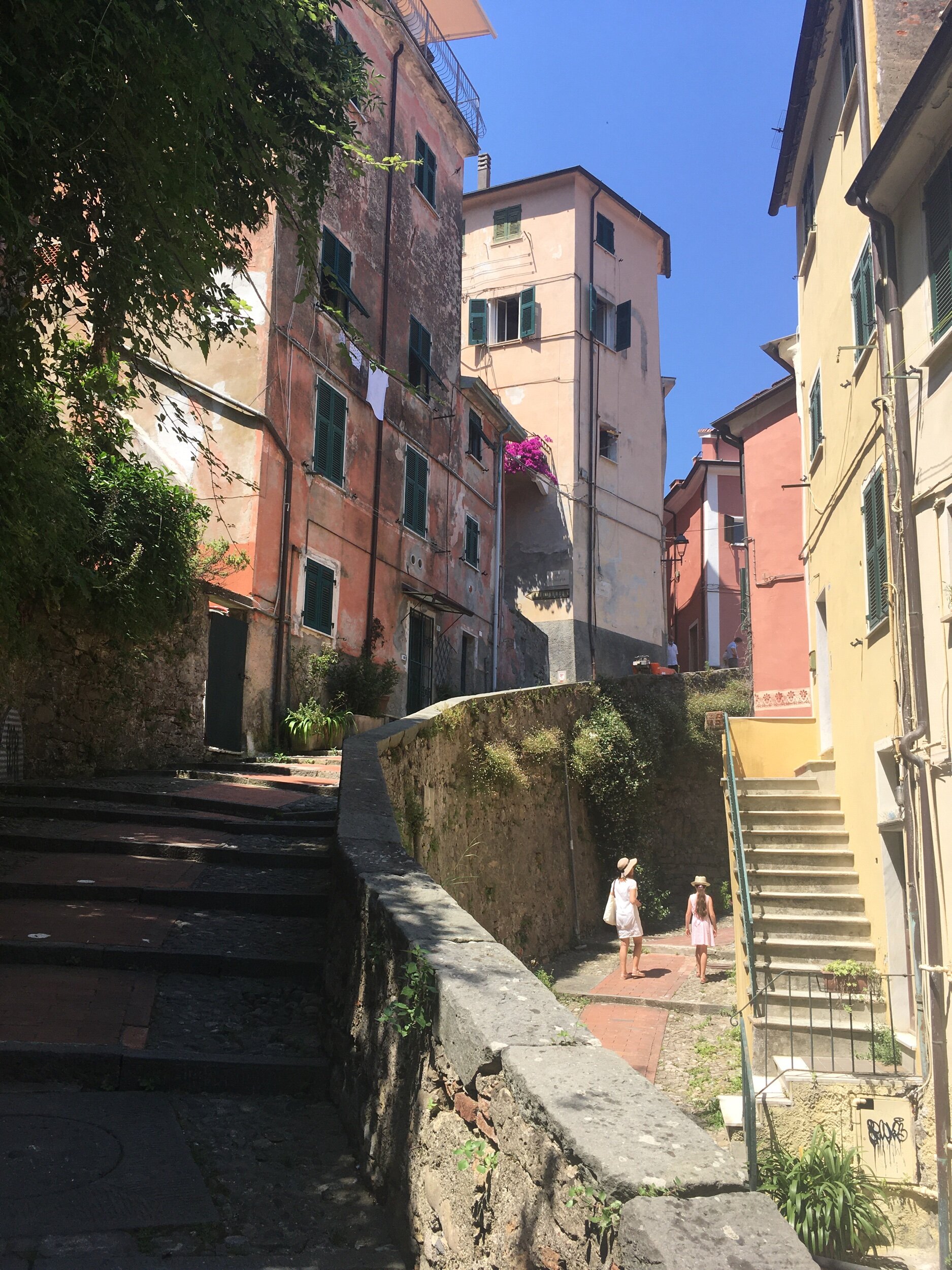
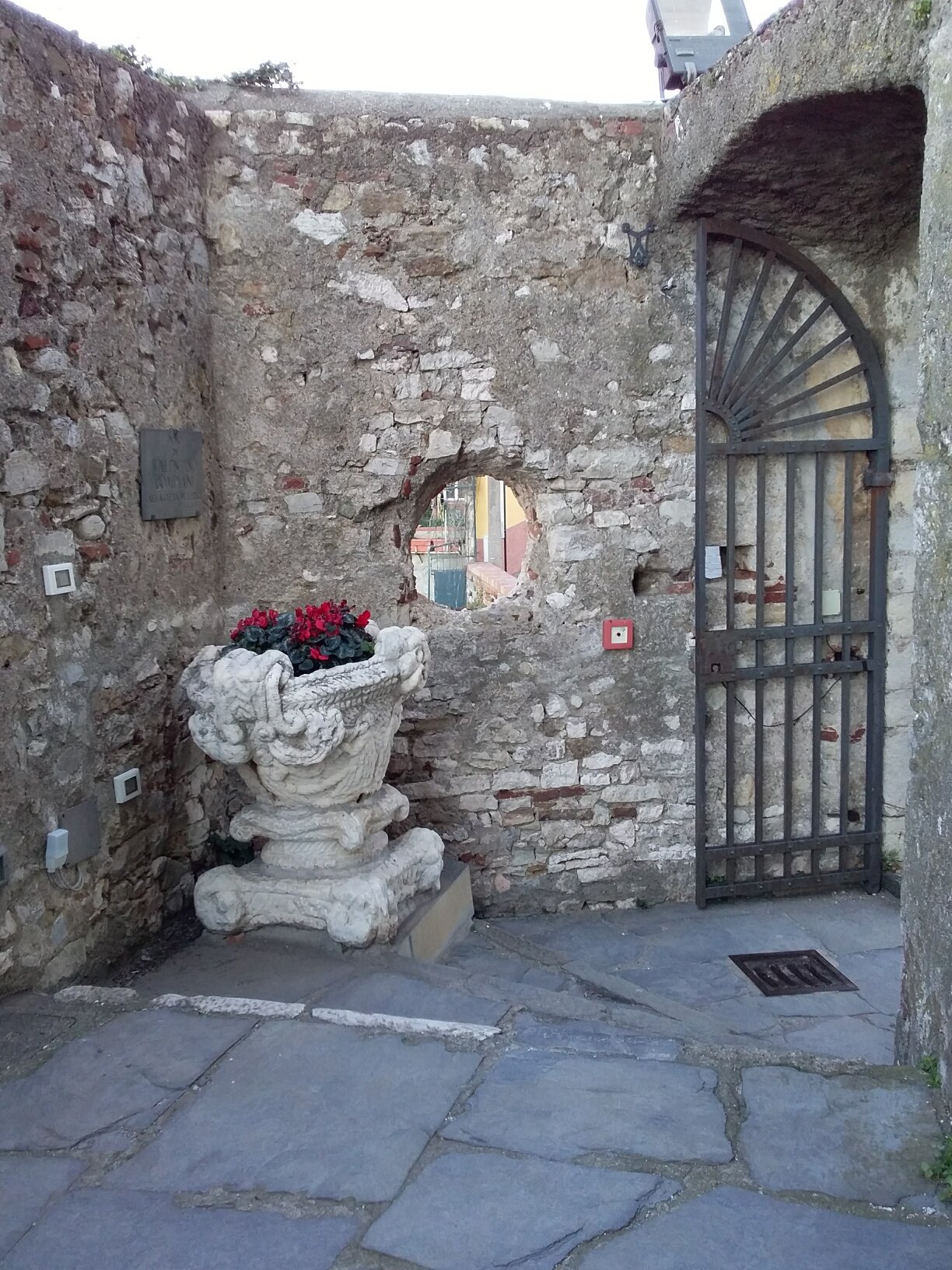
And as if all this wasn’t enough, a Medieval castle stands guard on a rocky cliff high above the harbor.  Climb the steps through pretty narrow lanes up to the castle for stunning views out over the harbor (there is also access via elevator from the town up to the castle). Sometimes you’ll even find a special event, such as an art exhibit, inside. 

IMG_2635.jpeg
20190319_165658_resized.jpeg
20190319_162221_resized.jpeg

There is so much more to explore in Lerici, that a day trip simply can’t include it all. There are hiking trails to discover, a walk between Lerici and San Terenzio (the next equally charming town to the south), restaurants to try, and drives along narrow coastal roads. A return visit is a must! -post by Joanne

July 27, 2020 /Judy Giannnettino
lerici, Liguria, Italy Beaches, Italian Beaches
Italy, Italy travel, Liguria
The church in Gombitelli

The church in Gombitelli

Hillside Hamlets in Tuscany

July 20, 2020 by Judy Giannnettino

Part of the fun in exploring Tuscany, I am discovering, is finding hamlets high in the hills that many people have never heard about. These places might not have the museums or art that lure tourists from near and far but they certainly have history and charm and beauty. They are in their own way living museums.

Starting a hike in the village of Nocchi.

Starting a hike in the village of Nocchi.

I often am shown these places when hiking with one of the many trekking groups in the region. But driving is always another option (and sometimes I am so enchanted with a village during a hike that I drive back another day for more of a look).

Water once used to run mills
A villa in Nocchi
A villa in Nocchi
Old millstones
Old millstones

One recent hike led me and my fellow trekkers to three small villages in the municipality of Camaiore – Nocchi, Torcigliano and Gombitelli. Nocchi, our meeting point to begin the 15-kilometer trek, is among the oldest of the villages of Camaiore. It was established on a section of road that dates to Roman times. Situated in a beautiful valley, the village is an old mill town and remnants of those giant structures can still be seen today. The many mills were built along the Lucese (not Lucchese, as in Lucca) River and water was diverted through a “gora,” or millpond, to a mill’s huge stone wheels.

Geraniums
Geraniums
Overlooking a faucet in the forest
Capers growing in a stone wall

Nocchi had its share of villas as well – some of which remain today. Stone paths, buildings and walls – lined with gardens, gnomes and geraniums – make for a pretty spectacular sight. All three of these villages are lovingly tended to by today’s residents. We reached Torcigliano by hiking through what is now dense forest but once was land cultivated by the farmers of the area who grew, among other things, olives and chestnuts. Old faucets still dispense cold water (such a refreshing relief on a muggy summer day). One we stopped at had a small statue of the Virgin Mary watching over it. Mountain streams run through the land, a stone bridge that looks like it should be on the page of a fairy tale book crosses one of them and a long-abandoned mill is covered with vines and other greenery deep in the forest.

Simple beauty
Simple beauty
Modern mural on an old wall
Non-stop faucet
Non-stop faucet

Torcigliano – in addition to being a thing of beauty in and of itself – has modern-day murals on one long wall, as well as a running faucet at the side of one of the village walkways. It is a beautiful spot up close as well as from a distance. Seen from the surrounding hills as we walked to Gombitelli, its sun-baked rooftops surrounded by forest greens, it was easy to understand why people have lived here for so long.

Gombitelli

Gombitelli

Gombitelli was once home to a castle, the ruins of which remain on a steep hillside (too steep and out of the way for our hike). It and Torcigliano were also known for their blacksmiths and ironwork. And Gombitelli is where a well-liked Italian sausage is made. It is a simple yet stunningly beautiful village set into the hillside with amazing views of Lucca in the distance.

Torcigliano
Torcigliano
A fairy tale bridge
A fairy tale bridge
A fountain/piece of art
Peeking through a gate
An old mill
An old mill
Gombitelli
Gombitelli

A huge thanks to Tuscan Trail Tours for leading this adventure. I adore the big cities of Italy – Rome, Florence, Naples, etc. – and I am so charmed by the Tuscan towns that I have chosen to live in one (Lucca), but these and other hamlets have my heart as well.   -post by Judy

IMG_2837.jpg


July 20, 2020 /Judy Giannnettino
Italian flags continue to fly from many windows in Lucca, a testament to national pride and a collective effort to defeat the COVID virus.
Italian flags continue to fly from many windows in Lucca, a testament to national pride and a collective effort to defeat the COVID virus.
Italy in Phase Three

July 13, 2020 by Judy Giannnettino in #italytravel, Italy travel, Living in Italy, Lucca

It’s July and here in Italy we have now moved into Phase Three of the COVID-19 response. This further easing of restrictions, which began on June 15, is a slow roll out of what promises to be a long period of the “new normal.”

Some measures remain in place. Masks are still required, though now only in enclosed public spaces (groceries, shops, offices, banks) or when in groups. Here in Lucca that means early morning walks on Le Mura (the walls surrounding the historic center) when there are no crowds can be enjoyed without a mask. Wow — that’s huge progress. When walking, masks are in hand, or around the neck, ready to be pulled into place when meeting someone and stopping to chat face to face.

Social distancing poles dot the beach in Lerici.

Social distancing poles dot the beach in Lerici.

Social distancing is required, even on the beaches. Large group meetings are still banned and public schools remain closed.

Lucca Italian School, a private school where I continue to study Italian, has reopened for small, socially distanced group learning and priviate instruction (they also continue to offer online lessons). Thinking about the huge garden space that surrounds the school, and the large and lovely terrace, I know that this is the place to study Italian this summer!

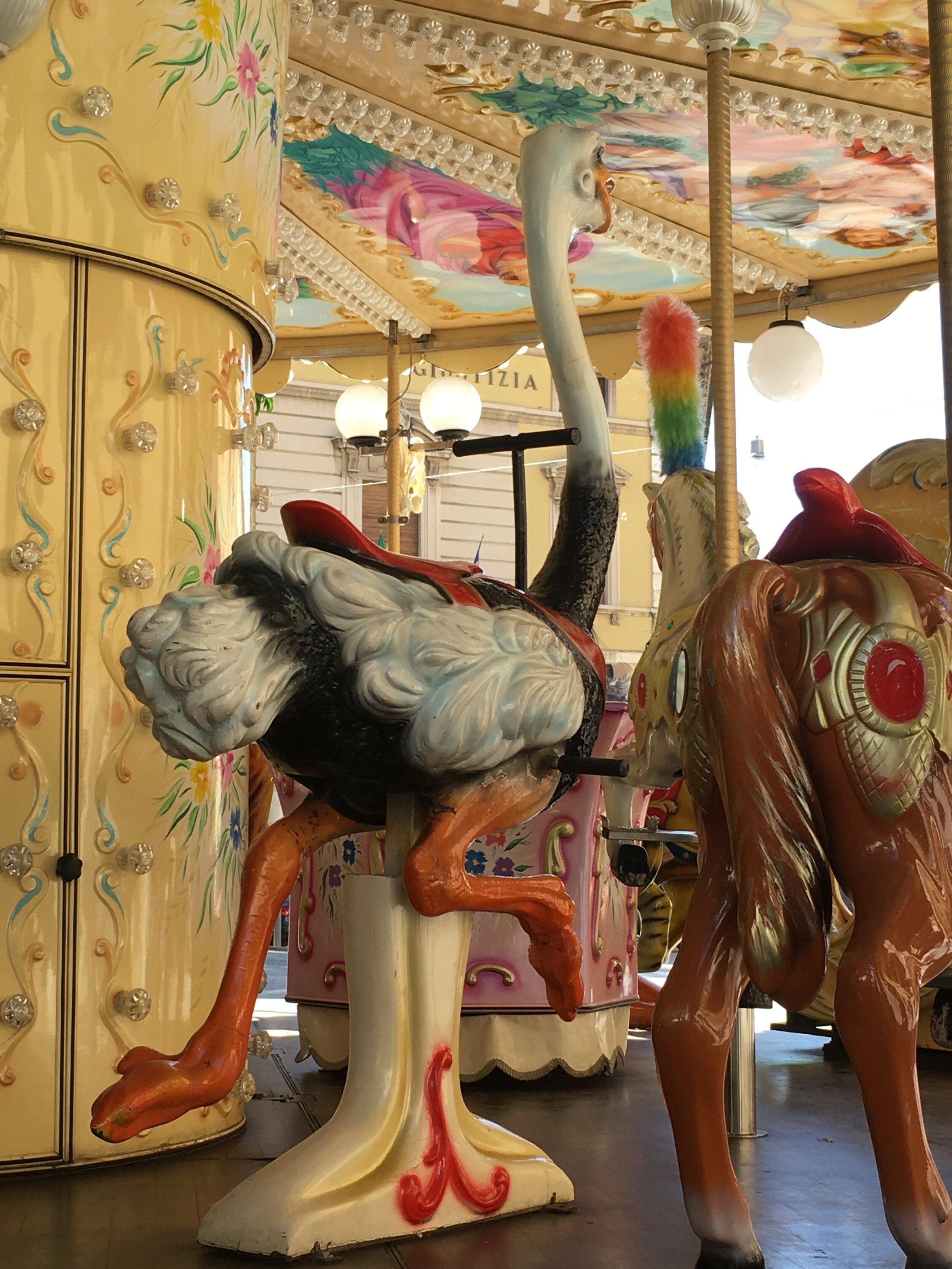
Other big changes include playgrounds reopening as of mid-June (a joy for kids and parents alike) and the carousel in Lucca’s biggest piazza, Piazza Napoleone, is once again whirling happy children around and around on a variety of fantastic animals.

It wouldn’t be summer without a ride on Lucca’s beautiful carousel.

It wouldn’t be summer without a ride on Lucca’s beautiful carousel.

Amateur sports have been permitted since late June. Just think how happy Italian kids are to get back to playing soccer! Movie theaters and performance spaces have opened as well with limits as to the number of people admitted at any one time. The outdoor movies, a highlight of summer here in Lucca, have begun too. This year they will limit attendance, require advance seat reservations, and provide plenty of space between movie goers.

A spritz on Piazza San Michele - perfect on a summer evening and a post-lockdown treat

A spritz on Piazza San Michele - perfect on a summer evening and a post-lockdown treat

By mid-July nightclubs can begin to open, with socially distant dance floors. No dirty dancing allowed! And bring a mask for the dance floor, removing it to sip a drink when not dancing.

I must say that this is an activity I can skip altogether. I’m content with sipping a coffee at a cafe or a drink on a warm summer evening in a pretty piazza.

I have a new appreciation for these simple pleasures.

Travel is also opening up, with travelers from EU countries as well as England and Ireland, allowed to visit Italy without the need for a quarantine on arrival as of mid-June. Soon, travelers from non-EU countries who have managed to gain control of their COVID infections will be allowed to return as well. Sadly, the United States will not meet the requirements as COVID continues to run rampant there and so no tourists from the U.S. will be permitted to enter Italy (or most EU countries). It’s a bit unclear at this point when those of us who live in Italy, but need to make a trip back to the United States in the coming weeks, will be permitted to return to our Italian homes. One thing for certain is that we will need to self-quarantine for two weeks on our return.

A recent road trip took me past the tiny hill town of Castello di Nozzano. The ability to get out to hill towns, beaches, mountains, and cities is a huge benefit of Italy entering Phase 3.

A recent road trip took me past the tiny hill town of Castello di Nozzano. The ability to get out to hill towns, beaches, mountains, and cities is a huge benefit of Italy entering Phase 3.

The best part of the advance into Phase Three is that it means that with continued social distancing and prevention measures, Italy has, through much economic and social pain, not just flattened the curve but driven the new cases down to a trickle.

July 13, 2020 /Judy Giannnettino
#covid19italy, Italy Phase 3
#italytravel, Italy travel, Living in Italy, Lucca
  • Newer
  • Older

Powered by Squarespace