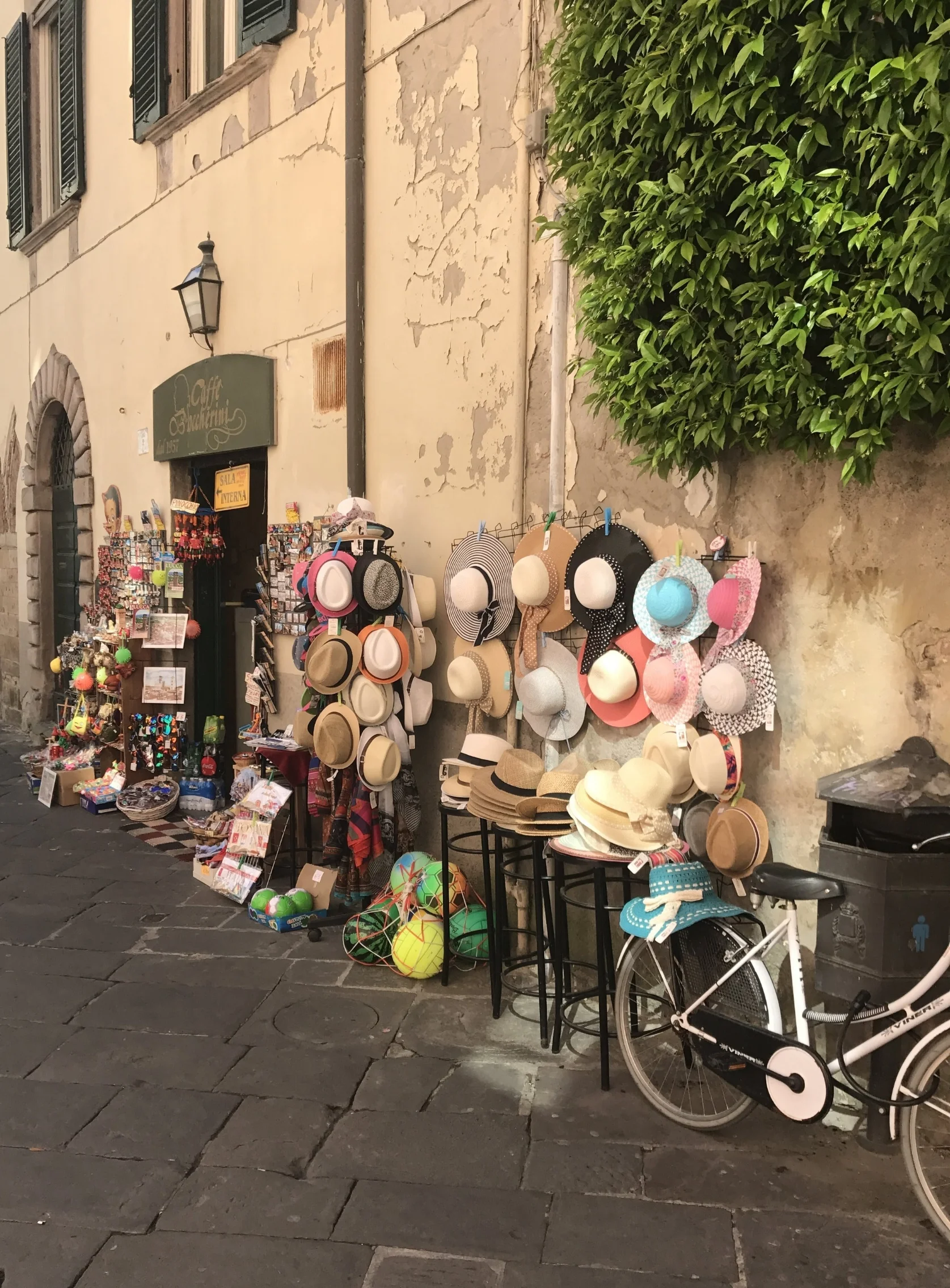
Bologna for Beginners: The Historic Center

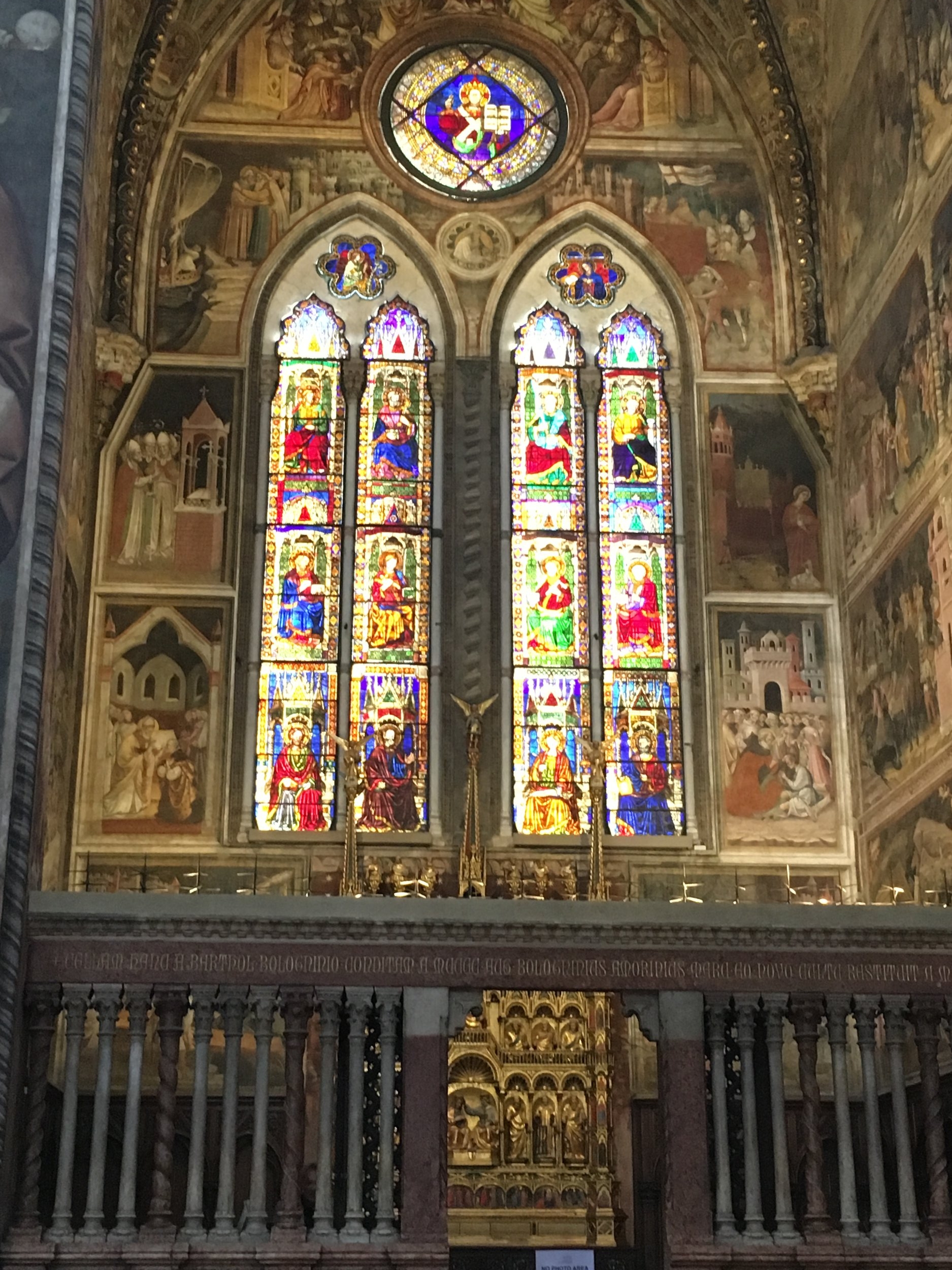
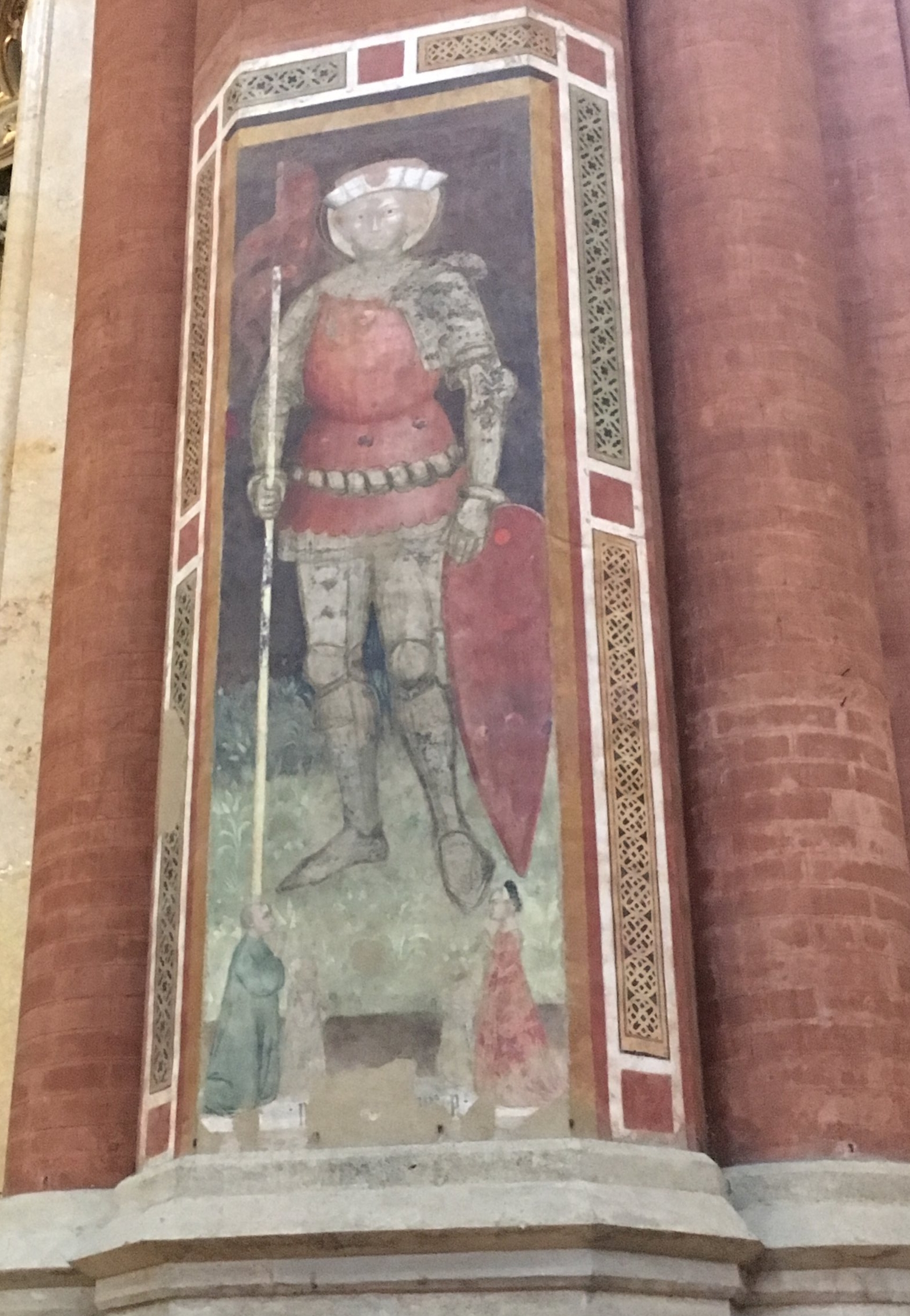
Fresco, Church of the Crucifix, Santo Stefano

Fresco, Church of the Crucifix, Santo Stefano

Bologna is not one of the major tourist destinations in Italy, at least not for Americans, which is both a shame (because it's fabulous) and a blessing (because it remains less crowded than Rome, Florence, and Venice and moves at a decidedly slower pace). Many of the guide books skip over it or give it barely a mention and yet my Italian friends love this city and visit often. Add to that the region's reputation as la pancia (the stomach) of Italy with a unique and fabulous cuisine and I had to check it out for myself. And so, with a long weekend to spend, I headed to Bologna with few expectations other than exploring, wandering, and sampling good food.

It didn't take long for me to become enamored with this city - the beautiful pale red hues of the buildings and roof tops, the large medieval plazas ringed with architectural masterpieces, the cafe/bars offering perfect seats for watching the action, the bustling markets, those unique and stunning porticos, the churches, the art, and - oh yes, the food. In short, what is there to like about Bologna? Everything!

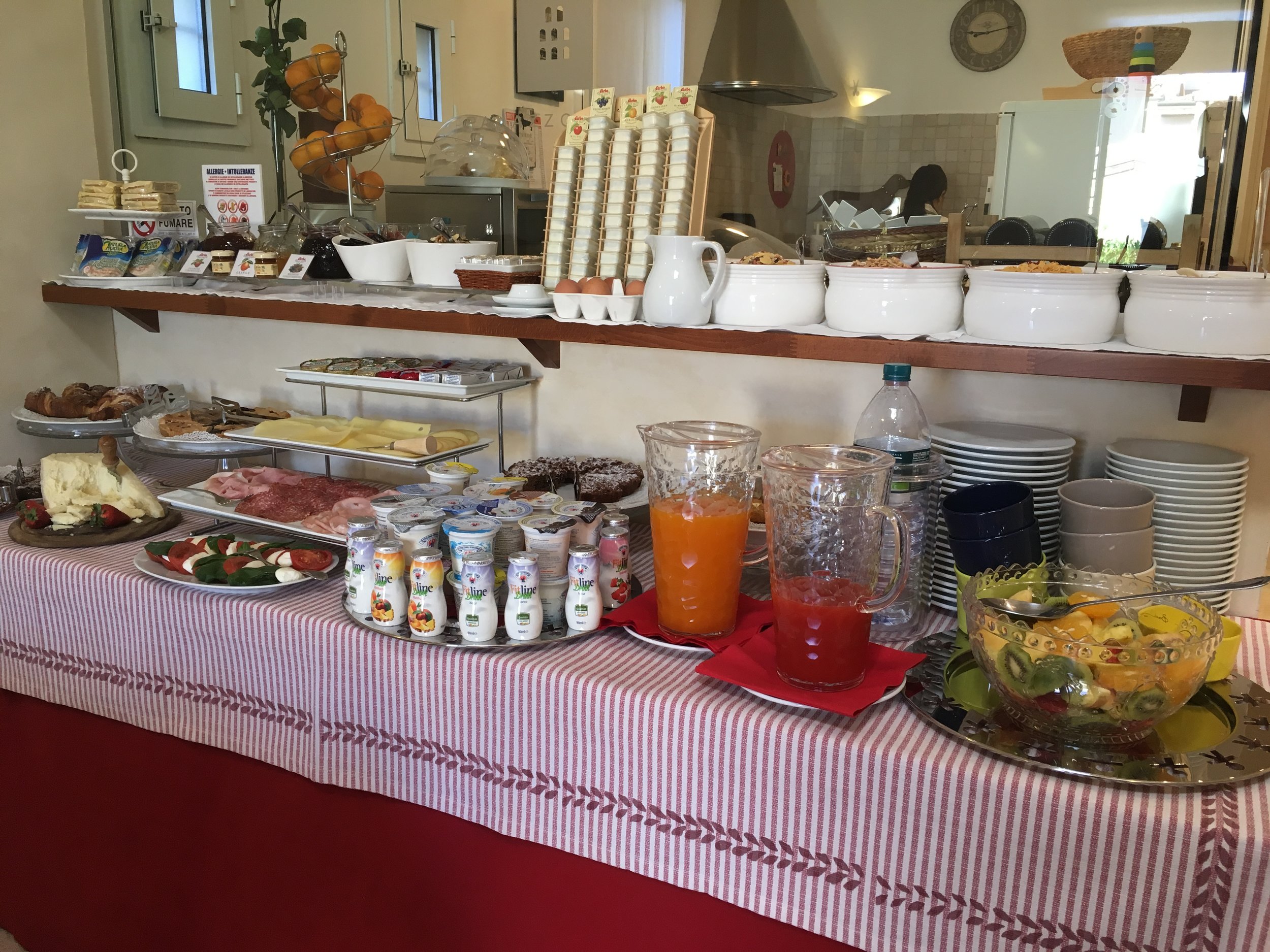
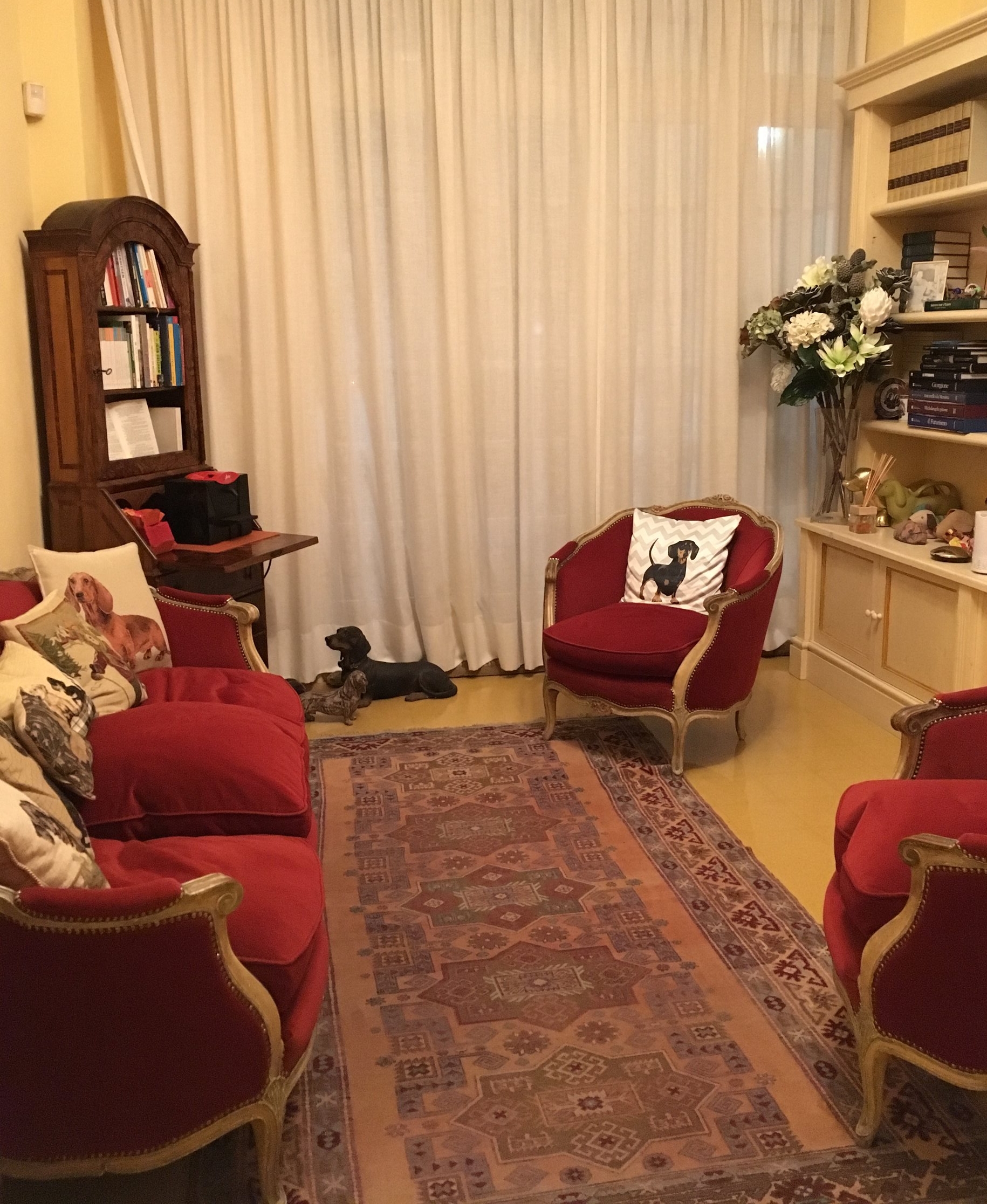
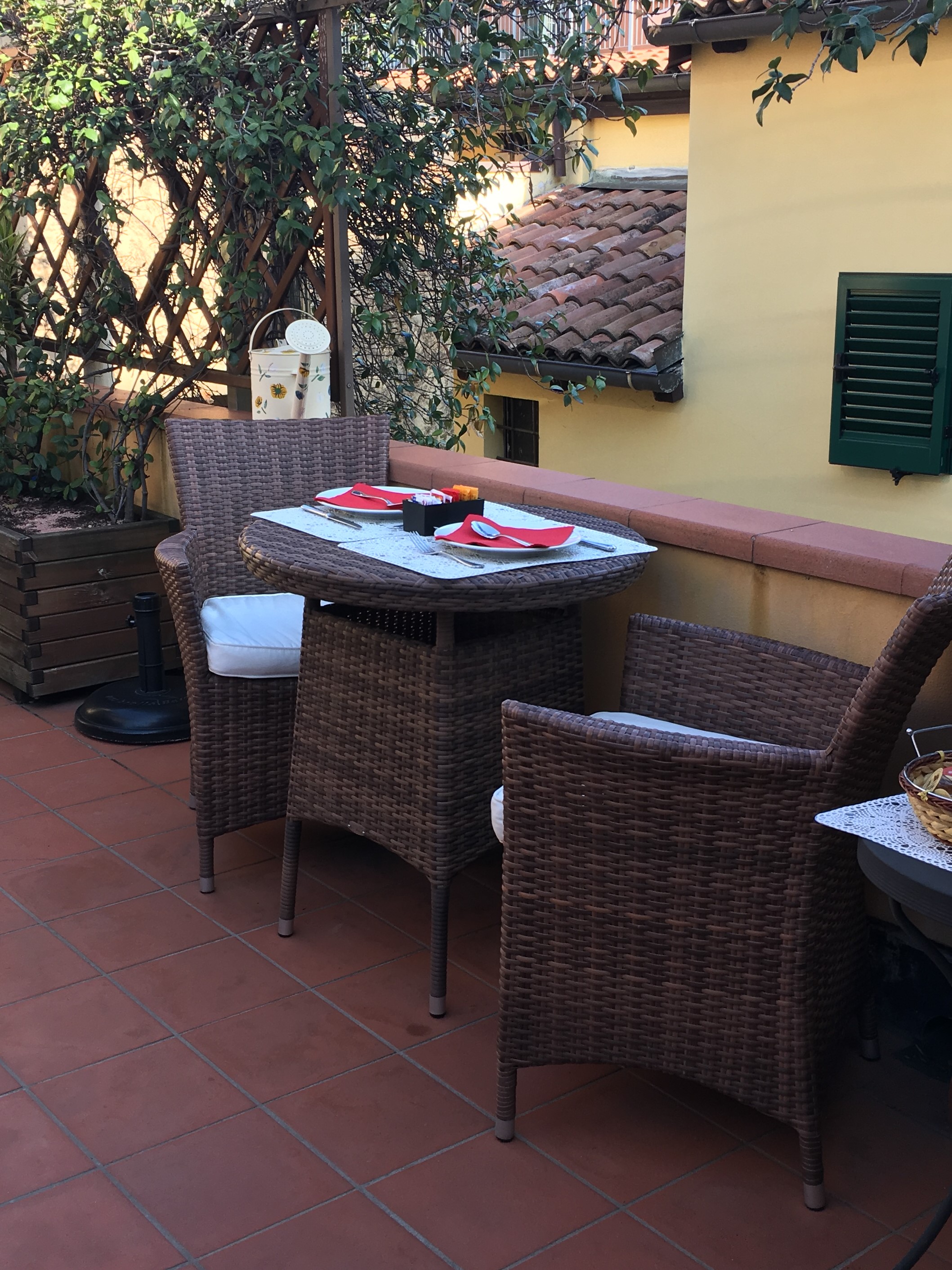
Bologna is just 35 minutes from Florence by train, but don't be tempted to "do" Bologna as a day trip. It is well worth spending several days in this beautiful city, so find a good B&B and settle in to explore. I was delighted with my stay at the B&B Palazzo Trevi on Via Frassinago. This is a warm and friendly place gracefully run by owners Consuela and Francesco. The rooms are comfortable and pretty, the breakfasts bountiful, and the location superb. Ask the owners for restaurant recommendations - they know the best spots in this neighborhood!
It's impossible to see everything Bologna has to offer in a few short days. It's best to map out top priorities and then schedule in lots of time for strolling the arcaded streets, sipping a morning cappuccino or an afternoon drink on a pretty piazza, and just watching and wandering.

A good starting point is a walk around the historic center, which is full of medieval buildings, towers, and piazzas. A pausa (break) for coffee at Bar Vittorio on Piazza Maggiore provides a view across across the piazza to the Basilica of San Petronio with its incomplete facade (bottom half marble, top half rough brick). Across the way is Palazzo d'Accursio and the clock tower. Built in the 1300s, this building now serves as the town hall.
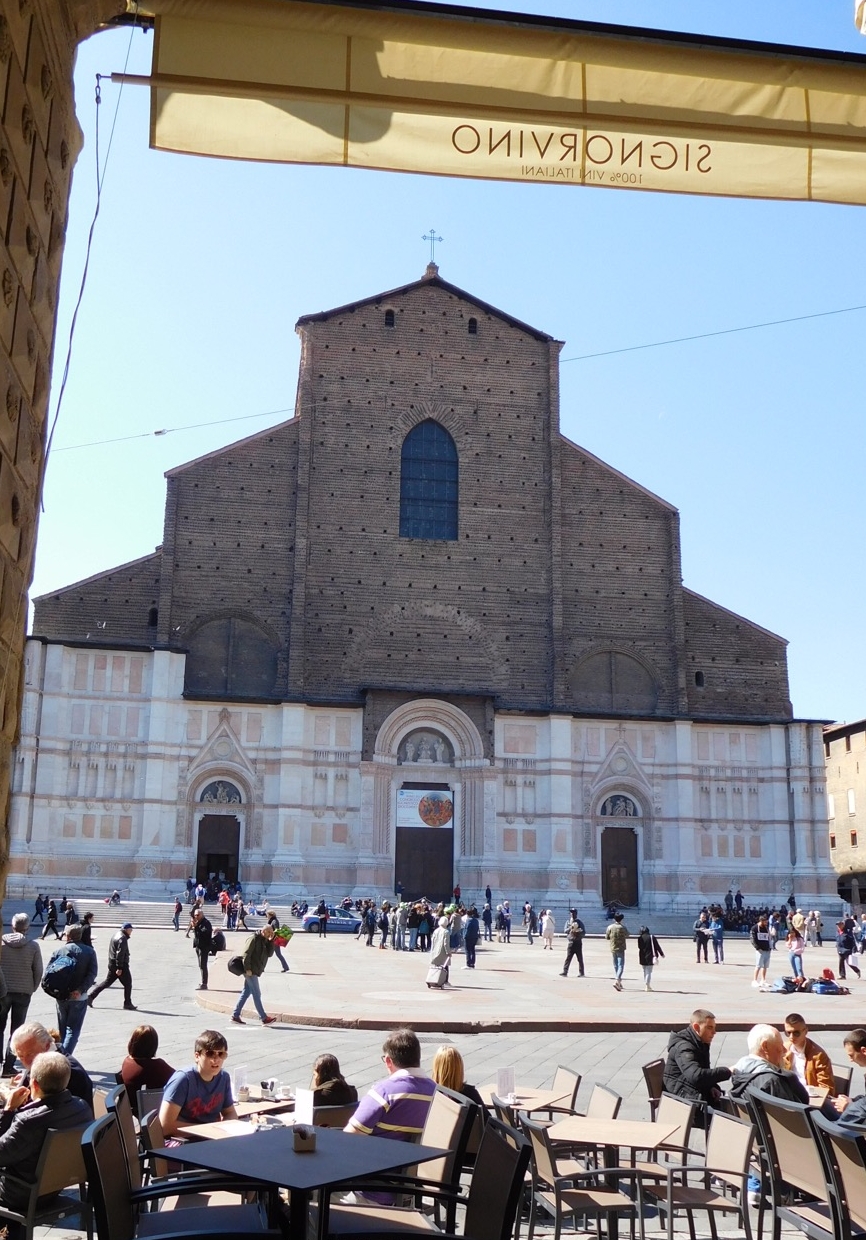
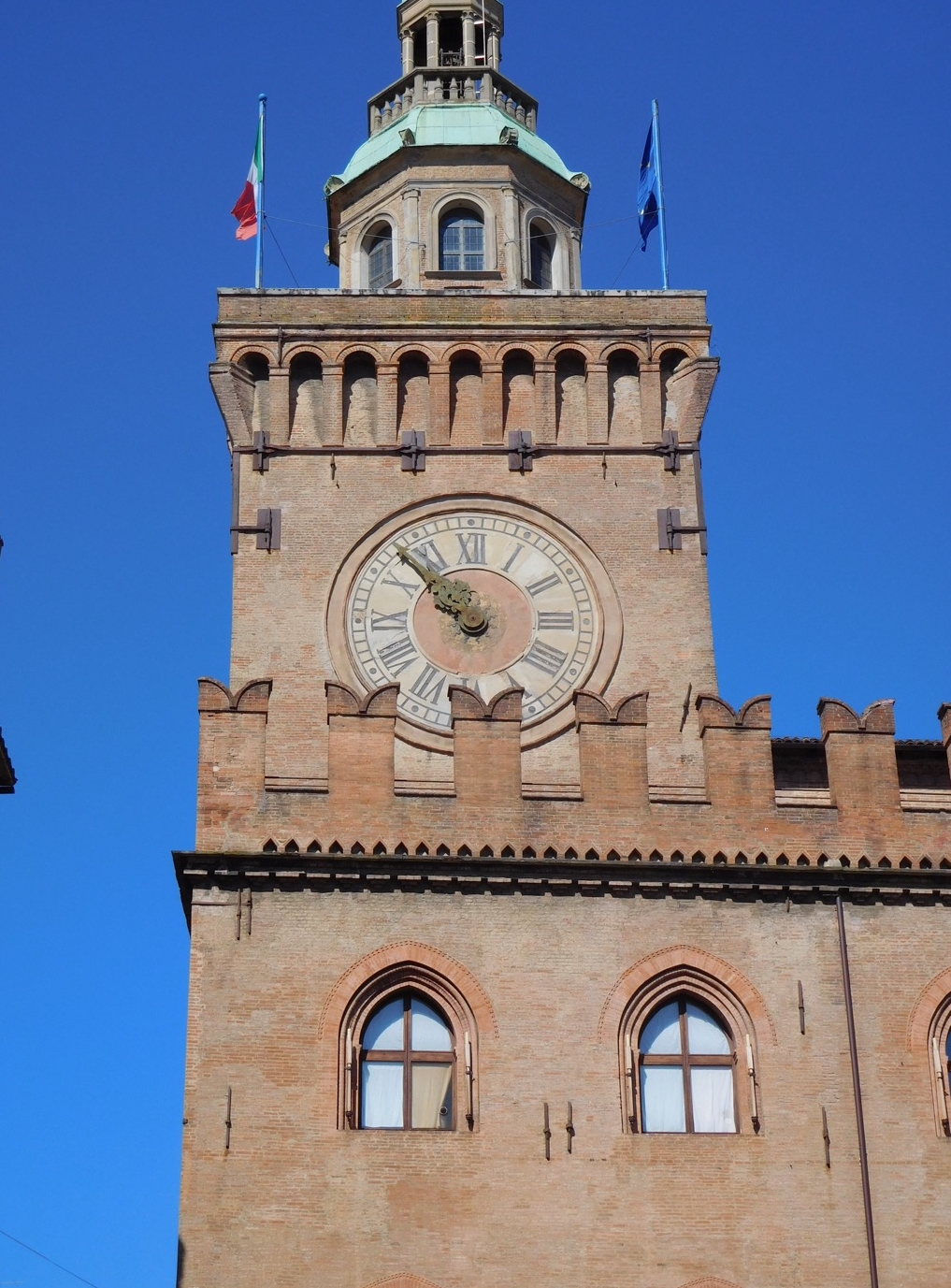
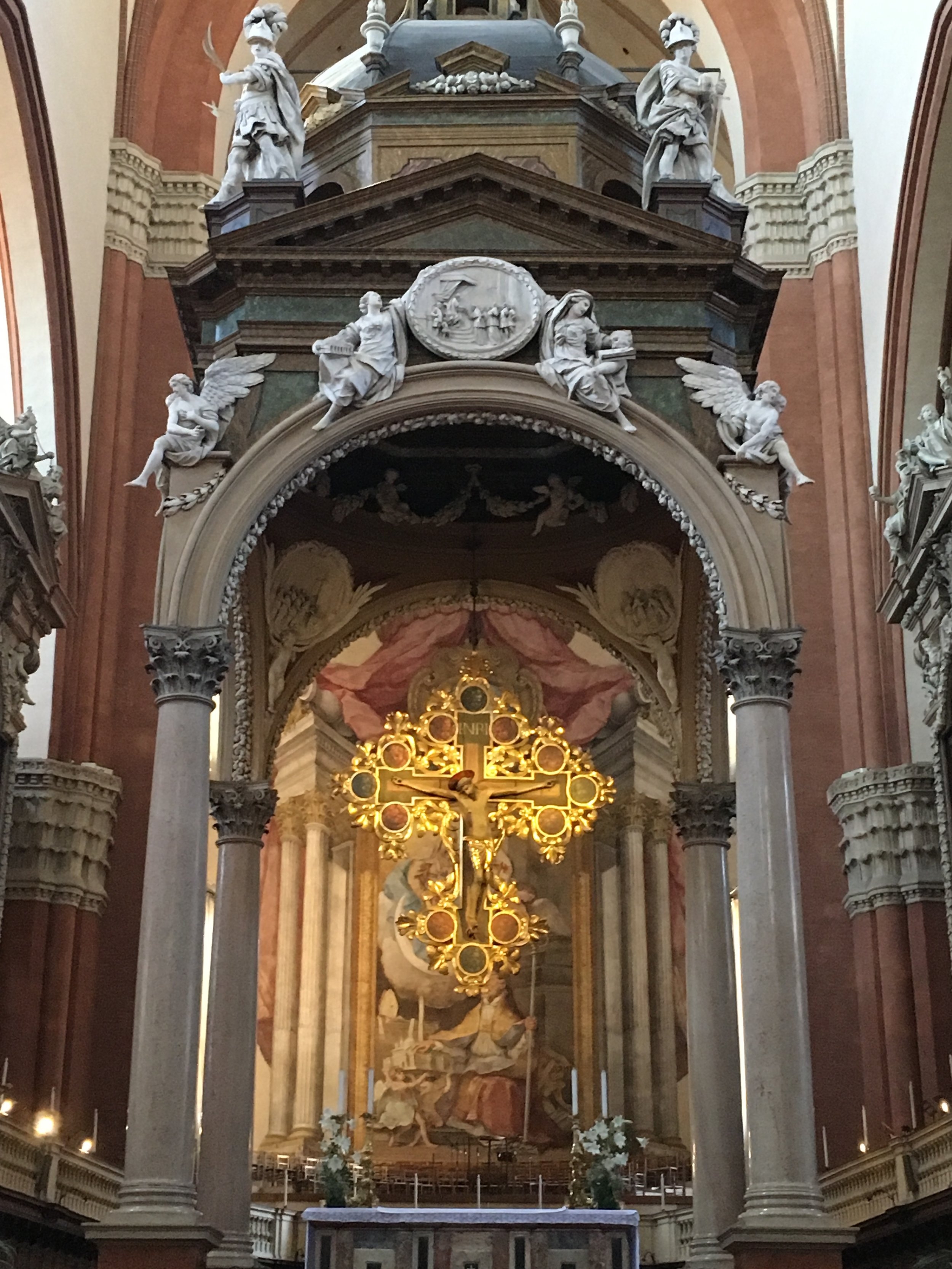
After pausa, it's just a few steps across the piazza into the courtyard of the Palazzo d'Accursio and a few more to visit the interior of the Basilica of San Petronio with its richly decorated side chapels, beautiful stained glass windows, canopied altar with ornate crucifix, and lovely artwork. There is also an interesting meridian line from the 1600s set into the floor, which provides an accurate way of marking the days of the year. There is a 2-euro photography fee in this church - pay the fee and get a colored armband or risk getting scolded for taking photos without one. At the end of the afternoon, a return to Piazza Maggiore is perfect for a glass of wine or an aperol spritz and more people watching.
Just around the corner is Piazza Nettuno, with the famous Fountain of Neptune. The fountain is currently being restored and is hidden by scaffolding. It is possible to schedule an appointment to go inside the scaffolding for a peek but this must be arranged ahead of time. Two fascinating buildings enclose this piazza. First is the Palazzo Re Enzo, built in the 1200s. It has a gorgeous central courtyard, impressive stairways, an arcaded upper floor and an interesting history.

Courtyard, Palazzo Re Enzo, Bologna.

Courtyard, Palazzo Re Enzo, Bologna.

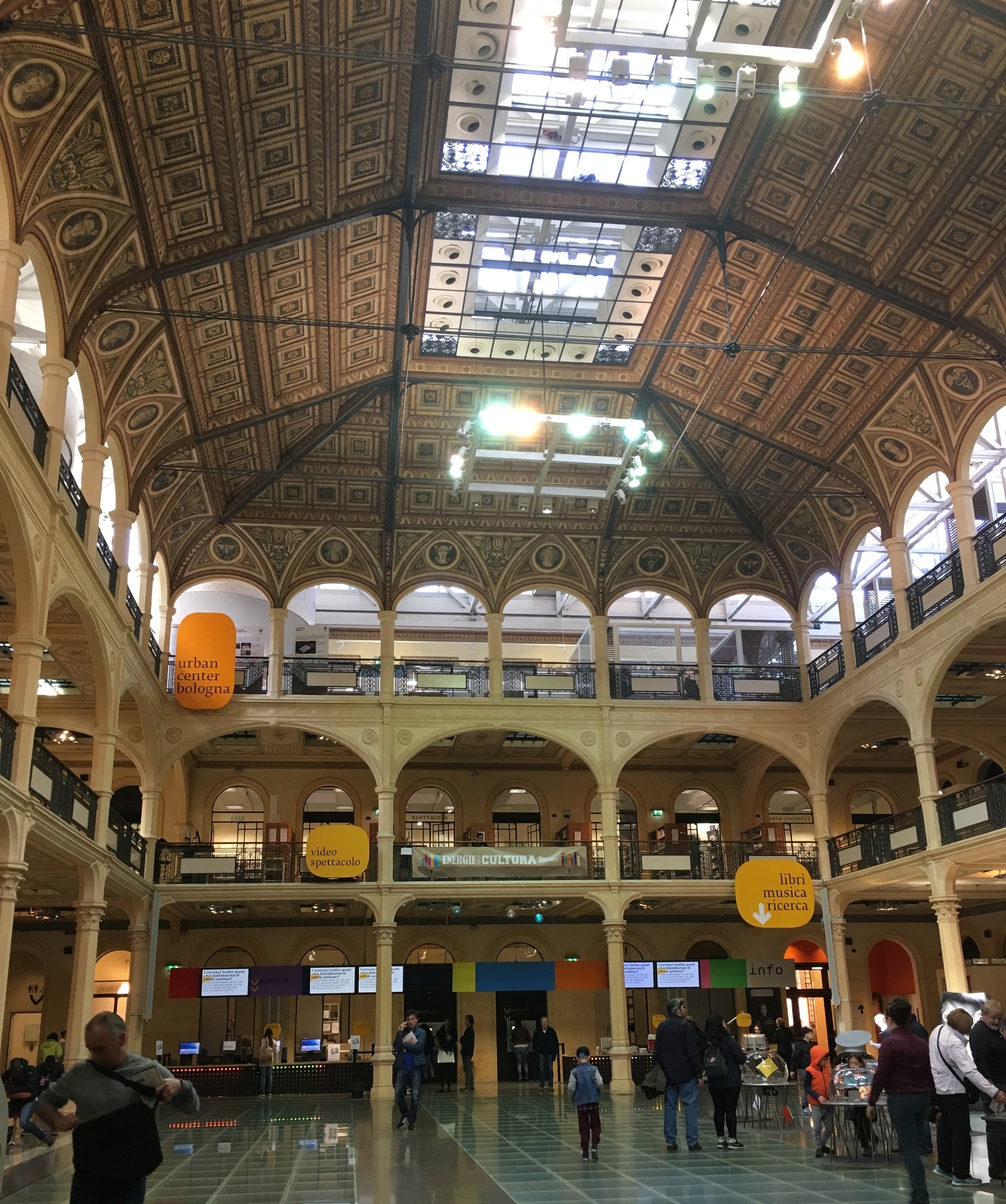
The second is the Bibliotecca Salaborsa, another medieval building, now the main public library and community center. It's worth stepping inside to see the unique architecture and ceiling and to get a sense of the vibrant community feel of this building, which is used by locals of all ages as a place to work, study, read, and meet. The basement houses a timeline showing the uses of the building over it's long history, as well as some Roman ruins.
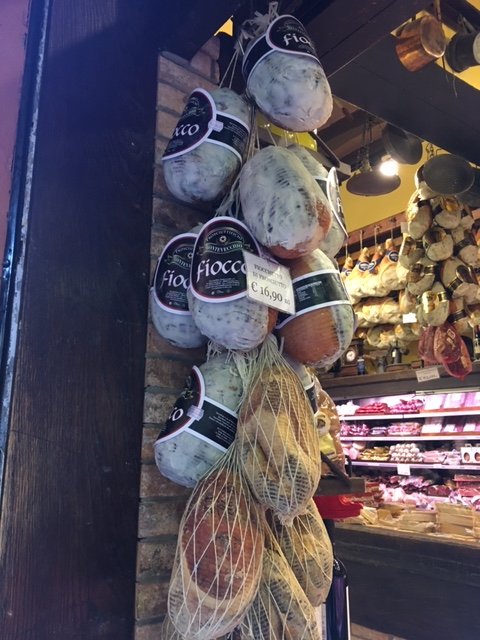
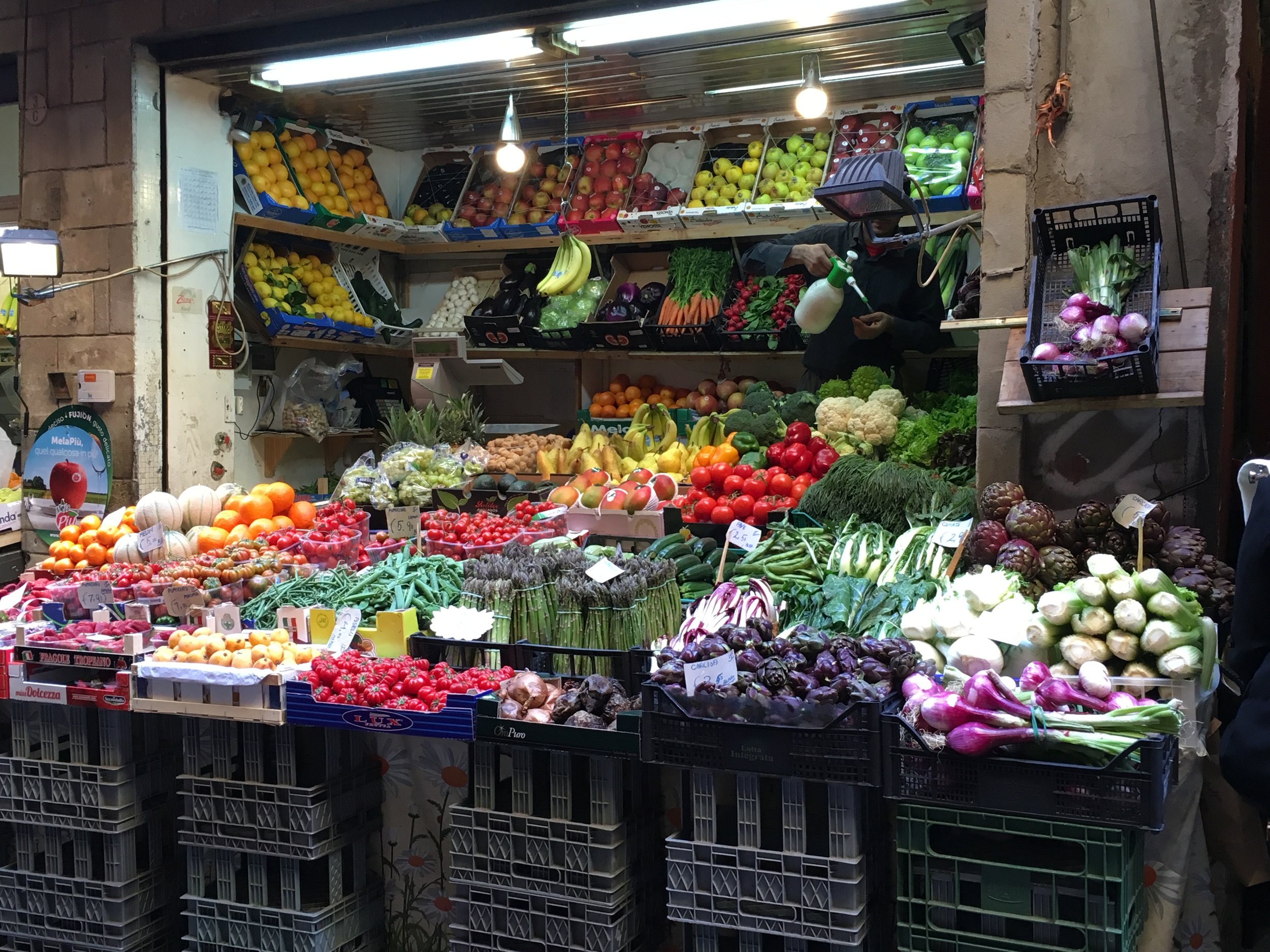
Piazza Maggiore leads right into Via Pescherie, the heart of the Quadrilatero, or old market. The street is narrow, crowded, and filled with salumeria (delis), fruit and vegetable stands, cheese shops, fish stalls, and lots of opportunities to dine on local specialties. 

The two towers portrayed by Pio Panfili, 1767.

The two towers portrayed by Pio Panfili, 1767.

Fanning out from Piazza Maggiore at the center, it's easy to spot the two towers that are the symbol of Bologna. Torre degli Asinelli (highest of the two and higher than the more famous leaning tower in Pisa) and the shorter Torre Garisenda, which has a more dramatic lean. The Asinelli's wooden interior steps are currently closed for restoration, scheduled to reopen in summer 2017.  

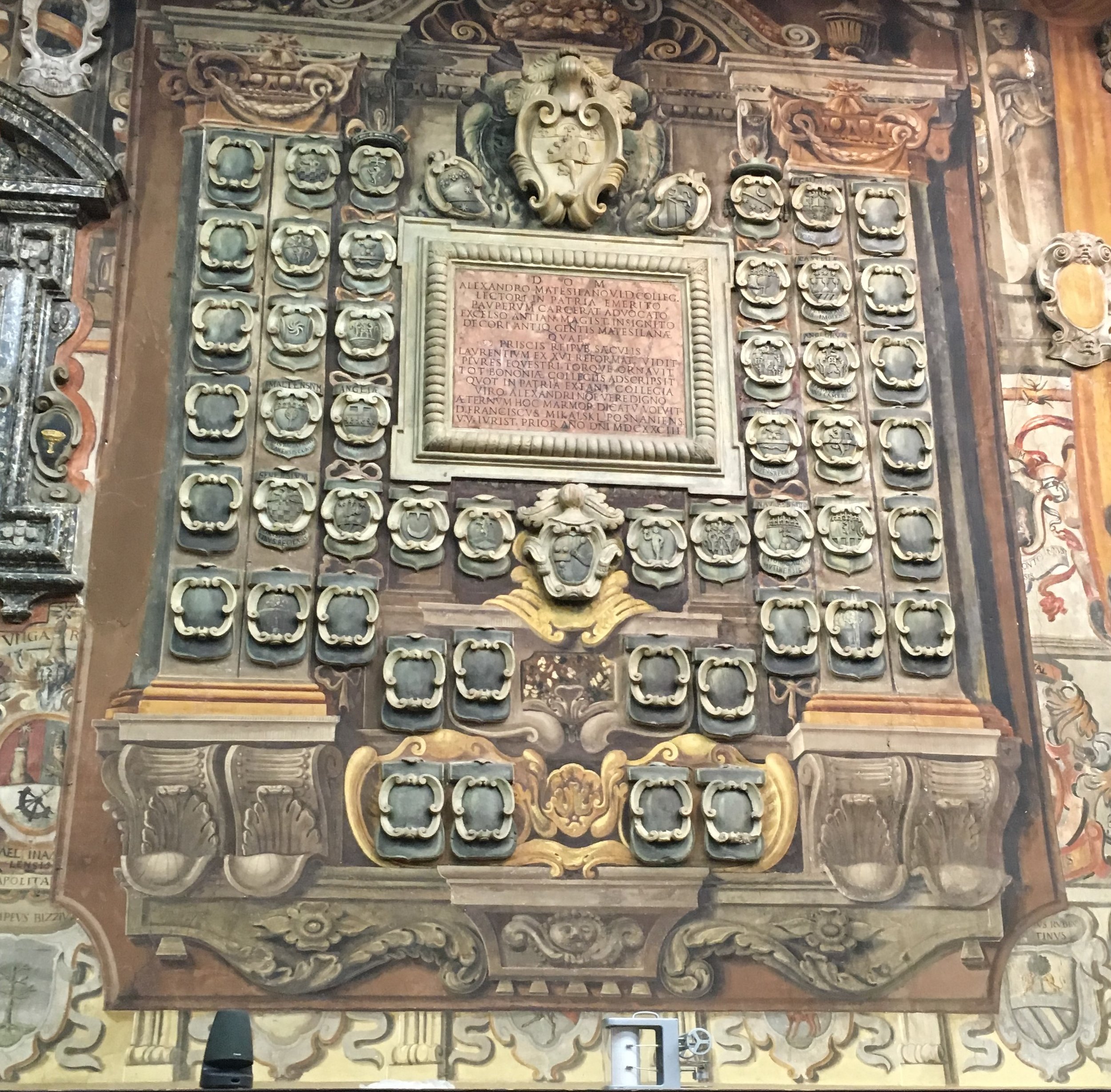
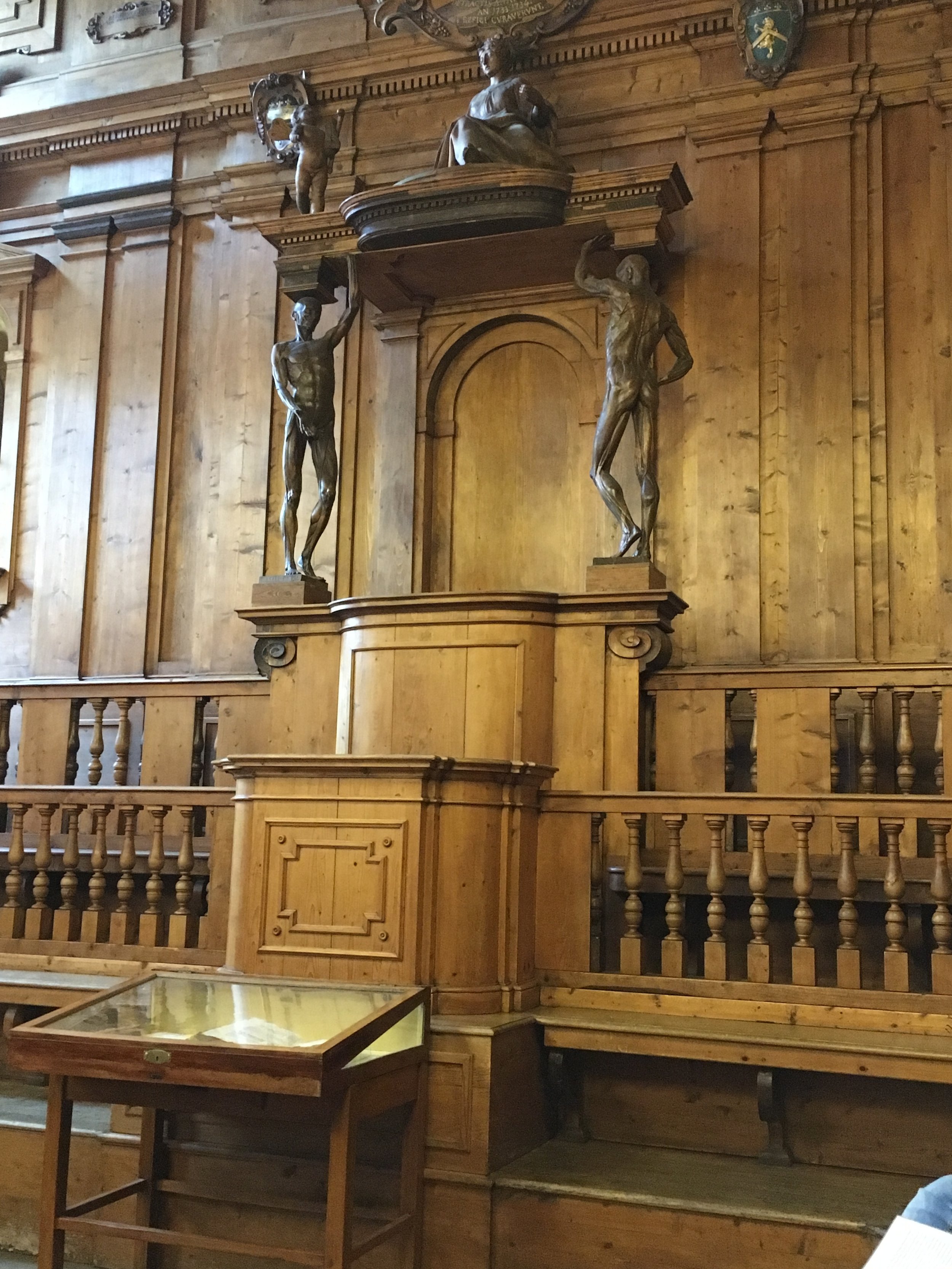
The Biblioteca dell'Archiginnasio is just a bit behind the Basilica San Petronio in Piazza Galvani. This building was the first central seat of the University of Bologna, in the 1500s. It housed the study of medicine, law, and arts. The building is set around a central courtyard, has broad staircases to the classrooms on the upper floors, and contains a famous anatomy classroom. The family crests of students, with names and countries of origin, line the walls. With a building this imposing, the students were bound to take their studies seriously. If only the university where I taught for many years were this beautiful!
No beginner's guide to Bologna is complete without some dining recommendations. After just four days I'm hardly an expert in Bolognese dining, but I did find some favorites:

Osteria Santa Caterina is known for it's salumi platters.

Osteria Santa Caterina is known for it's salumi platters.

Osteria Santa Caterina is a bit out of the center in the area around the Porta Saragozza, located near, and recommended by, the innkeepers at B&B Palazzo Trevi. This is a small, cozy neighborhood place with outstanding food and wine. They have a variety of salumi platters, delicious soups, tortellini in a rich brodo (broth), terrific lasagna, and the absolute best eggplant parmesan I have ever tasted. 

A morning cappuccino and a torta di mele (apple tart) at Pasticceria Gamberini.

A morning cappuccino and a torta di mele (apple tart) at Pasticceria Gamberini.


Pasticceria Gamberini sits under a portico on Via Ugo Bassi and has lovely pastries and cakes. It's a pleasant place to have a morning coffee and a pezzo dolce (sweet pastry). They have a beautiful array of pastries, cannoli, miniature tarts and sweets, and bite-size savories. They also have takeout panini and tremezzini (those triangular sandwiches) to go - perfect for a picnic lunch. 
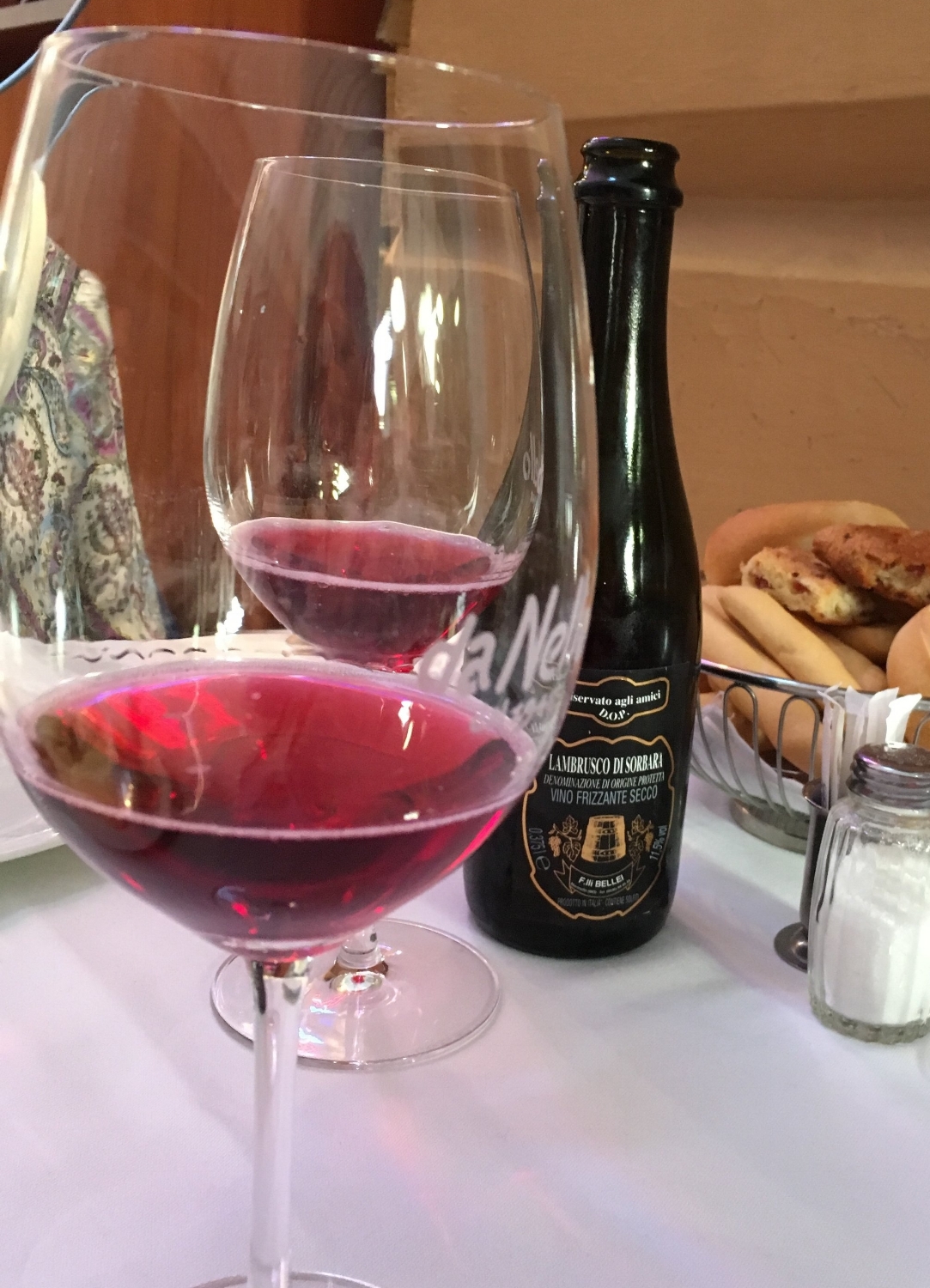
 

A local Lambrusco wine at Ristorante "da Nello"

A local Lambrusco wine at Ristorante "da Nello"

Ristorante "da Nello" is just off Piazza Nettuno, on Via Montegrappa. The food here is traditional, including pastas, fish, and meats. The flavors are authentic and delicious, the menu varied, the wine list good, and the waiters friendly. On a warm night, the outside dining area is delightful. 

In four days I've barely scratched the surface of Bologna. I am already looking forward to a return trip in the near future!                       -post by JB

Contacts:  

B&B Palazzo Trevi Via Frassinago, 32.   www.palazzotrevi.it


A Child's Eye View of Lucca

Colorful balloons for sale in Piazza San Michele.

Colorful balloons for sale in Piazza San Michele.

When I think of Lucca I picture medieval streets, renaissance walls, lovely gardens, music and fabulous food. Not so my 6-year-old friend Edie, who visited me in Lucca recently, along with her mom, Holly, and great aunt Pat. She gave me a whole new perspective - Lucca looks different when seen through a child's eyes.

At 6, Edie is already a good traveler. She likes the overnight flight, doesn't seem to suffer much from jet lag, and sleeps like a baby despite the time change - which made the adults in our group quite envious. She likes the outdoors and Lucca offers a lot of outdoor activities, making it a great destination when traveling with children.  She enjoyed discovering succulents growing along the wall (she recognized these from home), smelling the roses in the gardens at Palazzo Pfanner, and was delighted to find that Italy has some interesting bugs (though not spiders - she didn't care for those).

Here are some fun activities for young kids visiting Lucca (all come with Edie's endorsement) :

Photo courtesy of H. Baker

Photo courtesy of H. Baker

Ride the carousel. This was definitely a highlight though it took some thought for my young friend to pick which animal she wanted to ride. In fact, she needed several attempts to try out the different options. Smart girl!


Edie and me, exploring plant life on the walls. Photo courtesy of H. Baker

Edie and me, exploring plant life on the walls. Photo courtesy of H. Baker


Explore. Together we found "secret" spots all along the walls. Spots with huge rocks to climb, wild buttercups to smell, bugs to investigate, steps to climb, and statues to see. The wide grassy areas on the wall are great spots for running or playing games. Don't forget to look up - especially at the statue of the Archangel Michael atop the Basilica of San Michele, which Edie said was her favorite in all of Lucca. All this outdoor activity may explain why Edie slept so well! 

Sottosopra (upside down)

Sottosopra (upside down)


Find the playgrounds and let the kids climb, swing, and tumble. There are several playgrounds on the wide areas of the wall in Lucca and some down in the town as well. Edie tried out most of them and gave them her kid-tested seal of approval.

Drink a milkshake. Or two or three. Italian milkshakes are quite different from American ones - less ice-creamy and more frothy, like a frappe. Flavored with vanilla, these were a real kid treat. Pretty good for grown-ups too.

Eat foccacia. This may have been Edie's favorite food in Lucca, and who can blame her? It's one of my favorites too. 

The walls are the perfect bike path. Photo courtesy of P. Baker

The walls are the perfect bike path. Photo courtesy of P. Baker

Bike the walls. This is a great family activity, even if the adults do most of the work!  There are all types of bikes for rent - everything from two- or four-person surreys to tandem bikes and single bikes in adult and child sizes. Rent by the hour, half-day, or full day. When Edie's legs get longer we'll let her do the pedaling and she can go as fast as she'd like!


Do some shopping. Children love having some of their own money to shop for gifts to take home to grandparents or friends. Putting thought into picking out just the right gift is a valuable life lesson too. 

Some of Lucca's beautiful door knockers. Photos by E. Baker and H. Baker

Some of Lucca's beautiful door knockers. Photos by E. Baker and H. Baker

Take photos. Give a kid a digital camera and set them loose to take their own pictures - it's a great vacation activity and helps create wonderful memories. Edie especially enjoyed taking pictures of flowers and all the beautiful door knockers in Lucca. I think her mom liked those door knockers too! Edie used her mom's camera, but I suspect her very own will make a good gift before her next trip. 


Take a day trip to Pisa. This is especially fun for kids if they get to take the train from Lucca to Pisa, see the famous leaning tower, hear the music echo in the Baptistery, grab lunch in Pisa, and then take the train back to Lucca. This makes a perfect day trip and what child wouldn't like a photo of themselves next to the leaning tower as a reminder of their trip?

Edie and her mom, Holly, in a famous spot. Photo courtesy of P.Baker.

Edie and her mom, Holly, in a famous spot. Photo courtesy of P.Baker.

When traveling with a small child it's important to plan kid-size activities, shorten visits to places like museums and churches, and add in lots of breaks for active play time. It also helps to be based in a smaller, less chaotic city like Lucca. Having an apartment is a good strategy too  - it gives everyone room to breathe, accommodates child bedtimes, allows for some meals at home rather than always eating out, and gives a child a space they can settle into. Having a flexible agenda is key, as is planning some time for the parents to get out on their own for some grown-up exploring. Then relax and enjoy the view through a child's eyes.                           -post by JB

Florence - A City of Science As Well As Art

It’s not hard to fall in love with Italian men, especially when they are as intelligent and forward-thinking as Galileo Galilei. I have been enamored with Galileo for years – ever since someone described him to me as a polymath. A polymath (a person with significant knowledge of several subjects)! What’s not to love? The man was a genius! There is a great tribute to him - and to science in general - at the Museo Galileo in Florence.

A bust of Galileo in the Florence museum that bears his name.

A bust of Galileo in the Florence museum that bears his name.

The Museo Galileo, just behind the Uffizi Gallery, is a repository of scientific instruments ranging from telescopes to thermometers and covering topics ranging from The Science of Equilibrium to The Science of Warfare. The museum says it is “heir to a tradition of five centuries of scientific collecting” and credits the Medici and Lorraine families of Tuscany with emphasizing the importance of such collecting. Indeed, I felt like I was in a toy store for scientists as I wandered the rooms of the museum.

An astrolabe from the 16th century, used to measure the inclined position in the sky of a celestial body.

An astrolabe from the 16th century, used to measure the inclined position in the sky of a celestial body.

An astrolabe from the 16th century and a huge armillary sphere are just two of the items on display that help explain how Galileo and other astronomers from centuries ago looked at the heavens.

The giant armillary sphere at the Museo Galileo.

The giant armillary sphere at the Museo Galileo.

There is plenty of information about Galileo, too. And for the non-squeamish, there is a display of his right-hand index finger and thumb, and one of his teeth. It is said that admirers of the man removed the digits and tooth, as well as a vertebra, from his body as it was being transferred from storage to a tomb in Santa Croce Basilica.

Several telescopes at the Museo Galileo.

Several telescopes at the Museo Galileo.

Even for visitors who aren’t scientifically inclined, seeing the intricacy of the instruments used so many years ago is fascinating, as is reading about the practical applications of various scientific discoveries.                                                   -post by JG

Museogalileo.it


Cooking Class: Gnocchi

Eva demonstrating the making of gnocchi.

Eva demonstrating the making of gnocchi.

Gnocchi. Getting the Italian pronunciation right gives your tongue a workout - that "gn" sound is a struggle for English speakers (it sounds much like the "ny" in canyon) and don't forget that the final "chi" is a hard sound, like in "key". Gnocchi. 

I've eaten only a few truly good ones, all in Italy. Too often I've had gnocchi that were either gummy or pesante (heavy) and, to make matters worse, served in a sauce that was much, much too rich, making the dish even heavier. To make proper gnocchi - tender little dumplings - is a real test of culinary skill. Luckily it is a skill possessed by Eva, the maestra di cucina (cooking teacher) at Lucca Italian School (LIS).

One of the highlights of my last trip to Italy was a cooking class, sponsored by LIS, that included a hands-on lesson in the art of gnocchi making. The class was held in a fattoria (farmhouse) kitchen in the countryside outside of Lucca, with beautiful views, a great wine cellar, a large kitchen with plenty of space for our group of 10 students, and a wonderful dining room where we all enjoyed the food we had created. Picture us laughing, sipping wine, and chatting away in Italian (with a bit of English as needed) as we prepared a multi-course meal.

The fattoria kitchen, ready for the start of our cooking class.

The fattoria kitchen, ready for the start of our cooking class.

The ingredients for the gnocchi were simple - potatoes that were boiled, peeled while hot, put through a ricer, and then mixed with flour, egg, and salt. Sounds easy but the magic is in determining just the right amount of flour, which varies with the moisture of the potatoes and must be judged by feel.  Eva recommends about 300 grams (10 ounces) of white flour for every kilo (2.2 pounds) of potatoes along with 1 large egg and some salt. When well mixed, the dough is shaped into a long rope and cut into little pieces (about 1 inch each).

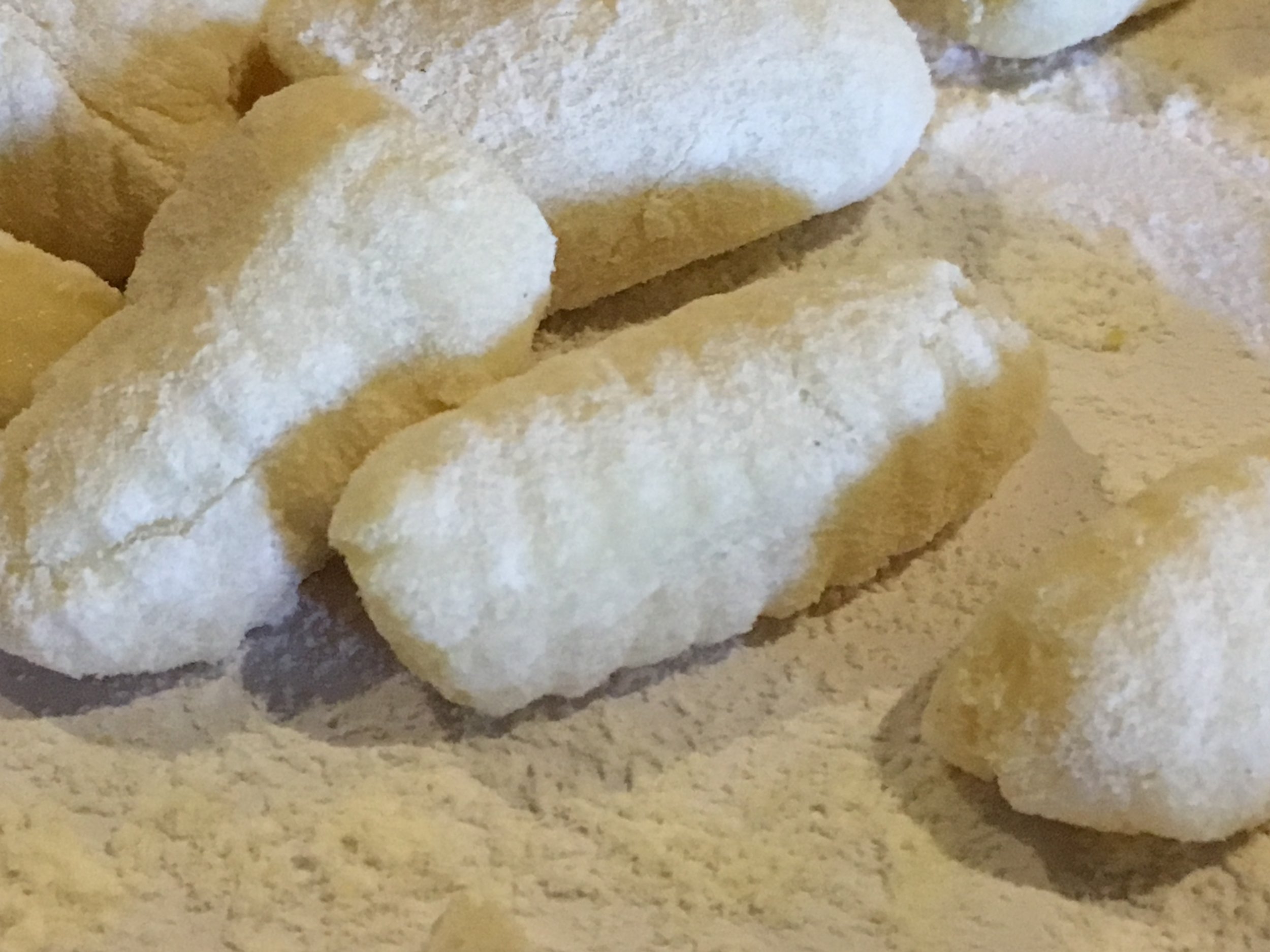
Then comes the fun part - shaping the gnocchi to create those little ridges that are the key to holding onto the sauce. We used the traditional wooden tool for shaping the gnocchi and everyone had fun learning the technique.

Finished gnocchi, dusted with flour and ready for immersion in boiling water.

Finished gnocchi, dusted with flour and ready for immersion in boiling water.

To go with the gnocchi we made a traditional ragu, starting with a soffritto (a saute of onion, carrots, and celery in olive oil), to which was added ground meat (beef and pork), a little tomato sauce (the tomato is subtle, not the base of the ragu), some red wine, and spices.

Finished gnocchi topped with ragu.

Finished gnocchi topped with ragu.

We started our cena (dinner) with a traditional panzanella salad and then moved on to the star of the meal - the gnocchi. They turned out just right - light and fluffy with the flavorful ragu clinging to the ridges, enhancing but not overwhelming the gnocchi. Topped with some grated Parmigiano-Reggiano, it was one of the best gnocchi I've eaten, thanks to Eva's great instruction! We followed the gnocchi with a porcini-stuffed chicken breast, an insalata mista (mixed salad), and a dessert of creme caramel, which we made during the class. After dinner, we all took home the recipes for each dish, along with some new Italian cooking terms and a lot of wonderful memories!                      post by JB

Contacts: Lucca Italian School

Happy LIS students sharing a great meal.

Happy LIS students sharing a great meal.

Scenes from an Italian Neighborhood

Each time I arrive in Italy, I spend the first couple of days wandering the neighborhoods of whatever town I'm visiting. Still feeling the effects of jet lag, wandering helps me to orient myself, scout places for future exploration and soak up the Italian vibe.

A shop display in Lucca.

A shop display in Lucca.

Even when I've visited a city before, such as Rome or Florence or Lucca, I enjoy my hours wandering. I am reminded that I am in vacanza (on vacation) with no need for hurrying. Inevitably, I find sights I have not seen before or I capture a new angle on an old favorite.

San Michele Church in Lucca.

San Michele Church in Lucca.

Neighbors chat outside a produce store.

Neighbors chat outside a produce store.

The social aspect of Italian life is always on display in some form - finding neighbors chatting or spotting old friends walking arm in arm makes me feel part of the warm culture, even if I'm wandering alone from time to time.

A nun walks toward a sun-splashed area of town.

A nun walks toward a sun-splashed area of town.

Kids pedal their way through town.

Kids pedal their way through town.

With no goal in mind, no destination I have to reach, I find myself more relaxed than ever and more in tune with la dolce vita (the sweet life) of Italy.

-post by JG