Two Parts Italy

Exploring Italy, travel, and living a flavorful life

  • Blog
  • About This Blog
  • Start Here
  • Recent Posts
  • Archives by Topic
  • Subscribe
  • Contact me

An Introduction to Padova: Part One

March 28, 2022 by Joanne Bartram

It is not uncommon for visitors to northern Italy to make stops in Milan and Lake Como, heading next to Venice.  It’s a wonderful itinerary but leaves out some of the less-visited cities in the Veneto region. One of these cities is Padova (Padua), which lies just a short train ride from Venice. It’s easy to spend a full day in Padova as part of a visit to Venice but it is even better to take a few days and really get to know this interesting city.   As a bonus, Padova is less expensive than major tourist destinations (including Venice), has fewer tourists (there were almost none during my off-season early March visit), is a friendly university town, and has some great food!  The URBS Picta card (sometimes referred to as The Padova Card) includes admission to a number of major sites and is a helpful adjunct in organizing a visit.
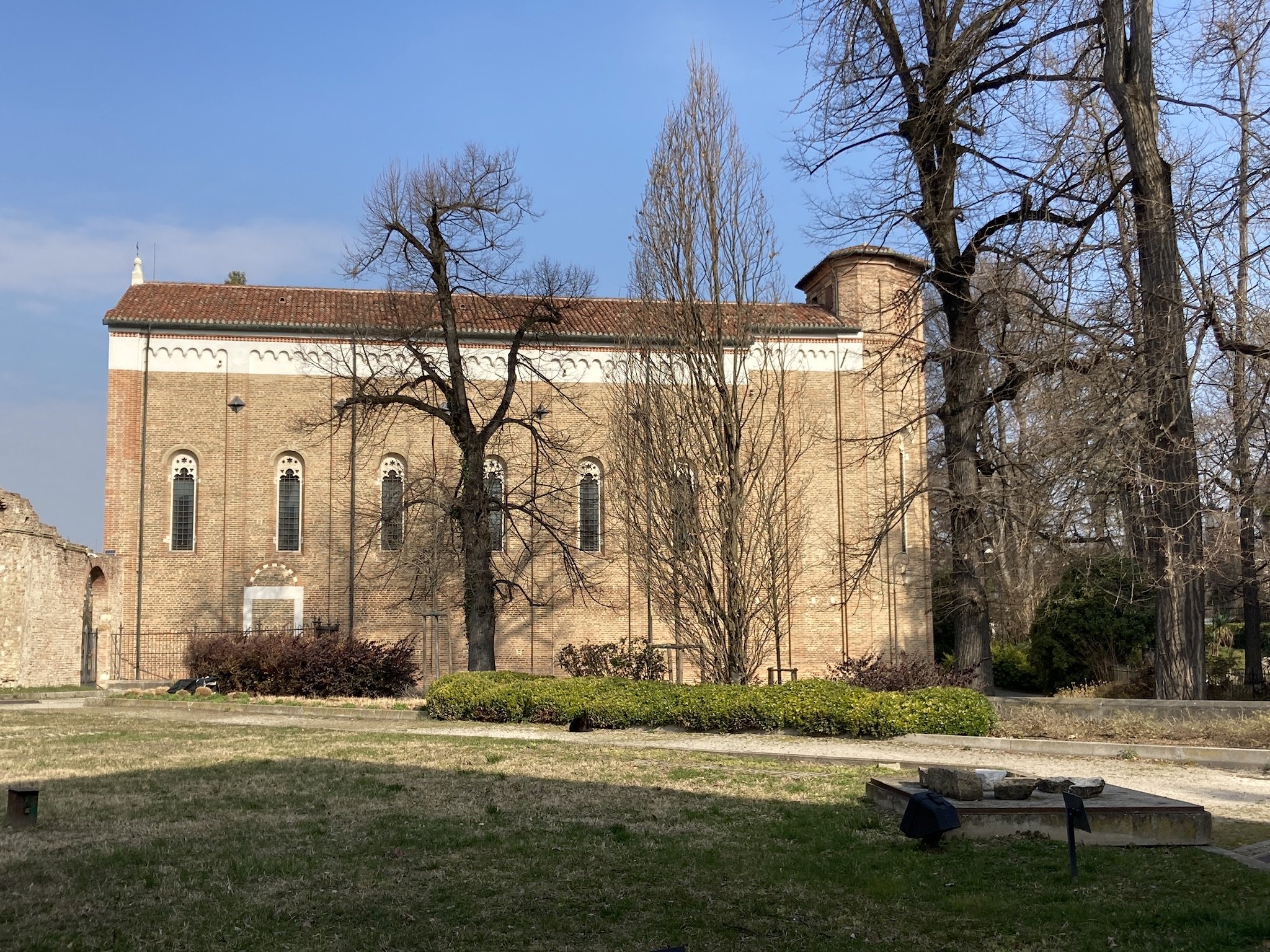
The Scrovegni Chapel. Simplicity on the exterior, glorious within.
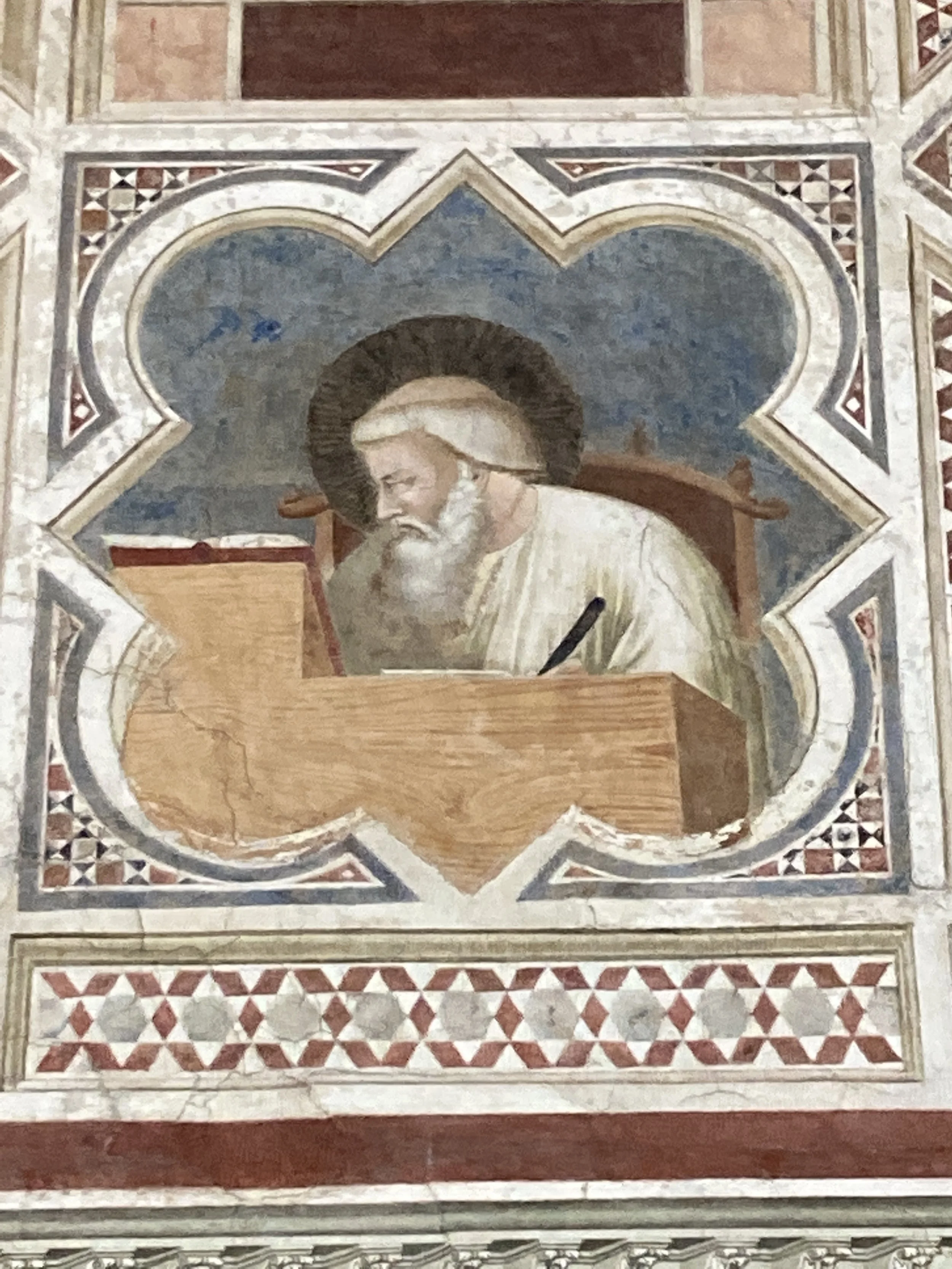
Detail, Scrovegni Chapel

 Visitors to Padova are most often drawn to the city by its two major sights, the Scrovegni Chapel and the Basilica of Saint Anthony.  It was the Scrovegni Chapel, filled with frescoes by the artist Giotto, that drew me to Padova earlier this month. The small chapel is a masterpiece of medieval art. Giotto, already a well-know artist, worked on the Scrovegni Chapel from 1303 – 1305, creating frescoes that demonstrate the revolution in artistic expression for which he is celebrated.  As in most churches of the time, the frescoes tell stories from the bible and the life of Christ.  They are arranged in a series of panels which wrap around the walls of the small chapel. The Scrovegni Chapel is an important site for those interested in the art of this period and the works of Giotto. Admittance is limited and must be reserved in advance. The Scovegni is such a wonder that it deserves a post all its own, with lots of photos. Coming soon!


The chapel grounds also contain the Eremitani Civic Museum. It is quite large with a wide variety of exhibits. Etruscan and Egyptian artifacts fill the main floor. Interesting, but less so than what comes next.

The upper floor is the real star - the Pinacoteca (Gallery of Paintings). It is filled with an outstanding collection of art by Italian masters. Not to be missed is Giotto’s painted wooden crucifix, moved to the museum from the Scrovegni Chapel.

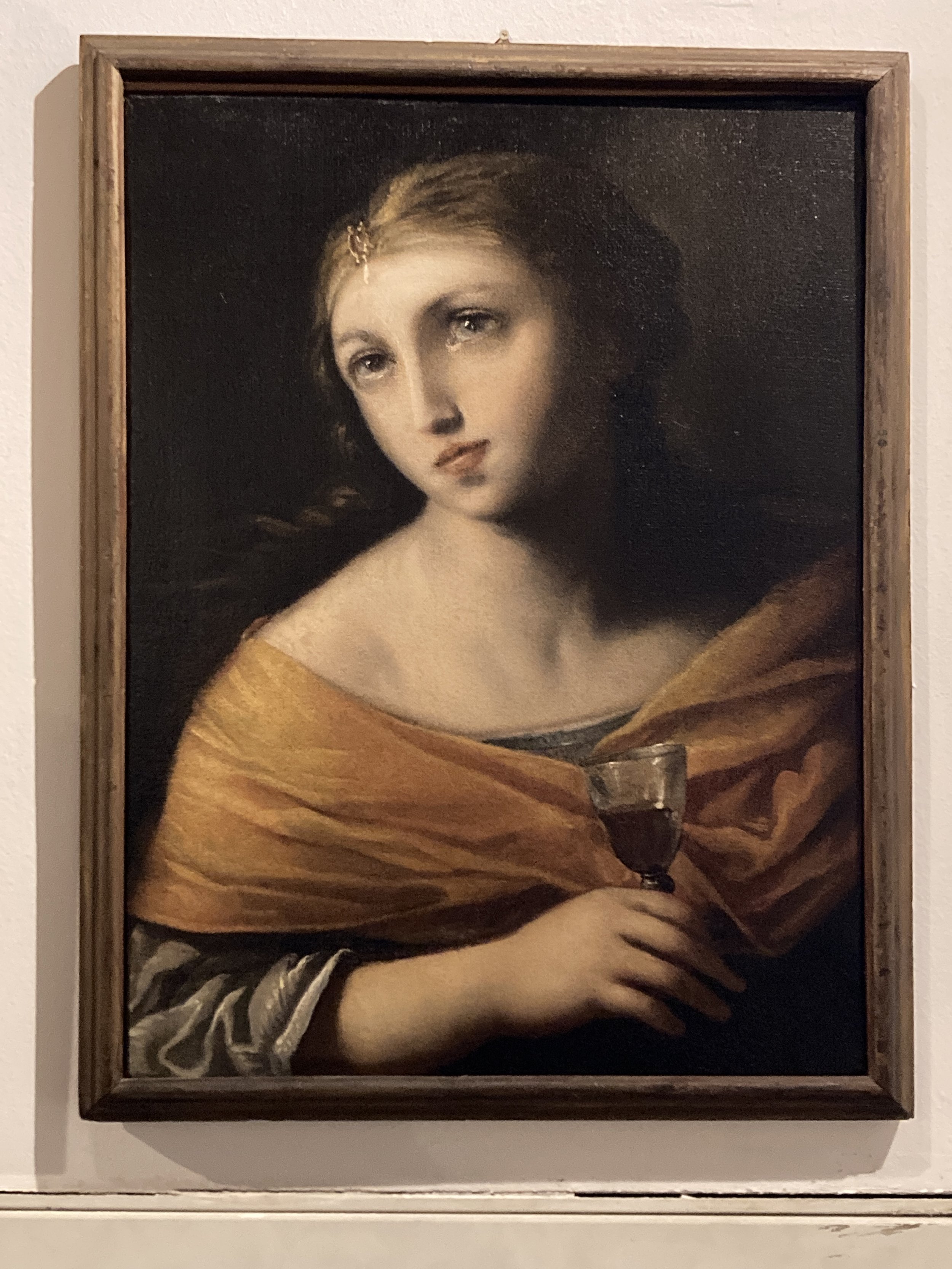
Among my personal favorites were the fierce angels painted by Guariento in the 14th century (below, top row) and the portraits by Ginevra Cantofoli done in the 17th century. Female artists were relatively few in that time period, so it is always good to see the work of one prominently displayed. Contofoli’s portraits are especially lovely (below, bottom row).

IMG_4976.jpeg
2F6B5CF0-7907-4304-A5CA-2110CC264407.jpeg
IMG_4966.jpeg
IMG_4960.jpeg
E0271AF2-FC46-4BA2-BC2E-93901BFC6E56.jpeg
63899CB0-C978-4156-B92A-B0B70D787F3D.jpeg

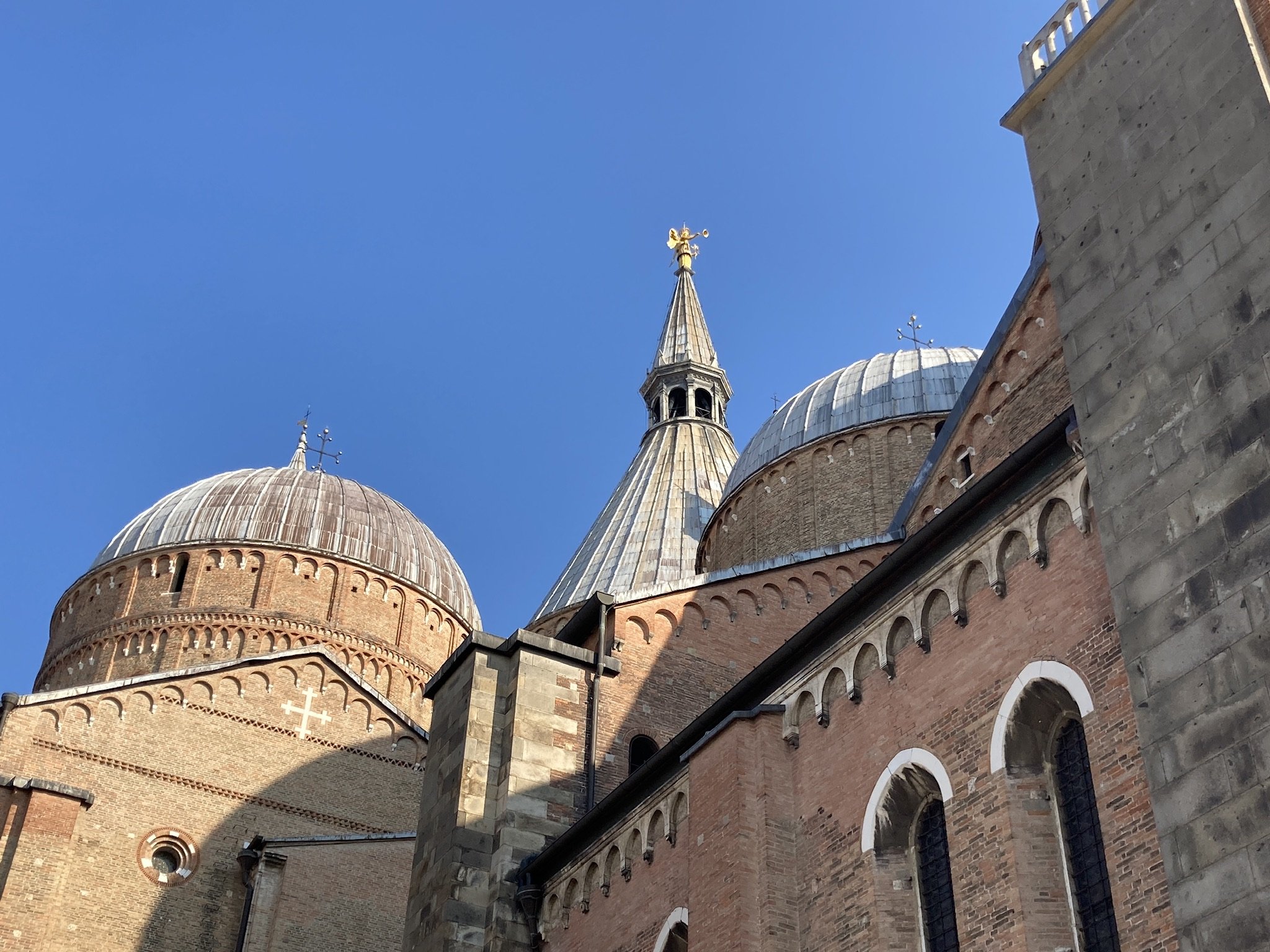
The second major site in Padova is the Basilica of Saint Anthony (Sant’Antonio di Padova). The basilica is an important site for those who come to seek the saint’s help.  St. Anthony is known to aid in finding lost things, protecting travelers, and for blessing women who wish to become pregnant.  It’s even said that he can help find a lost love.  Many believers come in pilgrimage to give thanks for prayers answered or to visit the chapel of the relics.

 I have always been amazed – and perhaps a bit disconcerted – by the concept of a relic.  In the case of Saint Anthony, the relics found in the ornate Chapel of the Reliquaries (within the basilica) include the jaw bone (complete with teeth), the tongue, and the vocal cords of the saint.  Worshippers, along with the merely curious, visit the chapel to see vestments worn by the saint along with his wooden coffin.  Then they climb the steps to the ornate wall displaying his head rest (no soft pillow here, this head rest is made of stone), the three relics, and other artifacts.
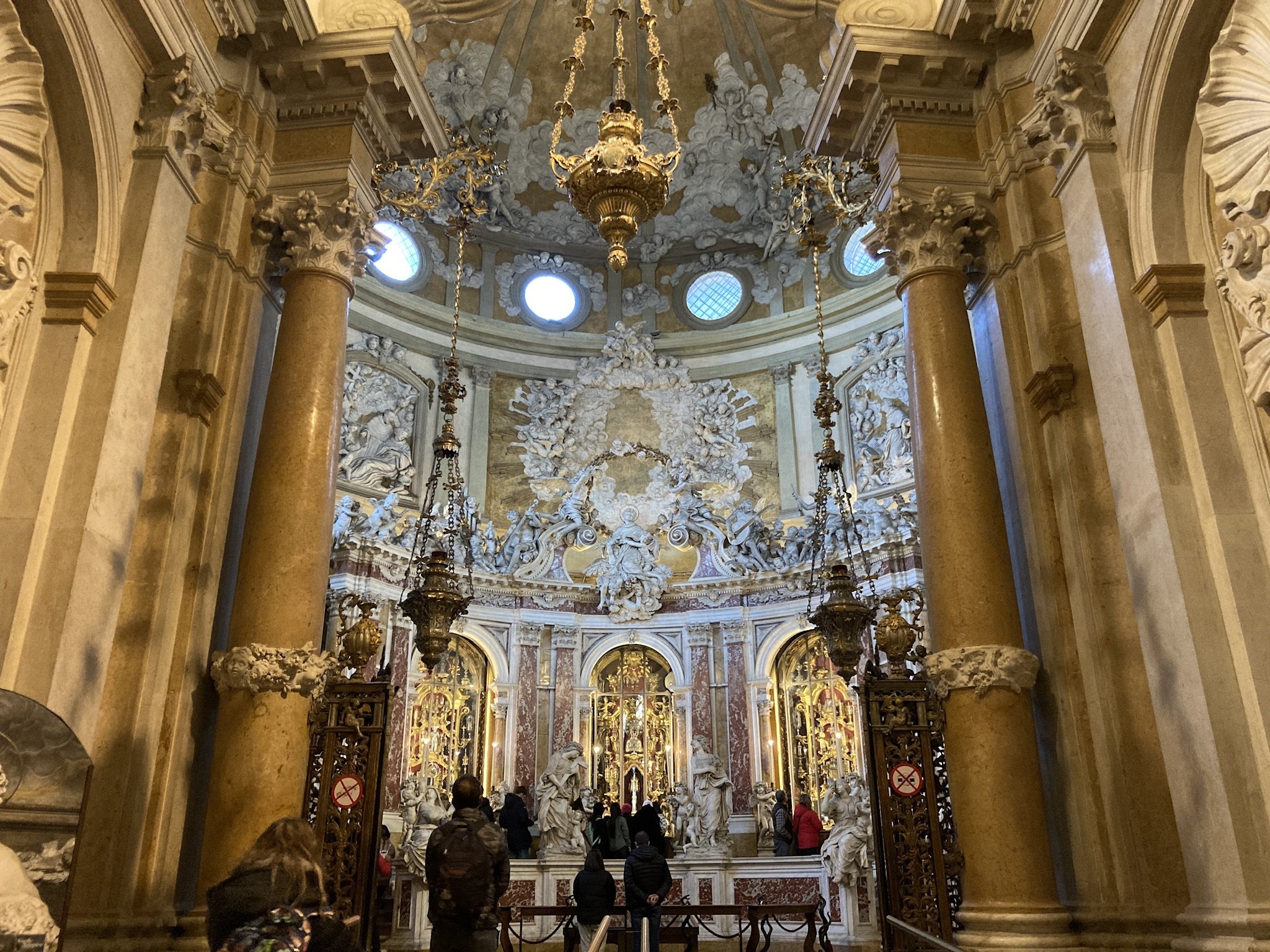
Chapel of the Reliquaries, Basilica of St. Anthony, Padova

 The tomb of Saint Anthony lies in a separate chapel within the basilica. This large side chapel is near to the tiny section of the basilica which was the original chapel (before the basilica was built) and where the saint was first buried.  His tomb was later opened and his body moved into the larger basilica. The tomb is surrounded by beautifully carved renaissance era marble panels representing scenes from the saint’s life, topped by an intricate gold ceiling, and elevated on a marble altar.  Worshippers pass behind the ornate altar to touch the tomb, in prayer or in thanks for blessings received.

IMG_4881.jpeg
IMG_4880.jpeg

The basilica complex also includes cloisters and the small but interesting Oratorio di San Giorgio (Oratory of Saint George). The oratory has frescoes detailing the lives, and martyrdom, of Saints George, Catherine, and Lucy. There is no better way to refresh childhood memories of the lives of saints than to view them through these illustrations.

IMG_5156.jpeg
IMG_5155.jpeg
IMG_5157.jpeg

While the Scrovegni Chapel and the Basilica of Saint Anthony are the most famous sights in Padova, the city has much more to offer. Next week, in Part Two, the introduction to Padova continues.

March 28, 2022 /Joanne Bartram

The daily market in Padova

A Morning in Padova's Market

March 21, 2022 by Judy Giannnettino in #italytravel, Italian culture, Italian markets, Italy travel, #padua

When I first visited Italy, nearly 30 years ago, I hoped to attend a cooking class.  I had been studying Italian cookbooks (especially those by Marcella Hazan) and wanted more than anything to cook in Italy, using local ingredients, with a teacher who could show me how to make authentic Italian dishes.  Unfortunately, the cost of the week-long classes just did not fit my budget.  Instead, I came to Italy determined to taste regional dishes, shop local markets, and take lots of notes.  Or, as someone said to me, “So, you’re going to Italy to eat?”  Well, yes.  That pretty much summed up my intention.

My first bite of prosciutto with melon was a revelation!

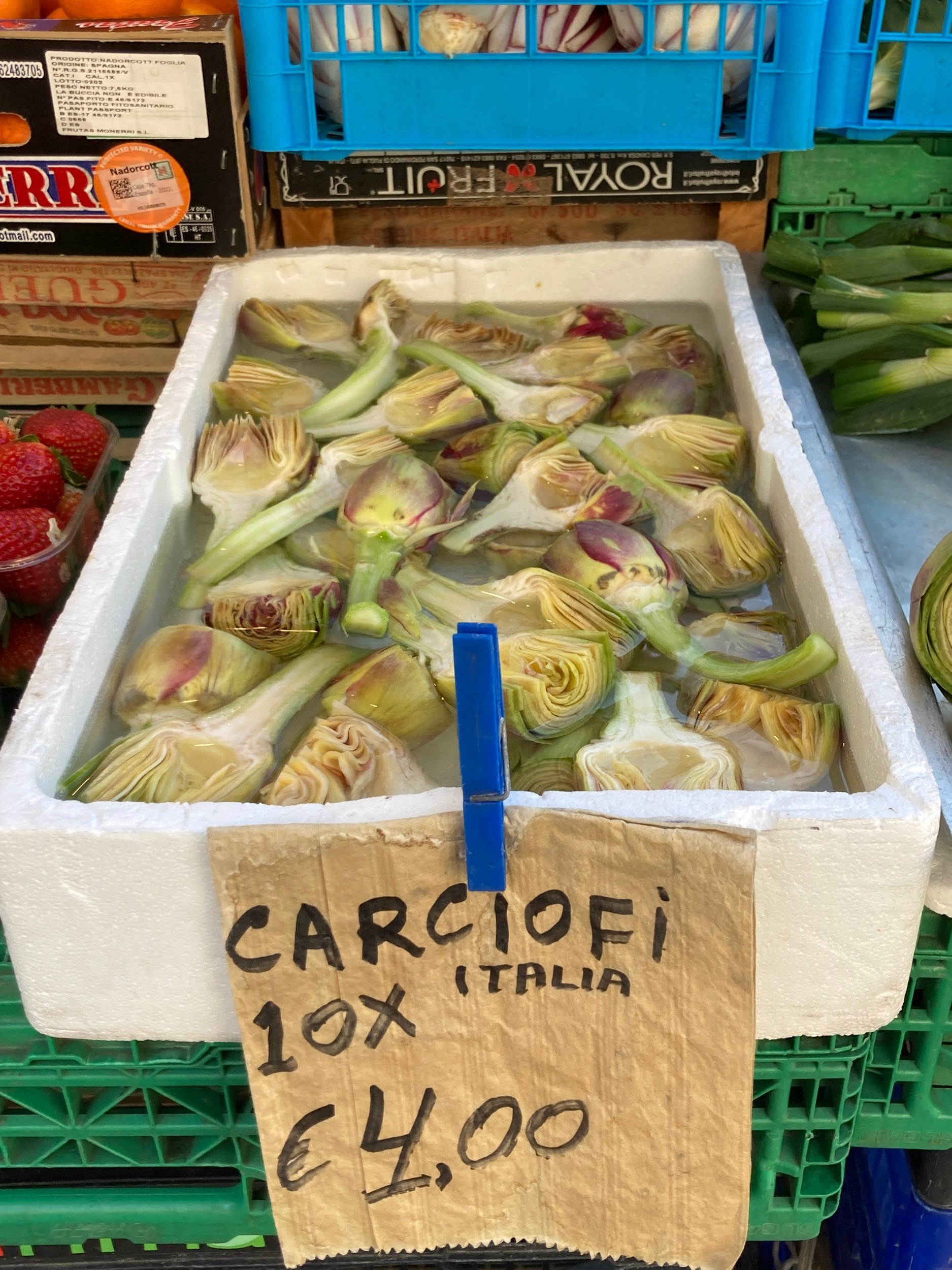
 I learned so much on that trip, in large part through food experiences.  Restaurant dining introduced me to many dishes – sweet melon wrapped in salty proscuitto, a delicate risotto with saffron, fish straight from the lake, tiny wild blueberries atop gelato, pasta fatto a mano (homemade). The flavors and preparation methods were enlightening.  As good as the restaurant meals were, it was the Italian markets which really enchanted me.  Fresh produce artfully displayed, pan-ready trimmed artichokes floating in lemon water, perfectly ripe melons.  I marveled at the fishmongers in Venice who arranged their products in photo-worthy displays and at the shops in Florence filled with hanging legs of prosciutto, a vast array of cheeses, and cases of colorful filled pastas.  How I longed for a kitchen on that trip!

Fresh pasta at the Sant’Ambrogio market in Florence

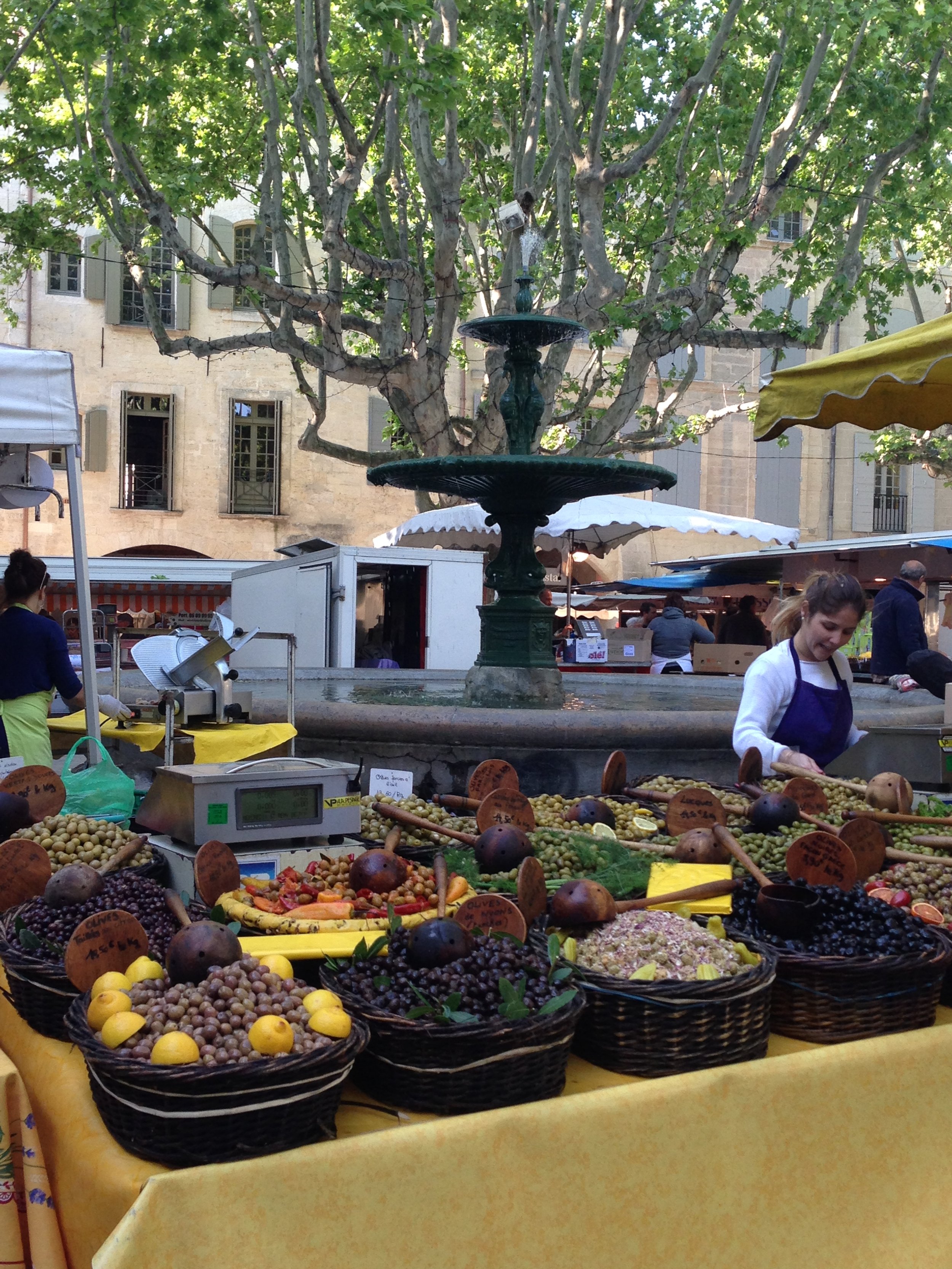
 Since that time I have sought out markets whenever, and wherever, I’ve traveled.  They form some of my most vivid travel memories.  The best ones are the “mamma’s markets”, catering to locals rather than tourists.  Two of my favorites over years of travel are the weekly market in Uzes France (oh those olives!) and the Sant’Ambrogio market in Florence.   

Italy is not the only country with fabulous markets. This one in Uzes, France is among my favorites.

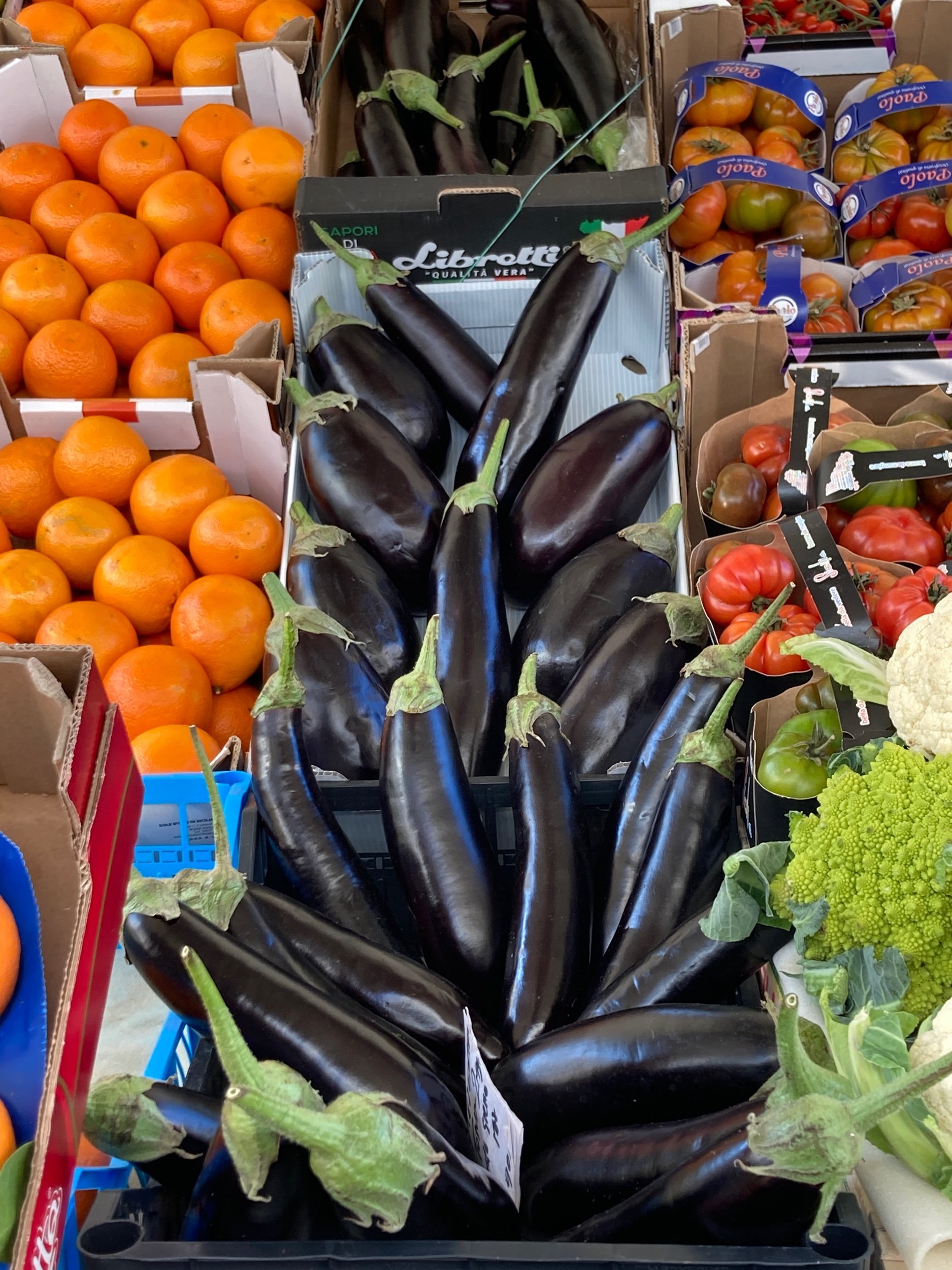
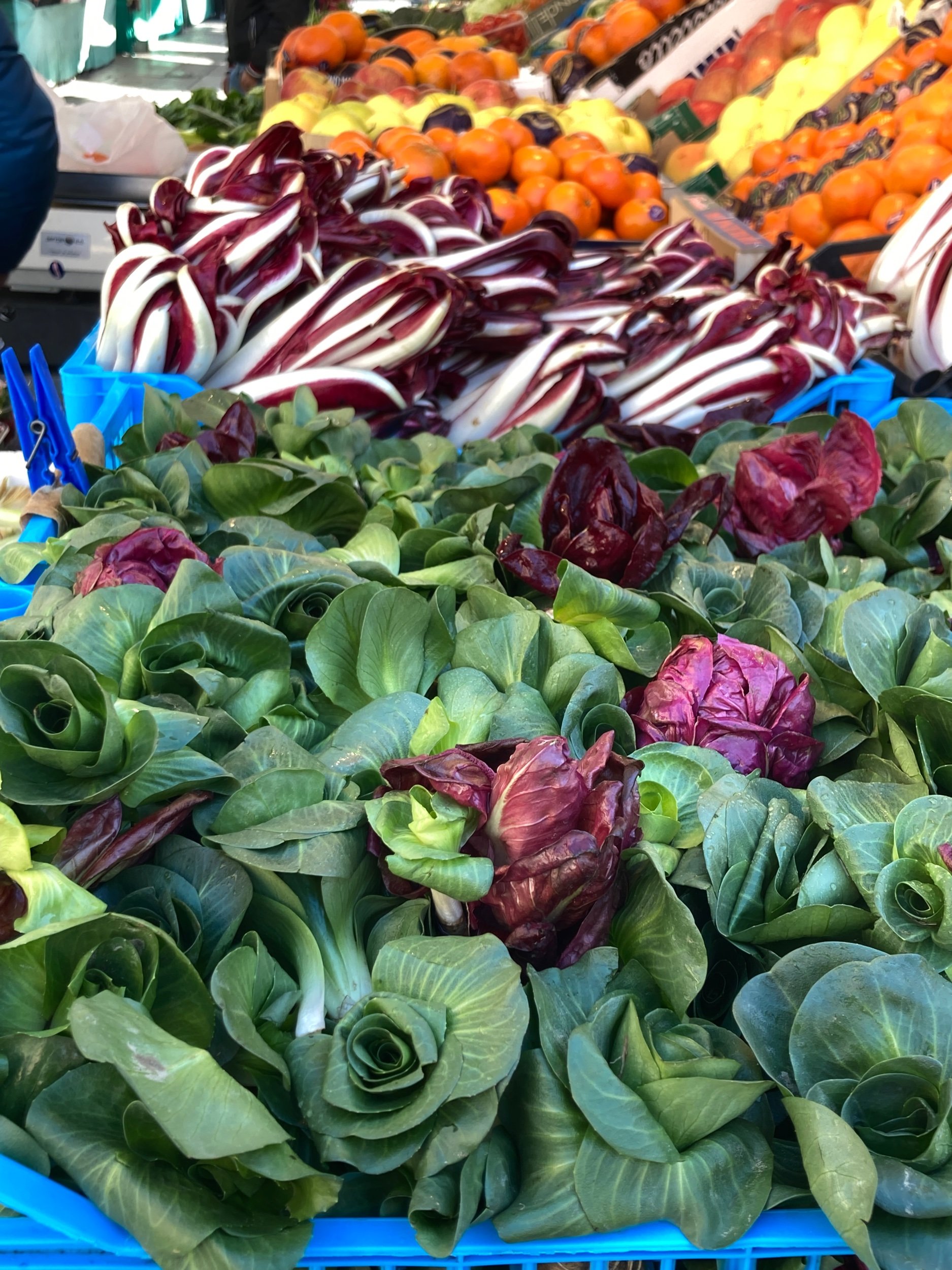
 My most recent market experience was in Padova (Padua) where I was delighted to find a fabulous daily market.  The outdoor market, centrally located in Piazze delle Erbe and Piazza della Frutta, was a wonderland of fresh fruits and vegetables.  Multiple vendors set up stalls each morning filled with just about everything a cook could desire -  baskets of bright lettuces, mounds of greenish-purple artichokes, piles of vibrant oranges, rows of tomatoes in different shapes and sizes, fat stalks of asparagus, dark purple eggplants, dried beans, herbs, and even flowers.  

IMG_5027.jpeg
IMG_5036.jpeg
IMG_5043.jpeg
IMG_5030.jpeg

Spending a morning there was a joy.  In the afternoon the market stalls disappeared and the piazza became a social hub of cafes, bars and casual restaurants. 

Beautiful blossoms in the Padova market

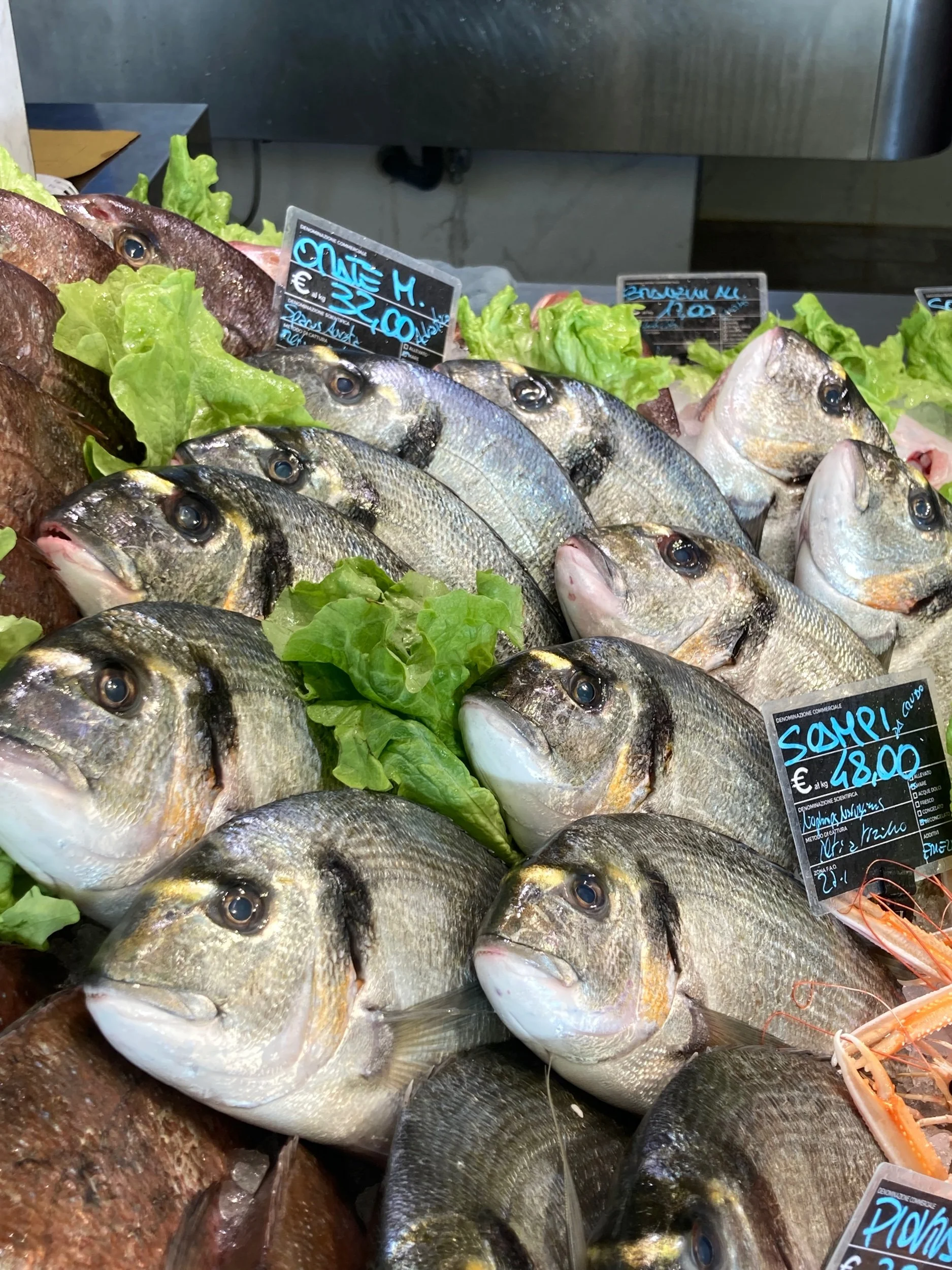
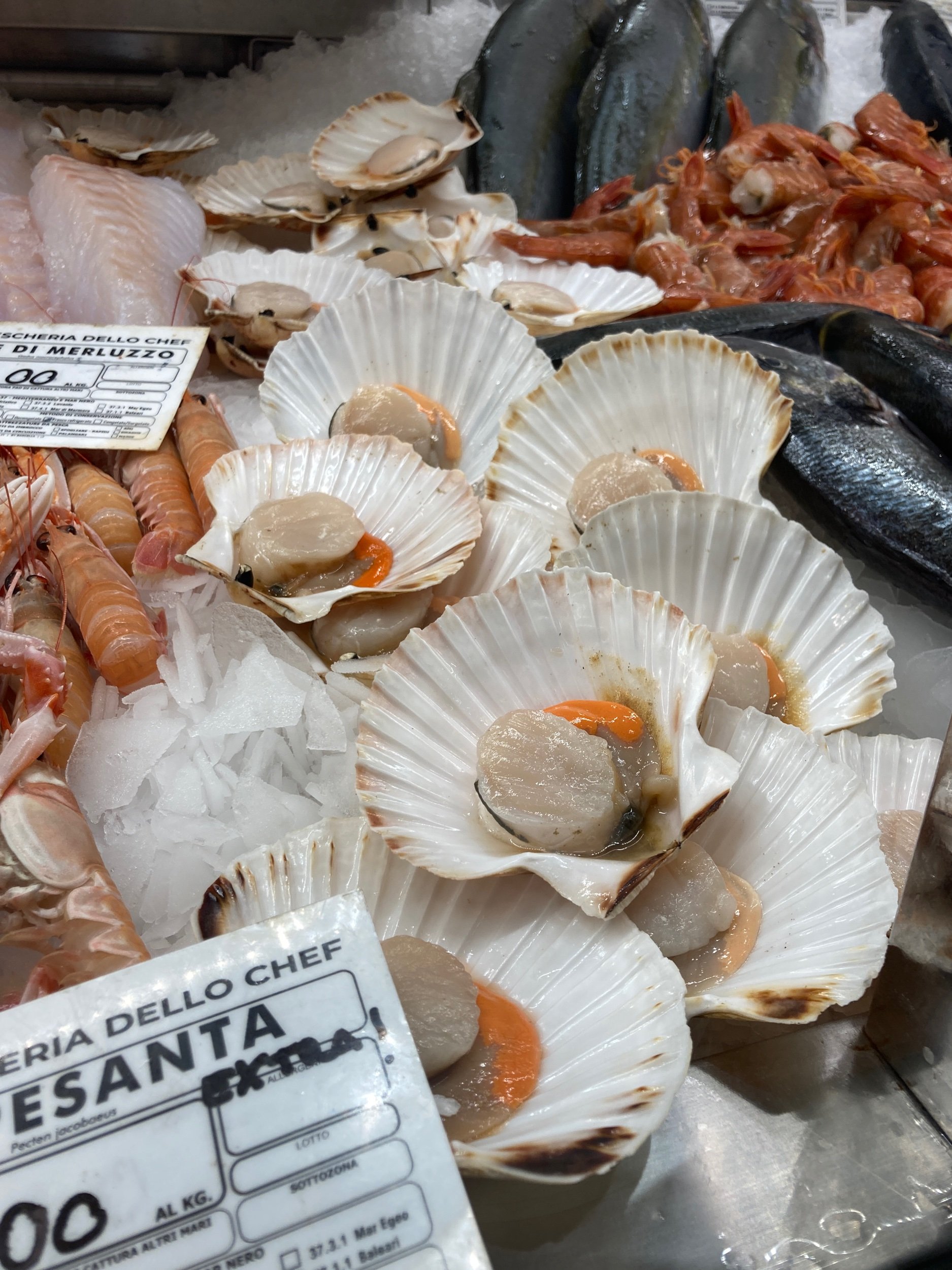
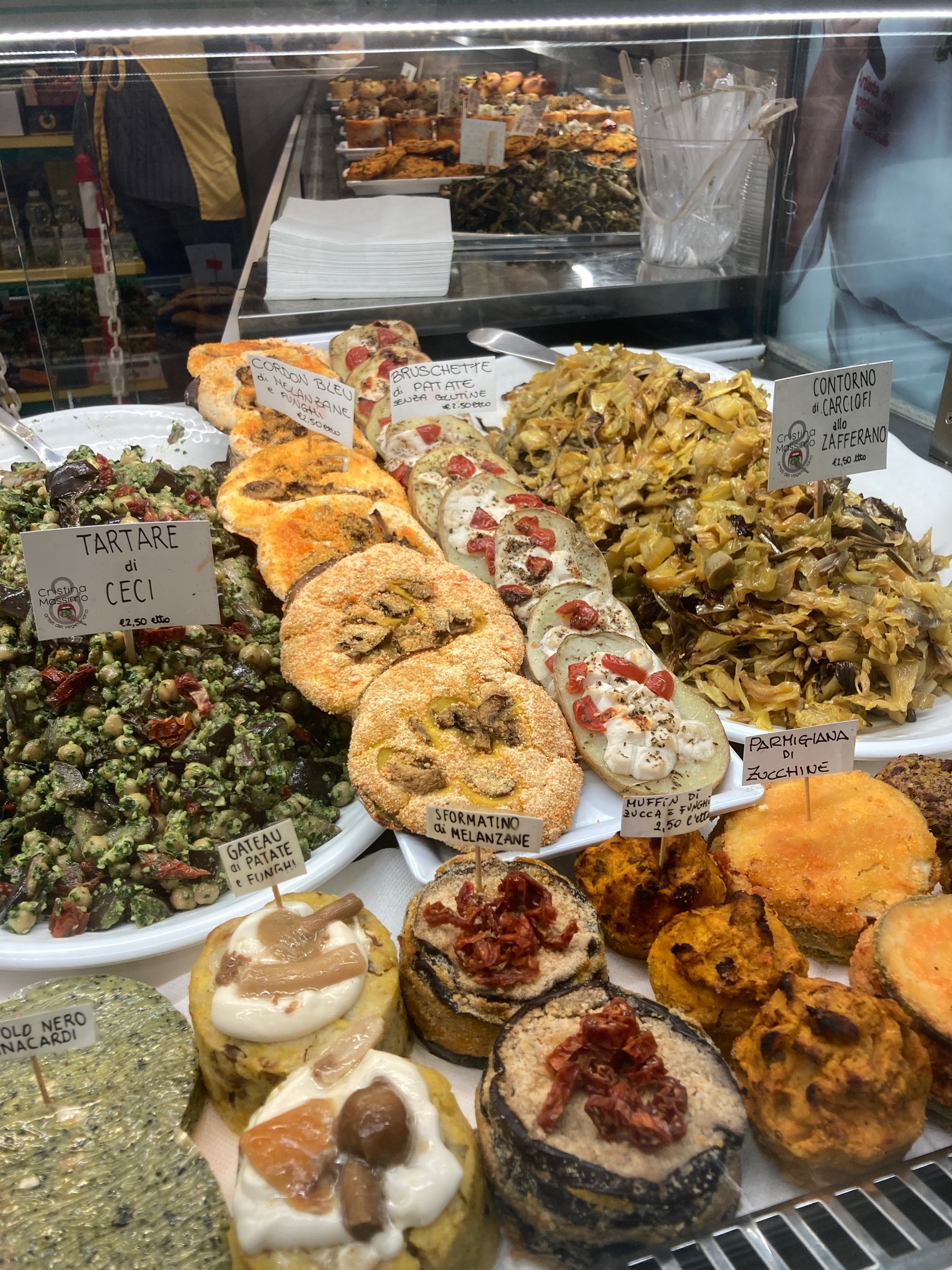
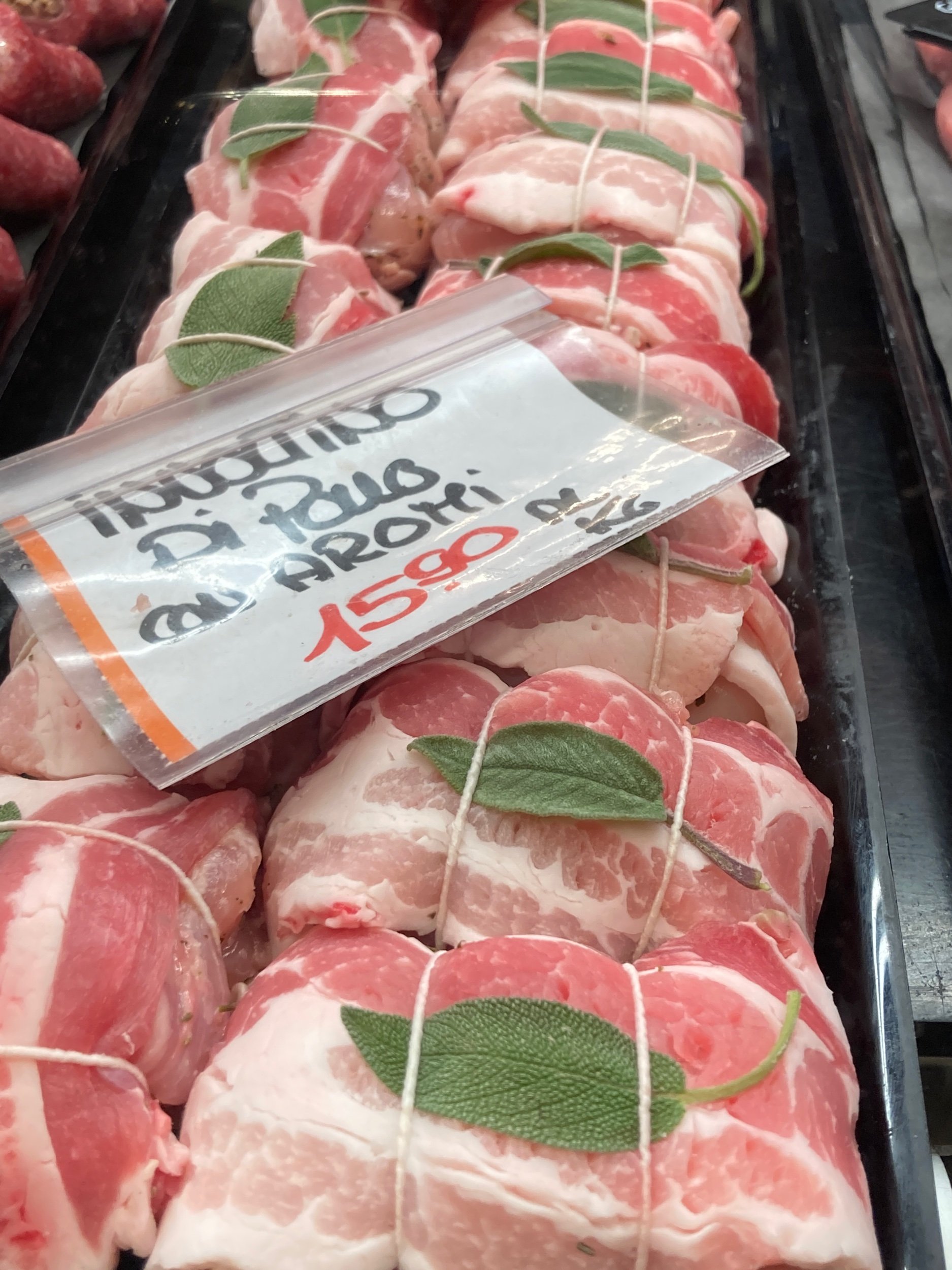
 In addition to the outdoor market stalls, an adjoining indoor market lies beneath the Palazzo della Ragione.  The culinary fun continued here with a host of shops selling fish, meats, prosciutto, bread, pastries, cheeses, and a variety of prepared foods.  There was even a rare sight in Italy – a “to go” coffee bar.   

IMG_5047.jpeg
IMG_5064.jpeg
IMG_5075.jpeg
IMG_5079.jpeg
IMG_5082.jpeg
IMG_5071.jpeg

There is so much to appreciate in Padova – stunning frescoes, historic churches, architecture, historical buildings, parks (I will get to all of these in another post) but never underestimate the power of a good market to add a fun experience when exploring a new city. 

March 21, 2022 /Judy Giannnettino
Padova, Padua
#italytravel, Italian culture, Italian markets, Italy travel, #padua

The baptismal font, Baptistry of Padova (Padua)

Italian Baptisteries

March 14, 2022 by Joanne Bartram

A baptistery can be an area, often a small chapel, inside a church where the baptismal ceremony is held. It might have a simple font holding holy water, a more elaborate basin or a much larger basin for baptism by immersion.

A baptistery (battistero in Italian) may also be a completely separate building next to a church. This arrangement is quite common in Italy’s historic churches where the battistero may be just as elaborate, if not more so, then the church itself. Colorful frescoes, beautiful paintings and statues, and ornately carved baptismal basins make these wonderful places to visit. I try to seek them out whenever I head to a new Italian city.

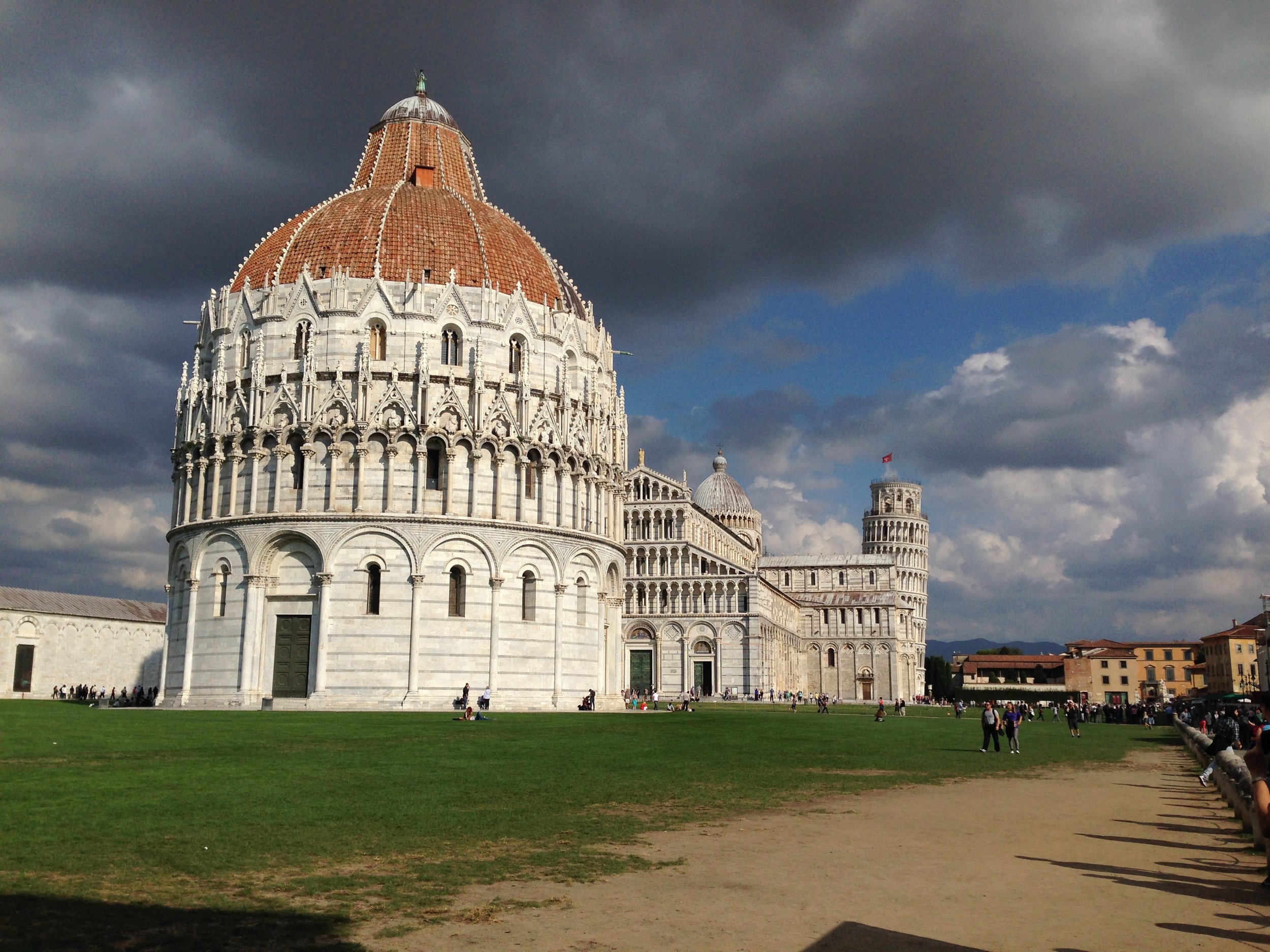
Pisa’s baptistry lies across the Field of Miracles, opposite the Leaning Tower.

Baptistery buildings tend to have several things in common, beginning with either a round or, more symbolically, an octagonal shape. The eight sides of the octagon represent the 8th day, which in Christian theology is the day in which new life begins. Baptisteries also are most often named for San Giovanni. This is of course because San Giovanni (St. John in English) was known as San Giovanni Battista (St. John the Baptist). He performed the rite of baptism even before Christian times as a form of purification. He later became one of the 12 apostles.

Florence’s Baptistery with its beautiful marble facade.

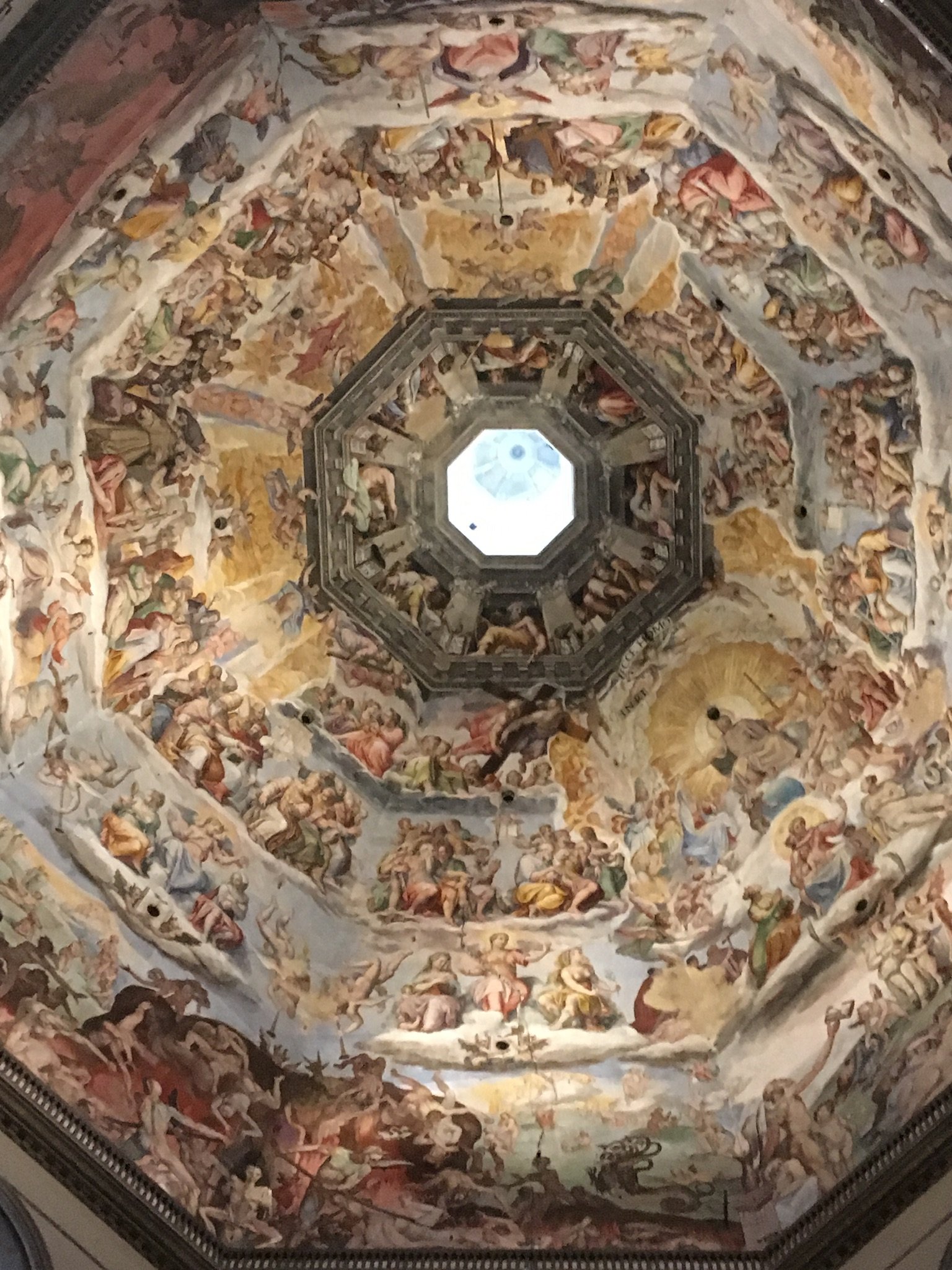
Florence, baptistery ceiling

Some baptisteries are well-known and are on the “must-see” list for visitors to Italy, others are outside of major tourist cities and often (sadly) less visited. In Tuscany the major ones include the Baptistery in Florence and the one in Pisa. Each is unique in its own way. The Baptistery in Florence has the classic octagonal shape. The exterior is clad in white and green marble and is famous for its 3 sets of brass doors - one by Pisano and two by Ghiberti. The interior is a study in contrasts - solemn below and glorious up above.

The baptistery in Pisa, on the opposite side of the cathedral as the more famous Torre Pendente (Leaning Tower), is quite different. Round in shape, it is fairly plain on the inside. Perhaps its most notable feature is the acoustics. Step inside and sing a few notes, you’ll be amazed at the echo and the sound quality.

As wonderful as these two Tuscan baptisteries are, the one I really love is in Emilia Romagna, in the city of Parma.

Detail from a fresco, Battistero di San Giovanni, Parma

The baptistery sits beside the Cattedrale di Santa Maria Asunta, Parma’s Duomo.  And while the church itself is lovely, it is the baptistry which steals the show.   

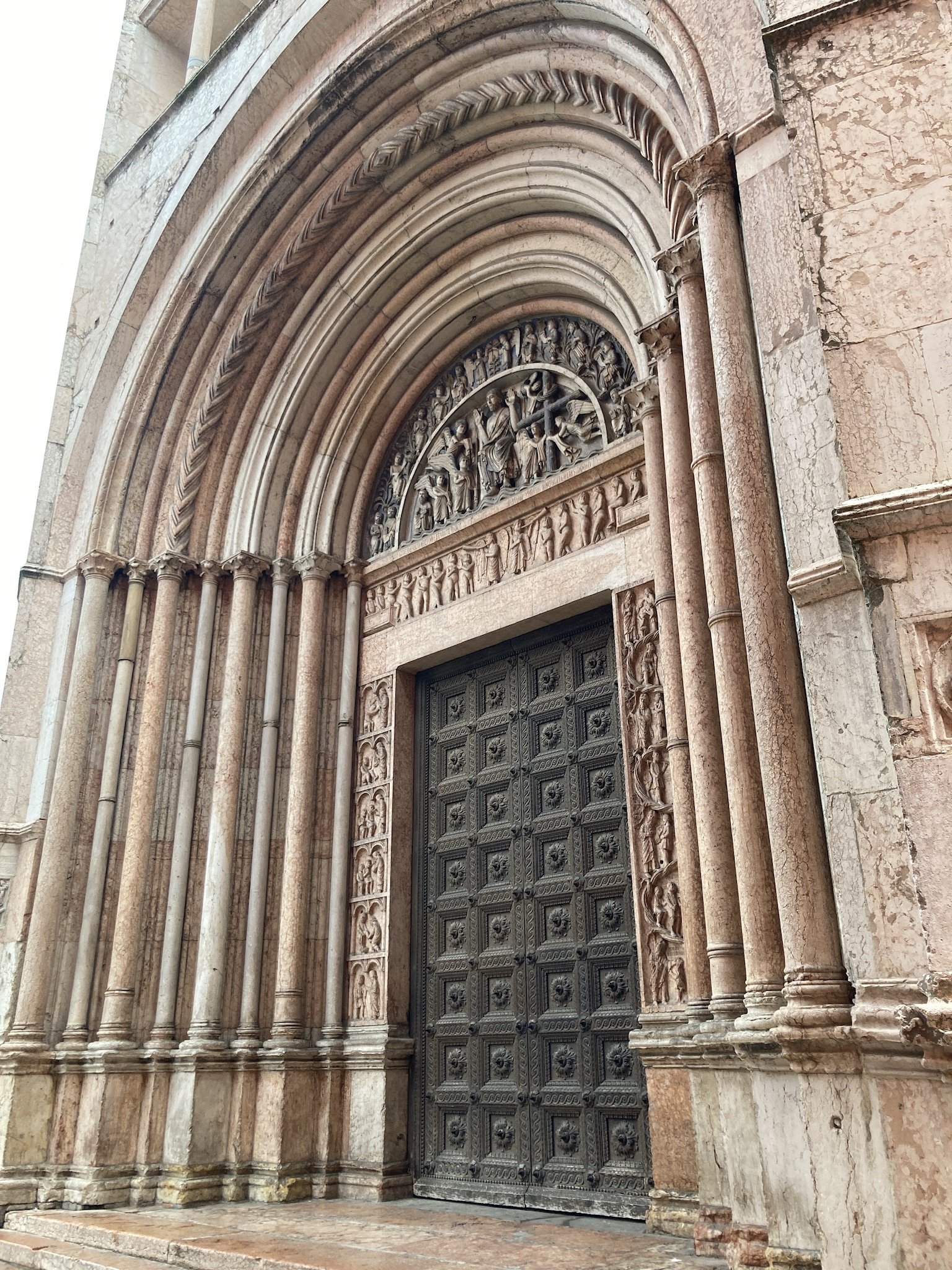
Battistero di San Giovanni, Parma

The exterior is octagonal, clad in pale pink marble.  Around the bottom are a series of sculptures which include a host of animals – real and mythical – plus zodiac symbols and the four virtues (Chastity. Charity, Faith, Hope). Reaching to the sky are four levels of arches loggia, then a ring of closed arches and, finally, the top with several small pinnacles. The doors are elaborate and flanked by columns of the same pink marble, carvings rest in the arches above each door.

Pink Verona Marble faces the baptistery in Parma. Note the carved animal panels.

Stepping inside is to enter a medieval world full of symbolism, religious storytelling, and powerful artistic expression.   The larger of two baptismal founts, this one of pink marble, sits in the middle.  .  The walls are divided into 16 shallow niches, each with vibrant frescoes.  Sculptures represent the seasons and months of the year.

Interior of Parma’s baptistery

Standing beneath the umbrella like ceiling is nothing short of spectacular.  It is divided by 16 “ribs” which frame individual scenes. There are six bands which circle the dome, each with a different focus.  There is the story of Abraham and that of John the Baptist.  A bit higher is Christ, Mary and the Prophets.  Higher still, the Apostles.  Finally, a band of stars and the red center (the color red symbolizes love) representing heaven. 

The unique ribbed ceiling in Parma’s baptistery. Each band tells a story.

There is so much to see here that a lifetime could be spent studying all the images and symbolism.  My short visit provided just an introduction and, before my next visit, I will be reading more about this historic and evocative place. I’m not sure where in Italy I will travel next, but wherever I wander I hope to find another fascinating baptistery.

Masked visitors look up in wonder at the ceiling of the baptistery in Parma. (November 2021)

March 14, 2022 /Joanne Bartram

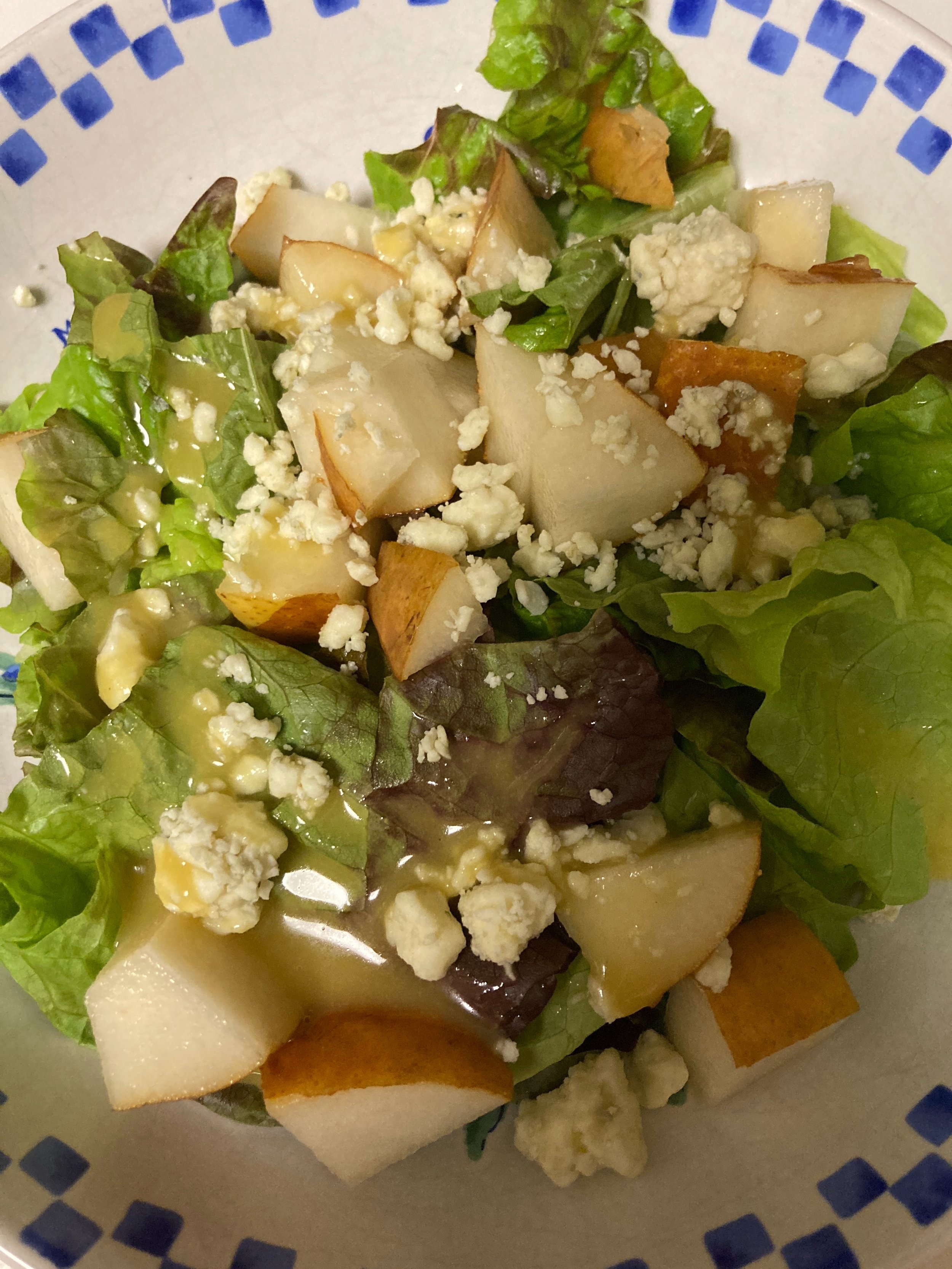
Nothing beats a perfectly ripe pear combined with gorgonzola in a salad!

From My Italian Kitchen: Winter Salads

March 07, 2022 by Joanne Bartram in Italian markets, Living in Italy, recipes

A caprese salad, drizzled with balsamic glaze.

Growing up in my family, salads were strictly summertime fare. There wasn’t much variety in the salads we ate, in fact there was no variety at all. Salad meant one thing - iceberg lettuce, tomato (luckily, living on Long Island we had really good locally grown tomatoes), and cucumber. The dressing was always the same, a combination of olive oil (at least it was labeled olive oil, I have my doubts), vinegar, and a packet of Good Season Italian Dressing mix. Toss it all together and serve alongside everything from spaghetti to hotdogs to grilled steaks. When I moved from New York to Colorado, I got my first taste of avocado in a salad. A definite improvement. I think the first major variation on the familiar salad theme that I tasted was a Caesar salad - romaine lettuce, salty anchovies, cheese, and a flavorful dressing. And garlic croutons! My eyes were opened to new possibilities.

And then I started traveling to Italy. I remember with clarity the first time I tasted an Italian caprese salad with creamy mozzarella, perfectly ripe tomato, fresh basil, and really flavorful olive oil. Equally joyous was my first panzanella. The ingredients were familiar (cucumber, tomato, red onion, olive oil, red wine vinegar, bread) but they came together in a new and exciting way, one that made my taste buds explode. In Lucca, I tasted my first shaved raw artichoke salad topped with pear and pecorino cheese. I also discovered an arugula salad topped with big shaves of parmesan and carpaccio of beef. What a revelation!

Salad never looked like this when I was growing up!

Now it is mid-winter and the weather is cold and windy. The sun warmed tomatoes of summer are long gone. How I miss those summer salads! I had almost forgotten about winter salads, usually opting to put my cold season veggies in warming soups and stews. But then I had lunch with some friends who served the most delicious salad alongside soup on a chilly day. What a great reminder that winter salads can be just as tasty as the summer ones!

At this time of year the markets are full of beautiful winter veggies, many of which go well in salads. Spinach, beets, fennel, broccoli, and cauliflower are all good raw and can be added to a bowl of greens for a simple, and healthy, salad. Roasted veggies, such as red peppers and Brussel sprouts, also make great additions to a winter-time salad. The same goes for winter fruits, especially pears, apples, and clementines. Nuts, plentiful in Italy during the winter, add the perfect crunch. Combined with good leafy greens (thankfully available year round), some local cheese and a flavorful dressing, the result is a cold weather salad every bit as wonderful as a summer one. Hearty enough to be a lunch-time meal on their own, winter salads also pair well alongside a soup, pasta or roasted meat.

Starting with a base of leafy greens, these combinations are my winter favorites:

Pear with gorgonzola and chopped roasted pecans

Toasting the pecans makes them even better in this salad. A gorgonzola dolce is perfect paired with the nuts and pears.

Beets with shaved parmesan, pecans and tiny bits of preserved lemon peel. Pecorino works well too in place of parmesan. No time to roast beets? Many markets sell them packaged and already cooked.

A friend brought me a jar of candied lemon peel from Poland. It adds a perfect zing to a beet salad.

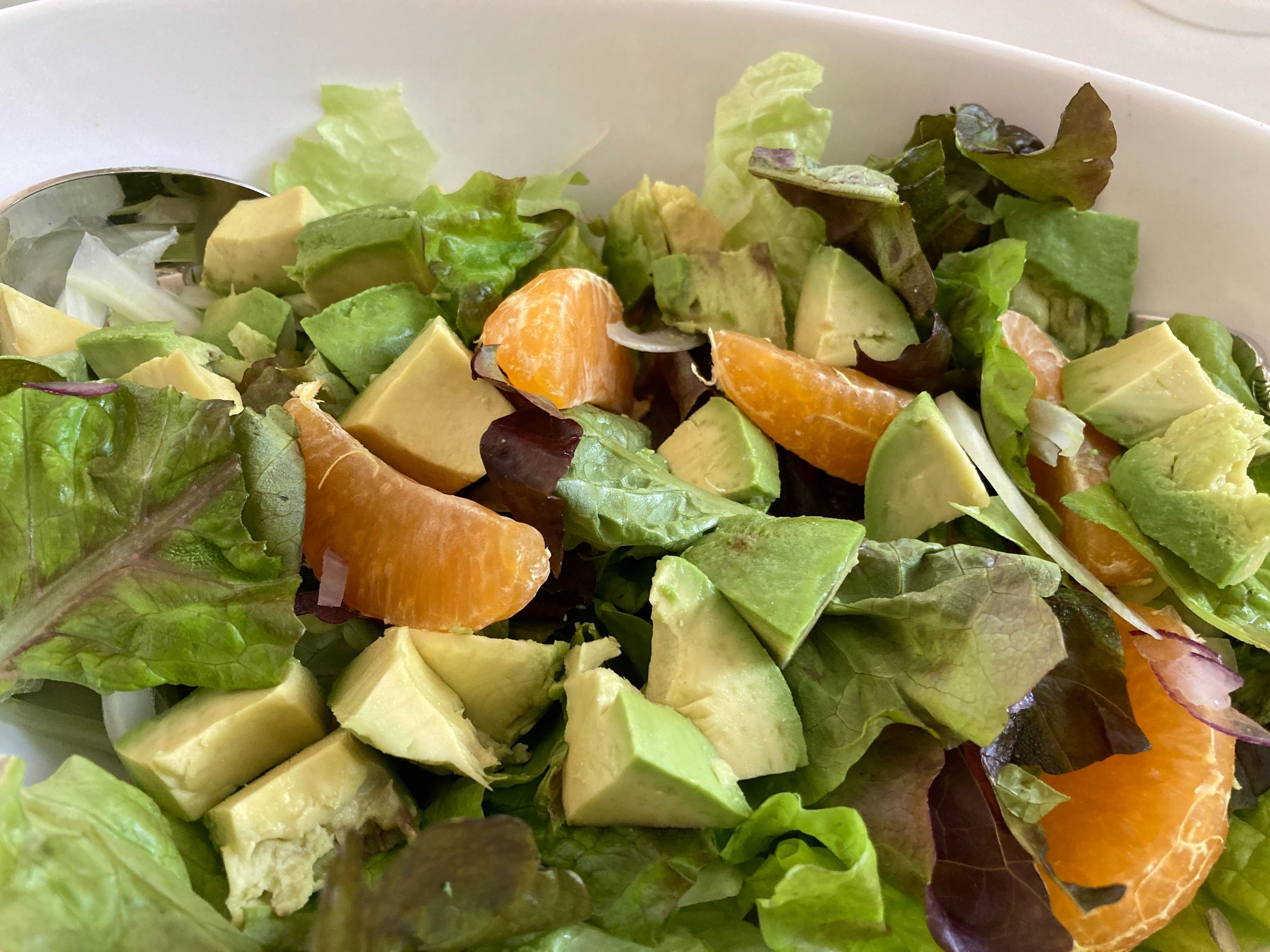
Shaved fennel, avocado, red onion and clementines

Red leaf lettuce with pear, pecorino fresca, and walnuts. Apple works well in this combination too.

Look for perfectly ripe pears and a good fresh pecorino for this salad. The better the cheese, the better the salad!

As for dressing, something with a bit of sweetness goes well with winter salads, especially those with fruit or beets. I like to mix equal parts of Dijon mustard, honey, my favorite olive oil, and either lemon juice or white wine vinegar plus a touch of salt and coarse ground pepper. This mixture goes well with any of the above combinations.

Thanks to my friend Susan for reminding me how tasty a winter salad can be!

Ending with this image - keeping the Ukrainian people in my thoughts and in my heart

March 07, 2022 /Joanne Bartram
winter salads
Italian markets, Living in Italy, recipes

The Defiance of Magnolias

February 28, 2022 by Joanne Bartram

I had a post scheduled for today, on the topic of winter salads. I have, I hope - if technology didn’t get the better of me - delayed its publication until next week. Should it appear today despite my best efforts, please forgive me. With a war raging a mere 1328 miles from me (the distance from Lucca to Kyiv in the Ukraine), salad just doesn’t seem all that important. I have other things on my mind.

Yesterday morning I went for a long walk to try to wrap my head around the idea of a war that seems at once so close and yet so far away. It was a cold and windy morning here in Lucca, so I wrapped up in scarf, gloves and hat and headed toward Corso Garibaldi. There I hoped I might find a few trees in the early stages of bloom to provide some beauty in a world that seems suddenly very, very dark.

Sure enough, the trees along Corso Garibaldi (Lucca’s own Magnolia Street) are beginning to flower. Most have a few buds or a few barely opened white or pale pink magnolia blossoms. But there was one tree midway along the street that was in glorious full bloom, full of deep pink blossoms. It seemed to say “damn the winter, I declare it to be spring”. Its beauty was unmistakable, almost defiant.

I know that magnolias are also in bloom in Kyiv right now. I hope a few stand in defiant bloom though I fear that many are toppled, broken, and stripped of their beautiful blossoms by the violence of war. As people flee the city, in the lingering cold of winter and with what little they can carry, I doubt that magnolia blooms are something they notice. Gentle, quiet beauty can hardly compete with the ugliness of war. I can only hope that peace and sanity will win and that, when they do, some defiant magnolias will still be standing to welcome the Ukrainian people home.

February 28, 2022 /Joanne Bartram
  • Newer
  • Older

Powered by Squarespace