Two Parts Italy

Exploring Italy, travel, and living a flavorful life

  • Blog
  • About This Blog
  • Start Here
  • Recent Posts
  • Archives by Topic
  • Subscribe
  • Contact me
87149CC1-FA2A-4C43-8DDA-E8C675BA6E4A.jpeg

A Spring Brunch at Home in Italy

April 12, 2021 by Joanne Bartram in #springintuscany, Cooking, food, Living in Italy

Warning: this post may make you hungry !

The very small size of my Italian apartment, not to mention the lack of a real oven in the minuscule kitchen, makes entertaining a challenge. I’ve managed as many as 6 for a dinner but that took a lot of juggling and some very cozy seating around the table. And now, when social distancing is the norm, even 6 is way too many. But it’s spring, the weather is gorgeous, the markets are full of beautiful strawberries and asparagus, and I’ve been itching to prepare a meal for friends. When the pandemic rules limiting visitors were relaxed over Easter weekend I was able to invite 2 friends to my home for a meal. With that in mind, I happily started planning a brunch menu. Sometimes it’s fun to get a little fancy and this was one of those times. When you find me ironing a vintage table cloth, you know I’m about to get fancy! Pretty flowers, a nicely set table, the good dishes, and soft music set the stage.
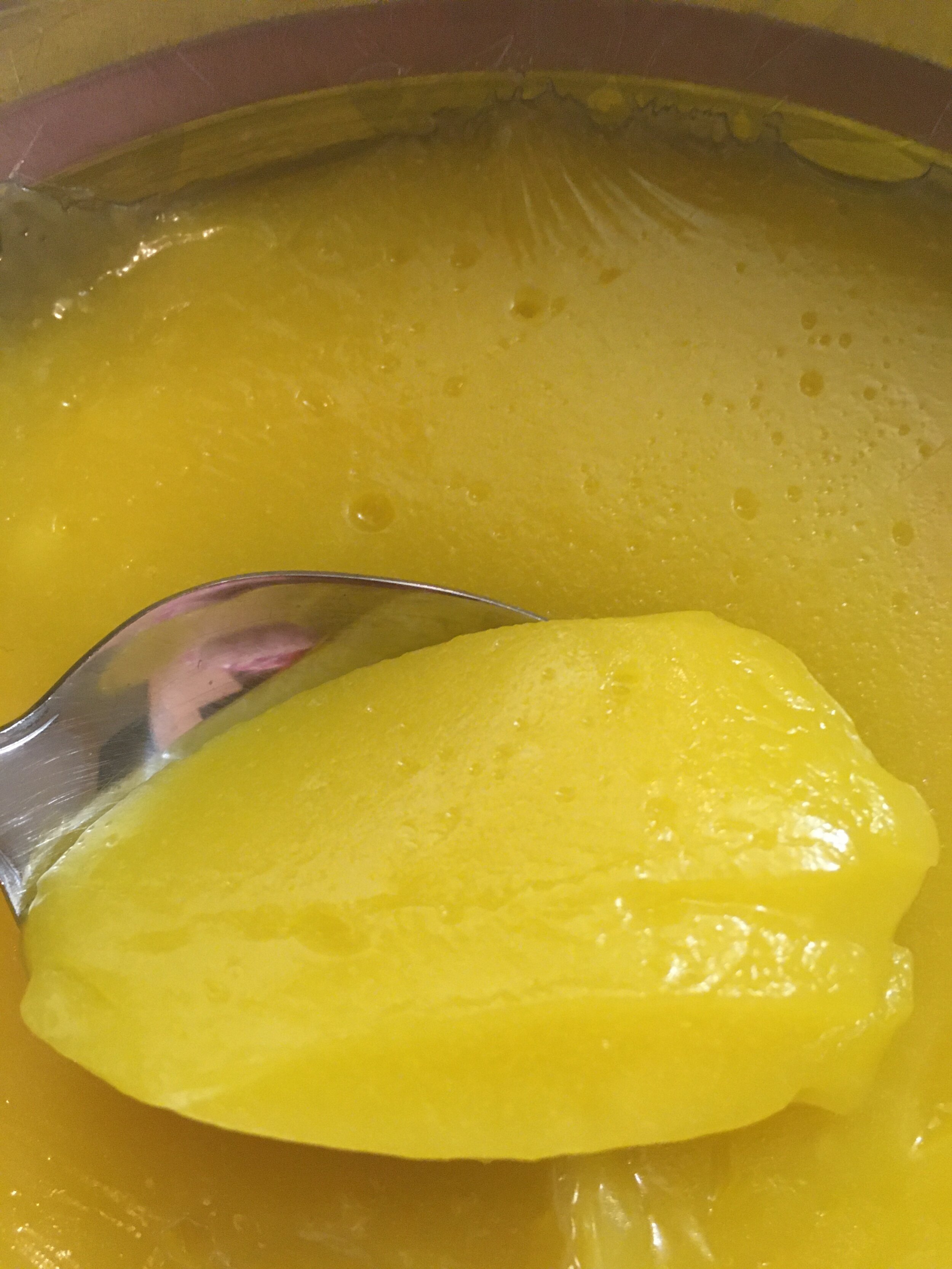
Homemade lemon curd - nice and tart with a smooth as silk texture.

Homemade lemon curd - nice and tart with a smooth as silk texture.

The brunch menu combined some wonderful Italian ingredients with some of my American standards and gave me chance to fix some of my favorite dishes.

Preparations started a couple of days beforehand with the making of lemon curd. This no-fail recipe from Fine Cooking magazine is better than any lemon curd I have ever purchased. (https://finecooking.com/recipe/classic-lemon-curd). It’s my go to recipe for a fancy brunch or tea menu. Using juicy Italian lemons makes it even better. The hardest part was setting it aside until the day of the brunch. I may have sampled just a taste (or two) beforehand.

Of course where there is lemon curd there must be scones. I prepped the dry ingredients a couple of days before; it was easy to finish the dough and bake them on the morning of the brunch. The scones and lemon curd paired nicely alongside a bowl of bright red strawberries.

EDAB3A6D-785C-4387-9814-84B45C86A2C1.jpeg

The main dish was a crustless quiche, another Fine Cooking recipe (https://finecooking.com/recipe/crustless-quiche-with-red-peppers-goat-cheese).

These small  tin foil baking dishes aren’t very elegant, but they fit nicely in my little countertop oven.

These small tin foil baking dishes aren’t very elegant, but they fit nicely in my little countertop oven.

This is a versatile recipe because it is so easy to vary the ingredients. I have only a small countertop electric oven (two steps above the Easy Bake oven I had as a kid), so I divided the quiche base into two smaller pans. In one, I used the red peppers and goat cheese from the original recipe. In the second pan, I crumbled crisp pancetta, sautéed mushrooms, and fontina cheese. My tiny oven only baked one pan at a time but, covered with foil and set on top of the oven while the second one baked, the first one stayed nice and warm. And they were delicious - soft and light as clouds. All the credit goes to this fantastic recipe - it’s a snap to make and always a hit.

I couldn’t resist the fat stalks of asparagus I found in the market. Cooked quickly and drizzled with a lemony vinaigrette they made a simple and tasty addition to the menu. Both asparagus and the quiche go well with some slightly salty prosciutto, so I added a small platter of that and the meal was complete.

Is there a better combination than fresh spring asparagus and prosciutto?   Well, maybe a summertime prosciutto with melon, but that’s a few months off yet.

Is there a better combination than fresh spring asparagus and prosciutto? Well, maybe a summertime prosciutto with melon, but that’s a few months off yet.

Well, almost complete. We were celebrating spring so mimosas made with Prosecco and orange juice made brunch even more festive.

Good company, good food, and lots of laughter. A good way to welcome spring !

April 12, 2021 /Joanne Bartram
italian food, brunch, easter italy
#springintuscany, Cooking, food, Living in Italy
This daily special at restaurant Nonna Clara caught my eye.  Cacciucco is not a common dish here in Lucca.

This daily special at restaurant Nonna Clara caught my eye. Cacciucco is not a common dish here in Lucca.

Cacciucco: An Italian Fisherman's Stew

March 29, 2021 by Joanne Bartram in Cooking, food, Italian recipes, Living in Italy

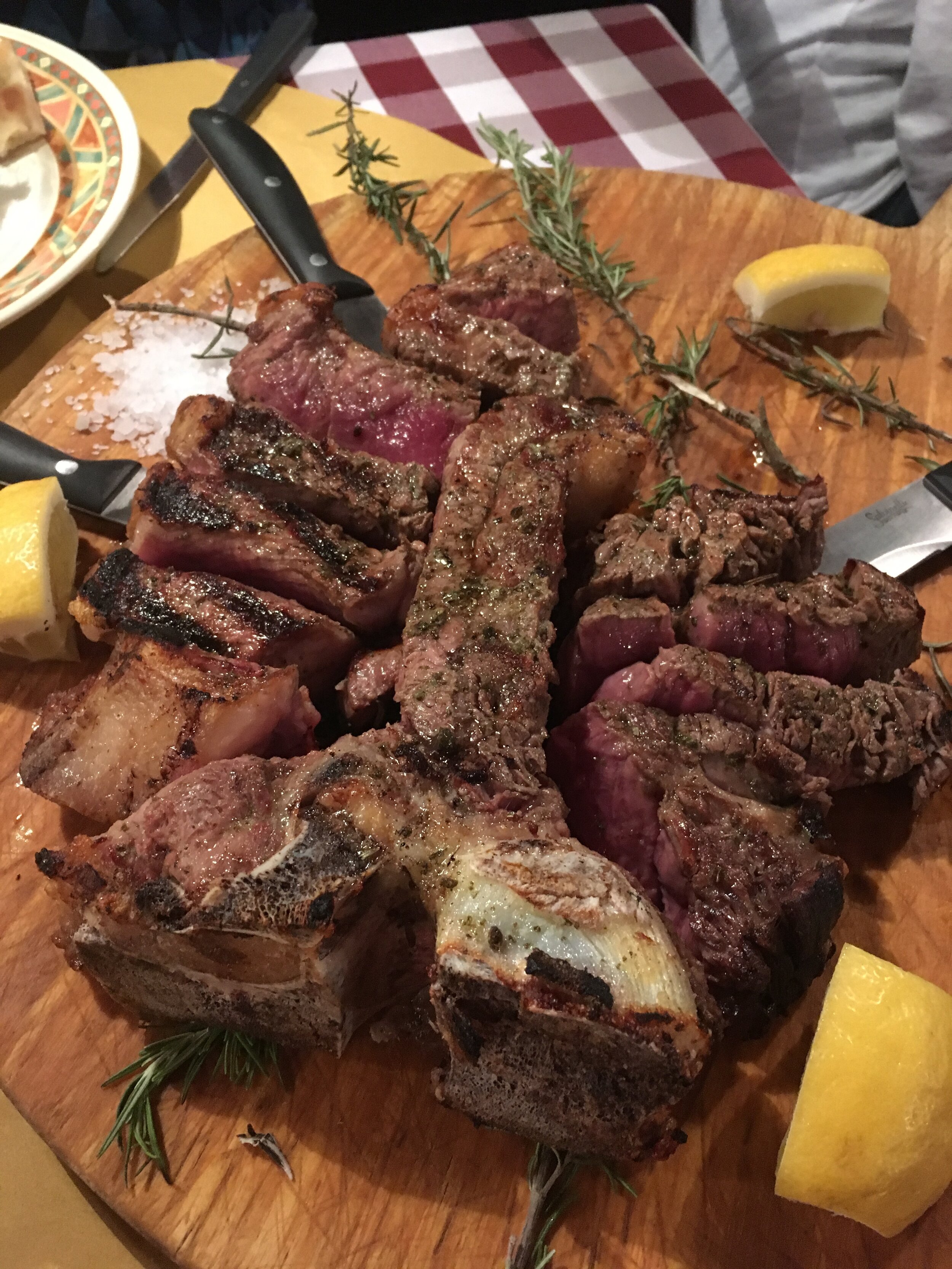
One of the things that most surprised me when I first started visiting Lucca is that, while we are only about 30 minutes from the sea, the traditional cuisine here is very meat-based. There is not a seafood market to be found within the centro storico (the historic center of town) and restaurants serve far more meat than fish. I’m not complaining, the meats are fabulous - porchetta (spit roasted pork), tender tagliata (slices) of beef, huge grilled Tuscan steaks, thin but oh-so-flavorful lamb chops, perfectly roasted chicken, cinghiale (wild boar). Even the traditional pasta of Lucca, Tordelli Lucchese, is a meat filled pasta topped with a meat sauce.

IMG_0551.JPG
IMG_6050.JPG
IMG_1347.JPG
A shellfish carbonara at Osteria Via San Giorgio, Lucca

A shellfish carbonara at Osteria Via San Giorgio, Lucca

There are some fish dishes to be found. The seafood carbonara at one local osteria is a particular favorite of mine, but these dishes are definitely in the minority.

I’ve searched for why this meat preference is so strong and the only answer I’ve found is that in times past wealthy people ate meat and poor people fished, cooking with whatever they caught. Lucca was historically a very wealthy town, so meat was plentiful and nobody fished.

That fish is less common here made it all the better when, on a recent chilly and windy March day, I walked past a restaurant take-out window advertising a daily special of cacciucco. Cacciucco is a fisherman’s stew with origins in the areas along the coastline of Tuscany which includes the port towns of Viareggio and Livorno. It is a bit like cioppino, the fish stew brought to San Francisco by Italian immigrants. However, cacciucco’s ingredients are more of a poor fisherman’s mix compared to the more expensive ingredients found in cioppino (crab, shrimp, scallops).

Cacciucco - thick with seafood and covered in a fragrant broth

Cacciucco - thick with seafood and covered in a fragrant broth

Of course there are legends surrounding the beginnings of cacciucco. It is said that the widow of a drowned fisherman made the first cacciucco from odds and ends of fish collected by her children from local fisherman. They took the mix of fish home and the mother cooked them (the fish, not the children) in a broth which she then spooned over day old bread. The neighbors caught the delicious scent and before long the dish became a local favorite. One whiff of a good cacciucco made me a believer in this legend! Another legend about cacciucco is that, to be authentic, it must contain 5 different types of fish - one for each C in the word cacciucco.

The recipe begins with a broth made from fish parts and white wine. To that base are added spices, tomatoes, and a mix of fish. The fish can include white fish along with octopus, mussels, cuttlefish, calamari, red fish, and scampi (or whatever else is available).

A mix of local seafood makes cacciucco a type of cucina povera (poor man’s food)

A mix of local seafood makes cacciucco a type of cucina povera (poor man’s food)

The ingredients vary from city to city and there is of course disagreement about which city makes the best version. According to one article I read (La Repubblica, 2010) the differences between a cacciucco in Viareggio versus one made in Livorno is that the Viareggio version is lighter and a bit more refined. There is no garlic and the fish is boned and filleted. In Livorno the dish is more rustic, including garlic and a soffritto (a sauté of onion, celery, carrot). Also, in the Livornese version, the fish is in chunks, including some pieces with bones.

If the sight of tentacles, scampi with heads, and fish bones bothers you then this may not be the dish for you. As for me, those little tentacles are tender and tasty and all the bits of fish are wonderful. Even better is mopping up the broth with a good piece of rustic bread.

If you’ve been watching the CNN program “Stanley Tucci Searching for Italy”, you may have seen him eating a cacciucco in Livorno during the Tuscany episode. That was definitely an upscale version, with the addition of lobster. Rather than mopping up the sauce with bread they tossed the leftover sauce with some pasta. Something to try!

This is not a dish I’d ever attempt to make at home. But I think I am going to have to make a pilgrimage to both Livorno and Viareggio as soon as possible to compare the two versions, all in the name of culinary research of course.

With restaurants closed to seating due to COVID restrictions, these take out windows are becoming more popular.  This one is in front of the restaurant Nonna Clara in Lucca.  Along with the street food some items from the regular menu are available …

With restaurants closed to seating due to COVID restrictions, these take out windows are becoming more popular. This one is in front of the restaurant Nonna Clara in Lucca. Along with the street food some items from the regular menu are available to go, including this day’s special of cacciucco .

March 29, 2021 /Joanne Bartram
italian seafood, cacciucco, italian food
Cooking, food, Italian recipes, Living in Italy
Frittelle di San Giuseppe

Frittelle di San Giuseppe

Frittelle for San Giuseppe

March 22, 2021 by Joanne Bartram in Festivals Italy, food, Italian culture, Living in Italy, Lucca

Italians must be the world champions of celebrations. There seems to be a festa (party) or a celebration for just about every occasion - saint’s days, onomastic (name) days, major religious holidays, national holidays, birthdays, sagras to celebrate regional foods. When you live in Italy, you festiggiare (celebrate) all of life’s special events. It is one of the things I love about living here. As an added bonus, many of these events include special foods. And although the pandemic has for the last year limited gathering for most of these events, small celebrations and culinary specialities continue to mark the occasions.

IMG_1621.jpeg

March is generally a quiet month in terms of celebrations. Epiphany is long over, the Carnevale season has ended (and this year it was cancelled almost entirely), Easter is not yet here. Food wise, the Carnevale sweets are gone and Easter cakes and chocolates are just beginning to show up in shop windows.

But all is not lost! In mid-March there is the Feast Day of San Giuseppe. It is the official onomastic day for the name Giuseppe and so a special day for anyone who carries that moniker. Because of San Giuseppe’s religious role as a father, the Feast of San Giuseppe has also become the Italian Father’s day. And … falling on March 19th it is also on the cusp of the spring equinox. Certainly this day deserves a special culinary treat!

A frittella makes a perfect sugary treat

A frittella makes a perfect sugary treat

To mark the day, pastry shops across Lucca are filled with Frittelle di San Giuseppe. Frittelle are delicious! A sweet batter, often flavored with a bit of lemon peel, is dropped by spoonfuls into hot oil (fritta = fried), filled, and then rolled in sugar. The traditional filling in Lucca is riso (a second cousin to rice pudding but more firm). Other varieties include chocolate, Nutella, and (my personal favorite) a delicious pastry cream. Some are vuoto (empty) with no filling to distract from the sugary treat.

Frittelle are crisp and sugary outside, light and often cream filled inside.  Yum!

Frittelle are crisp and sugary outside, light and often cream filled inside. Yum!

It was hard work having to taste test frittelle before writing about them, but I made the sacrifice. Crisp on the outside with a slight crunch from the sugar crystals, airy dough on the inside, and a delicious eggy custard filling. Scrumptious. In fact, I just may need another one to go with my coffee this afternoon. I think I’ll invite a friend to share !

IMG_1589.jpeg
March 22, 2021 /Joanne Bartram
frittelle, feast San Giuseppe, Italian dolci
Festivals Italy, food, Italian culture, Living in Italy, Lucca
Piazza dell’Arancio (Piazza of the Orange Tree) in Lucca, late February 2021

Piazza dell’Arancio (Piazza of the Orange Tree) in Lucca, late February 2021

The Many Meanings of "Orange" in Italy

February 22, 2021 by Joanne Bartram in food, Italy, Italian recipes

It’s funny how the meaning of a word can change depending on language and context.

In English, the word orange can mean either the color or the fruit. In Italian it is a little more complicated. The fruit is arancia, the orange tree is arancio, and the color is arancione.

Winter is the season for arance (oranges, plural) in this part of northern Italy. They grow bright and juicy on big trees or on smaller trees in large terra-cotta pots.. There is even one growing in a small piazza in Lucca, appropriately named the Piazza dell’Arancio (top photo).

This large orange tree grows a few steps from my house.  In the background is the Torre Guinigi (Guinigi Tower).

This large orange tree grows a few steps from my house. In the background is the Torre Guinigi (Guinigi Tower).

More interesting, and with deeper meaning, is what the word arancione has come to mean in terms of risk throughout Italy. Again, it has more than one meaning, both of which carry a warning.

Stormy weather ahead !

Stormy weather ahead !

An “allerta meteo codice arancione” (code orange weather alert) is used when storms threaten with dangerous conditions (heavy rain, wind, hail, thunderstorms, floods, etc). We’ve seen a lot of that this winter. The area where I live has a system that automatically sends a text warning when orange weather conditions are predicted. There are also a less severe yellow (giallo) warnings and more severe red (rosso) alerts for weather. It definitely gets my attention when my phone beeps with one of these messages.

The newest meaning of arancione, and the one that gets the most reaction from me, relates to COVID restrictions.

IMG_3907.JPG

The colors are the same as for weather - giallo (yellow, least restrictive), arancione (more restrictive including no indoor seating in bars and restaurants, closure of museums, and no travel outside of one’s home city), and rosso (red, most restrictive, stay home except for essential activities).

After about 5 weeks in the yellow zone, Tuscany was placed back into the orange zone on February 14th. The change was due to an increase in COVID cases and the threat associated with several COVID variants which have now arrived in Tuscany. The word arancione is definitely a trigger for me in this context, a less than happy color. But still preferable to the color red!

On a much happier orange note, I was delighted to receive a gift of some preserved orange slices just after the holidays. They went a long way towards restoring my appreciation for the word orange.

Dried oranges make a beautiful display at Gino Bistro in Lucca

Dried oranges make a beautiful display at Gino Bistro in Lucca

In a clear gift bag, tied with a ribbon, were glistening rounds of blood oranges, glazed with sugar and slightly dried. Beautiful to look at, but I had no idea how to use them. The friend who gave them to me suggested they would be wonderful in a cup of tea. She was right and that has become a cold weather evening ritual for me. She also suggested using them in a hot toddy. A hot toddy! What a perfect way to warm up on a stormy winter evening. It is said that hot toddies might even have medicinal properties - perhaps one will scare away any lingering viral particles.

Yw8Xl6VDRsWwMYDxjTodTQ.jpg

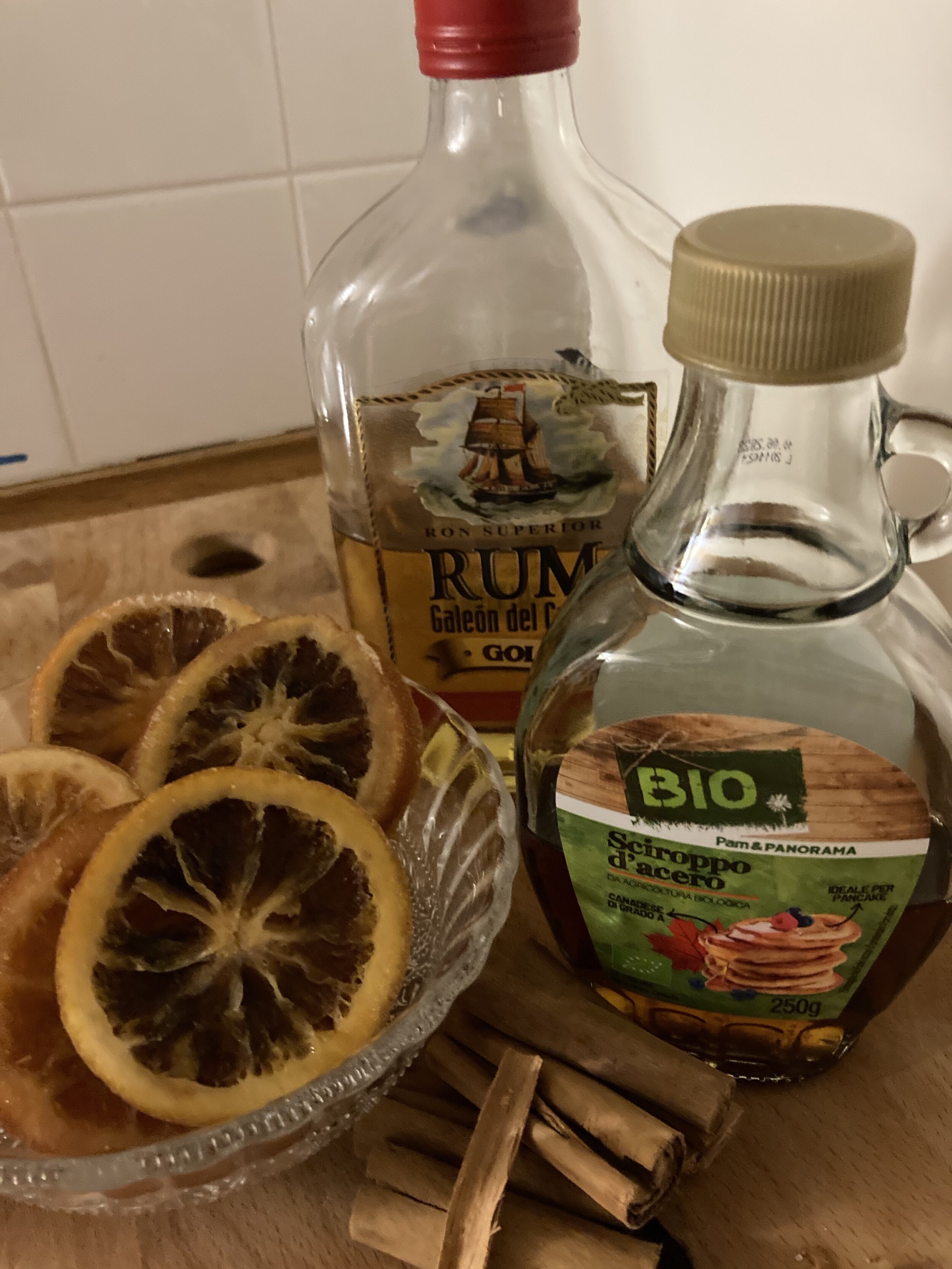
The search was on for a recipe and there were endless varieties. A true toddy starts with alcohol - bourbon, Irish whisky, rum or brandy. The common theme seems to be a dark colored liquor as opposed to clear ones like vodka or gin. Next comes a sweetener. Most often that is honey but some recipes use white or brown sugar, simple syrup, or (my personal favorite) maple syrup. Lemon is the next typical ingredient but here is where I substituted those beautiful rounds of preserved orange. I’ve tried it both ways and found that I like the orange slices even better than a fresh lemon slice. To my mind, using Italian preserved blood orange slices makes this it an Italian hot toddy, even if I could not find a translation for the word toddy in any of my Italian dictionaries.

To the above ingredients some boiling water or black tea is added - that’s what puts the hot in hot toddy. Those are the essential ingredients but there are many extra “add-ins” - cinnamon sticks, cloves, star anise, ginger, even chile. The variations are endless.

I was happy with the following very easy recipe: In a small mug (a 6 ounce coffee mug works perfectly) combine: 2 tablespoons of dark rum and 1 tablespoon of maple syrup. Add 1 slice of dried, sugar glazed orange and muddle it a bit to release the flavor. Next, fill the mug with boiling water or hot black tea and add 1 cinnamon stick. Using water makes the rum flavor more prominent, using tea mellows the taste of the rum. I like it both ways. Simple, tasty, and guaranteed to warm you up on a cold evening, especially if you are in the orange COVID zone with an orange alert storm howling outside.

Orange spiced hot toddy - che buono !

Orange spiced hot toddy - che buono !

February 22, 2021 /Joanne Bartram
hot drinks, orange zone italy, COVID italy, hot toddy recipe, #hot toddy, #oranges
food, Italy, Italian recipes
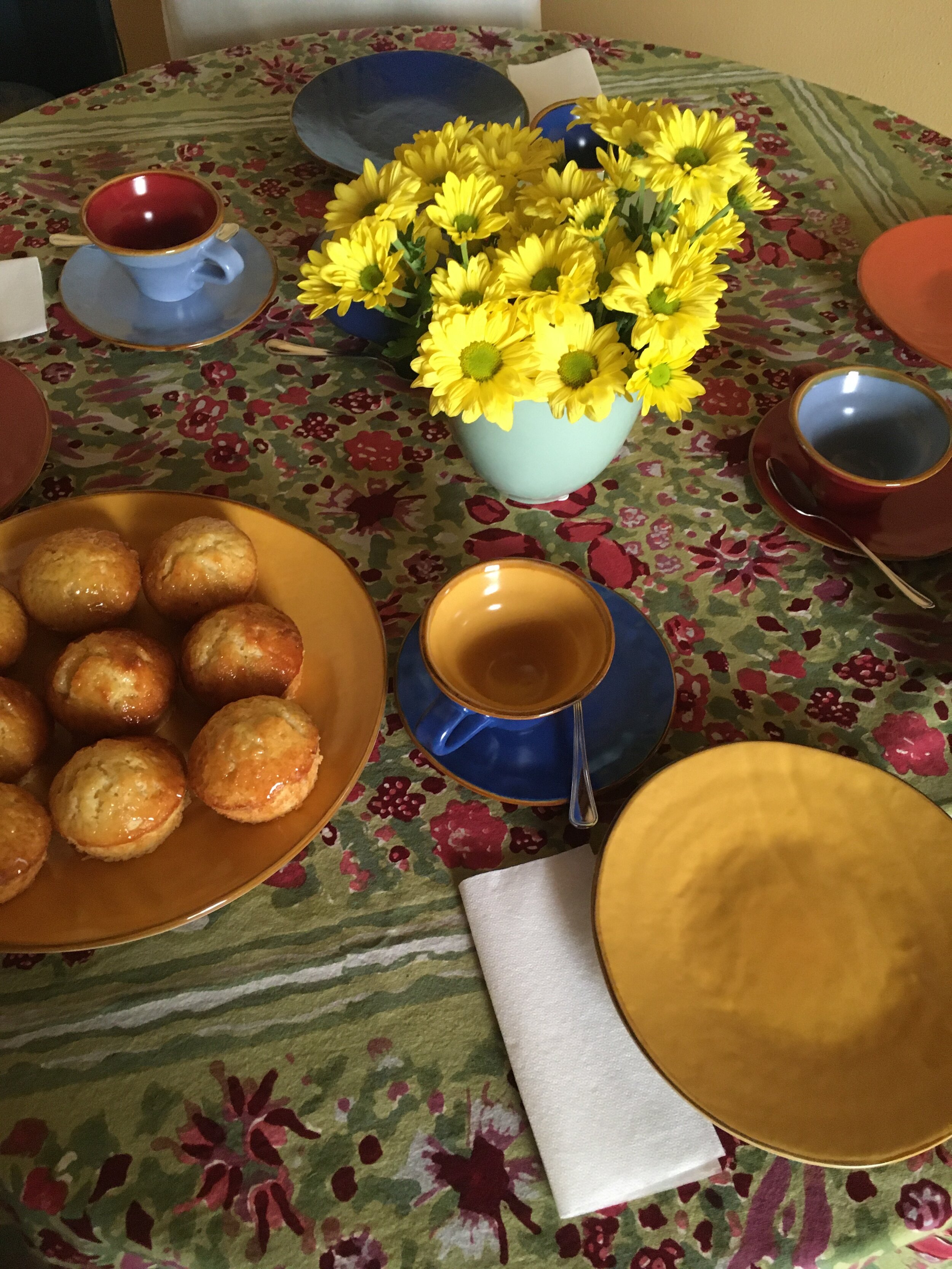
The table is set in Italy for a morning coffee with a pretty tablecloth, flowers, and the colorful handmade Italian stoneware dishes that came with my furnished apartment.

The table is set in Italy for a morning coffee with a pretty tablecloth, flowers, and the colorful handmade Italian stoneware dishes that came with my furnished apartment.

From My Italian Kitchen: Muffins

September 21, 2020 by Joanne Bartram in Cooking, food, recipes

We’ve all missed things during the last challenging months – family, travel, hugs (that’s a big one!), and getting together with friends to name a few.   One of the things I’ve missed most is entertaining. Having friends over to my home, gathering interesting people around my table, is one of my favorite things to do. I take great pleasure in the preparations - working in the kitchen (baking, chopping, stirring = culinary therapy). I also enjoy picking out just the right dishes, arranging flowers, and setting a pretty table in anticipation of guests arriving.  How I’ve missed this during the months when we were not allowed to have people over to our homes! Luckily, those times are past and now we can open our homes to friends – as long as the groups are small and everyone is well.  Social distancing means I can fit only 2 or 3 guests around my table. That size group is perfect for one of my favorite ways to entertain – the morning coffee or brunch.  

For me, morning gatherings always call for muffins, whether I’m baking in my tiny Italian kitchen or my slightly larger one in New Mexico.  

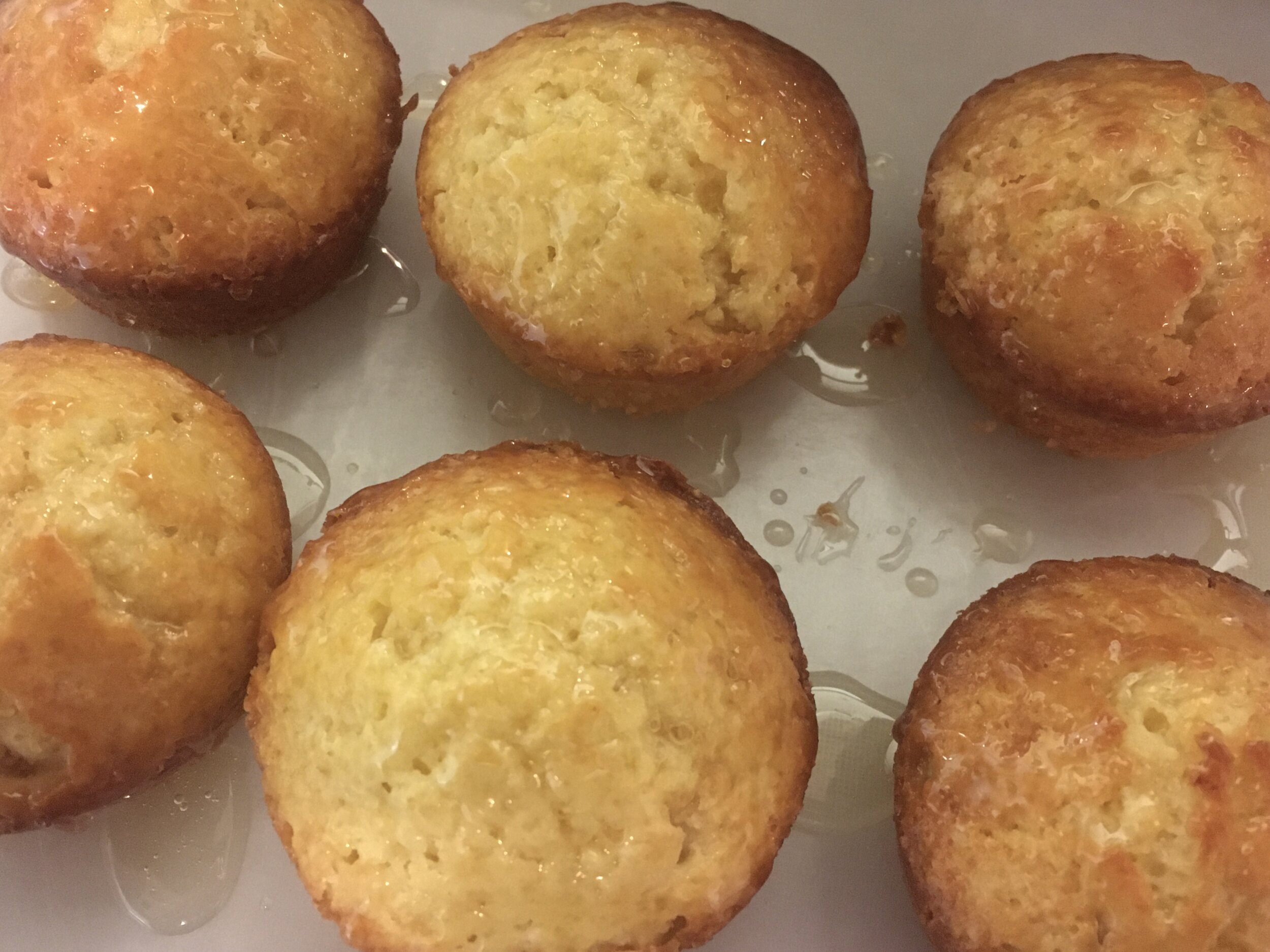
Lemon glazed muffins - my favorite.

Lemon glazed muffins - my favorite.

I almost always start the menu with muffins, add a pretty bowl of fruit, perhaps some yogurt or an egg dish.  Combine with coffee, tea (perhaps a mimosa), plus a couple of good friends and you’ve got the perfect socially distanced morning get together.  Since I’ve hosted brunches in both Italy and New Mexico this summer, both featuring muffins, I thought I would share some of my favorite recipes. 

Summer ripe strawberries with a little sweetened cream cheese go well with the lemon glazed muffins

Summer ripe strawberries with a little sweetened cream cheese go well with lemon glazed muffins

 First up, Lemon Glazed Muffins. I think of these as Italian muffins, both because the bright lemony flavor reminds me of summer in Italy and because I made them for the first time in the toaster oven in my tiny Italian kitchen. The recipe is adapted from a lemon quick bread; with some small changes it became muffins. The recipe makes a dozen, but is easily halved to make 6. It is hands down my favorite muffin!

 1 medium lemon (pick a juicy one!)  You’ll need the grated zest and 4 ½ teaspoons of juice.

1 ½ cups flour

1 teaspoon baking powder

½ teaspoon salt

1 cup sugar (plus another 2 tablespoons for the glaze)

½ cup butter

2 eggs, slightly beaten

½ cup whole milk + 1 -2 tablespoons

 Preheat oven to 350 degrees. Prepare a muffin pan (don’t use paper cups  – they don’t work well with the sticky lemon glaze)

Grate the peel from the lemon and squeeze for juice, set both aside for now.

Combine flour, baking powder, salt, and sugar in a medium size mixing bowl.

Cut in the butter to make coarse crumbs and then stir in the grated lemon zest.

 Beat the eggs slightly and add the milk. Stir the egg/milk mixture into the dry ingredients to moisten. (if too dry, add another tablespoon or two of milk).

Spoon batter into a prepared muffin pan and bake for about 25 minutes until tops are just golden.   Cool 5-10 minutes on a rack and then carefully remove from the muffin tin.

 Mix the reserved lemon juice with 2 Tablespoons sugar.  Bring to a slow boil, cook and stir until slightly thickened, about 5 minutes.  Brush the tops of each muffin generously with the lemon glaze.   These are good while still warm or when cooled to room temp. 

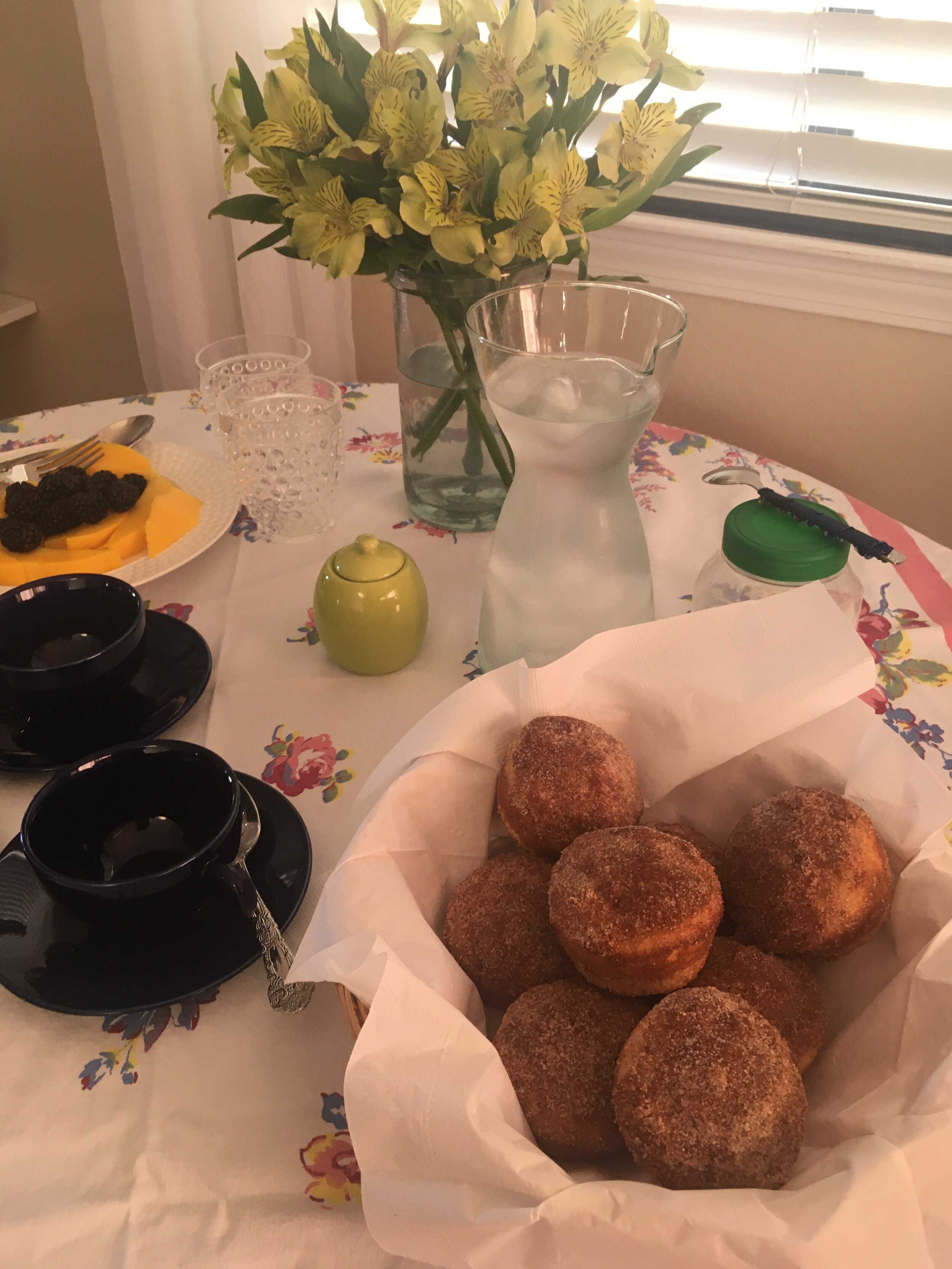
Another coffee get together - this time in New Mexico - with sugar crusted muffins and a plate of mango with blackberries. Yum!

Another coffee get together - this time in New Mexico - with sugar crusted muffins and a plate of mango with blackberries. Yum!

 Next, Sugar Crusted Muffins. I’ve been baking these muffins for over 50 years.  Really!  The recipe dates back to my 8th grade home economics class.  Since then I’ve made them countless times and have adapted the recipe to make blueberry muffins as well. If only my 8th grade teacher could see me now!    The recipe makes 9 generous or 12 smaller muffins.

1 ½ cups flour

2 teaspoons baking powder

½ tsp salt

½ cup sugar

¼ cup butter, melted.  (plus another ¼ cup melted butter for dipping the baked muffins)

½ cup whole milk + 2 tablespoons

1 egg, slightly beaten

additional sugar and cinnamon for topping

Preheat oven to 400 degrees.  

 Sift flour, add baking powder and salt; resift and add sugar.

Combine melted butter with milk and beaten egg, beat slightly and add to dry ingredients. Mix just to moisten.

Spoon batter into prepared muffin tin.  Bake for 15-20 minutes until the tops are firm and golden brown.

When cool enough to remove from pan, dip the top of each muffin into the melted butter (1/4 cup) and then into a small bowel with a sugar – cinnamon mixture (½ cup sugar and 1 tablespoon cinnamon).  


The cinnamon and sugar topping make these muffins the perfect treat for morning coffee.

The cinnamon and sugar topping make these muffins the perfect treat for morning coffee.

Blueberry Muffin Variation:  Use ¾ cup buttermilk, cut in the butter rather than using melted butter, add a big scoop of blueberries.  After spooning into the muffin tin (and before baking) sprinkle the tops with a little demerara sugar for extra sparkle and crunch. Doubling the recipe makes 1 and 1/2 dozen muffins.

Blueberry muffins were the star, alongside strawberries, for a brunch in New Mexico just before I left to return to Italy.

Blueberry muffins were the star, alongside strawberries, for a brunch in New Mexico just before I left to return to Italy.

 With fall quickly approaching, it’s the perfect time to fire up the oven and do some baking.  I’m looking forward to sharing my next batch of muffins with friends, especially now that I am back in Lucca after a couple of months in the United States.  And remember, in Italian the word for muffin is … muffin!


September 21, 2020 /Joanne Bartram
recipes, muffins, #muffins
Cooking, food, recipes
  • Newer
  • Older

Powered by Squarespace