Two Parts Italy

Exploring Italy, travel, and living a flavorful life

  • Blog
  • About This Blog
  • Start Here
  • Recent Posts
  • Archives by Topic
  • Subscribe
  • Contact me

Wandering through the back alleys of Venice on the way to Cantina Do Spade, a classic Venetian spot for cicchetti.

Craving Cicchetti

March 10, 2025 by Joanne Bartram in #italytravel, food, Italian culture, Living in Italy, Venezia, Venice, Veneto

Sometimes, when planning an evening out, someone will ask where I would like to go for dinner.  Often a local restaurant (whether I am in Lucca or back in New Mexico) sounds just right. But other times the place I want, the flavors I crave, are far, far away.  And nothing else will do. Right now, what I am craving is some really good cicchetti. 

The word cicchetti does not have an exact English translation.  Not to mention it may be second only to bruschetta as the most mis-pronounced Italian culinary word.   Let’s start there – the “ci” in Italian is pronounced like the English ”ch”, and the “ch” in Italian is a hard sound, like an English K.  So, pretty much backwards from English.  And those double consonants are drawn out. So, for an English speaker, cicchetti is pronounced something like this:  chik-KET-tee.  Cicchetti. Yum.

A plate of assorted cicchetti from Bacaro Frascoli in Padova. Fried cheese wedges, a tuna croquette, a cheese and caponata crostino, some fried anchovies, and - my favorite - baccalà mantecato .

The closest translation to the word cicchetti would be the Spanish word tapas. Or perhaps small bites or little side dishes.  A bruschetta can be a type of cicchetti as can miniature panini. Both cold and hot little dishes can be cicchetti. Put a bunch of these tasty little bites together, add a glass of wine, and you have dinner.  

All’Ombra della Piazza in Padova has a wonderful cicchetti bar with a seemingly endless variety from which to choose. No problem going back for seconds!

Bacari, or wine bars, serving cicchetti, are a Venetian tradition. They can be found in wonderful hidden corners of Venice and in some of the nearby towns of the Veneto, such as Padova.   Just about 4 hours by train from Lucca, a visit to either place is sure to include a stop for cicchetti at a local bacaro or cantina. It is a sure bet that the atmosphere will be lively, the wines good, and the variety of cicchetti will make it hard to choose.

It is no surprise that, like many Venetian dishes, cicchetti often feature fish. The classic version is a small piece of toasted bread topped with baccalà mantecato, a creamy, whipped salted cod.  Mixed with good olive oil, it is a simple but oh so good dish.

Sardines are often on the menu too, fried and in a vinegary dressing or just served fried and hot. 


Also classic are polpette, little fried croquettes made of meat or fish.   Some versions include potatoes mixed with cheese, meat, or fish. 

At Cantina Do Spade there were many types of fried cicchetti to try.

Hot dishes of a couple of spicy shrimp or a single flavorful scallop are on the menu too. Not a fish fan?  Well there are also fried olives or crostini topped with assorted ingredients – cheese, caponata, pumpkin, caramelized onions, lardo, salumi. The selections are endless and change over the course of an evening because as fast as they are eaten they are replaced with something new and different!

The cicchetti bar at Cantina Do Spade is tiny (though there is a bigger restaurant in the back). We were fortunate to find 4 seats!

A bacaro is typically small with limited seating or sometimes no seating at all.  Head to the bar, pick out an assortment of cicchetti, order a glass of wine and either stand at the bar or head outside to enjoy your dish perched on a bench or a canal wall.  If you arrive right when the place opens you just might snag one of the few seats. This was the case at Cantina Do Spade in Venice when some friends and I enjoyed a plate (ok, several plates) of cicchetti and a glass (maybe two) of wine. 

I am in Lucca now, far from my favorite cicchetti places in Padova and Venice.  I’ll have an aperitivo with friends tonight, but the little bowls of peanuts and potato chips they’ll serve will leave me longing for a good bacaro and some of my favorite varieties of cicchetti.   Time to plan a couple of days in the Veneto!

A selection of cicchetti at All’Ombra della Piazza in Padova. Most of their selections on the night we visited were crostini topped with cheese plus a variety of toppings. It was impossible to choose a favorite.

Cantina Do Spade S. Polo 859 Venezia

All’Ombra della Piazza Via Pietro d’Abano 16. Padova

Frascoli Bacaro / Cicchetterai Veneziana. Via del Santo 93. Padova

March 10, 2025 /Joanne Bartram
cicchetti, Venetian cicchetti, Venetian food, bacaro
#italytravel, food, Italian culture, Living in Italy, Venezia, Venice, Veneto

Risotto with Pumpkin and Sausage

February 24, 2025 by Joanne Bartram in #italiancooking, cooking Classes Italy, Fall in Italy, food, Italian recipes

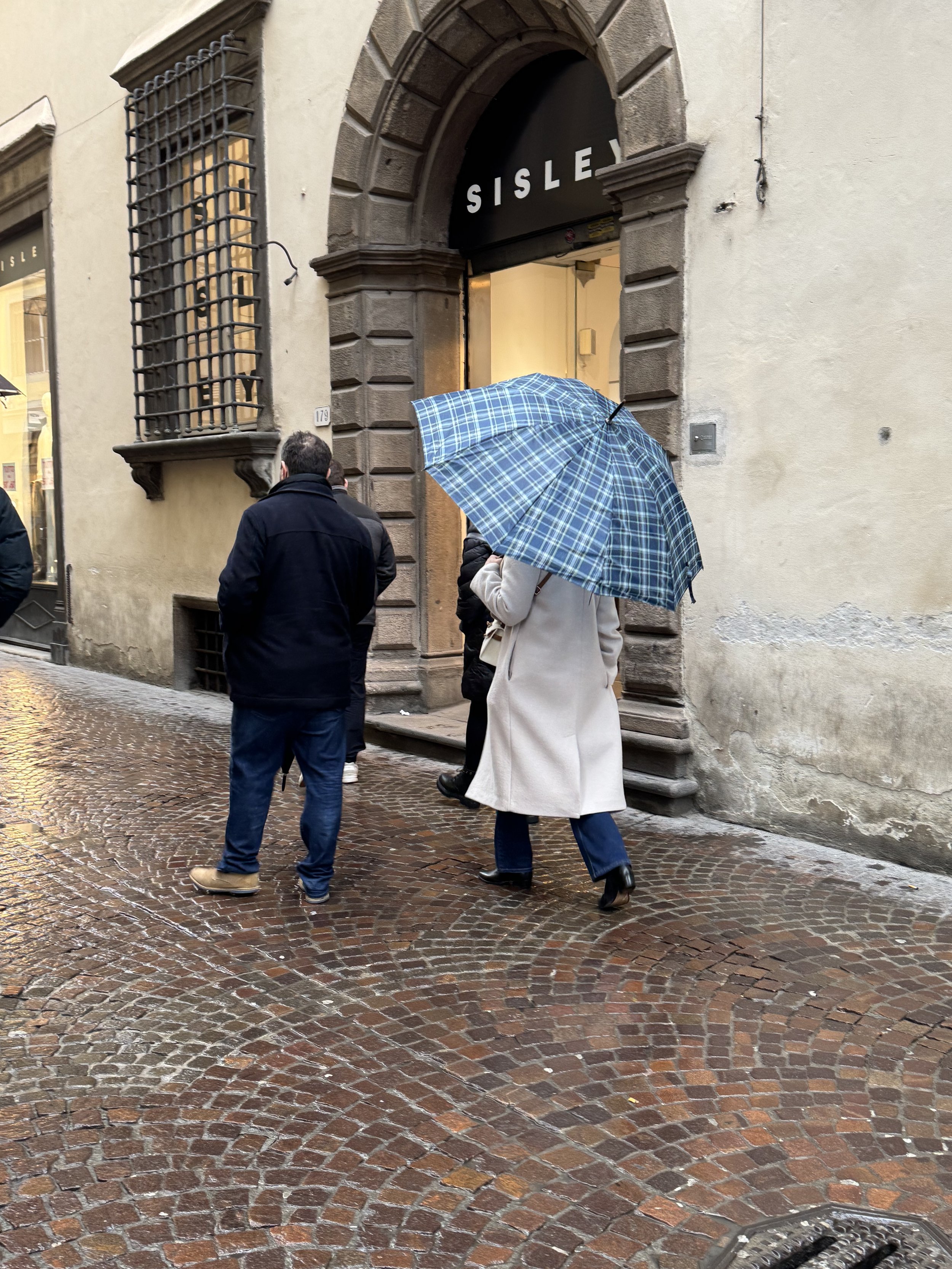
Rainy days are numerous in Lucca this month. But with an ombrello in hand we just go about our days.

After a few days of clear weather, just enough to tempt us to think about spring, we are back to cloudy wet weather here in Tuscany. My weather app has me prepared for several rainy days in a row this week. I hope the app is wrong (as it often is), but the rainy forecast has me in the mood for some Italian comfort food. For me, that means risotto.

Rice is not the first thing that pops into most people’s mind when thinking of Italian food. Rice may not have been native to Italy, but since arriving along ancient trade routes from the East it has become a staple. Northern Italy, especially the Po Valley, is an ideal setting for growing rice. Flat land and lots of water are key. And that is a good thing because rice, in the form of risotto, is a very popular dish in northern Italy.

The short, plump grains with a high starch content in Riso Nano Vialone make for a delicious creamy risotto with a “loose” consistency.

There are three main types of rice used in risotto - Carnaroli and Arborio are likely the ones most non-Italian cooks have heard of and they are the ones I first learned to use. But, In a recent cooking class at Extra Virgin Cooking, Chef Giuseppe introduced our group to a third type, Nano Vialone Veronese, which he explained resulted in an especially creamy texture. He wasn’t kidding! The risotto con fungi (risotto with mushrooms) we made in class that day was wonderful with great flavor and a perfect creamy texture. Since then, Nano Vialone Veronese has become my go to risotto rice.

Risotto has many variations, both regional and seasonal. In Lucca, at this time of year, pumpkin and sausage take center stage. I first tasted this combination at Trattoria Gigi and immediately set out to make a version at home. It is the perfect comfort food for a rainy February day. Here is my version of Risotto con Zucca e Salsiccia (Risotto with Pumpkin and Sausage). Here in Italy it is easy to find already peeled and cubed pumpkin in the markets which speeds the preparation of this dish. I sneak in a little French Calvados for a bit of a flavor twist, but white wine works just as well.

Ingredients are important. I first developed this recipe using Carnaroli rice, which works just fine. For a creamier texture, I now prefer Nano Vialone Veronese rice.

Ingredients:

Delicately sliced leeks add wonderful flavor to this risotto

2 cups raw pumpkin, in small cubes.

5 teaspoons Extra Virgin Olive Oil (EVOO), divided

1 leek cleaned, cut in half lengthwise, and thinly sliced (about 1 cup)

1 ¼ cups risotto rice ( Nano Vialone Veronese, Carnaroli, or Arborio)

3 Tablespoons Calvados or white wine

3 ½ cups vegetable broth

¼ teaspoon Kosher salt

1/8 teaspoon white pepper

Roasting the pumpkin is key to developing its flavor.

300 grams sausage, crumbled and cooked through.

2 Tablespoons butter

Toss the cubed pumpkin with 2 teaspoons EVOO and roast at 400 degrees F for ~ 20 - 25 minutes (until tender). The smaller the cubes the faster it will be done. Set aside.

Sautè sliced leek in 2 teaspoons EVOO until tender.  Add 1 teaspoon more of EVOO to the leeks, followed by the rice.  Toss the rice to coat with oil and then toast lightly for 3 or 4 minutes.

 Add the Calvados or wine and stir while it evaporates.

Pour 1 cup of hot vegetable broth into the rice, bring to a simmer.  At this point you can cover the pan and turn off the heat, allowing the rice and broth to sit for up to an hour or so.

When ready to finish the risotto, add a second cup of hot broth and bring the rice back to a simmer.   Over low heat, stir until the broth is absorbed.  Continue to add the rest of the broth (up to 1 ½ more cups) in ½ cup portions, stirring until each addition is absorbed and rice is tender.

With the last addition of broth, add the cooked sausage and small cubes of the roasted pumpkin to the risotto.  Cook and stir until the broth is absorbed and the risotto has a creamy texture.

IMG_1206.jpeg
IMG_6570.JPG

Stir in 2 Tablespoons of butter.   Serve immediately.   A little sprinkle of parmigiano reggiano cheese is nice when added at the table. A crisp white wine pairs well with this risotto. Buon appetito!

February 24, 2025 /Joanne Bartram
risotto with pumpkin and sausage, Risotto, risotto rice varieties
#italiancooking, cooking Classes Italy, Fall in Italy, food, Italian recipes

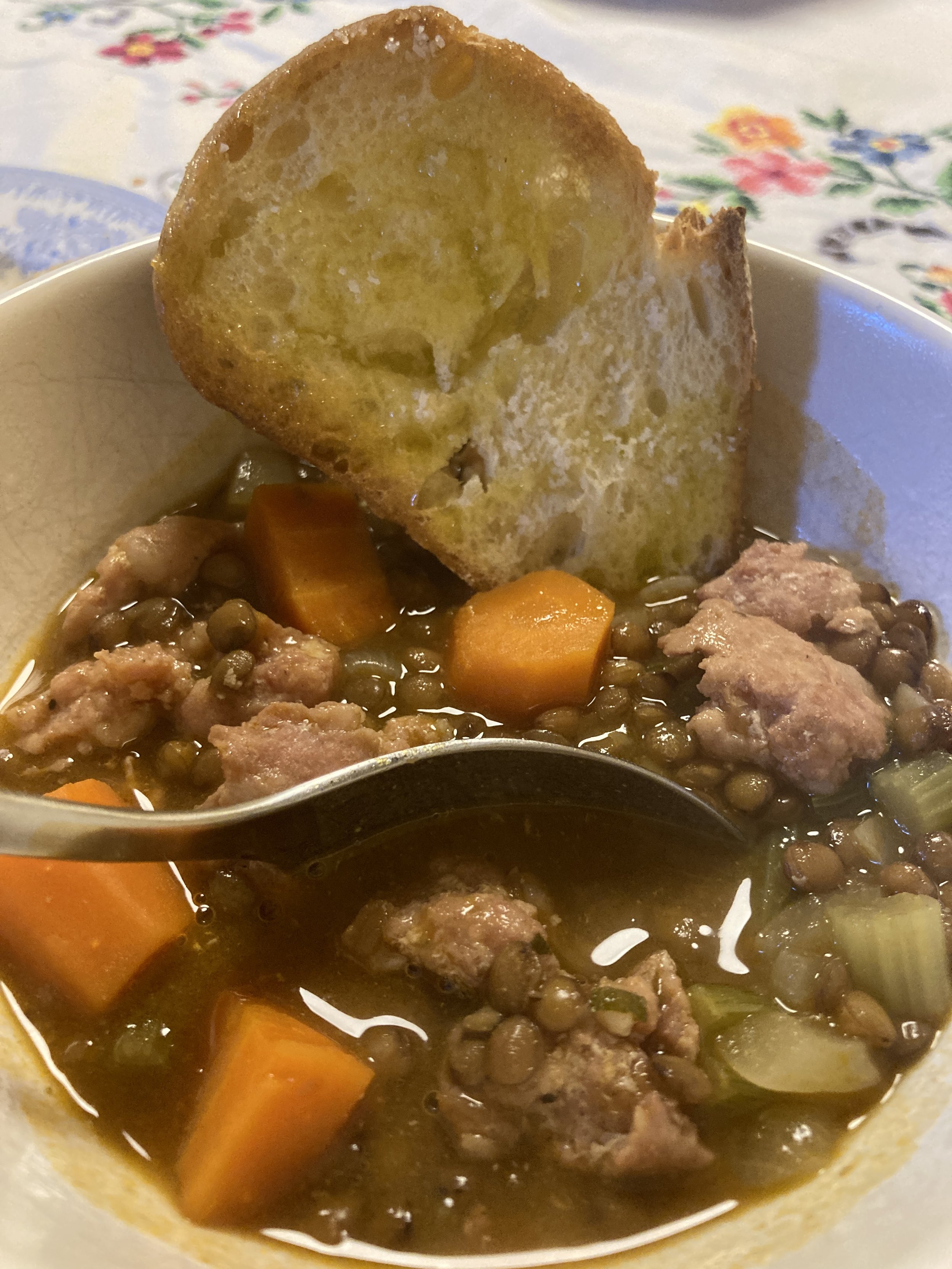
Rich with vegetables and sausage, this lentil soup is sure to bring good fortune in the new year.

From My Italian Kitchen: Lentil Soup for the New Year

December 30, 2024 by Joanne Bartram in #italiancooking, food, Italian culture, Italian recipes, Living in Italy

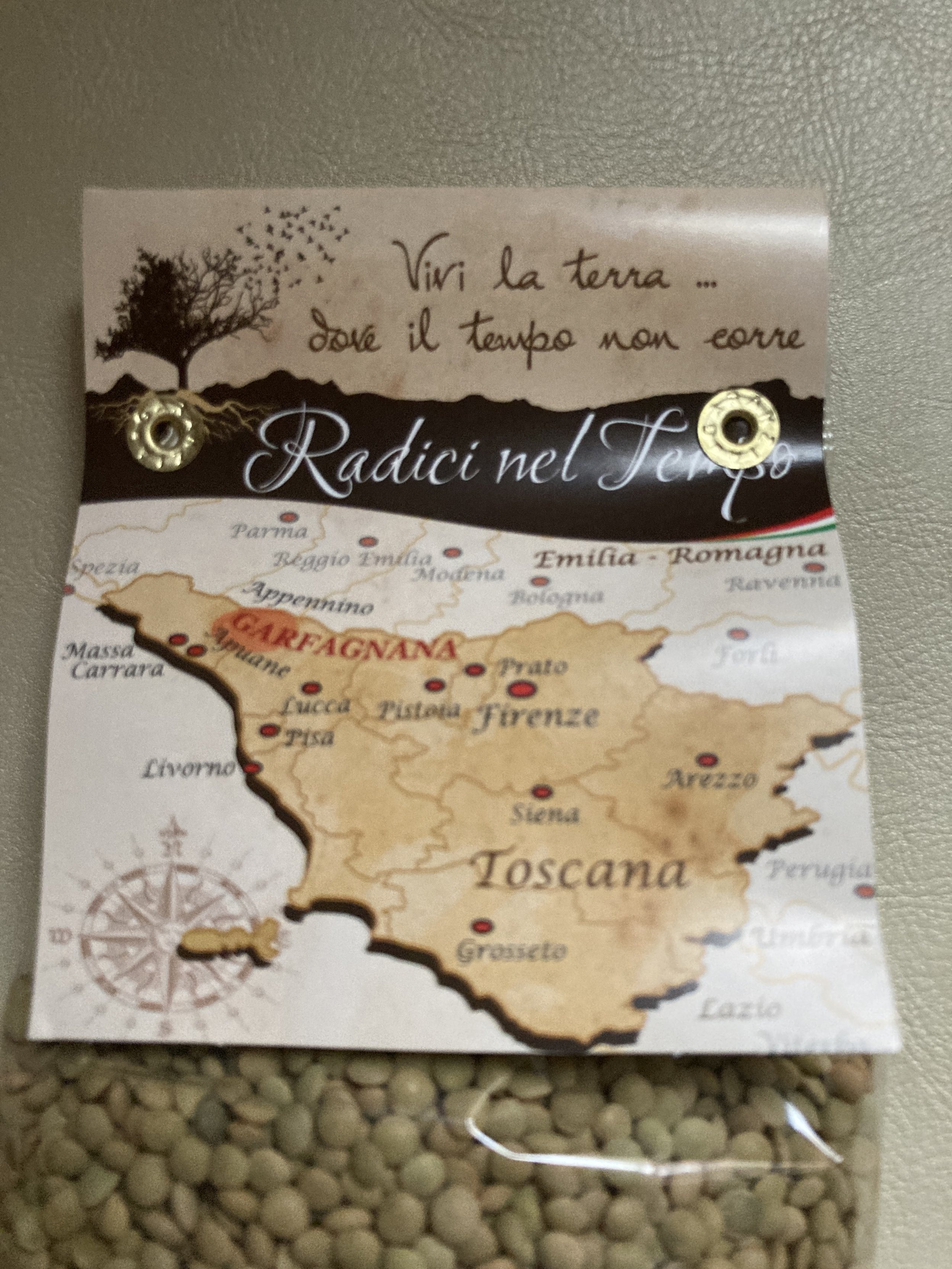
Tiny green lentils, grown near Lucca in the Garfagnana are my choice as a base for lentil soup

Lentils (Lenticchie in Italian) are a traditional food in Italy at the New Year.  The round shape resembles a coin and those tasty little coins portend fortune in the new year.  And who couldn’t use that?

Since I love soups, my Italian new year tradition is a rich lentil soup filled with veggies and sausage.

 For this soup, the perfect lentils (both for texture and flavor) are the tiny green ones. Here in Italy I use ones from the Garfagnana, the area of Tuscany northwest of Lucca.


In the US, finding imported Italian lentils may be a challenge, but some type of tiny green ones can often be found in the supermarket.  They work almost as well as Italian ones in this soup.  Do they bring Italian fortune?  Hmm.  That I can’t guarantee.

Simple crostini are perfect alongside this soup. Good bread toasted, good EVOO, a rub of garlic and a sprinkle of salt are all you need.

Simple crostini - thin slices of toast rubbed with garlic, drizzled with really good extra virgin olive oil, and sprinkled with a touch of salt - makes the perfect accompaniment for this soup.

Here’s my recipe:

Zuppa di Lenticchie (Lentil Soup)

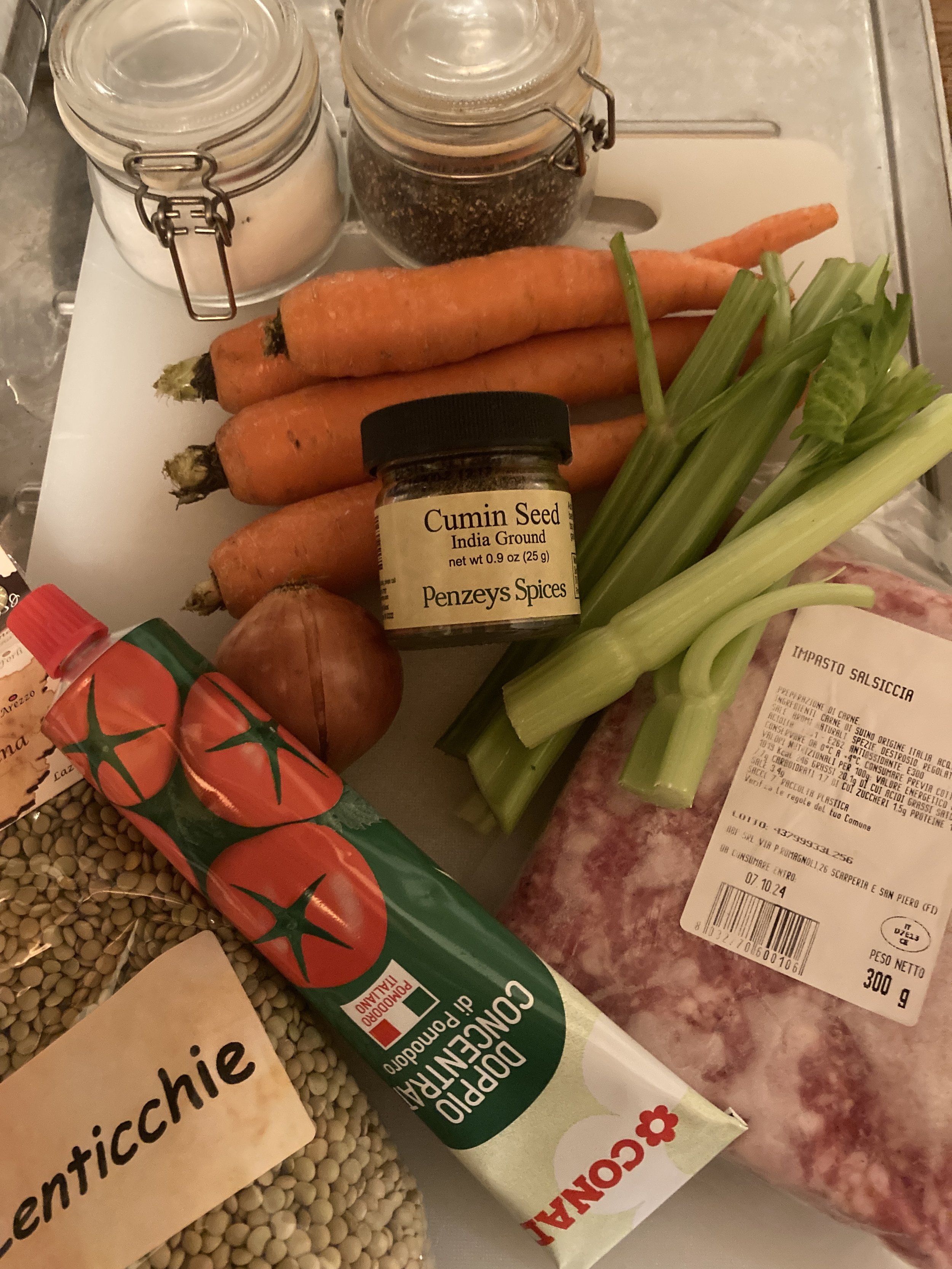
 190 grams small green lentils (1 rounded cup)

1 medium red or yellow onion, chopped

2 ribs celery, cut as small dice (about ¾ cup)

2 – 3 carrots, cut as medium dice (about 1 ½ cups)

2 tablespoons double concentrated tomato paste

¼ teaspoon course ground black pepper

½ teaspoon ground cumin

½ teaspoon salt

1 tablespoon chopped fresh parsley

200 grams pork sausage, crumbled

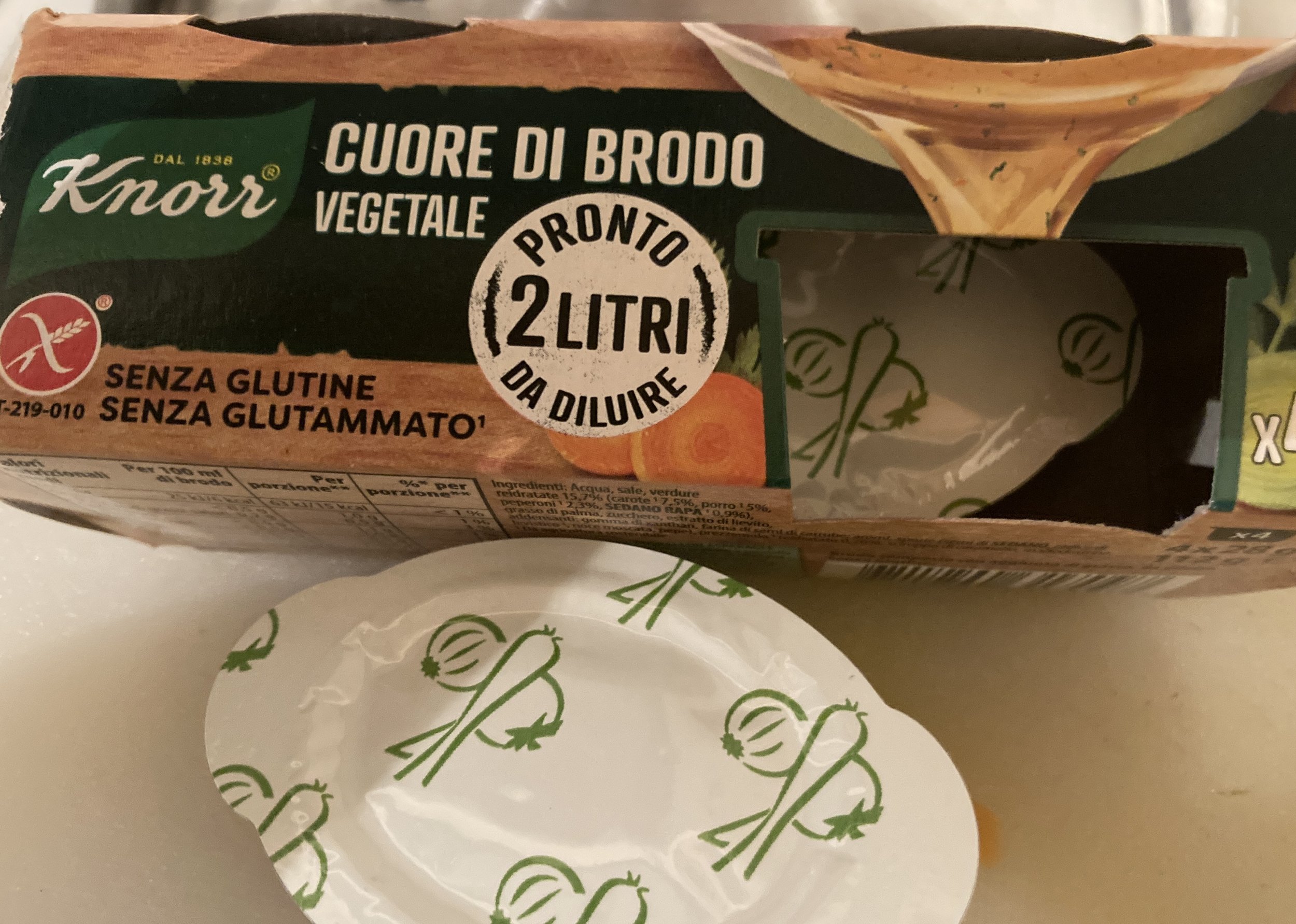
1 ounce container of Knorr vegetable stock *

 Cover lentils with boiling water, soak x 15 minutes and then drain

Cover drained lentils with 1 inch of water, bring to a boil and simmer x 15 minutes

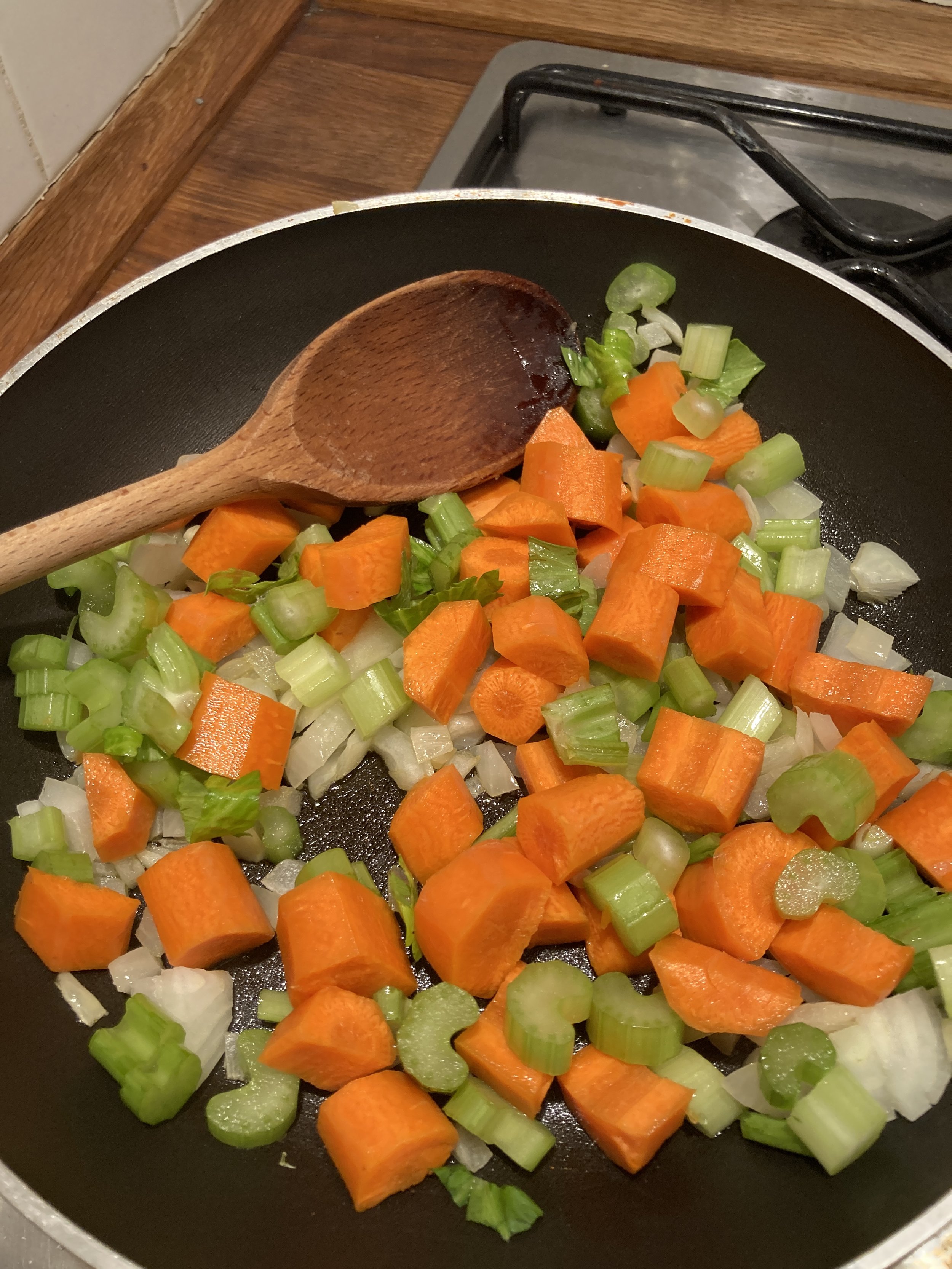
Meanwhile, sauté onion in 1 tablespoon extra-virgin olive oil until onion softens and is transparent. Add celery and carrots and sauté another 5 minutes.

Add sautéed veggies, spices, tomato paste, and chopped parsley to the lentils.

In a frying pan, crumble the sausage and brown until cooked through, add to lentils along with the Knorr vegetable stock or bouillon cubes.

Add ½ cup water and simmer everything x 30 minutes, adding more water as needed to thin the soup.

 *In Italy, Knorr vegetable stock is called Cuore di Brodo Vegetale and comes in a package of little 1 ounce plastic cups of jellied stock.  These are sometimes available in the US, but can be hard to find at least in New Mexico where I am from so I usually bring some from Italy.  If not available, just substitute a low salt vegetable bouillon cube or two or homemade vegetable broth in place of the water. 

Buon appetito, Buon Anno Nuovo


December 30, 2024 /Joanne Bartram
lentils, italian soups, lentil soup, new year traditions italy
#italiancooking, food, Italian culture, Italian recipes, Living in Italy

This pumpkin soup, from Cibrèo Trattoria in Florence, was my inspiration.  

From My Italian Kitchen, Roasted Pumpkin Soup

December 02, 2024 by Joanne Bartram in #fallinitaly, #italiancooking, Autumn in Italy, Cooking, Fall in Italy, food, Italian recipes

Fall in Italy is pumpkin season. Pumpkin shows up in many dishes - in creamy risottos, as the filling for tortelli, and as the base for a warming soup. Each fall I look forward to the appearance of all of these dishes on the menus of local trattorie, a sure sign of fall’s arrival.

This fall I have been experimenting with recipes for two of these dishes, a risotto and a zuppa di zucca (pumpkin soup). While it is always a treat to have these dishes in a restaurant, there is something very satisfying about making them at home.

For the pumpkin soup, I have tried to recreate the one I enjoyed last fall at Cibrèo Trattoria in Florence. It was a vellutata (a smooth, velvety soup) topped off with a drizzle of olive oil and a bit of sweetness from crushed amaretti. Unfortunately, their recipe was nowhere to be found, so I had to experiment to come up with something close. My version is not an exact replica of their’s, but it is pretty tasty!

The key to this soup is starting with chunks of roasted pumpkin and some roasted garlic. Canned pumpkin just won’t do - it doesn’t have the right flavor or texture. Roasting both the pumpkin and the garlic are essential for creating a complex flavor. Turmeric, cinnamon, and maple syrup pair perfectly with pumpkin. And, for a bit of tang, feta cheese. Lastly, crisp Italian Amaretti cookies add just the right touch of sweetness on top of the finished soup.

 Ingredients:

6 cups cubed pumpkin

1 head of garlic

3 tablespoons Extra Virgin Olive Oil (EVOO) + more to garnish finished soup

1 medium potato (~ 150 grams), cooked until soft

¼ cup onion, finely diced

2 tablespoons finely diced carrot

The sweetness in the amaretti adds a perfect touch to this soup.  Be sure to use the crisp ones.

10 ounces feta, crumbled

800 ml (~ 3 1/3 cups) chicken broth

¾ teaspoon salt

½ teaspoon coarse black pepper

1 teaspoon turmeric (or more to taste)

¼ teaspoon cinnamon

3 tablespoons maple syrup

¼ cup half and half (or whole milk)

1 package crisp Italian Amaretti cookies.  2 cookies, crumbled, per bowl of soup

 Directions:

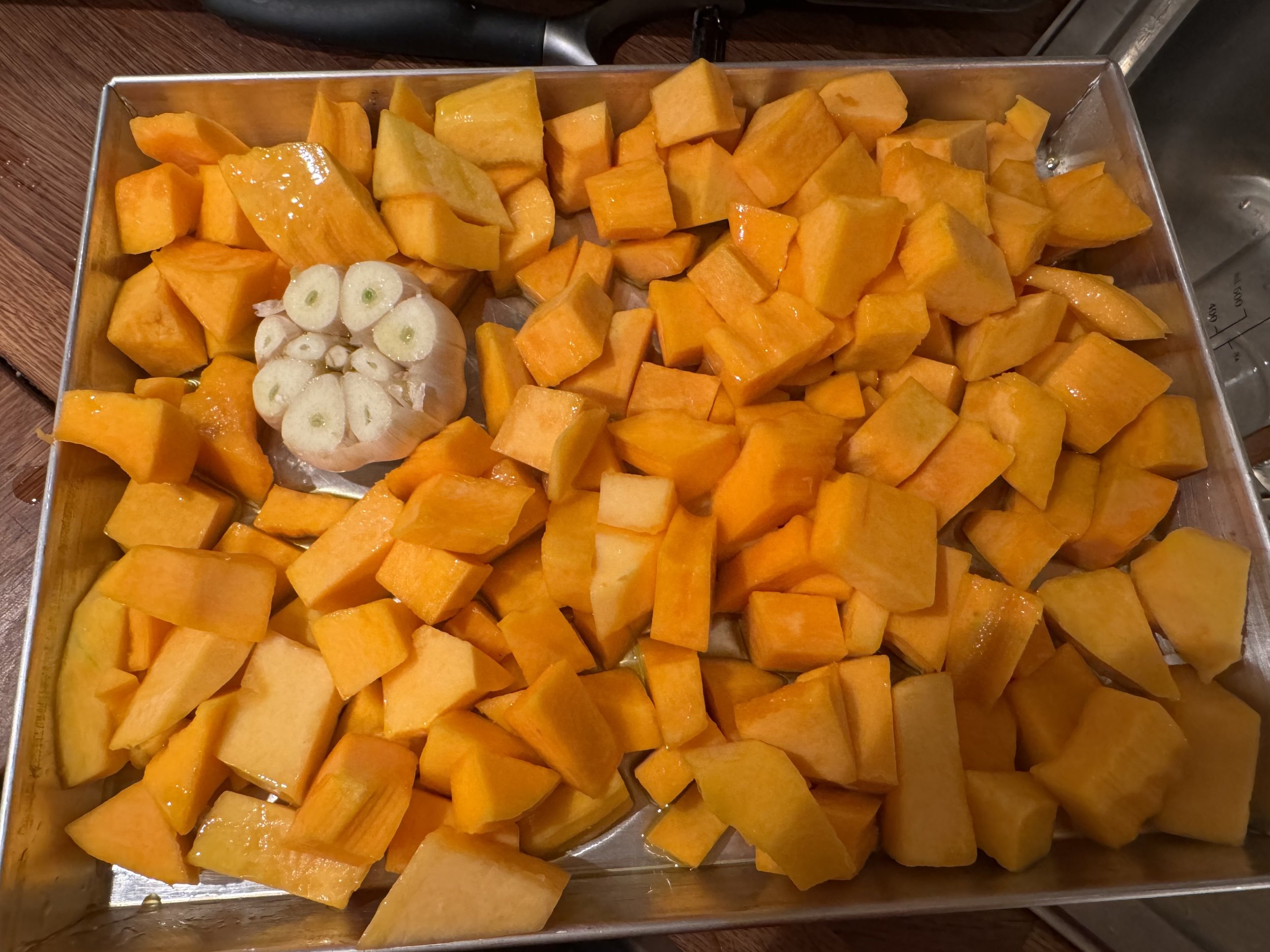
Peel and cube the pumpkin (even easier if you can find it already peeled and cubed in the market). Toss with 2 tablespoons of EVOO and place on a rimmed baking sheet. 

Pumpkin chunks and garlic ready to roast

Cut the top third off a head of garlic, remove the loose skins, and place the intact head in the pan with the pumpkin.  Pour 1 tablespoon of EVOO directly on top of the garlic and then flip it over so that the cut side is down.  Drizzle 2 tablespoons of EVOO over the pumpkin cubes.

Roast at 400 degrees for 45 – 75 minutes until pumpkin is soft and garlic soft and fragrant.   The more the pumpkin is spread out on a large pan, and the smaller the pieces, the quicker it will cook.  60 minutes is about average.

 While the pumpkin is roasting, boil the potato, mash, and set aside.   Sautè the onion and carrots in a little bit of EVOO until softened.  Set aside.

Roasting the garlic keeps the flavor mellow, start with half the head of garlic and add more to taste

Place the roasted pumpkin, along with any accumulated juices, into a large soup pot.  Add the feta, mashed potato, and carrot / onion mixture to the warm pumpkin.  Squeeze the roasted garlic cloves into the mixture (depending on how much garlic flavor you like, start with half the head of garlic and then add more to suit your taste).  Mash all with a potato masher.

Add the chicken broth (substitute vegetable broth for a vegetarian version), spices, and maple syrup.  Heat soup over low heat and simmer x 15 minutes. 

Blend with an immersion blender, then add the half and half

To serve:  drizzle a small amount of EVOO over each bowl of soup.  Top with 2 crushed amaretti cookies.  The slight sweetness of the cookies makes the soup sing!  For a bit more tang, crumble a tablespoon of feta on top.

This soup tastes even better gently reheated the next day.  It also freezes well, just defrost in the fridge overnight before reheating.

My version - I may have used a bit more amaretti than Cibrèo did.  I like the sweetness.

December 02, 2024 /Joanne Bartram
fall recipes, pumpkin soup
#fallinitaly, #italiancooking, Autumn in Italy, Cooking, Fall in Italy, food, Italian recipes

My pasta making friends Cindy and Lauresa

An Evening of Pasta Making

August 19, 2024 by Joanne Bartram in #italiancooking, food, Italian recipes

 It’s always fun to cook with friends. That is especially true when it comes to making pasta.   Making pasta fatta a mano (handmade pasta) is enjoyable work and it’s always more fun when there is someone (better yet a group) to share the work.  

My 12 year old grandson is a pro !

I am not a professional pasta maker by any means, but I’ve had some experience and have been successful at teaching my 12-year-old grandson, Jack.  He is now an independent pasta maker and my chief pasta making buddy.  So, when a trio of friends recently asked if I would teach them how to make pasta, I felt up to the task and quickly suggested an afternoon of pasta making followed by dinner.  

We quickly agreed to a plan - they provided wine, salad, and dessert while I collected all the ingredients for the pasta and put together a simple pre-pasta making aperitivo. Game on !

There are probably a thousand recipes for pasta dough.  Proportions vary as do some of the ingredients – with eggs or without?  All 00 flour or some semolina?  Salt?  Oil?   I’ve tinkered with all of these and have found what works best for me is 2/3 flour (type 00) mixed with 1/3 semolina, a pinch of salt, eggs, a drizzle of olive oil and sometimes, especially when working in a dry climate, 1-2 tablespoons of water.   This combination makes a great tagliatelle - an egg based pasta, cut into wide strips, perfect for holding onto a sauce. (detailed recipe at end of post)

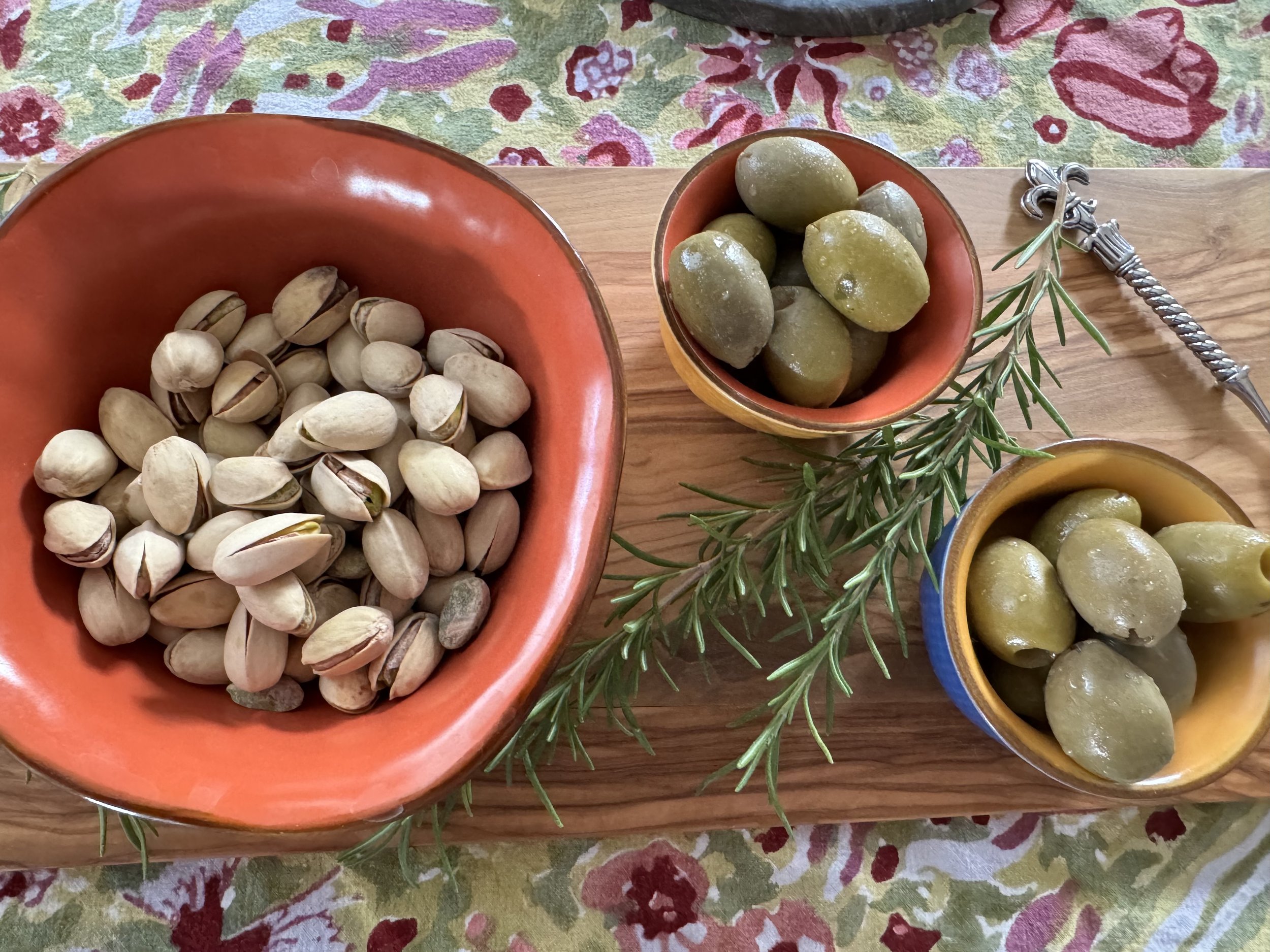
 My friends arrived and, after a fortifying round of white wine sangria and some nibbles, we got to work.    

Fortification for the work to come!

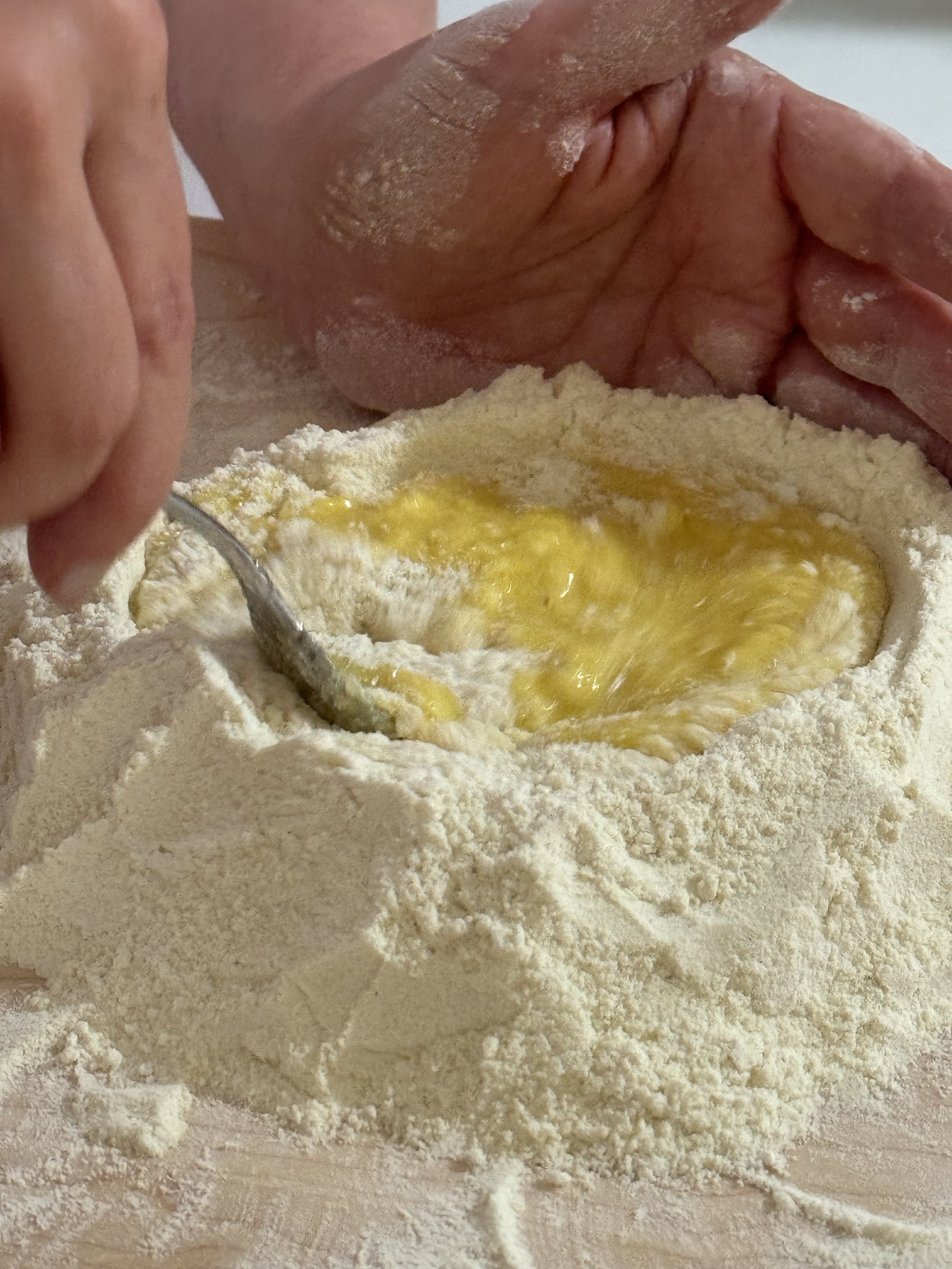
After mixing the 00 flour, semolina, and salt, they each made “the volcano”.   Into the center went the eggs, olive oil, and 1 tablespoon water.   Rule one – don’t break the sides of the volcano and allow the eggs to flow out !   

I am happy to report that the eggs were mixed and the volcano walls remained intact as they slowly incorporated the flour into the eggs to make the dough.  Success!

Next step was kneading after which the dough was wrapped in plastic wrap to rest for 30 minutes. This was just enough time for another glass of wine, to put the water on to boil, to heat the Amatriciana sauce which I had made the day before, to toss the salad, and set the table.  Quick work with several people!

The next step surprised my pasta makeing friends in that the work of rolling the pasta dough into thin sheets took quite a bit of time – even with the use of a pasta machine.  

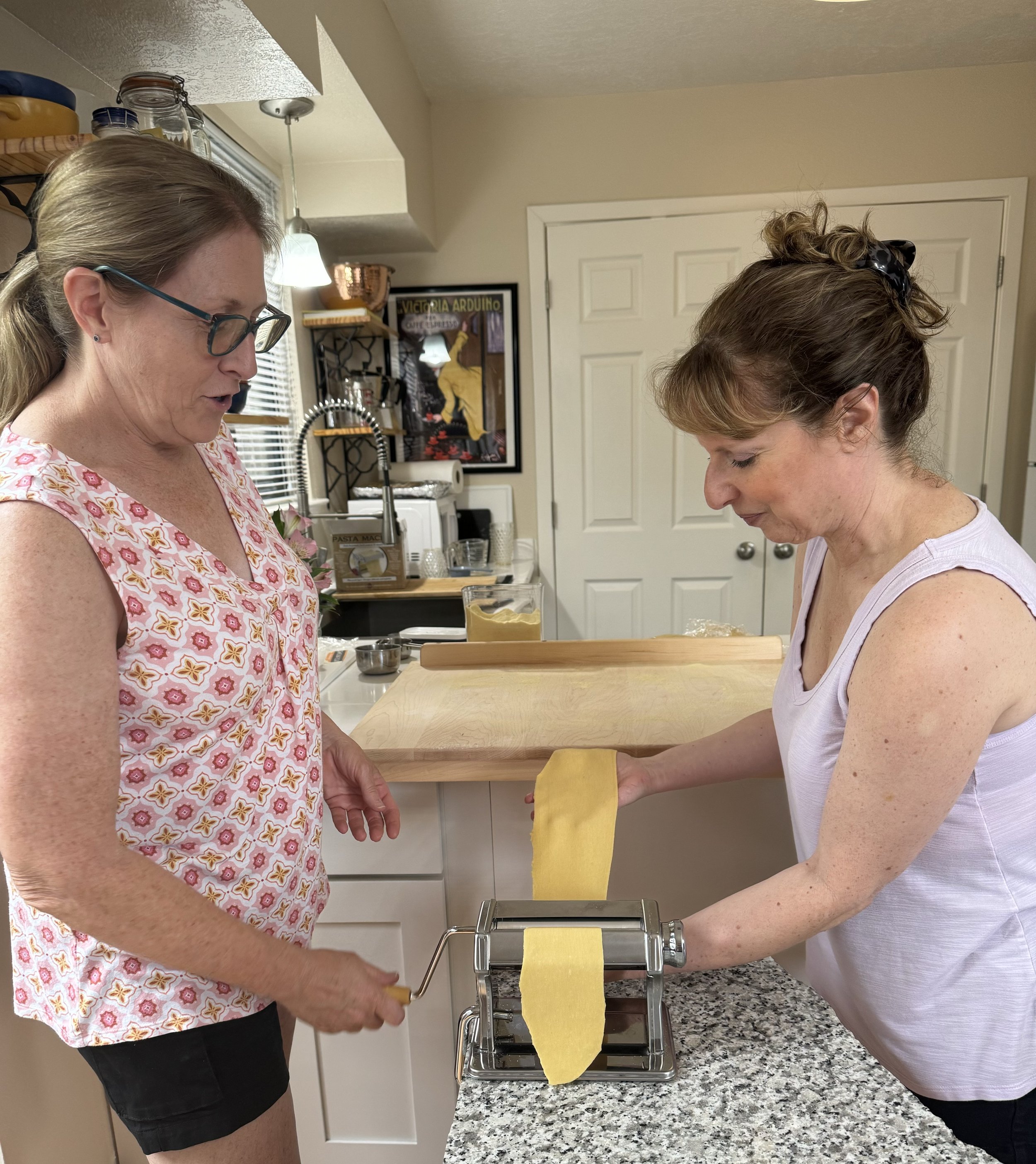
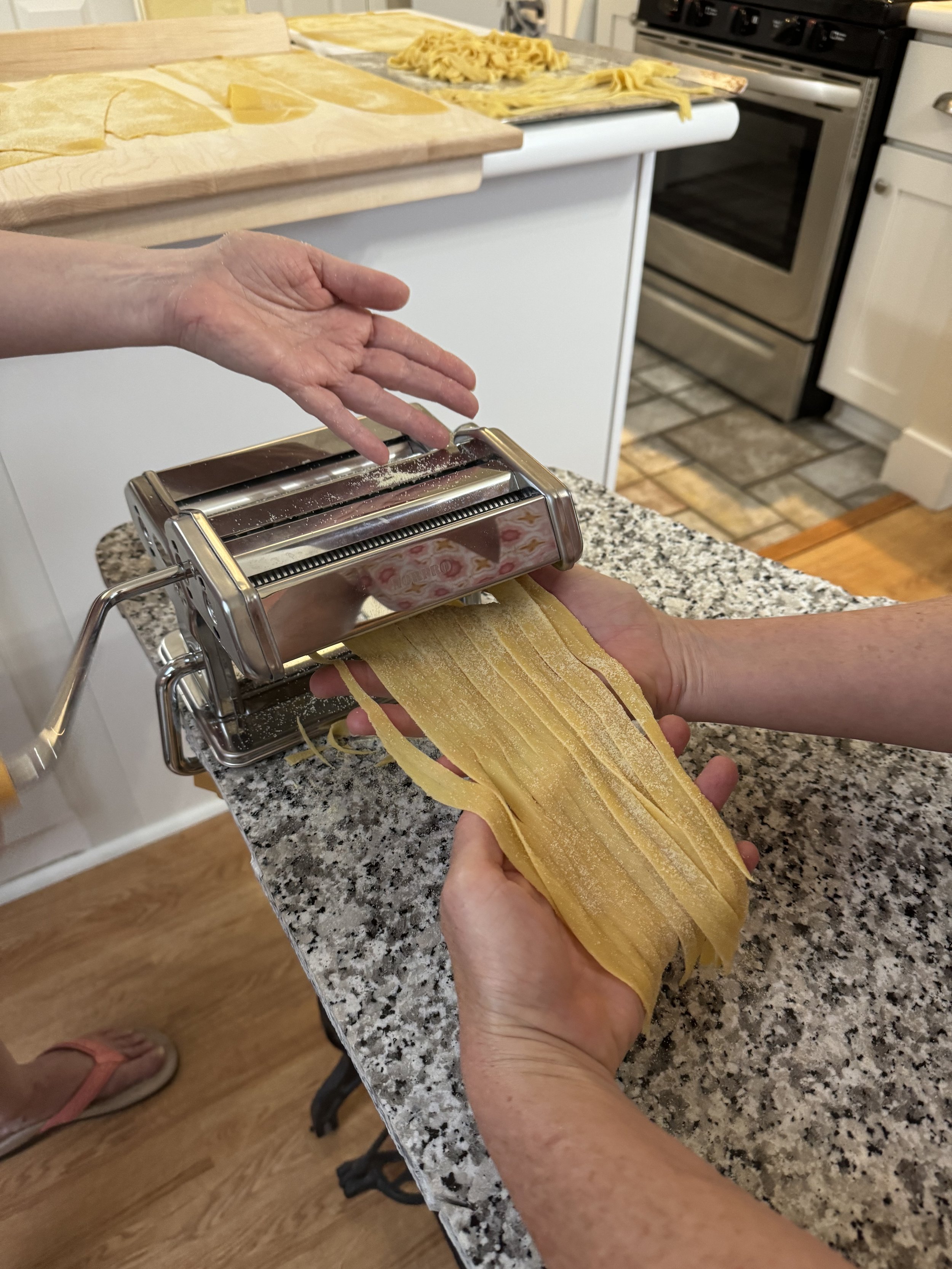
Several hands made the job much easier.  After the thin sheets were created, the actual cutting into tagliatelle was much faster.  Soon they had a tray full of beautiful, thin strands of tagliatelle.   Lots and lots of tagliatelle. Way more than the 4 of us could possibly eat, so some went straight into the freezer.

Cooking the fresh pasta took almost no time.  We tossed it with the sauce, some grated parmesan, and wow, perfect pasta !

My friends were pleased with their efforts and pronounced that pasta making was fun work. Dinner was tasty and we had a lot of fun along the way.  What a great way to spend a Friday evening! 

Time to enjoy all our hard work!

I’ll look forward to our next adventure in pasta making.  Maybe pici next time?

Basic Fresh Pasta Recipe

 1 cup 00 flour

½ cup semolina flour

Pinch of salt  

2 eggs

1 teaspoon extra virgin olive oil (EVOO)

1-2 Tablespoons of water if needed

Combine 00 flour, semolina, and  salt.  Place on board and make a well in the center. Into the well put the eggs and EVOO. Mix with a fork until yolk and white are well blended, being careful to keep the liquid inside the well of the flour.  Slowly incorporate flour, finishing with a firm but not dry dough.  Add 1-2 tablespoons water if dough seems too dry (but dough should not be sticky).  

Knead dough until smooth and slightly springy.  Wrap in plastic wrap and rest for 30 minutes to an hour. 

Roll dough into thin sheets (if using a machine start on #1 (the widest setting). Roll, fold in half and roll again.  Then roll on progressively higher numbers, ending with #6.   Dust sheets of pasta with semolina until ready to cut.

The extra pasta went into the freezer and the next week made a wonderful pasta carbonara.

Cut sheets into desired shape (my machine has rollers to cut either tagliatelle or spaghetti) and toss cut pasta with a small amount of semolina to prevent sticking.

Drop into boiling salted water 6-10 minutes (al dente).  Drain and toss with your choice of sauce.

 Note: the cut pasta freezes well. A week later it was perfect in a pasta carbonara.

August 19, 2024 /Joanne Bartram
freshpasta, pasta making, pasta fatta a mano, italian cooking
#italiancooking, food, Italian recipes
  • Newer
  • Older

Powered by Squarespace