Two Parts Italy

Exploring Italy, travel, and living a flavorful life

  • Blog
  • About This Blog
  • Start Here
  • Recent Posts
  • Archives by Topic
  • Subscribe
  • Contact me

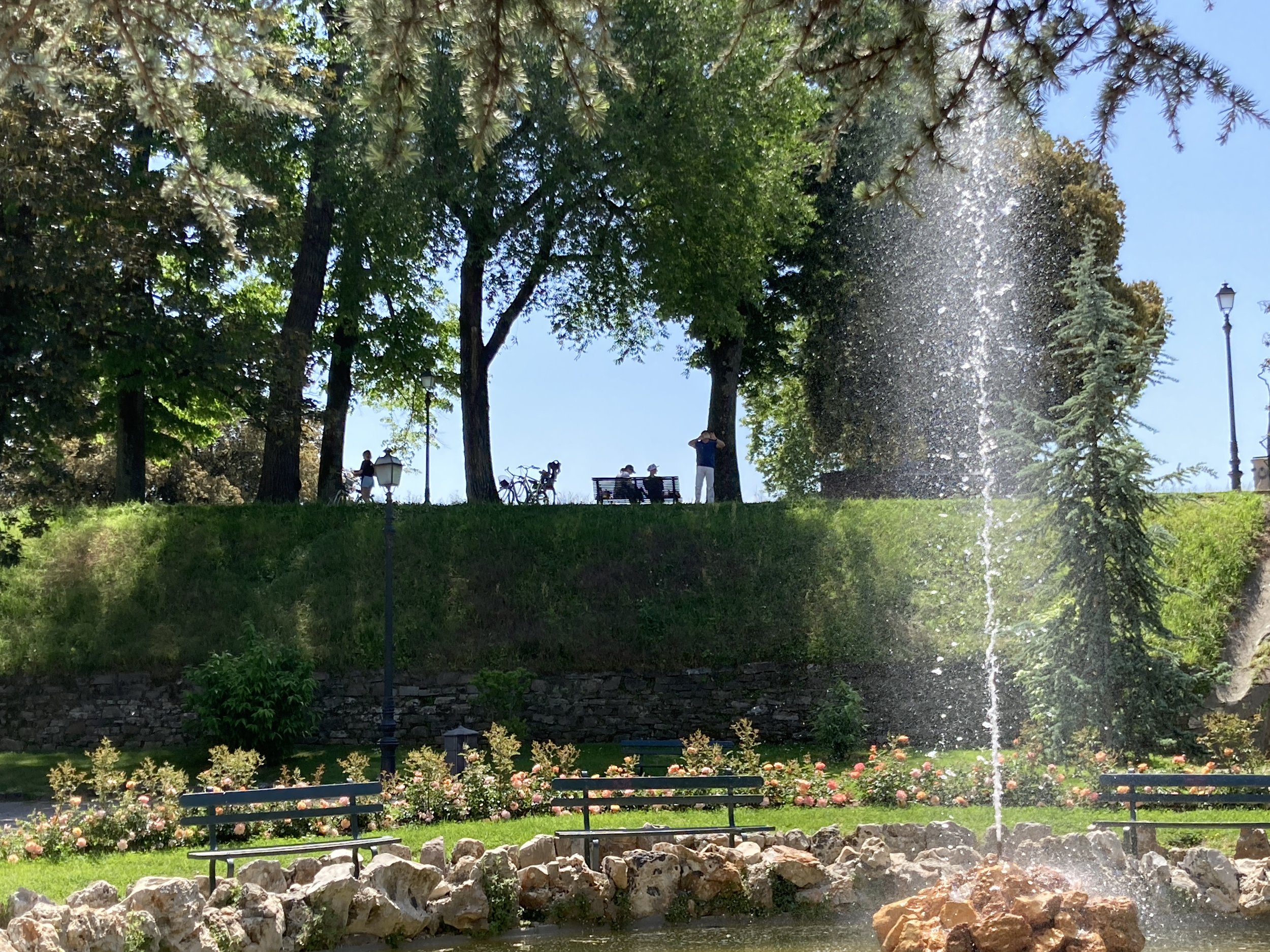
This fountain is surrounded by peach colored roses. It’s a popular spot to sit, have a gelato, and watch the activity up on the walls.

Lucca in Bloom

May 23, 2022 by Joanne Bartram in #lucca, #springintuscany, Italian gardens, Italy, Lucca

April was quite cool and rainy this year; it seemed that spring would never arrive. Perhaps that long wait for spring has made May, with its lengthening days and beautiful weather, even more welcome. Right now the temperatures are perfect - just warm enough mornings, sunny warm afternoons, perfectly comfortable evenings. There are soft breezes and plenty of opportunities to stop and enjoy the feel of the sun on one’s face. Cool weather clothes have been packed away (finally!) and the midday sun gives a hint of the hot summer weather that is just around the corner. This is the in-between season, and it is one of the best times of year to be in Tuscany.

These roses can be found in the large park just behind the Church of San Francesco.

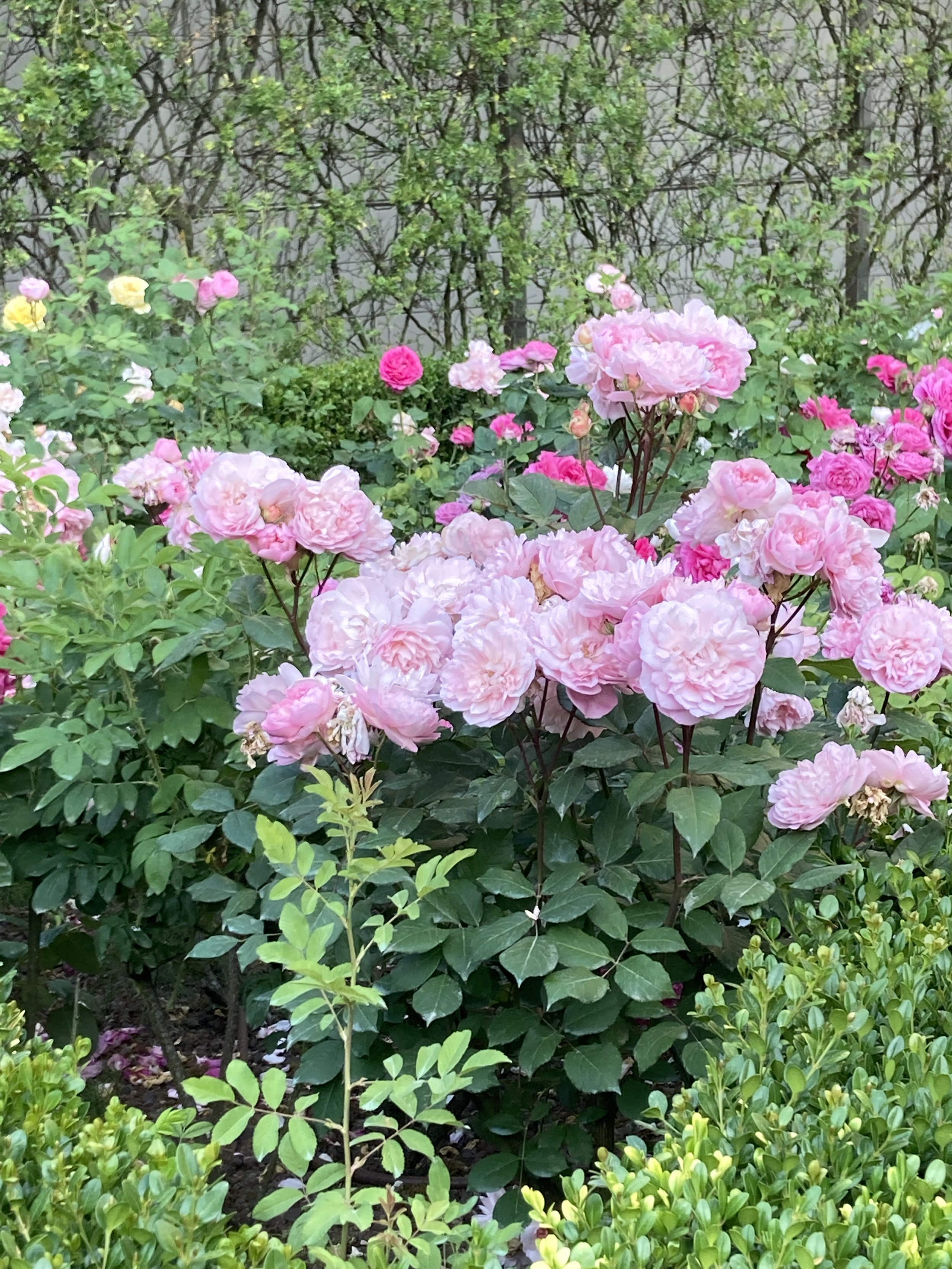
The magnolia blooms are long gone, the wisteria have mostly faded, and there are no poppies inside the historic center of the city (though they are a marvel out in the countryside). But that does not mean there is a shortage of color in town because in May Lucca erupts in roses and they are glorious.

This multi-colored rose garden is up on the walls that surround the historic center of Lucca.

I wish I could add a link that would share scent, because the roses fill the air with a soft, delicate perfume. This seems especially true for the banks of pink roses just outside Porta San Pietro, the main entrance into the city. Visitors to Lucca often enter this porta on their way from the train station into the city. And what a good first impression this makes!

Fragrant pink roses at Porta San Pietro. And why is there always a truck that “photo bombs” a good picture?

It’s impossible to walk past without stopping to appreciate the various shades of pink, the wonderful scent, the buzzing bees.
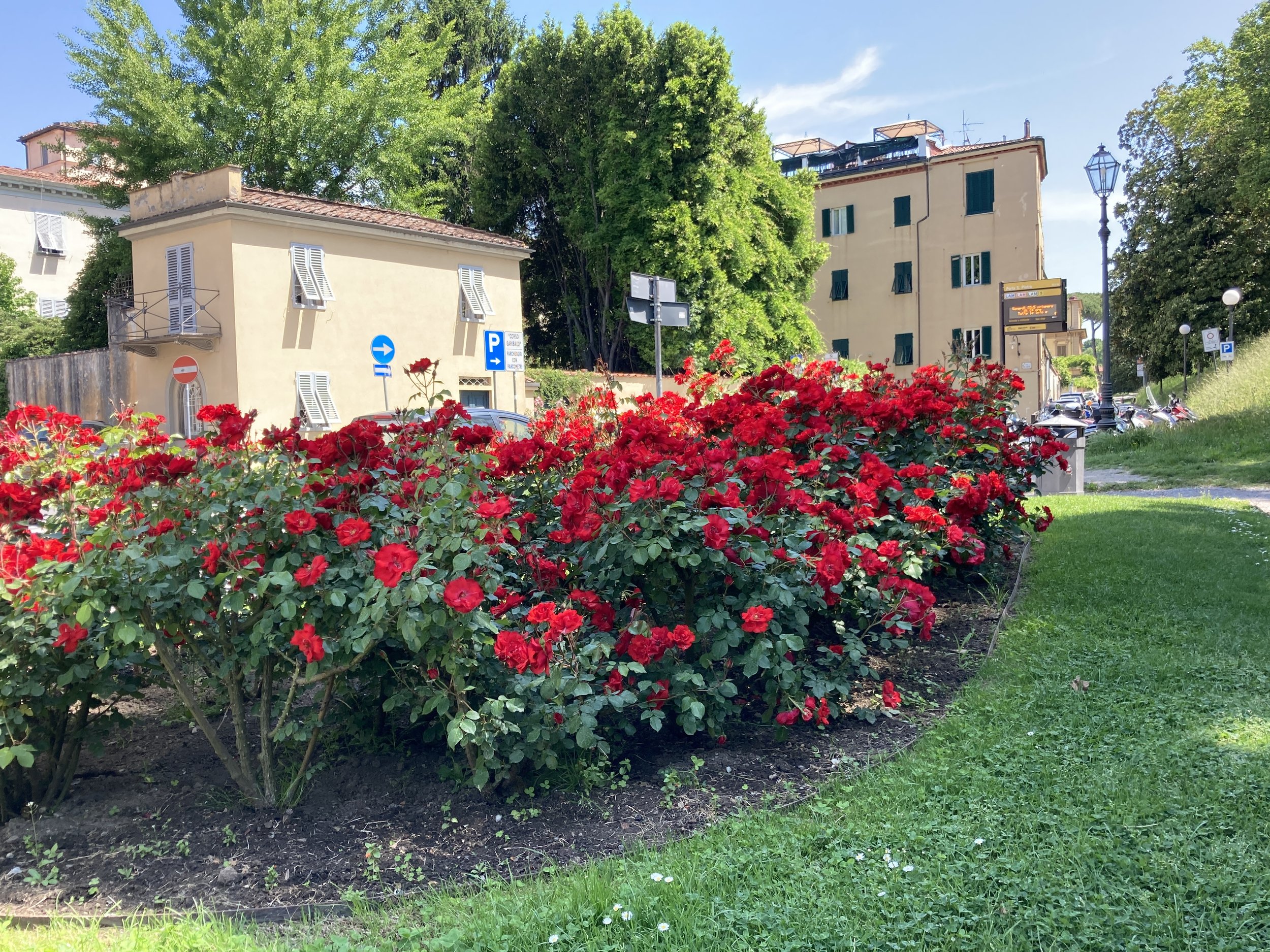
Not to be outdone by the pink roses just outside Porta San Pietro, these red ones are just inside the porta.

One of my favorite rose-filled places is the rose garden in the series of three small gardens in the chiostro (cloister) beside the Church of San Francesco. With an old well in the middle of the garden, and banks of roses fanning out in all directions, this is a delightful and well tended formal garden.
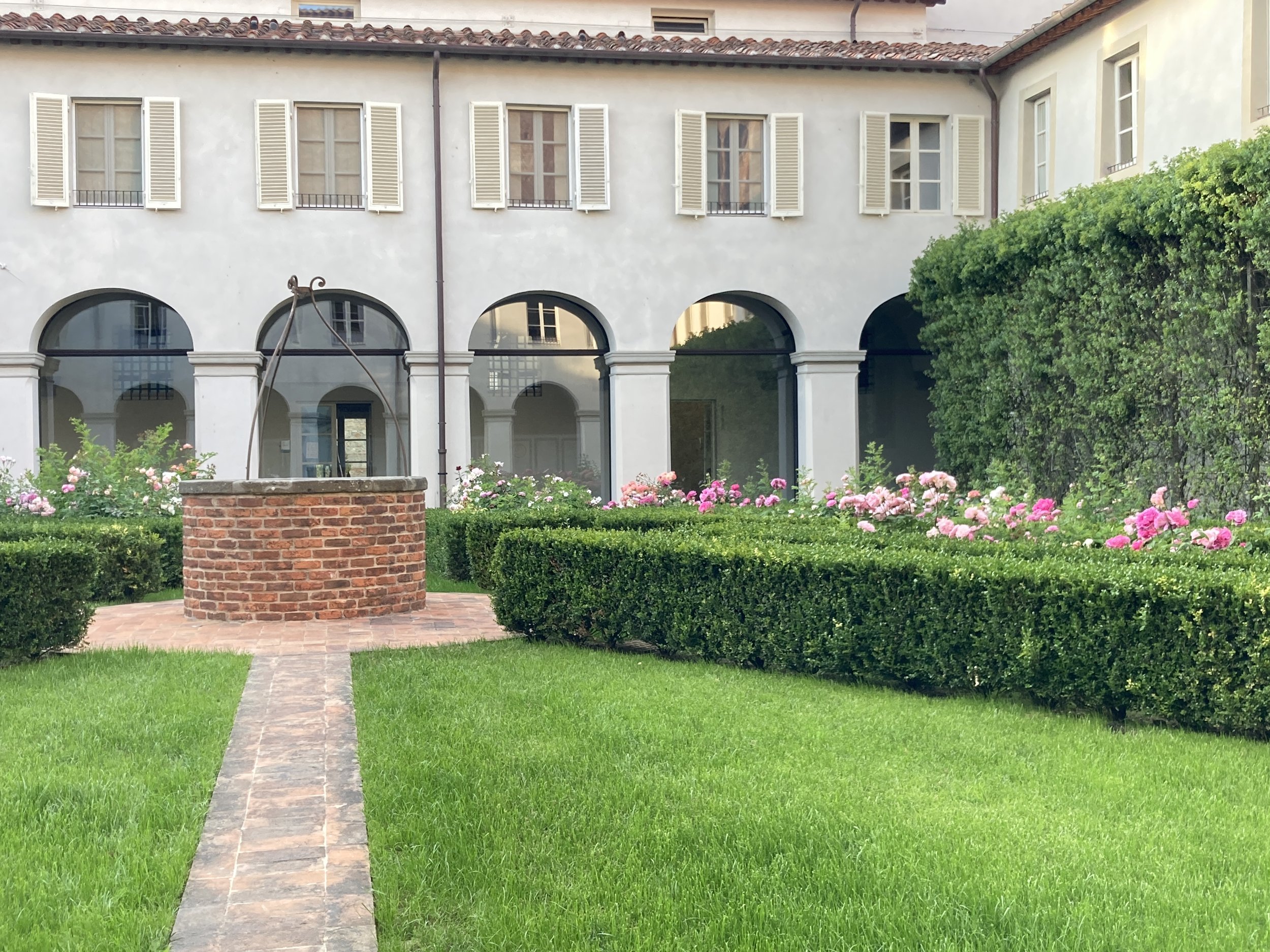
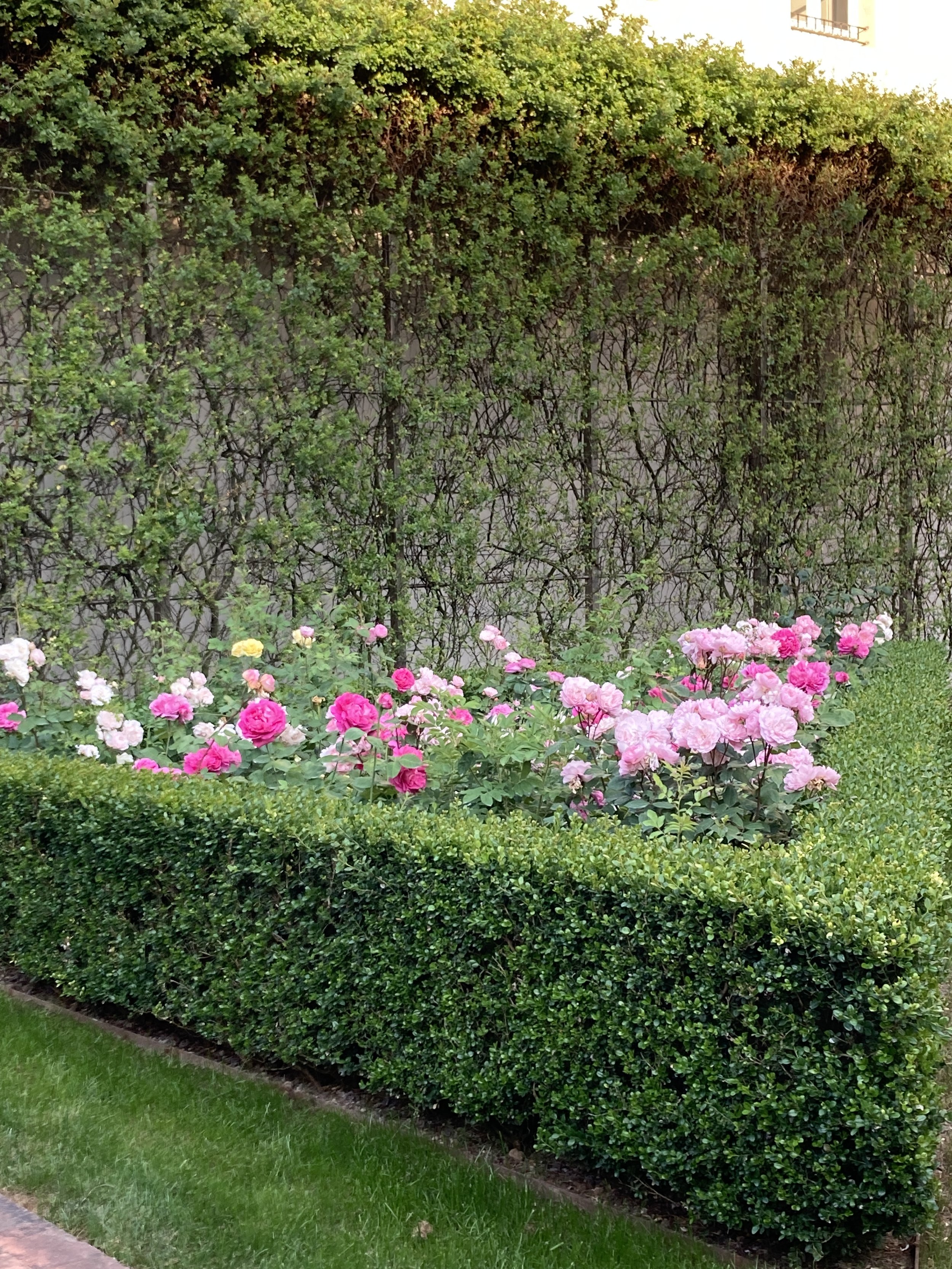
5681B0FD-7F0F-4416-8DF7-5B84B9ADA3AB.jpeg
AE51CB47-215C-4426-9FB6-55213CEA2666.jpeg
AD41AA51-D84B-42DD-85DB-69BA968D120B.jpeg

What a joy it is to walk through Lucca on a warm spring day and find these beautiful blooms.
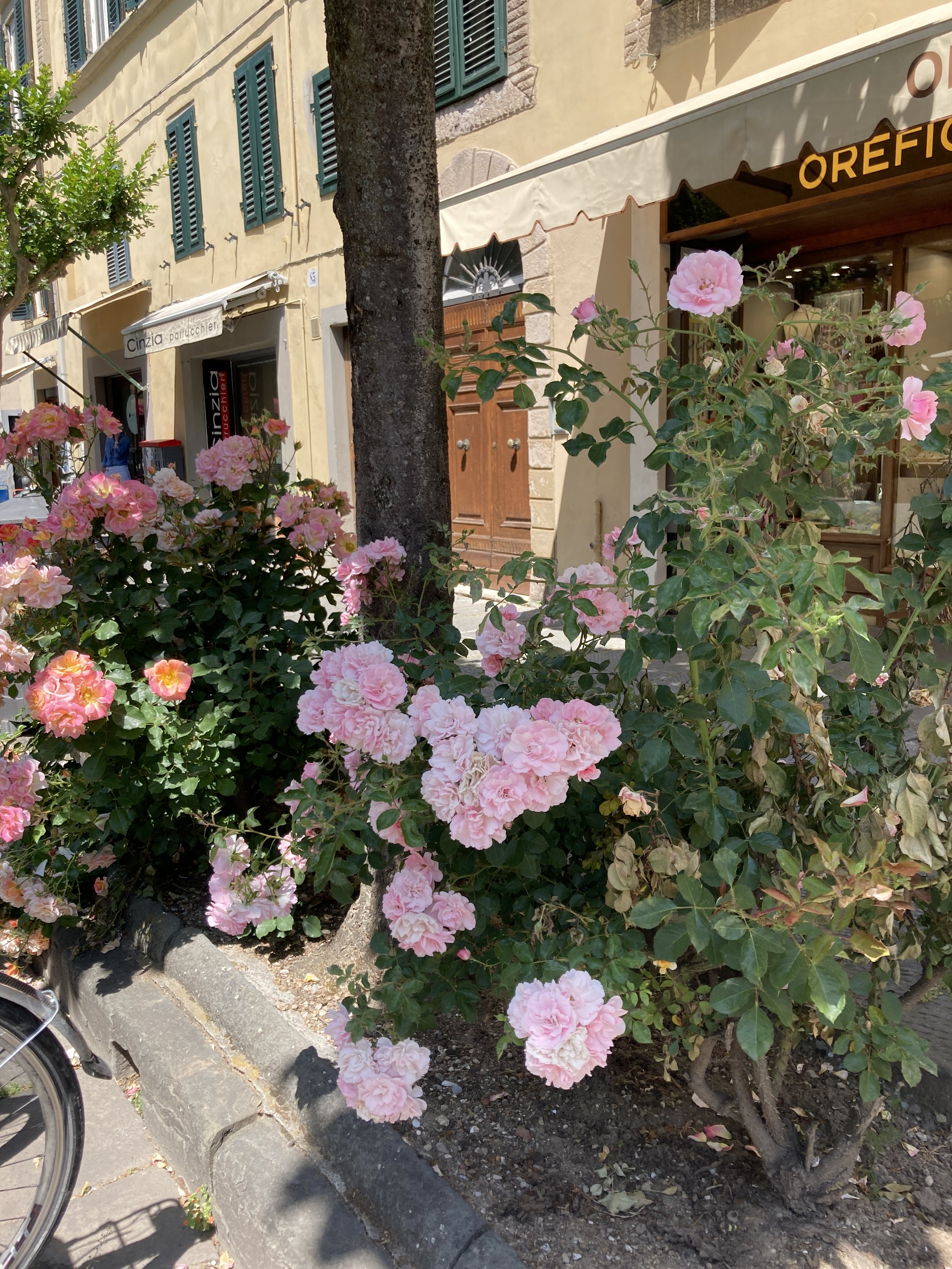
Street side roses on Corso Garibaldi

May 23, 2022 /Joanne Bartram
Spring Tuscany, spring in Italy, Garden Lucca, Gardens in Italy, Italian Gardens, #roses italy
#lucca, #springintuscany, Italian gardens, Italy, Lucca

Spring in Pietrasanta: Art, Philosophy, and Giraffes

May 16, 2022 by Joanne Bartram in #lucca, Italian art architecture, Italian culture, Italy travel, Italy, Tuscany

Pietrasanta has everything a small town in Italy should have - beautiful scenery, a lively main piazza, historic buildings and statues, a lovely church, cafes, and good food. And art. It is the art that draws me back time after time.

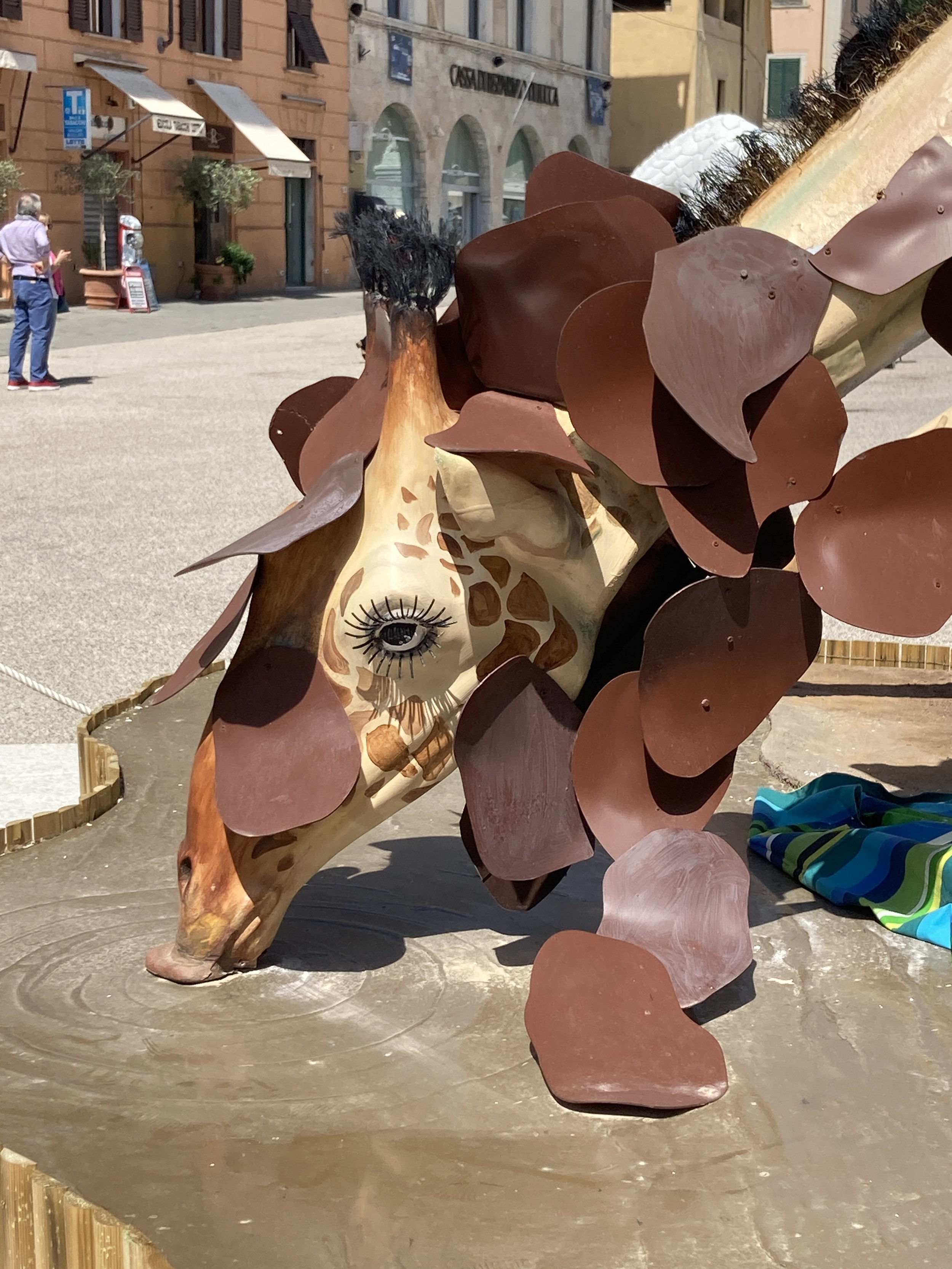
One of many whimsical giraffes that can be seen throughout Pietrasanta this month.

Visiting is easy as it is just an hour-long train ride from my home in Lucca. Unless of course, as in my most recent visit, there is an interruption on the tracks, train delays, an extra change of trains, a track in a tiny station with no signage, and you hop on the wrong train and have to double back. But don’t let that discourage you! My friend and I laughed it off and eventually arrived to spend a lovely day in Pietrasanta.

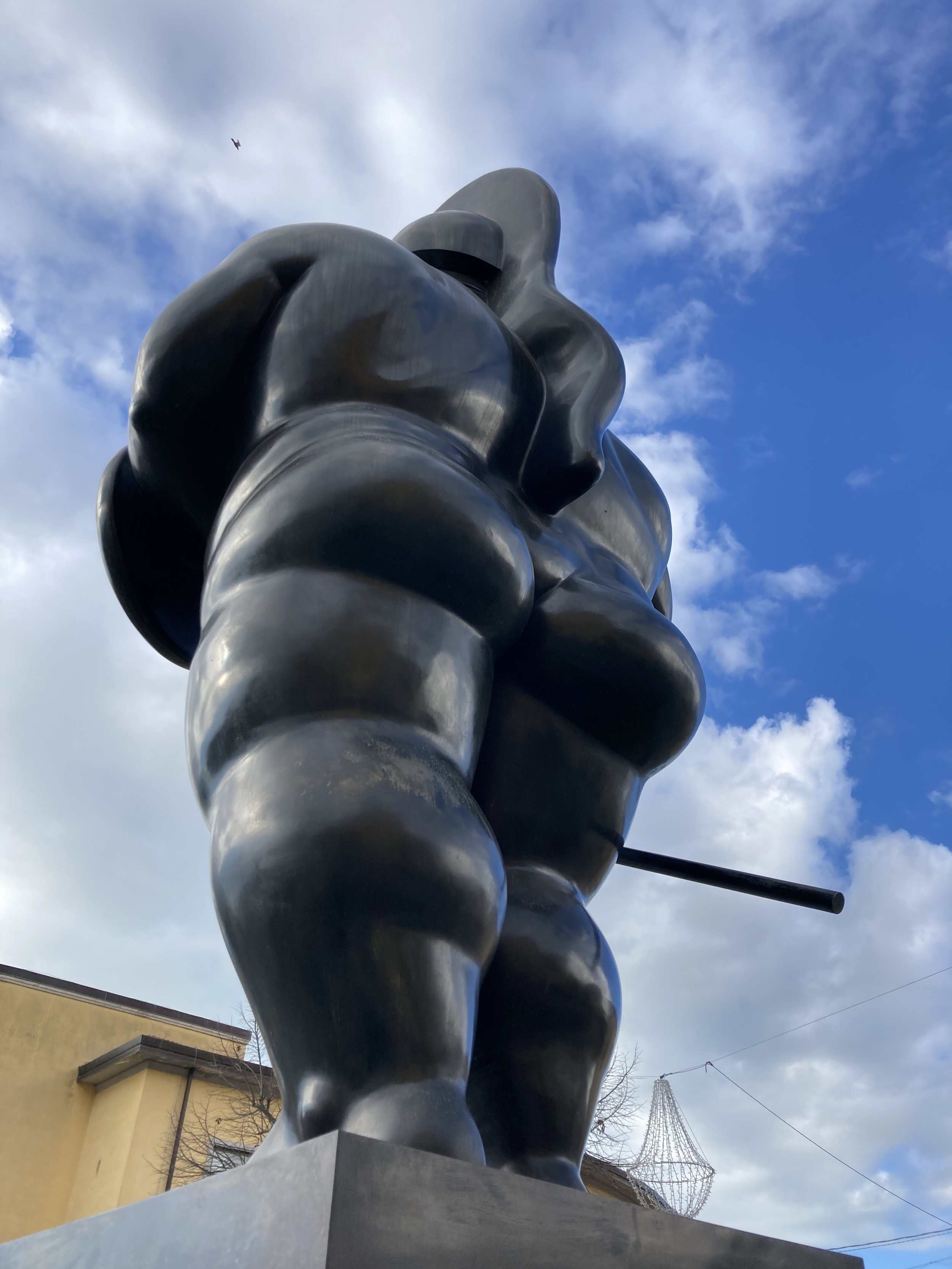
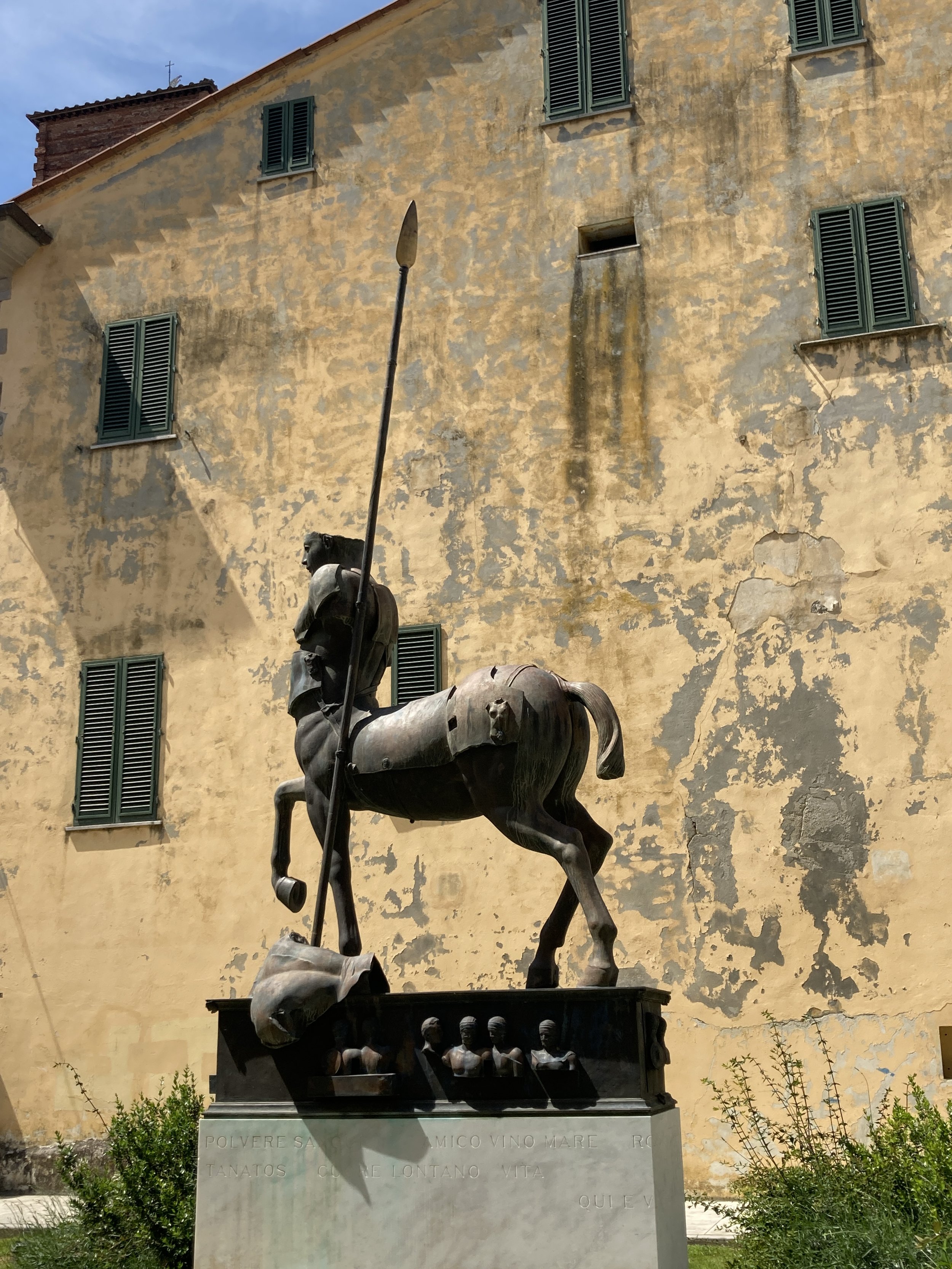
Famous as a center of sculpture (the marble quarries of Carrara are nearby), the town has permanent outdoor installations of bronze and marble sculptures, from smaller pieces to Botero’s massive bronze warrior (below).

CC1D846C-D0C6-4EB9-98AD-96C87DFFC193_1_201_a.jpeg
5853D5E2-CBB7-4A7E-9C0E-F90E3295F19A.jpeg
C95C05B5-2B06-4416-84BA-41EE353B441E.jpeg

In addition to these permanent works, Pietrasanta hosts temporary exhibits which fill the main piazza and nearby spaces (as well as some indoor spots) with an ever-changing display of works by contemporary artists.

The current exhibit, in place until June 5th, features the artistry of Sandro Gorra. Gorra’s background is in commercial art where he worked as an illustrator and creative director for advertising campaigns. That was his work. Today, he concentrates on his art which includes sculpture, illustrations, and a sort of philosophical short poetry which accompanies his works. And then there are his giraffes.

Gorra says that this piece, made from 4 tons of marble, is one of his favorites. A loving mother giraffe tending to her baby.

Why giraffes? According to a published interview with Gorra, the giraffes serve as a parable, representing man’s desire for superiority. A giraffe towers above, looking down on everyone. Each one is unique in his spotted form.

This begs the question - without those spots, what would the giraffe be? Anonymous! Naked!

Change - a predictable part of life - in progress.

Change is inevitable and the spots on Gorra’s giraffes do indeed change. They fade away, they fall off, new ones appear. In fact, during my visit, two men, one looking suspiciously like the artist himself (or was that just my imagination?) were busy painting new spots on two of the giraffes. This would be consistent with Gorra’s view that change is to be expected and that irony is a part of the human (and giraffe) condition.

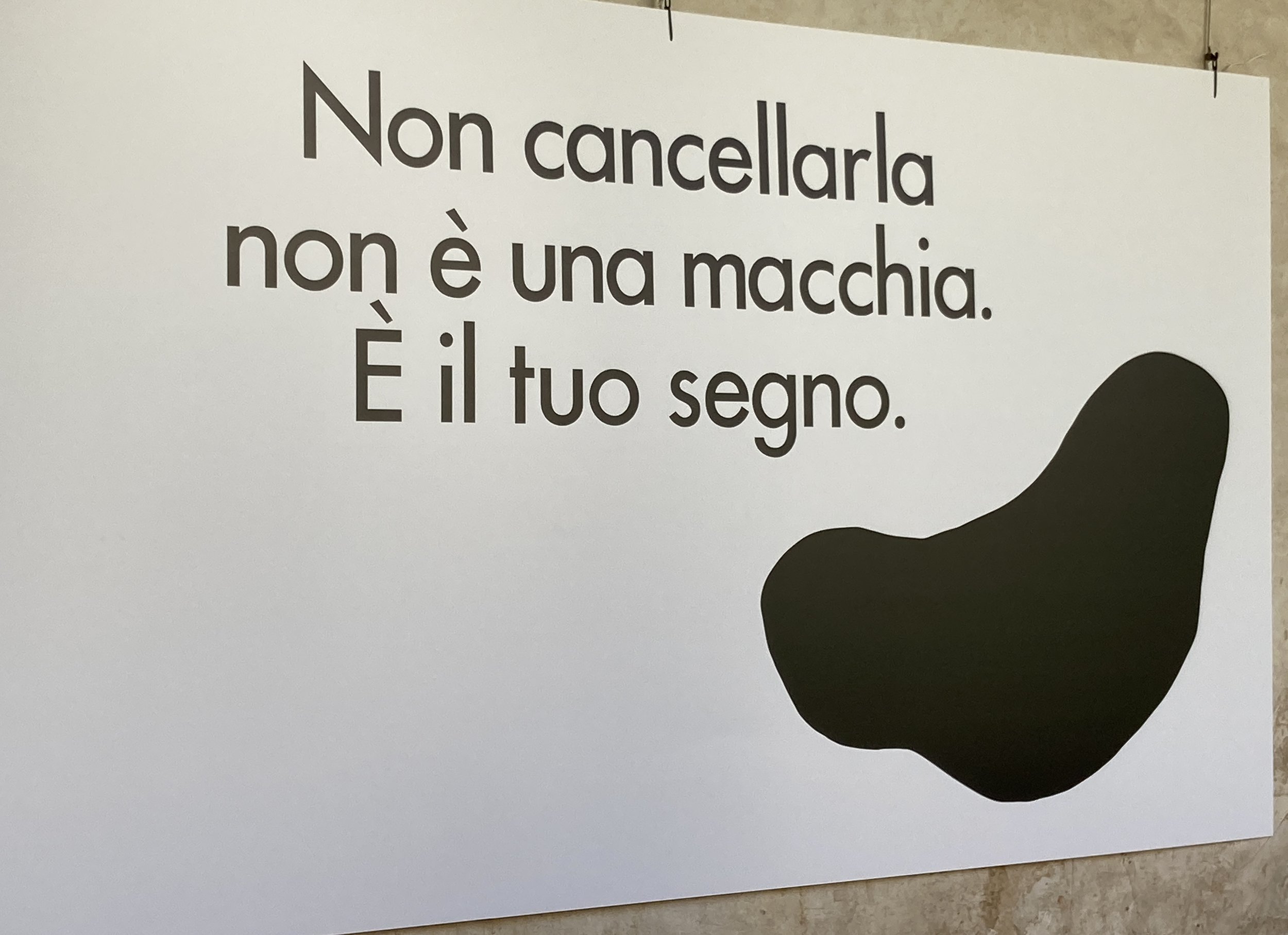
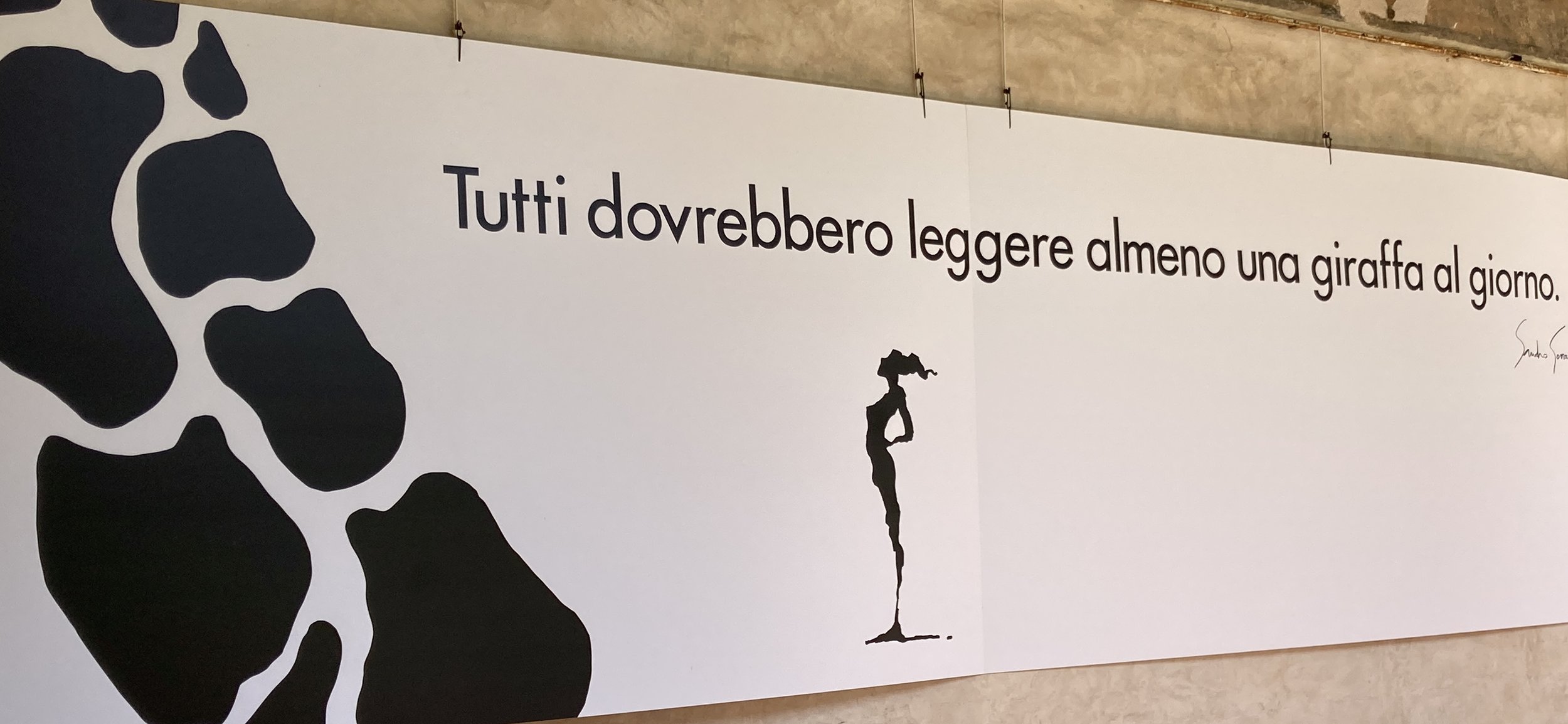
Alongside the works of art are illustrated phrases, providing an intriguing look into the artist’s mind and bits of his philosophy. I enjoyed these sprigs of wisdom just as much as the sculptures. Both made me smile, both made me think. Isn’t that the best part of art?

Here are some examples (any mistakes in translation are entirely my fault).

Don’t erase it, it is not a stain. It is your sign.

Ideas are always around, but if you don’t notice them they go away

And my favorite one of all - it just may become my personal mantra:

Everyone should read at least one giraffe a day.

A day in Pietrasanta is always a joy. Sipping a cafe in the Piazza del Duomo. Strolling through the piazza and the Chiostro di Sant’Agostino. A quick visit to the beautiful Duomo. Wandering the side streets. A quick stop at the Misericordia Chapel to see Botero’s Heaven and Hell frescoes. A relaxed lunch at a favorite spot. Add in Gorra’s giraffes and the day is just perfect!

May 16, 2022 /Joanne Bartram
Pietrasanta, Sandro Gorra, Contemporary Italian Art, #italy, #artitaly, #sandrogorra
#lucca, Italian art architecture, Italian culture, Italy travel, Italy, Tuscany

The entrance to the Musei Reale (Royal Museums) in Torino, Italy. The spire in the background sits atop the Chapel of the Shroud.
Torino: 4 days, 3 Museums

January 17, 2022 by Joanne Bartram in #italytravel, Italian art architecture, Italy, Italy travel

Pausing for some down time between museum visits is essential!

I love visiting Italian cities and their many fabulous museums. But … too much museum time can be overwhelming! The last thing I want to do when exploring a new place is to spend all of my time dashing from one museum to the next in an effort to see it all. Travel is so much more enjoyable when there is a balance between select museum visits and time for all the other things a city has to offer - gardens, architecture, music, nature, markets (especially markets!), out-of-the-way neighborhoods, outdoor monuments, shops. Just sitting in a cafe sipping a cappuccino or a having a glass of wine in a local enoteca, watching daily life unfold around me, is a huge part of the fun.

When I visited Torino last fall I spent many happy hours wandering through the center of town, exploring the Quadilatero Romano neighborhood, enjoying the large piazzas and doing some window shopping. I also made plans to visit two museums - the Musei Reale (The Royal Museums, which include the Palace of the Savoys and the Chapel of the Shroud) and the Museo Egizio (Egyptian Museum). Truth be told, it was the Savoy Palace that I most wanted to see. The whole idea of Egyptians in Italy seemed a bit strange to me, but it was top of the wish list for my travel companion, and highly recommended by several friends, so I was game to give it a try (and I am very glad that I did).

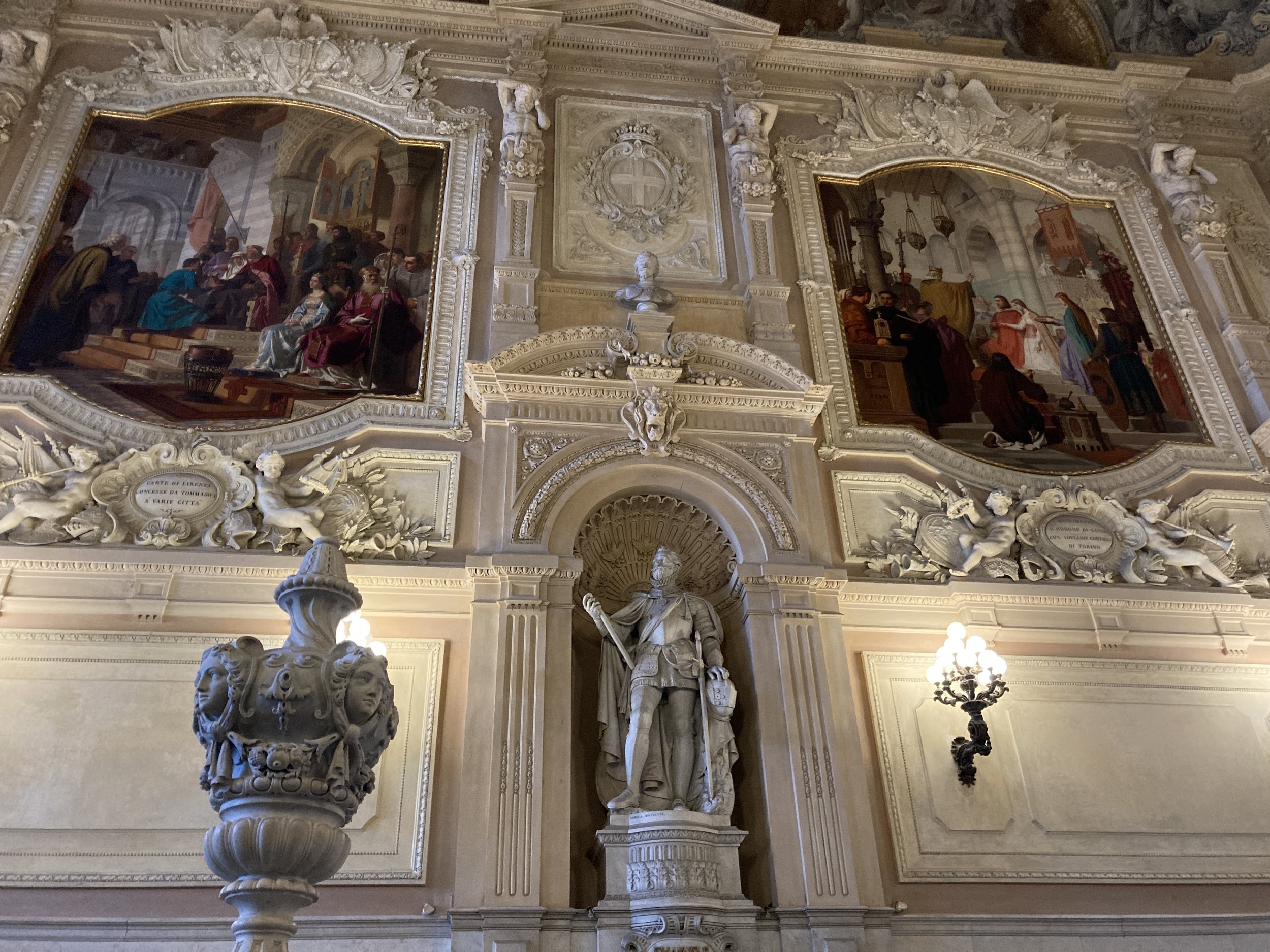
The entrance hall of the Royal Palace in Torino.

To fit both venues into a short visit, and avoid museum overload, we booked a combined tour through the agency Get Your Guide. The approximately 4 hour tour began at the Royal Museums and finished in the Egyptian Museum. Sofia, our tour guide, was fantastic and balanced explanations in both Italian and English for our mixed-language group of about 10 people. She was equally knowledgeable about the Royal Museums and the Egyptian Museum. She achieved the perfect mix of fact, legend, history, and interpretation of the exhibits.

Throne Room, Royal Palace

The two museums are dramatically different. The grand staircase in the Savoy Palace, the beautiful furnishings, the history of the Savoy family which is integral to the birth of modern Italy, all speak of a gracious and easily imagined era. Because the palace is still furnished, there is a real sense of how the Savoys lived here - the elegant Throne Room, the opulent dining room, the ball room, the hidden balconies for musicians, the exquisite wood work, the sculptures. The opulence is dazzling.

IMG_3017.jpeg
IMG_2975.jpeg
IMG_3025.jpeg

There is also a long gallery filled with a collection of armor and armaments. You can even get to know the former king’s favorite horses! Something fascinating is to be found around every corner.

IMG_2990.jpeg
IMG_2998.jpeg
IMG_3001.jpeg

The tour of the palace ended in the chapel build to house the Shroud of Turin. The chapel was fairly recently reopened after more than 20 years of restoration following a fire. The Shroud itself is nowhere to be seen (the nearby Duomo hosts an informative shroud exhibit but the real thing is too valuable to display), but the chapel itself is a work of art. The architecture, especially of the unique cupola (dome), and the sculptures are breathtaking (or, to use one of my favorite Italian words, mozzafiato!). The chapel was the perfect ending to the Royal Museums tour.

The multilayer hexagonal dome in the Chapel of the Holy Shroud rises high above the dark marble interior of the chapel.

On the other hand, and from a very different era, the Egyptian museum is filled with mummies and sarcophagi.

The story of how Torino came to host this collection of artifacts - and the faked Egyptian artifact that started the collection - made a fun story at the start of the tour. The guide’s explanations put this remote era into perspective and helped the artifacts blend together into a cohesive story. I was glad to have experienced this!

IMG_3066.jpeg
IMG_3043.jpeg
IMG_3065.jpeg
IMG_3047.jpeg

Although my goal was to just see these two museums, our last morning in Torino was gray and rainy. Not a good day for the outdoor exploration we had planned.

Instead, my companion and I walked over to see the Mole Antonelliana. This architectural stunner, designed by Alessandro Antonelli, is the symbol of Torino. It is such an iconic image in Italy that it is engraved on the Italian 2 euro coin. The spire rises high above the city and is visible from quite a distance. Once upon a time this was the tallest brick building in the world, it may still be the most beautiful. The bottom of the building is square, with another square portion siting on top. Above that rises a dome, topped by a very tall spire.

The Mole Antonelliana as seen from the gardens of the Royal Museums

Up those cables travels the elevator - quite the view !

Right through the middle of the building’s interior a glass elevator rides up cables to give visitors a view from high above.

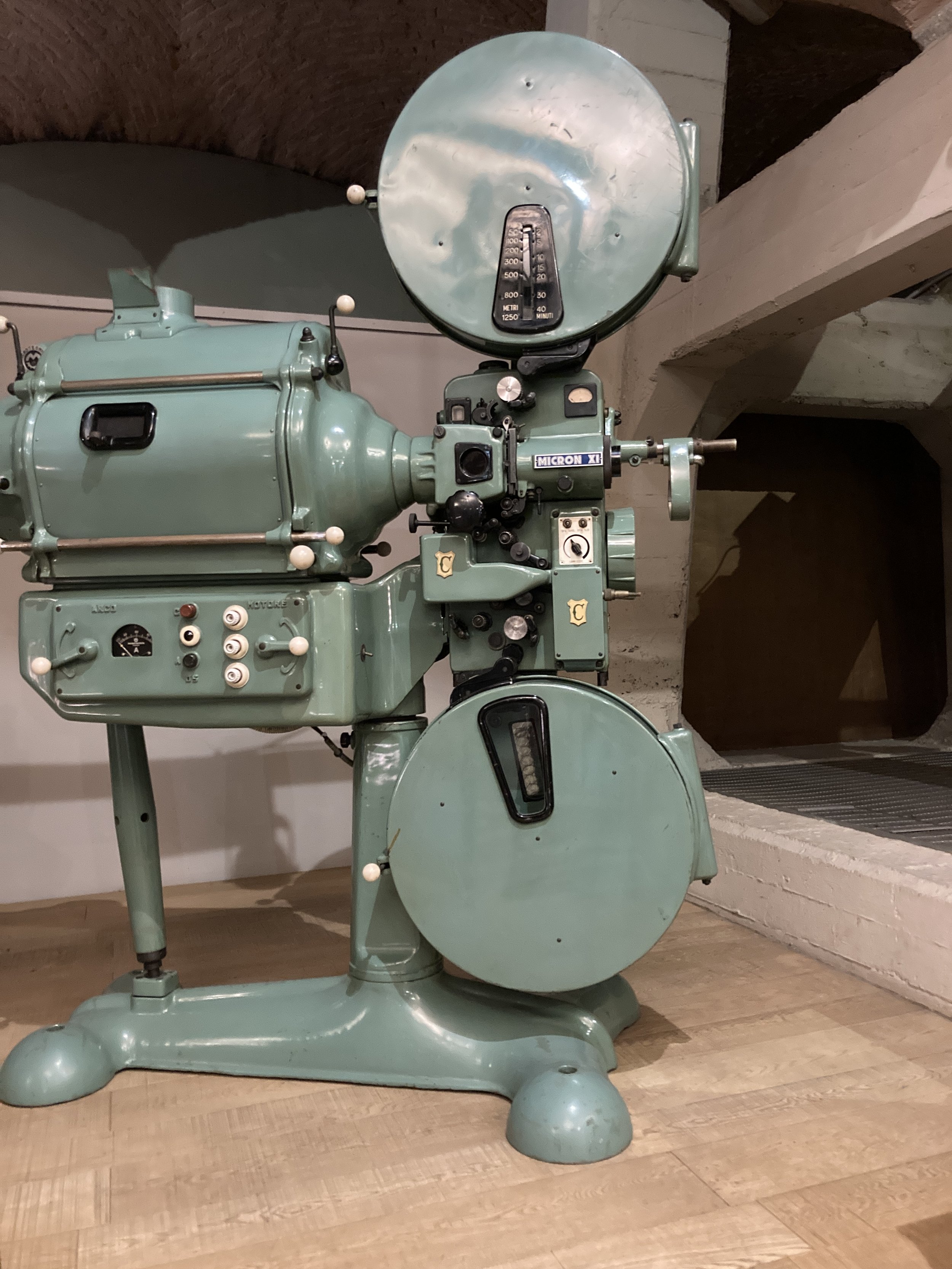
Originally destined to become a synagogue (no doubt without that elevator), today the building houses the Museo Nazionale del Cinema (National Cinema Museum).

I had not intended to go to inside the museum, but the outside of the building was so impressive that I really wanted to get a peak inside. I was totally unprepared for the experience of the cinema museum inside the Mole Antonelliana. A riot of sound, color, and visual effects fill the main hall. Big screens around the room show a variety of videos - there were even lounge chairs to sit back and take it all in! Exhibits trace the history of movies back to shadow images, stereoscopes, and the science of optics. There are collections of movie posters, costumes, special effects, and characters. It was too much to appreciate in a single short visit and definitely a place I will return to on my next trip to Torino (I think my grandkids would love it too).

05F3E678-90F9-4CE2-8C68-E44B13B790F0.jpeg
CCF732E8-8EFD-435A-9187-C298B67F4595.jpeg
027A5566-AD3E-4701-B241-1050DE02F012.jpeg
DBBECC60-7D67-464E-A7F8-093DF313FAD2.jpeg

The next time I get to Torino there are even more museums to visit - Ancient art in the Palazzo Madama and Italian national history at the Museo Nazionale del Risorgimento. I am glad that I didn’t try to do them all in a single trip!

January 17, 2022 /Joanne Bartram
Turin, Torino, #torino, #turin, Musei Reale Turin, Museu Egizio Torino, Museums Turin Italy, Get your Guide tours
#italytravel, Italian art architecture, Italy, Italy travel

Bold color along the east side of the walls that surround Lucca.

November

November 15, 2021 by Joanne Bartram in #fallinitaly, #lucca, Italy, Living in Italy, Lucca

November is a gentle month here in Lucca. The tourists, who returned this summer and lingered into September and October, have mostly returned to their homes. Lucca Comics and Games, smaller than usual this year but still bringing lots of costumed visitors to town over the Halloween weekend, has come and gone. We may have given up our summer Aperol Spritzes in favor of deep red wines but we are still enjoying outdoor seating at cafes. I am thankful for the ones that have set up heaters so that we can continue to sip a morning cappuccino or an evening aperitivo outside in a pretty piazza.

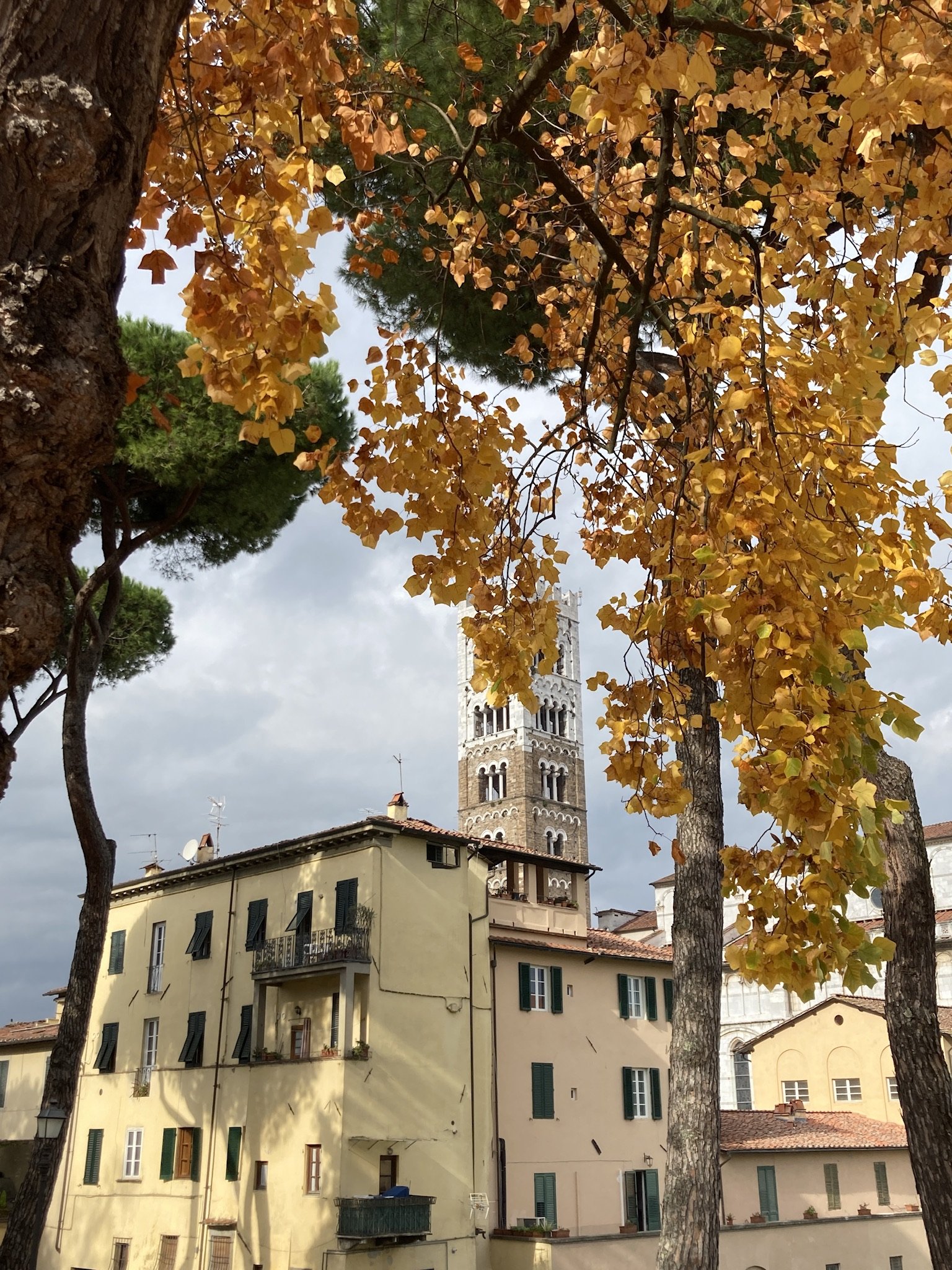
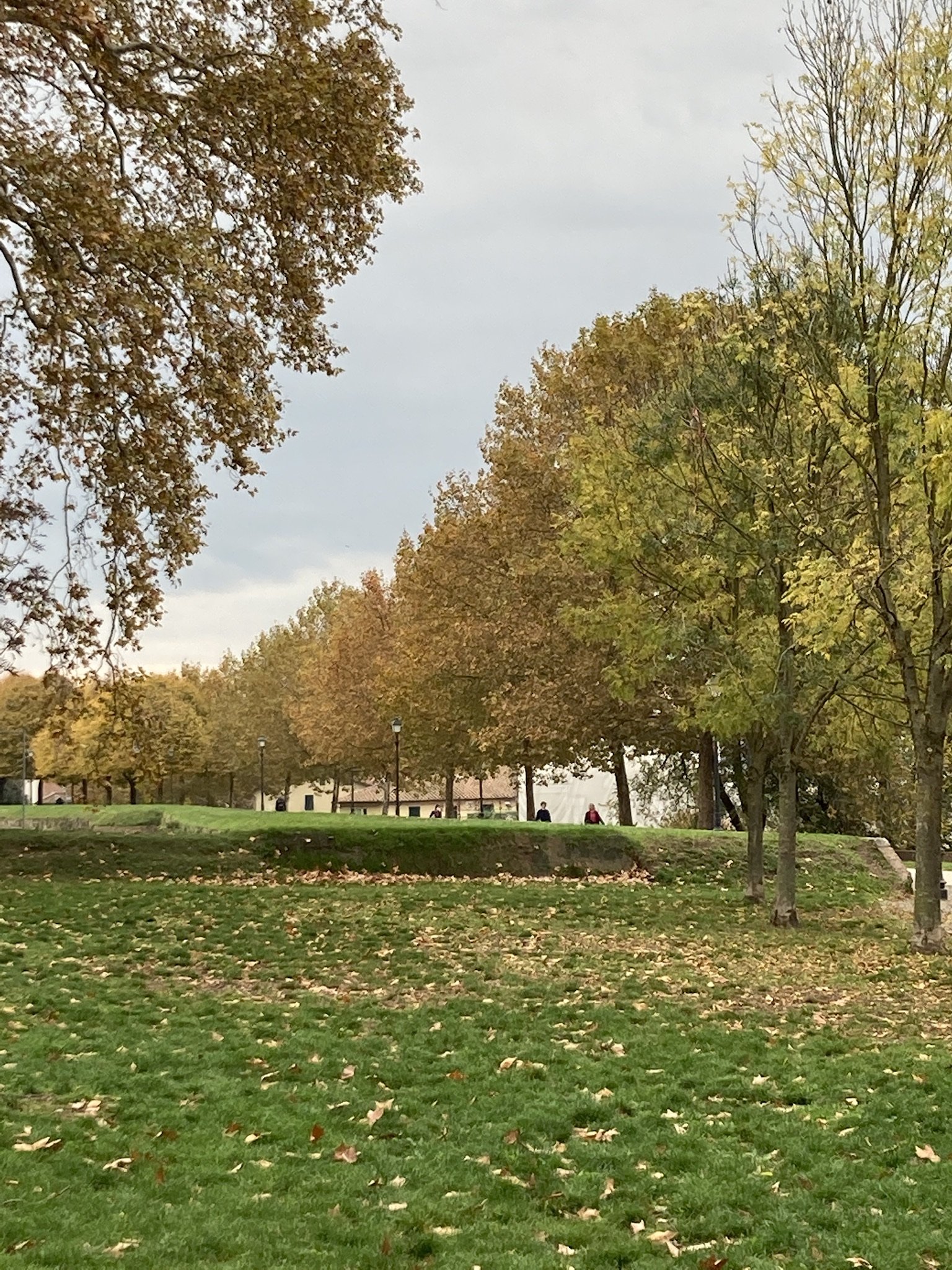
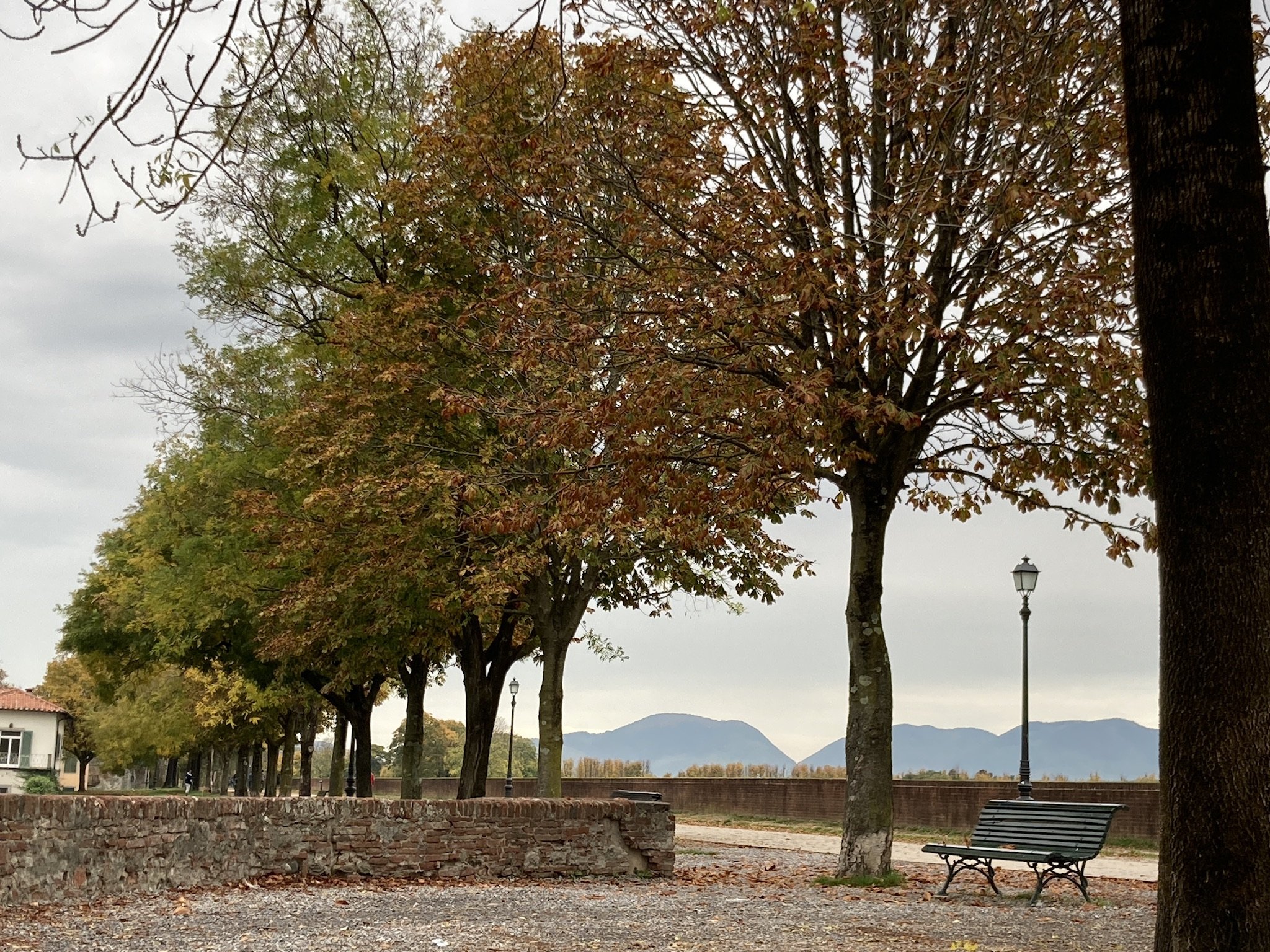
Of course the very best part of November is the explosion of color throughout Lucca. A walk along Le Mura (the ancient wall surrounding the historic center of town) is a kaleidoscope of changing views. The wall makes a complete circuit, so that some parts face north, others south, still others east or west. Each section is planted with different types of trees and receives varied amounts of sun and shade, so the type of foliage varies as does the progress of color change and the dropping of leaves. In November, the reds, golds, yellows, and browns provide a complex palette of hues. They contrast with the evergreen pine trees, the green of grass and moss, and the ever changing skies.

ADDD542D-E11A-48E8-9E67-12BC400B1CFD.jpeg

Along the southern stretch of the wall.

November walks along the wall engage other senses as well - the sound of dried leaves crunching under foot (or the squish of wet ones on rainy days) and the gentle touch of leaves drifting overhead like a colorful snow storm. But beware the less gentle feel of a chestnut falling on your head! And as a bonus - the distant sound of church bells ringing gives many of my November walks a pleasing soundtrack.

A view towards the Church of St. Gemma, outside the walls of Lucca.

Not all the colorful action takes place on the walls. From the walls, the views out over the larger city of Lucca are also full of fall beauty. And those distant hills!

Distant hills make a dramatic backdrop to the walls northern section.

Throughout town the season is changing too. A walk through the botanic gardens is enchanting at this time of year. The trees ringing Piazza Napoleone are changing colors too. Not all the color is on the trees - colorful scarfs are wrapped around the necks of everyone to ward off the chilly weather.

Piazza Napoleone

Street vendors are beginning to roast chestnuts, a smell that hints of winter just around the corner. And while many of the Americans here are beginning to plan Thanksgiving dinners (we are oh so thankful that we can gather together this year), local shops are already beginning to display Christmas goods (I am not ready for that yet!)

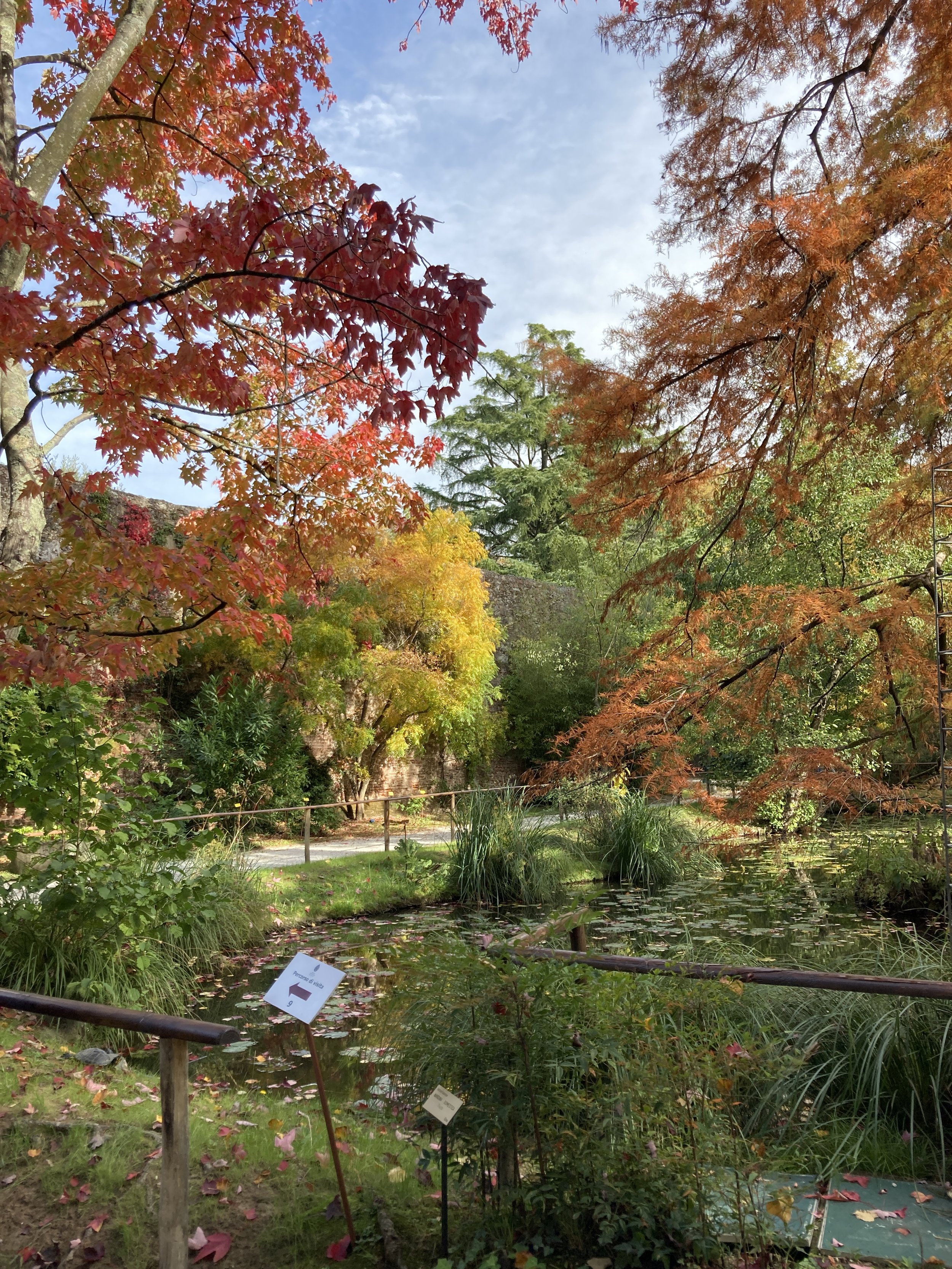
Fall in the Orto Botanico (Botanic Garden)

November here is so lovely - the chilly mornings, the long hours of dusk, the mild temperatures, the colorful trees, even the scattered rain showers. Lucca continues to enchant.

November 15, 2021 /Joanne Bartram
Fall Italy, Fall Lucca, Lucca
#fallinitaly, #lucca, Italy, Living in Italy, Lucca

The Quadrilatero Romano : A Different Side of Torino

November 08, 2021 by Joanne Bartram in Italian art architecture, Italian culture, Italy, Italy travel

Like many Italian cities, Torino (Turin) has Roman roots. But that history is less obvious here than in places like Rome, Verona or even the small town of Lucca where I live. In Torino, you have to hunt a bit for its Roman beginnings.

The Quadrilatero Romano is where Torino began; where the Roman city stood. It stretches north and west from the Palazzo Madama. Today it is a characteristic and vibrant neighborhood. But look closely and the traces of Rome appear.

The most obvious Roman feature is the Porta Palatina, the only one of the Roman gates into the city which remains. It rises at the northern end of the Quadrilatero, where it has stood since the 1st century BC. The central portion has a stretch of arches, larger ones for vehicles and pedestrians at ground level with two levels of windows above . The archways are flanked at either end by a pair of polygonal towers. It’s easy to imagine Roman chariots passing under the large main arch. Nearby is a stretch of Roman wall, in the same brick. The Roman theater was also located in this area and other Roman ruins can be found nearby.

3B455D5F-D4C0-4D96-8BF0-4454C2C72A6E.jpeg

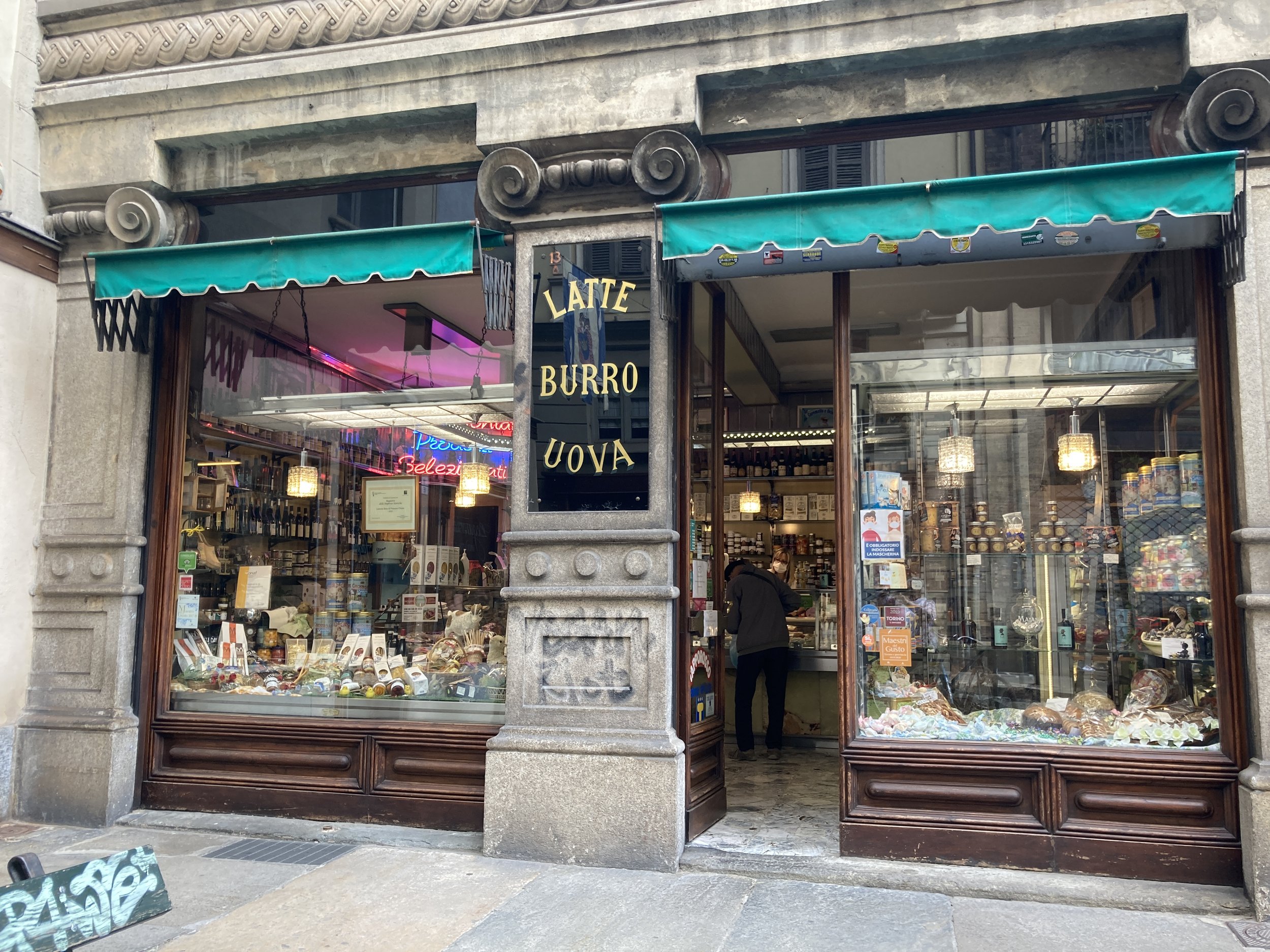
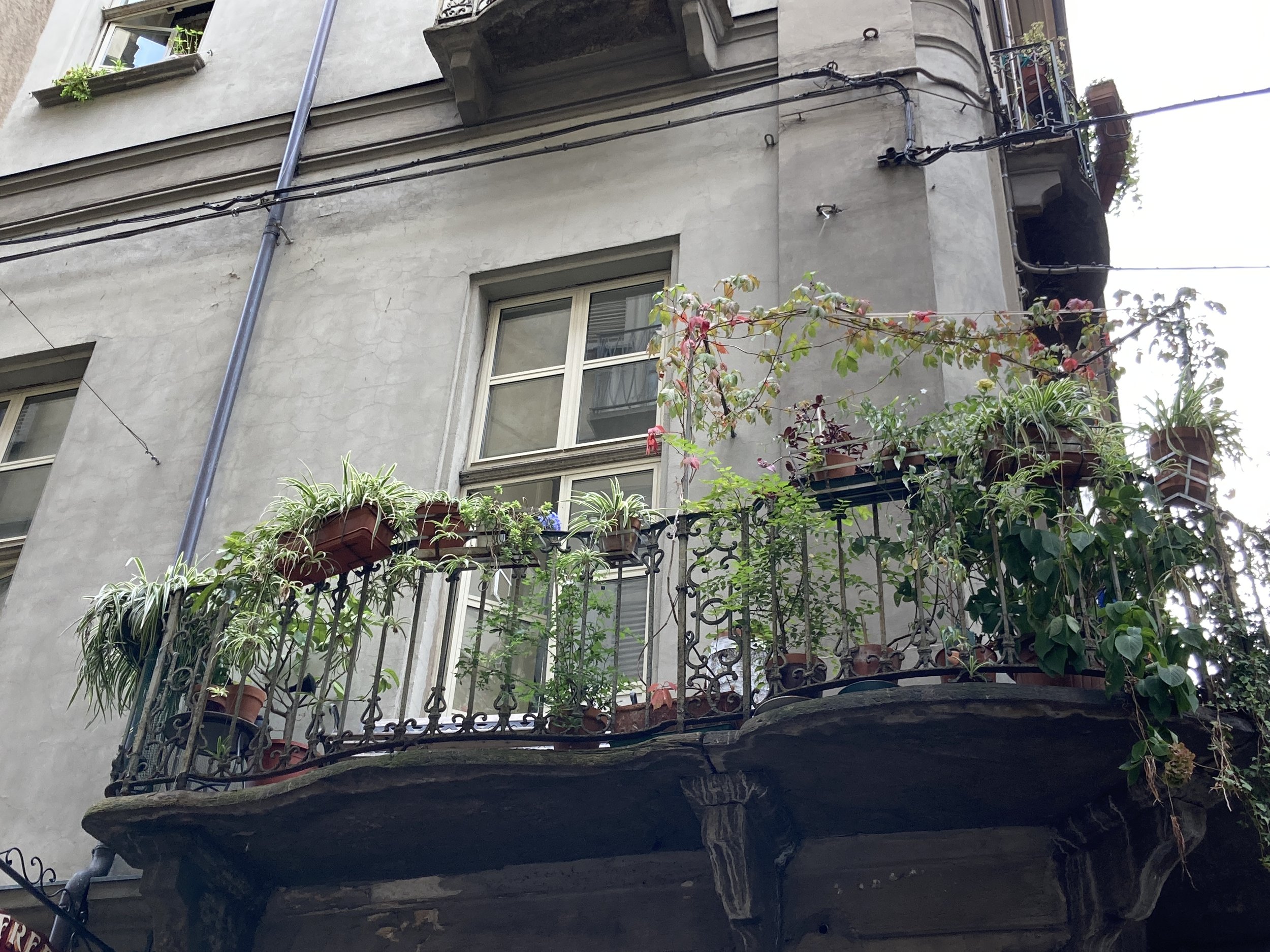
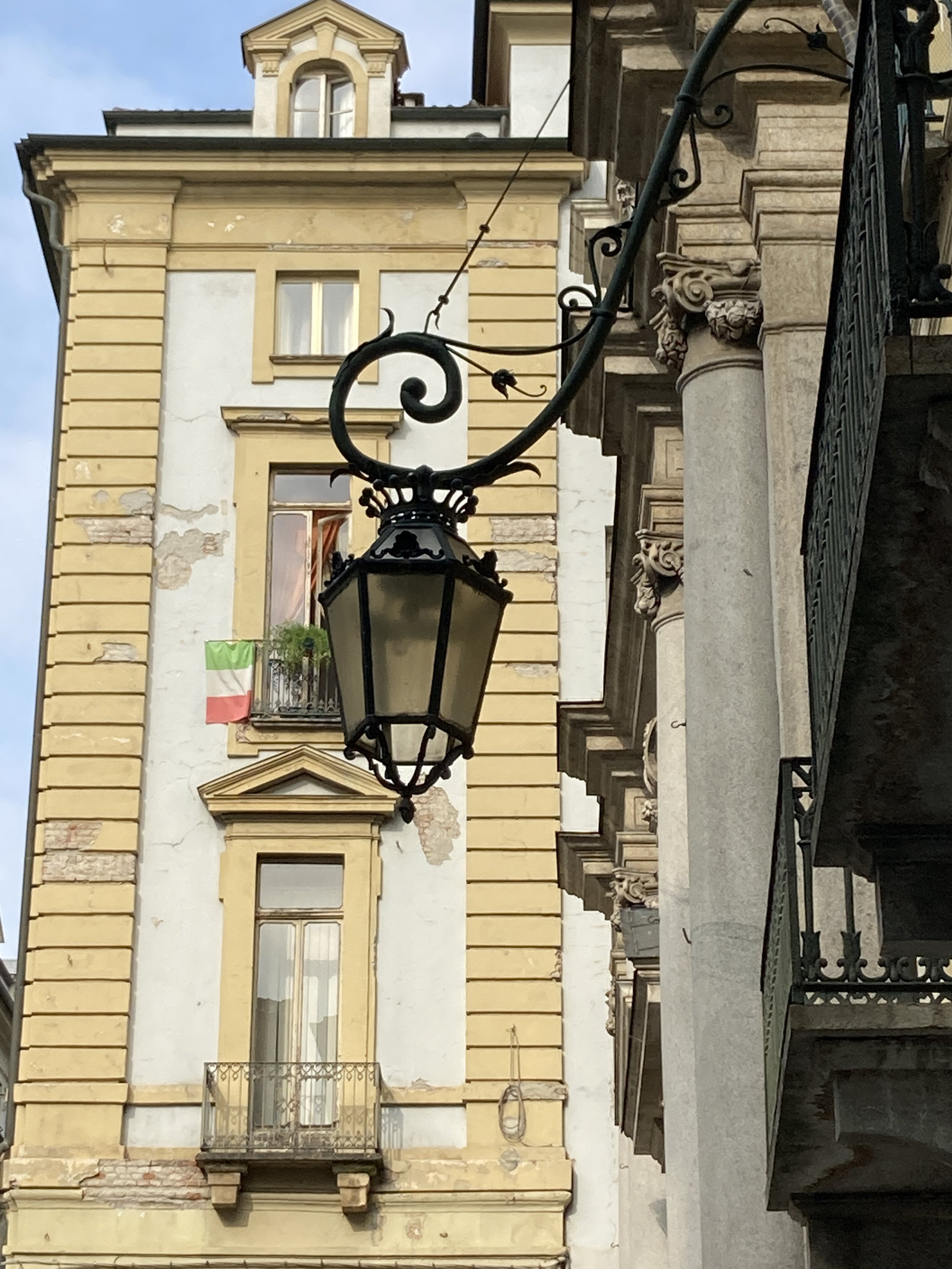
Beyond its Roman roots, the Quadrilatero is a unique area with a small village feel, quite different from the other areas of central Torino. The streets are narrow and dressed up with pretty street lamps and small balconies. Interesting shops, cafes, and restaurants dot the streets. It’s a place that makes you want to linger.

157D4F4F-CF6E-4F12-96C6-2C243CC2EB75.jpeg
3337233F-BA7F-4696-835E-D850FEA69A37.jpeg
ABA44425-A5CA-4C2B-B688-40B503F1A15F.jpeg
5E6392FE-7492-4473-8F69-0D0769E1F55B.jpeg

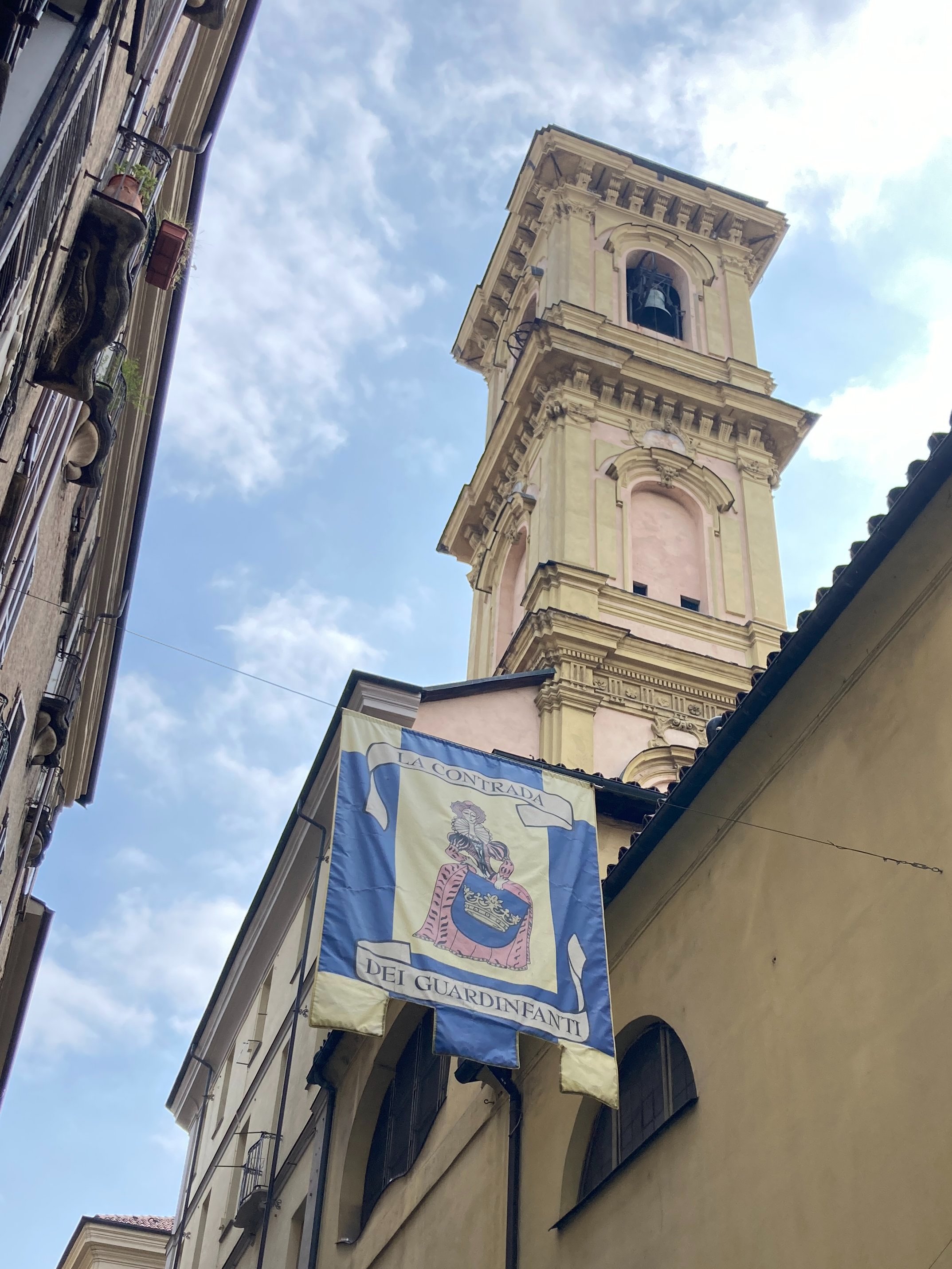
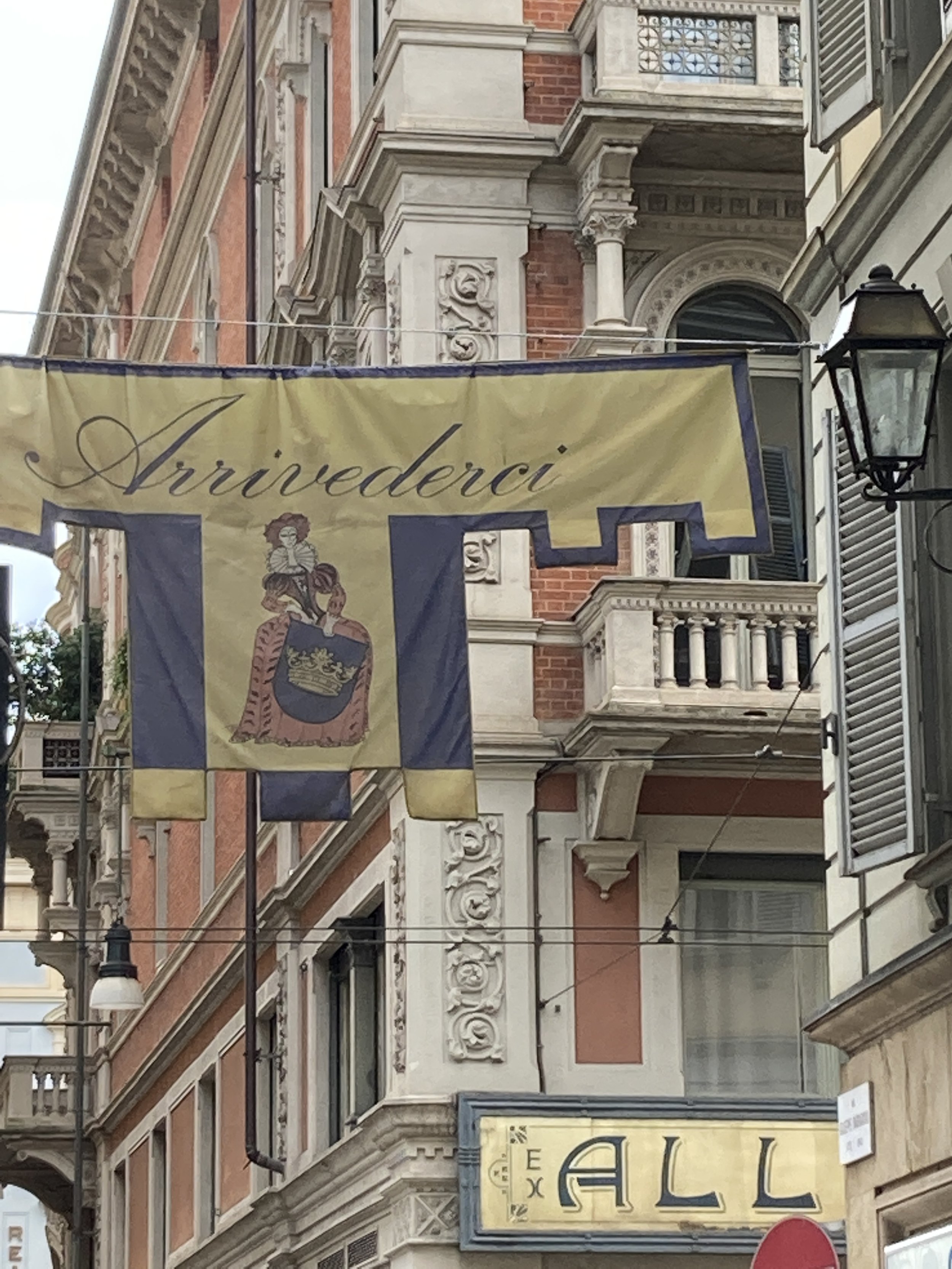
Overhead are a series of colorful banners identifying the Contrada dei Guardinfanti. A contrada is a district, but I have to admit that I had no idea what a guardinfanti was. Something for guarding babies? Nope, not even close. The banners mark this area as the district where merchants of the particular contraption which went under a ladies dress giving it a full appearance - called guardinfanti - had their shops. Clearly these were not Roman merchants, but from a later more fashionable era! Today their banners contribute to the unique old world feel of this neighborhood.

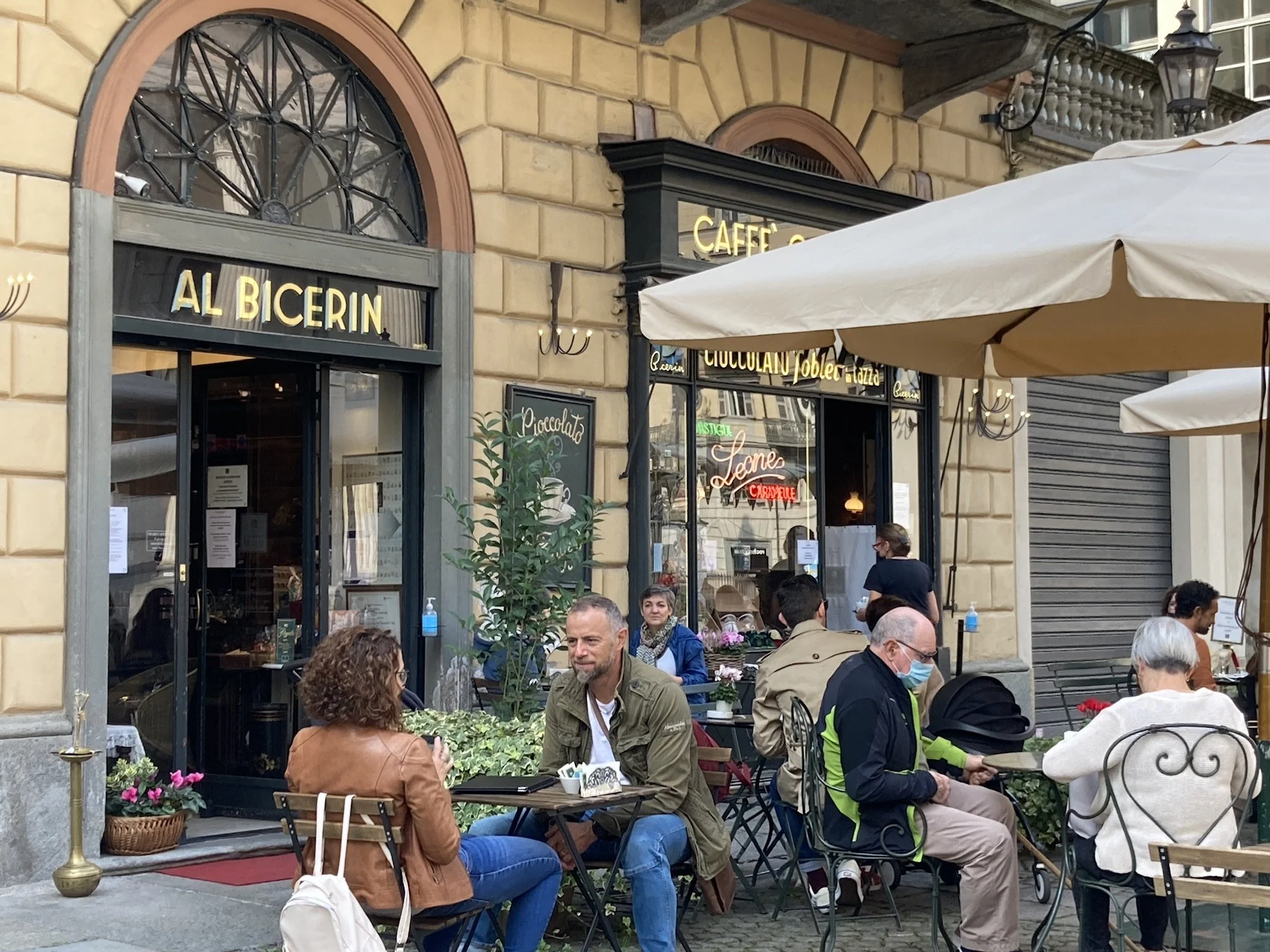
One of the largest piazzas in the Quadrilatero, at its western edge, is the Piazza della Consolata. This is a lovely square and the perfect place to stop for one of Torino’s signature treats - a Bicerin. The Bicerin is a hot drink with layers of coffee, chocolate, and cream. I saw two variations in Torino - one with 3 distinct layers and another with two layers (with the coffee and chocolate combined in a single layer). There is no better spot to sample one than at Caffe` Bicerin in Piazza della Consolata. Not too sweet, with just the right blend of coffee and chocolate. I had to try one in the name of research, right? As for the accompanying plate of cookies, I have no excuse!

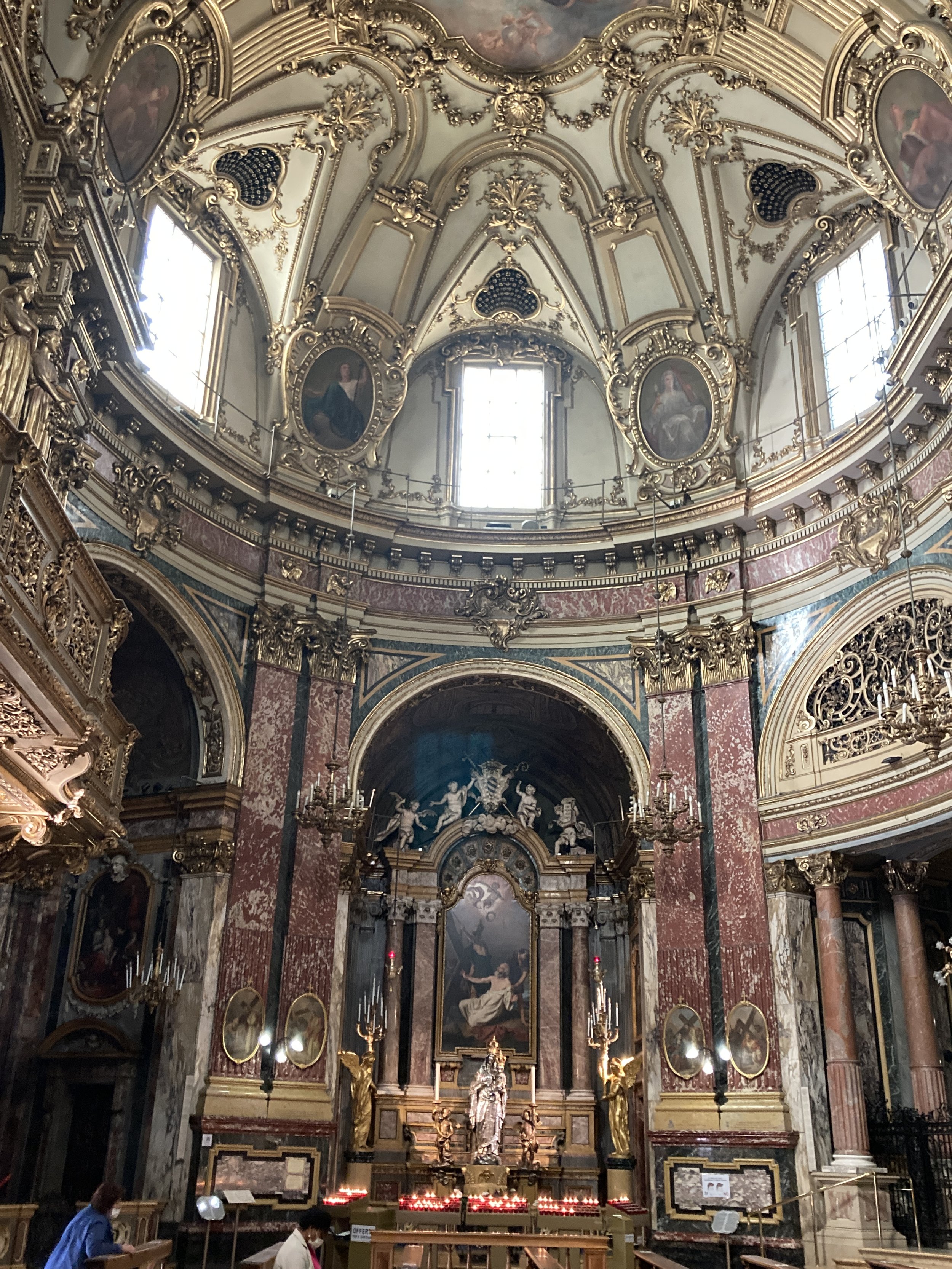
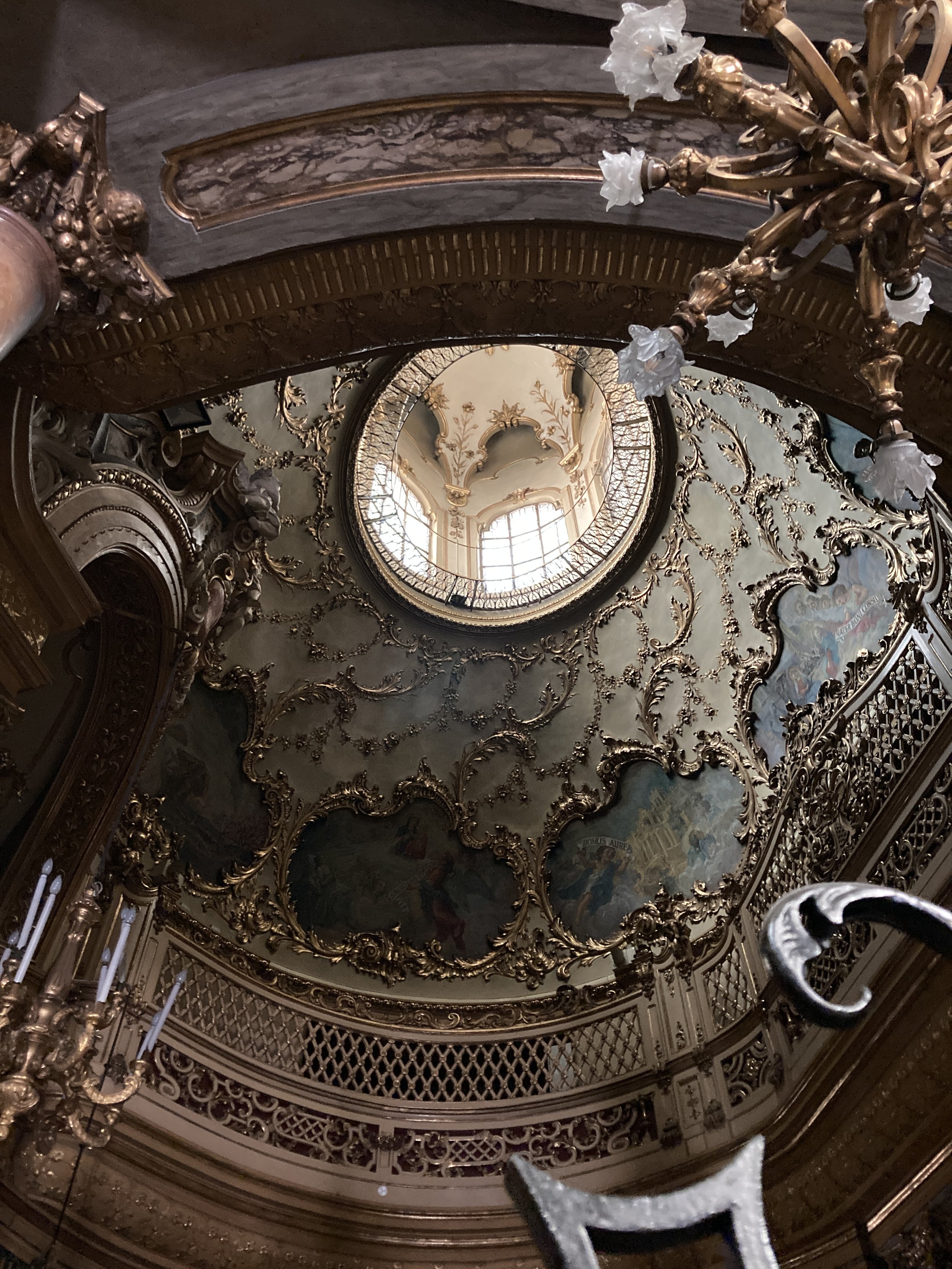
After sipping a Bicerin, a step across the piazza leads to the Santuario della Consolata (Church of the Virgin of the Consolation). The somewhat plain exterior of this church did nothing to prepare me for the ornate and colorful interior, including a most interesting crypt. Unlike most crypts, which tend to be dark and undecorated, this one was spectacular with very elaborate decoration. A jewel box of a small church.

CD6BF4B3-02A3-44C2-966F-310AEB4B1284.jpeg
6CCAB271-46A4-46E8-B69A-19CB8E9A59BA.jpeg

Whenever I visit a new place I always find myself wondering what it would be like to live there. In the case of Torino, I would happily live in the trendy Quadrilatero neighborhood. But I’d have to remember to limit my Bicerin consumption!

November 08, 2021 /Joanne Bartram
Turin, Torino, Quadrilatero Romano, Neighborhoods Torino, Bicerin, #torino
Italian art architecture, Italian culture, Italy, Italy travel
  • Newer
  • Older

Powered by Squarespace