Two Parts Italy

Exploring Italy, travel, and living a flavorful life

  • Blog
  • About This Blog
  • Start Here
  • Recent Posts
  • Archives by Topic
  • Subscribe
  • Contact me

A quiet walk through Lucca early on a Monday morning

A Quiet Monday Morning in Lucca

May 15, 2023 by Joanne Bartram in #lucca, #springintuscany, Italian culture, Italy, Italy travel, Living in Italy, Lucca

A crowded Piazza Anfiteatro during the Santa Zita celebration.

Lucca’s tourist season begins in earnest as soon as April arrives.  Between a host of holidays, a major music festival, and the arrival of gorgeous spring weather, the last few weekends have seen this small city bursting with activity and people.  

 This year it also seems as if the big tour groups, many of them coming from cruise ships docked in Livorno, have arrived early and in bigger numbers than ever.  The tour groups come from all over.  I’ve heard guides speaking in Italian, German, English, and French.  I am happy to see visitors introduced to Lucca, but …. and this is a big but … the small streets and alleyways of Lucca were not made for so many large groups. 

The smaller groups accompanied by private local groups move through town with ease (and are an ideal way to see Lucca), but the really big groups tend to obstruct traffic, clog the streets, and make moving through town quite difficult for locals. 

How I wish the large groups would be advised to keep to one side of the street to allow room for people to pass!  If I had a euro for every time I say “permesso” as I try to get through a large group, well, my rent would be paid for the next 3 months.   Do I sound grumpy?  Well, yes, I guess I am a bit.  After a quiet winter and early spring, the sudden arrival of crowds feels a bit overwhelming.

 The good news is that Monday mornings bring a bit of relief.  Last Monday I was out early to run some errands - a trip to the lavanderia (laundry) to pick up my linens, to the Ortofrutta (fruit and vegetable market) for some vegetables, and to the little shop that sells all kinds of electric lights and appliances to get a replacement light bulb for my kitchen.  I avoided doing these errands over the weekend, but a Monday morning seemed like the right time.  The quiet streets were just perfect for being out and about. 

Early on a Monday morning is the perfect time to go to the Ortofrutta. Look at those gorgeous fruits and veggies!

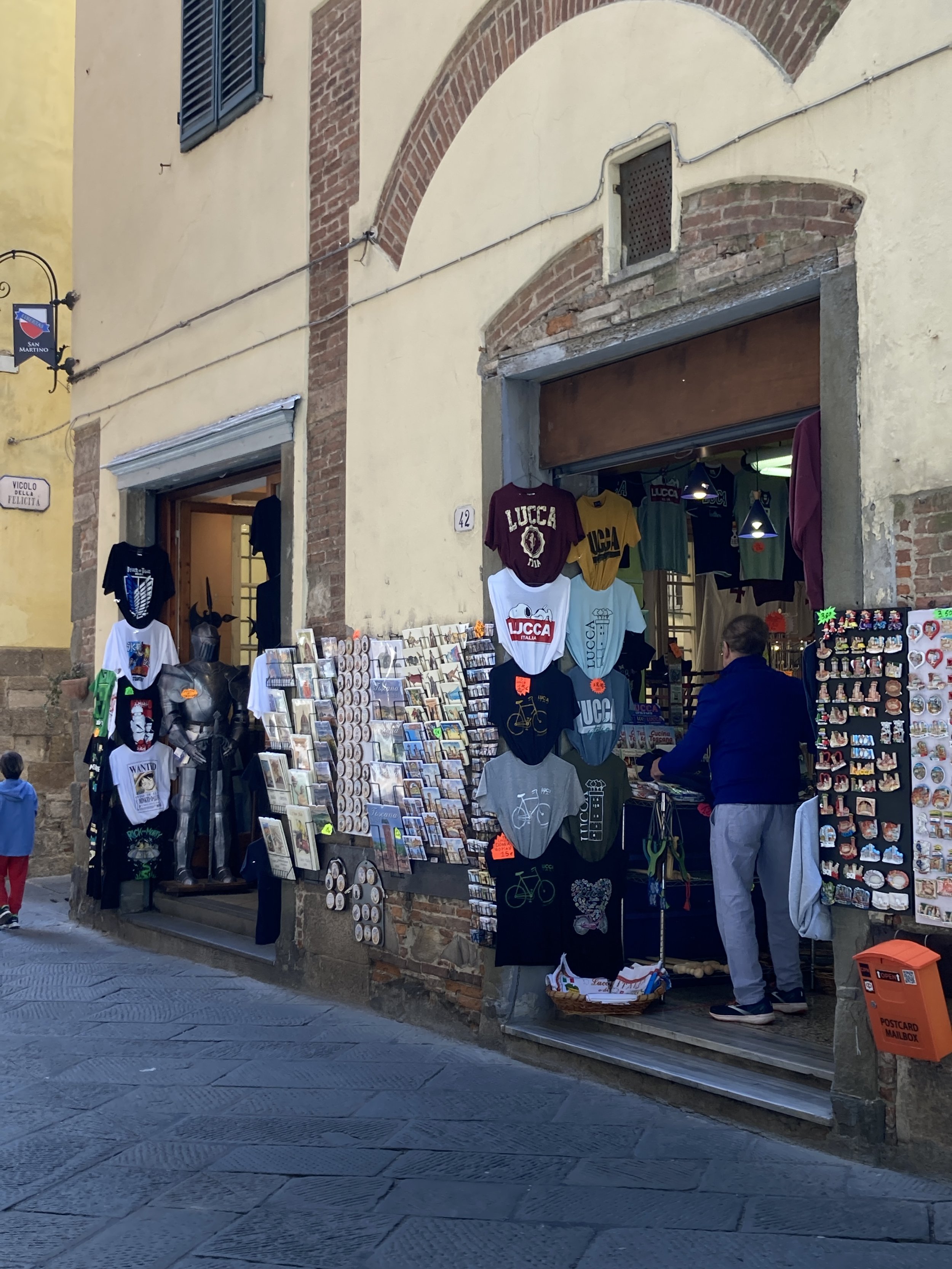
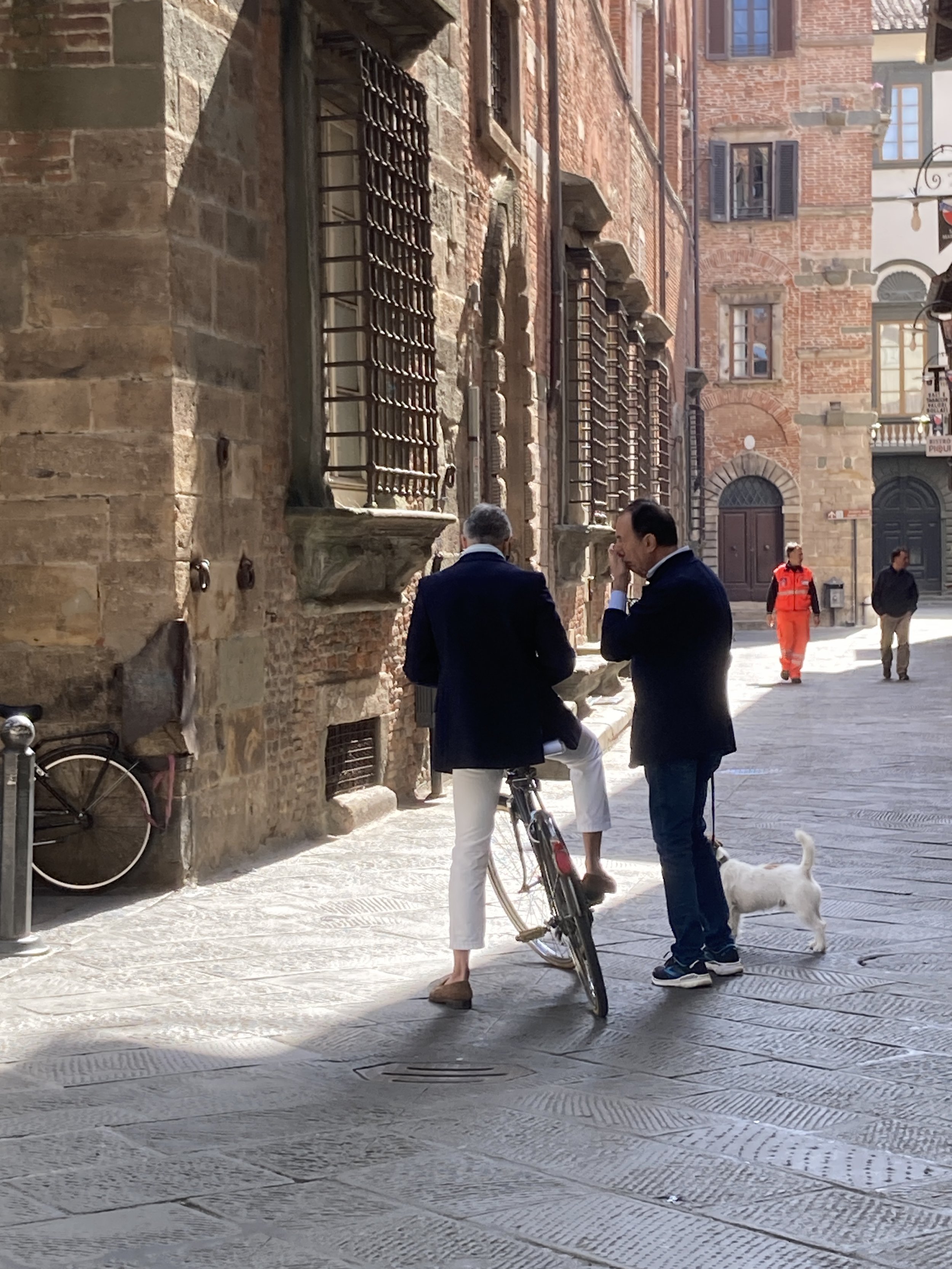
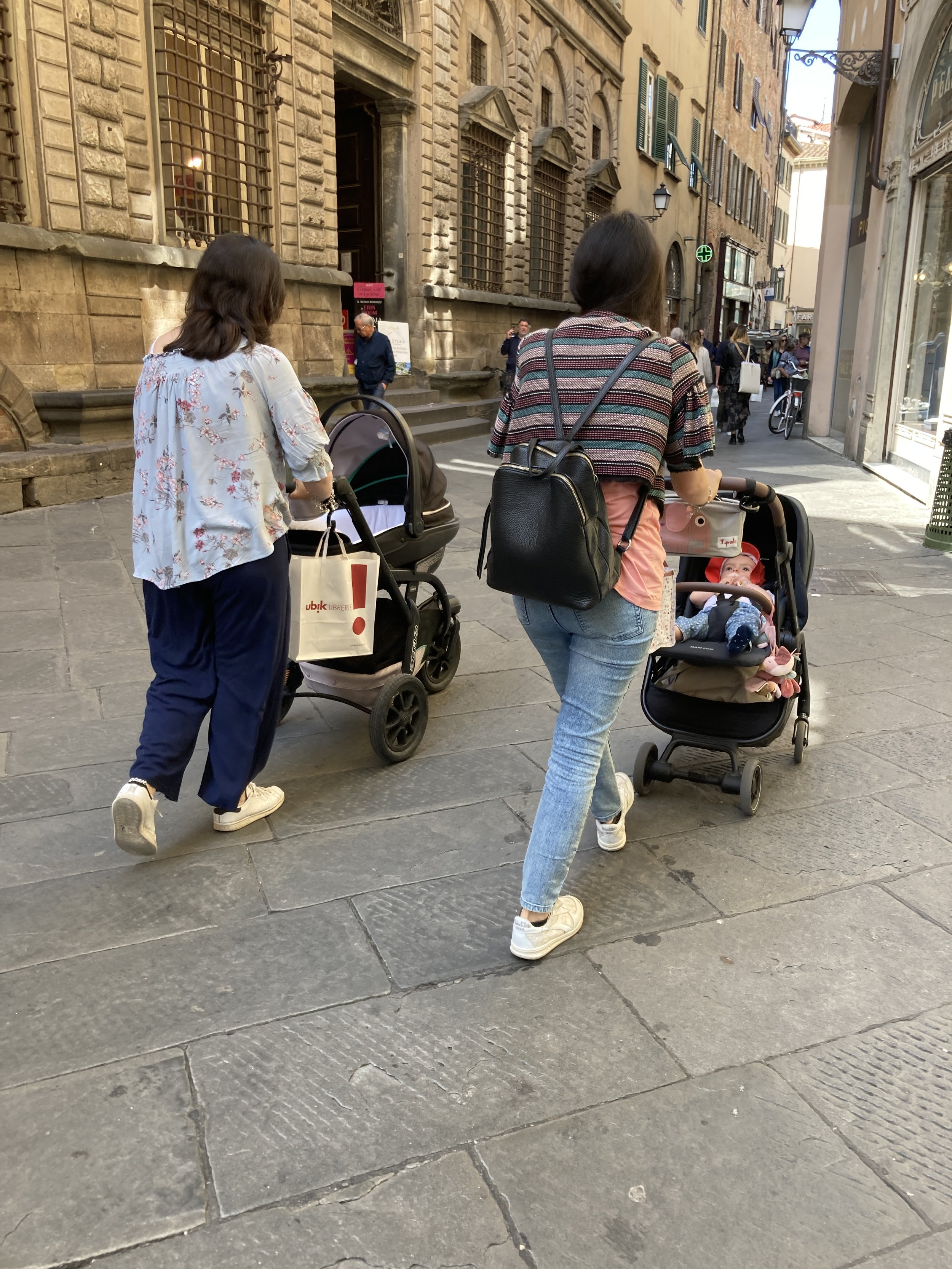
 Even the main piazzas were nearly empty and the streets around my apartment were quiet too. I encountered just a few locals going about their daily tasks. Shopkeepers were opening up and delivery trucks were bringing supplies to shops and restaurants. Birds sang and their songs were not lost in the hubbub of a busy weekend.
05E33DF5-E944-49D5-B2C1-88270C170354.jpeg
79170537-C975-4227-9C9D-72E584B5FF1F.jpeg
5B34C821-D7A7-41FD-B809-F85676F16518.jpeg

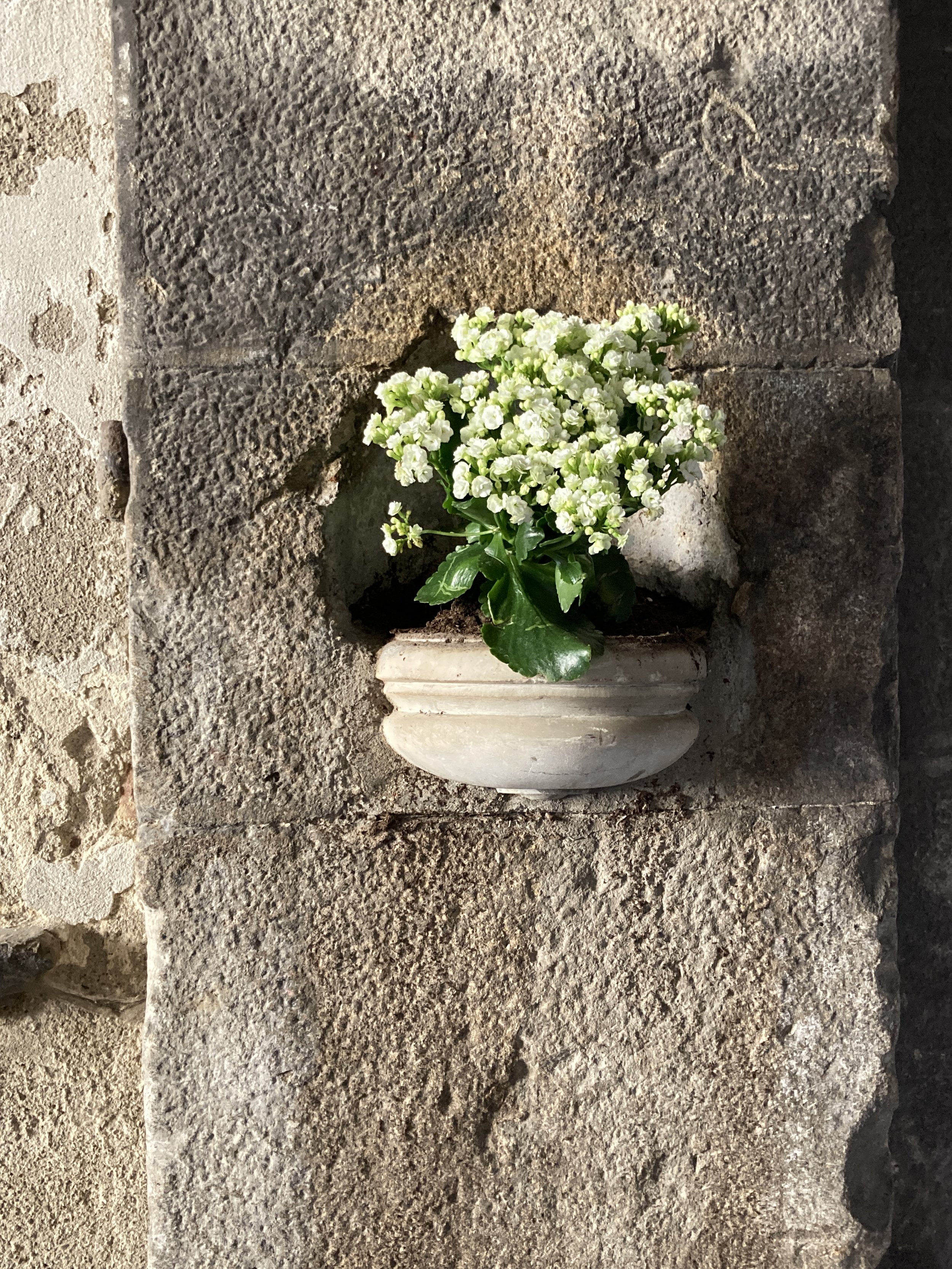
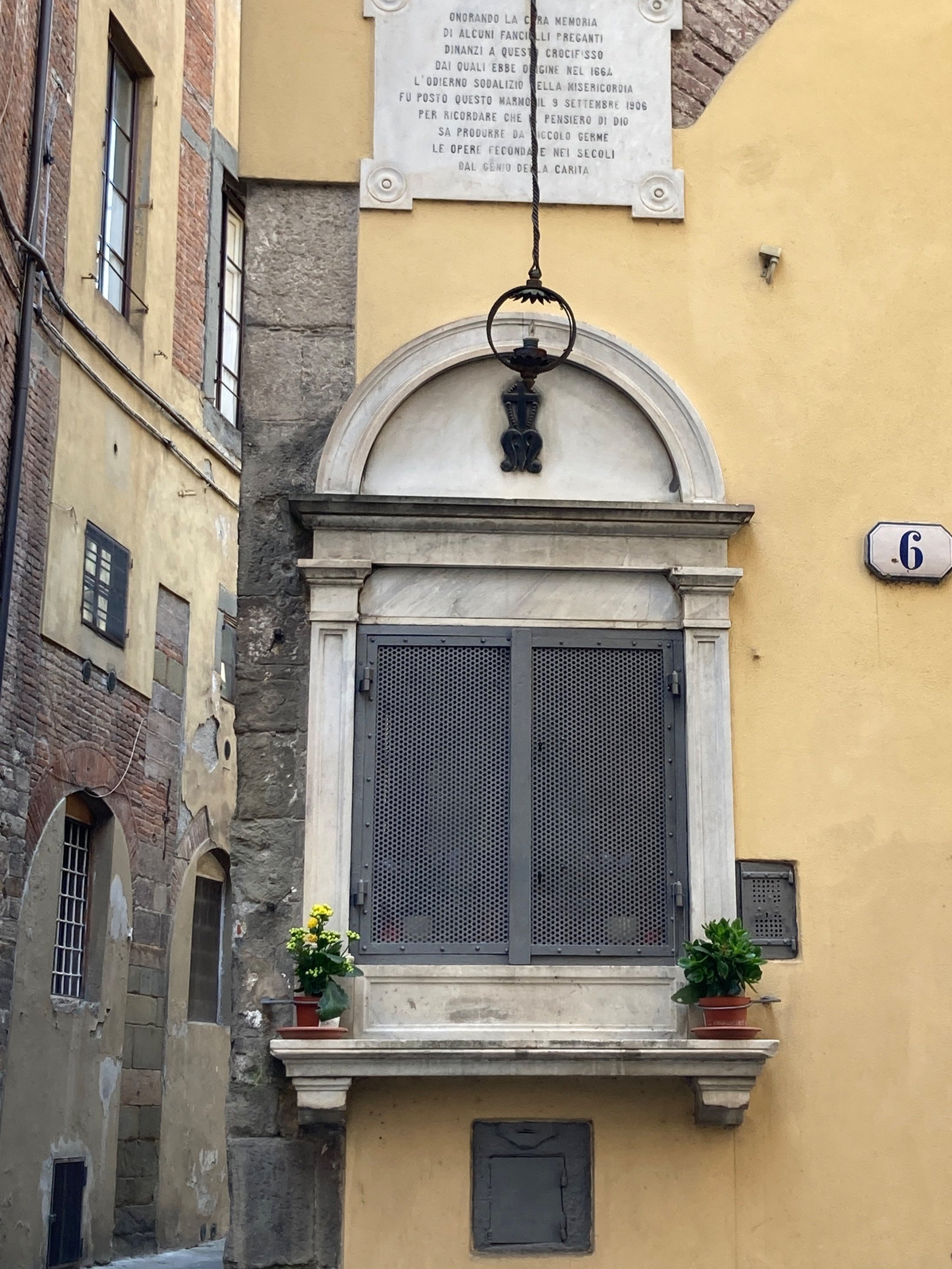
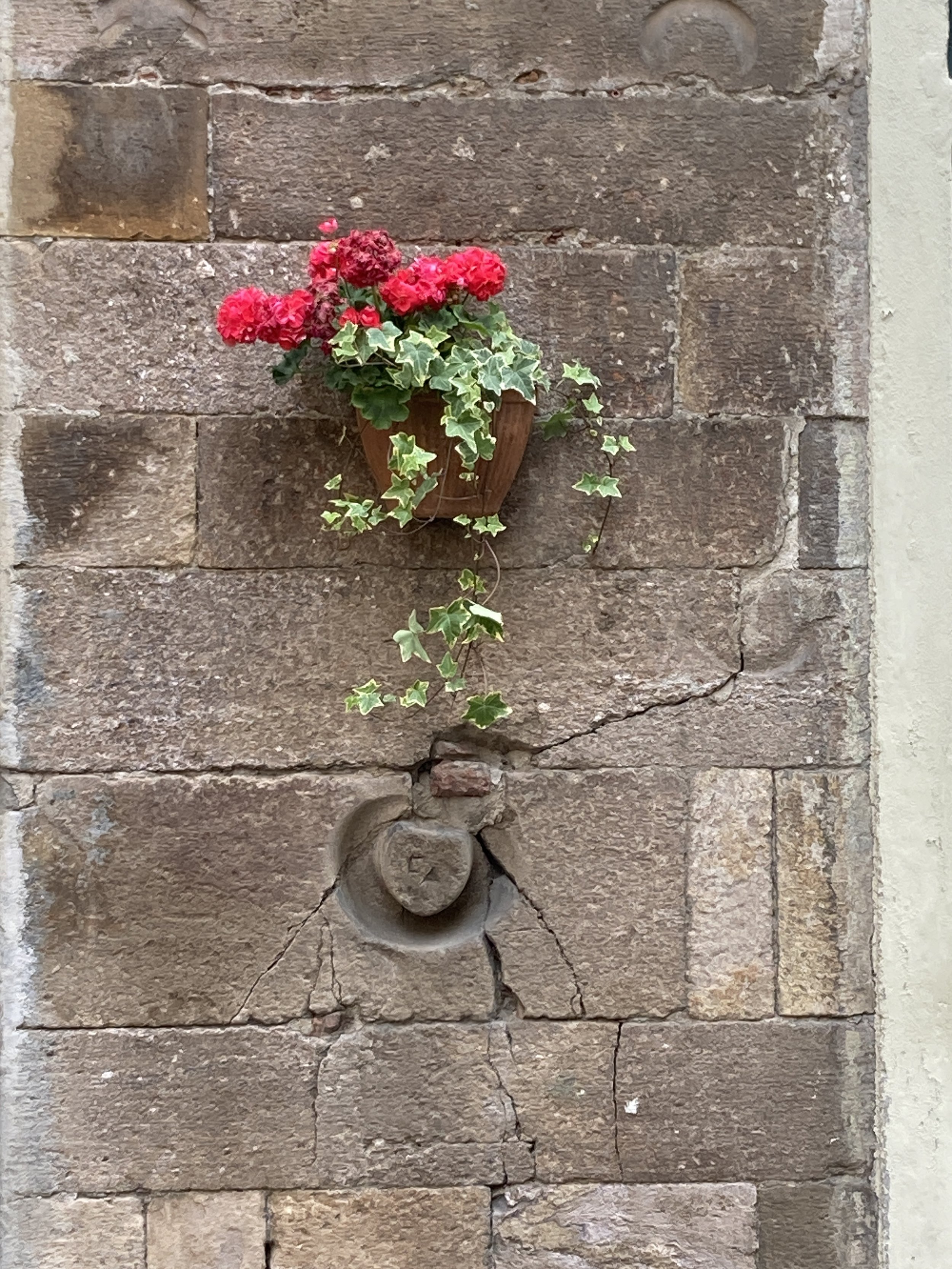
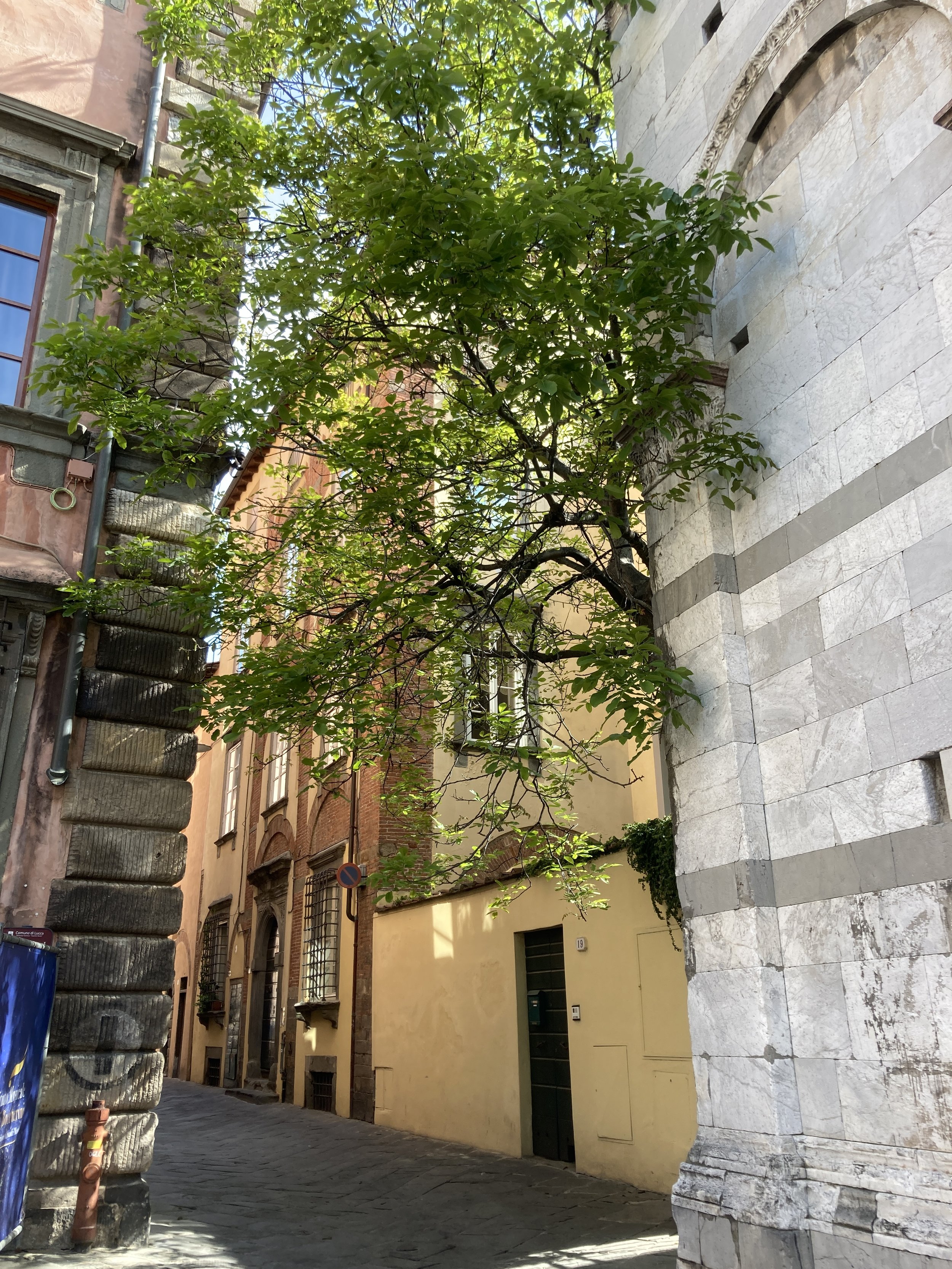
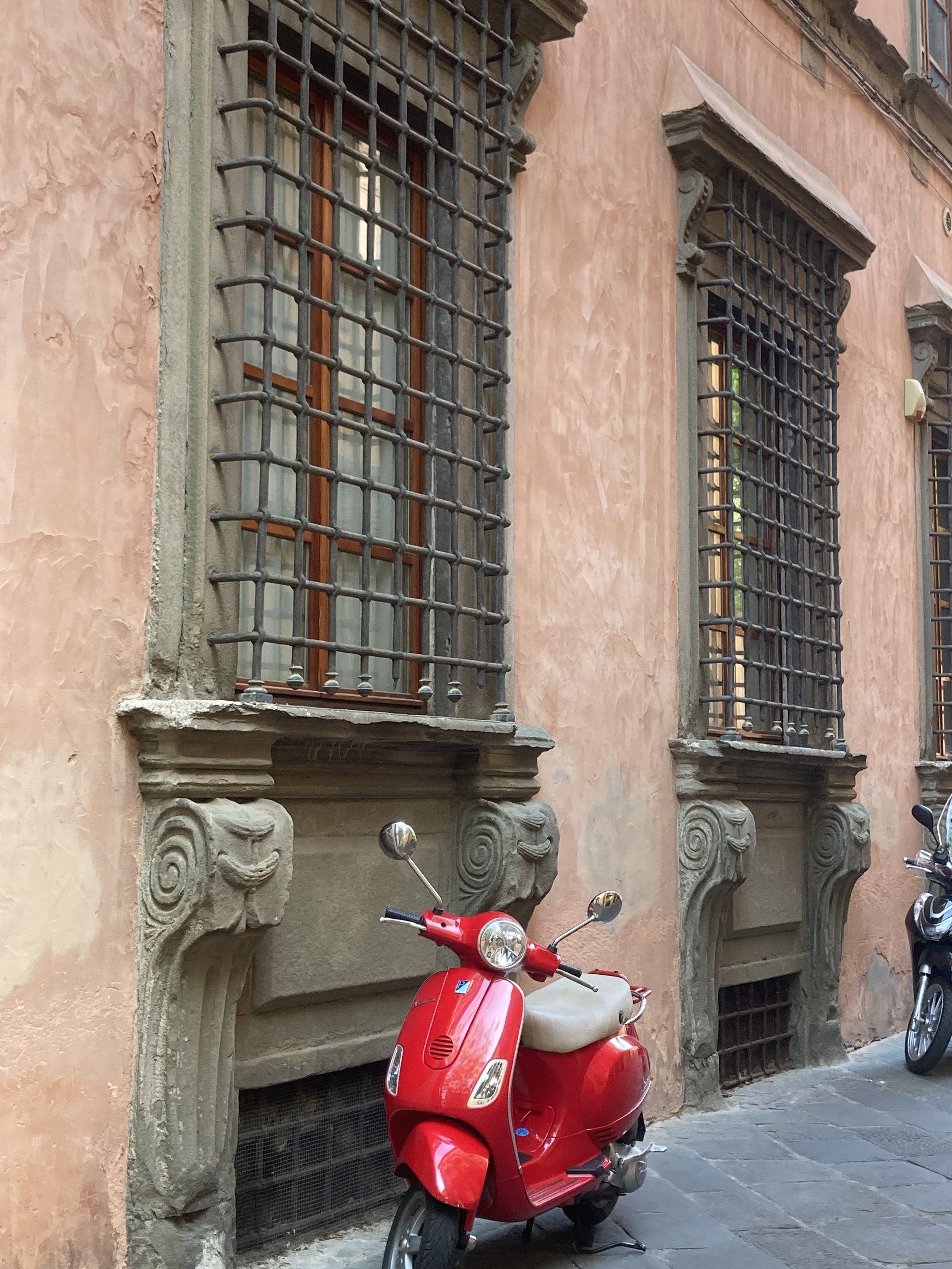
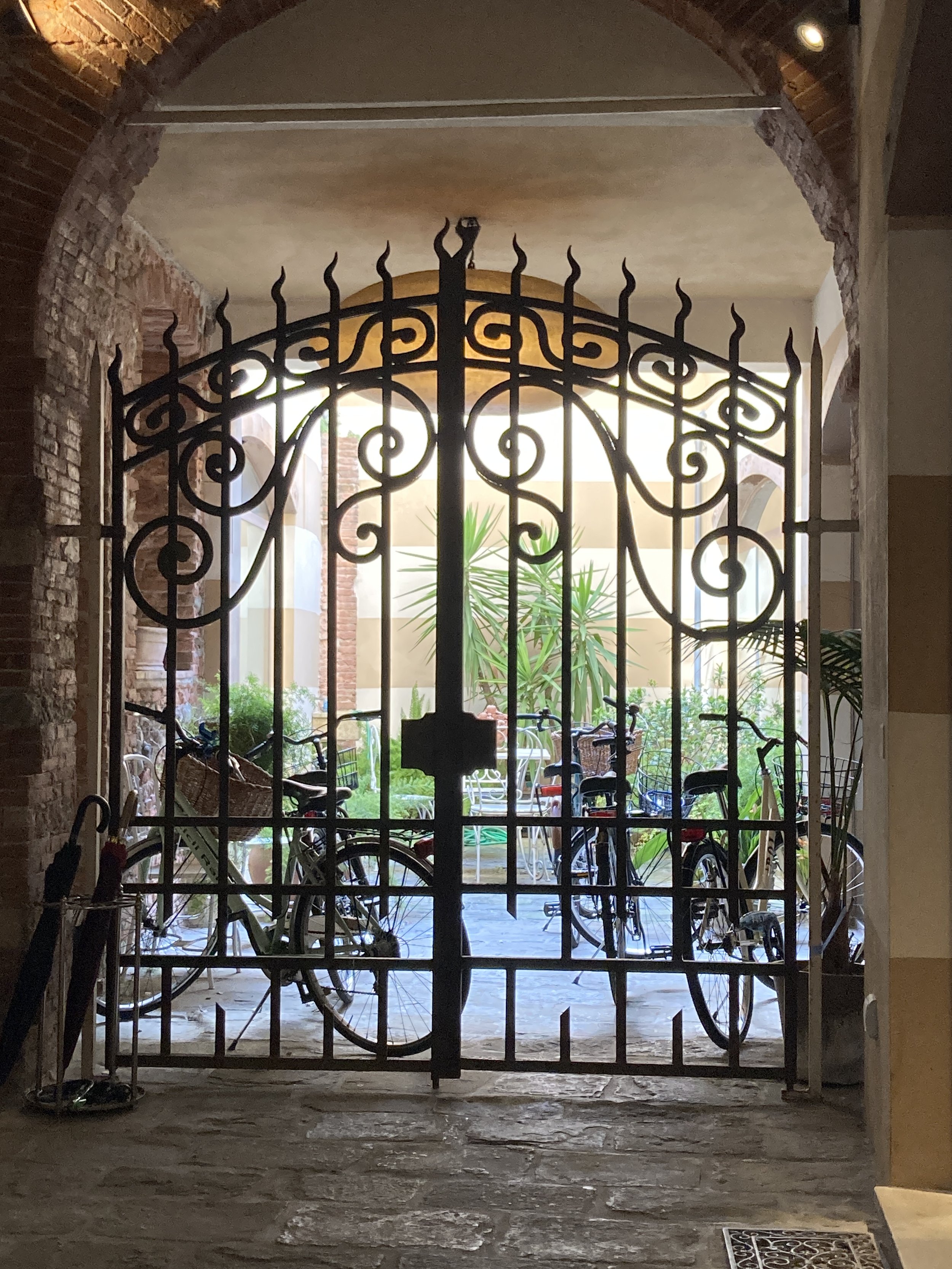
 Mild temperatures, a soft breeze, and uncrowded streets made for a perfect morning of wandering through town and noticing all the wonderful things about spring in Lucca.  Green trees, pretty flowers in pots and on balconies, the old brick of medieval buildings, pretty doors and windows, hidden corners, and the sounds of the city waking up and coming to life. 
B305E32D-A58E-4233-B95B-178E6EC33E88.jpeg
FA86CE44-2968-456C-80D4-0183634B514F.jpeg
E8B2B1B1-C08D-4312-9D93-EBA0F4182384.jpg

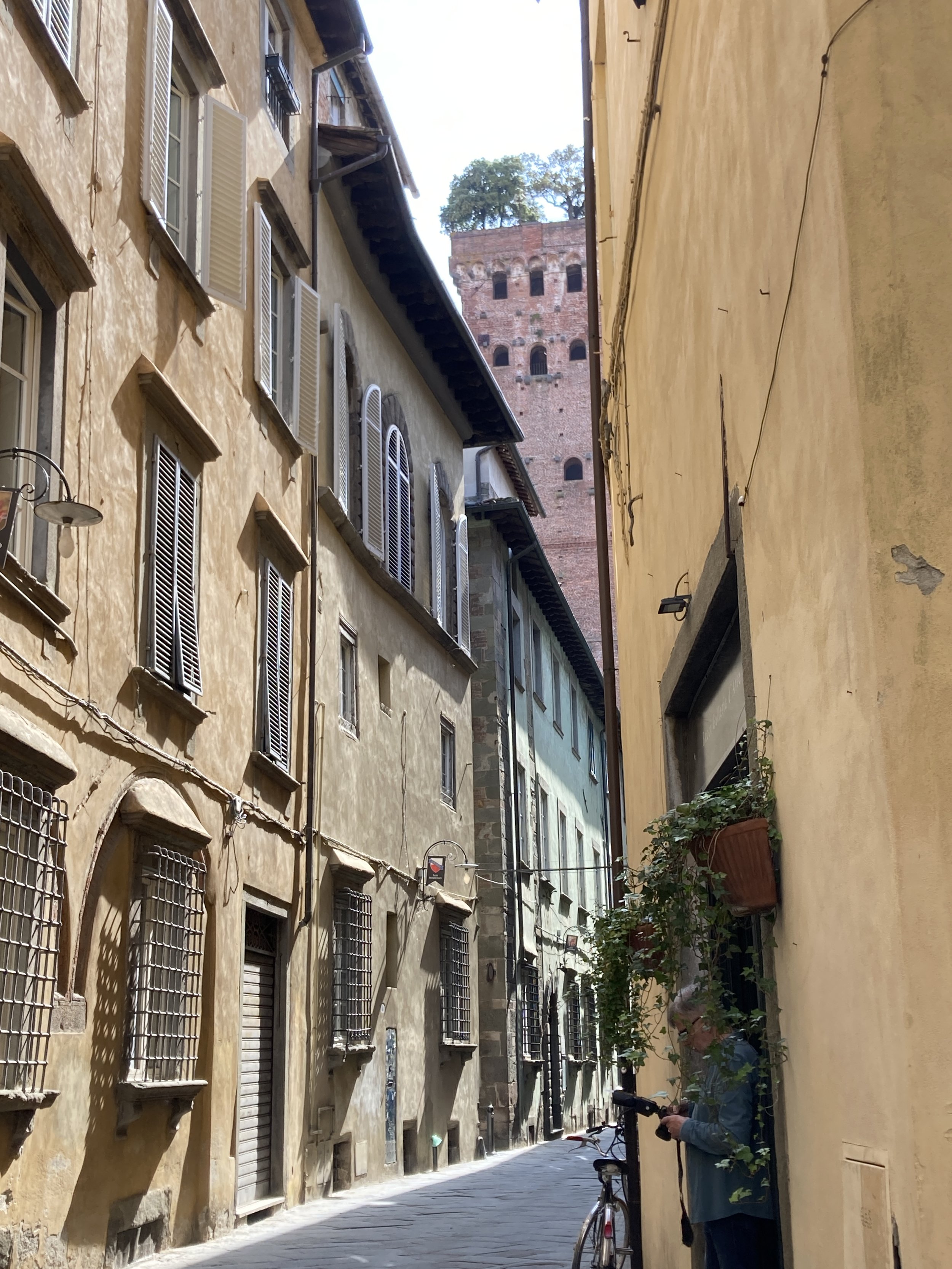
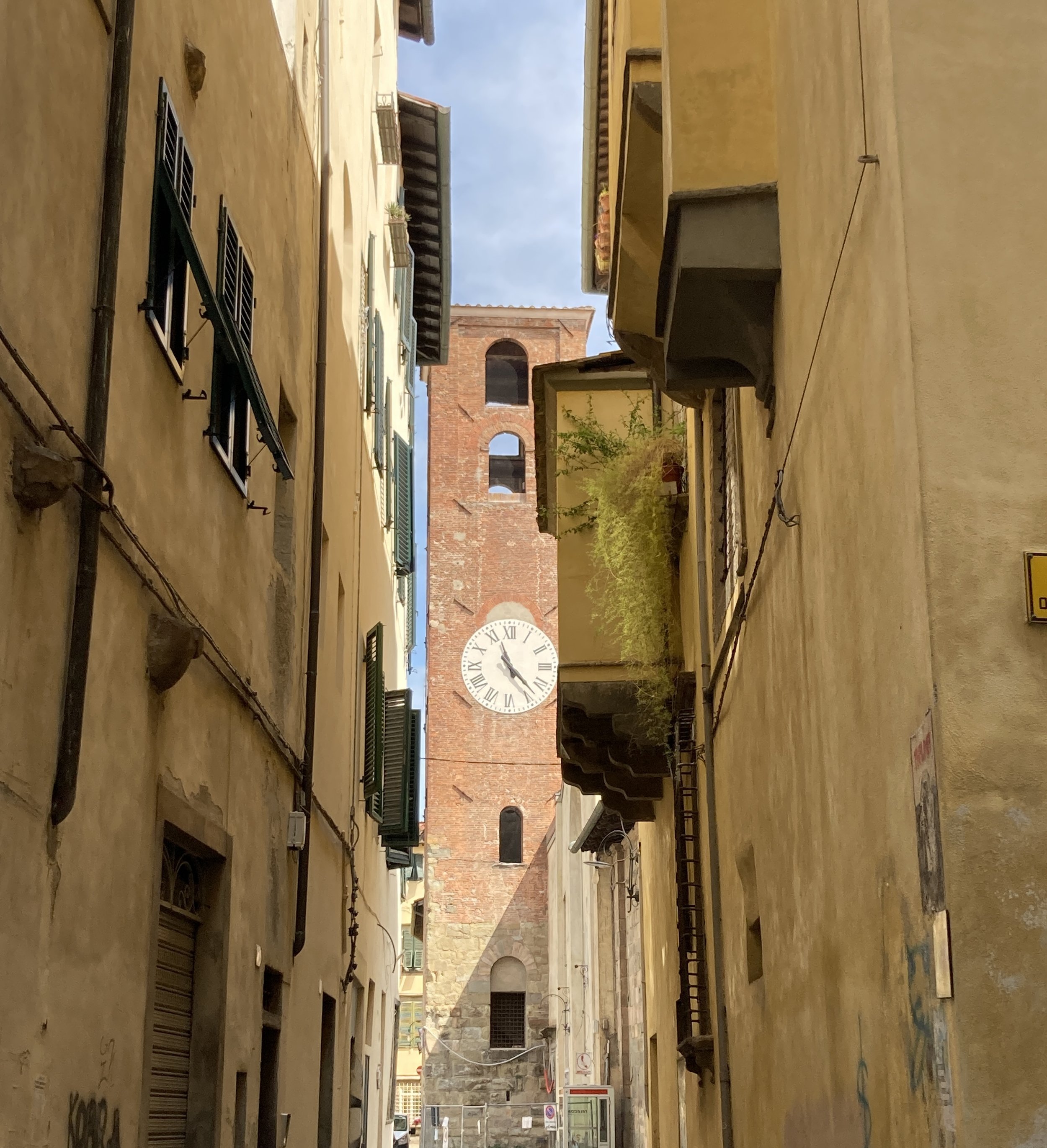
Even the street leading to the Torre Guinigi was nearly empty on this Monday morning.

 Around town the warm weather means that windows are open and the sounds of daily life pour out.  A baby crying.  Someone singing.  A radio on.  The sound of a brass horn coming from the music school near my apartment.  The musical sound of Italian chatter drifting out to the street.  These are some of the things I love most about life in Italy.

 The summer crowds, along with the heat and humidity of an Italian summer will soon be here. Those are some of the reasons I will soon head to New Mexico for much of the summer.  There I also have the bonus of a good long visit with my family – including my eldest grandson who will graduate from high school next week (does that ever make me feel old!).   But come August I will be glad to get back to Lucca, so glad that even the crowds won’t make me grumpy.


A few more photos of Lucca on a quiet Monday morning -
2B9292E8-FE65-47E1-8B55-A8E26B69B04E_1_201_a.jpeg
D46839C7-716D-4994-973B-B7756C35260A.jpeg
7A8C682E-2653-4A4E-8EE6-FE598BAEAF43.jpeg
FB07CFBE-38F5-41F9-9A7E-9B8E4988F93F.jpeg


May 15, 2023 /Joanne Bartram
spring Lucca, Life in Lucca, Life in Tuscany
#lucca, #springintuscany, Italian culture, Italy, Italy travel, Living in Italy, Lucca

La Foce - A Tuscan Garden With A Fascinating History

April 17, 2023 by Joanne Bartram in #italiangardens, #italytravel, Italian gardens, Italy travel, Tuscany

A 15th century pilgrim, walking along the Via Francigena on the way to Rome, might well have spent a night at hostel in the Val d’Orcia, just outside the current town of Chianciano Terme.  No doubt the accommodations, run by the Siena Hospital and Monastery of Santa Maria della Scala, would have been basic and the surrounding landscape the not-so-green clay hills found then in that part of Tuscany.  If that same pilgrim were to return today, he would not recognize the hostel, or the surrounding countryside, thanks in large part to the efforts of the Origo family.  While the intervening centuries saw the area impoverished and the hostel abandoned, in the 1920’s Antonio and Iris Origo bought the property, known as La Foce, and began its transformation. Today it is a remarkable spot - one of the finest estates and gardens in Tuscany.

The entry courtyard at La Foce, the meeting point for tours of the garden.

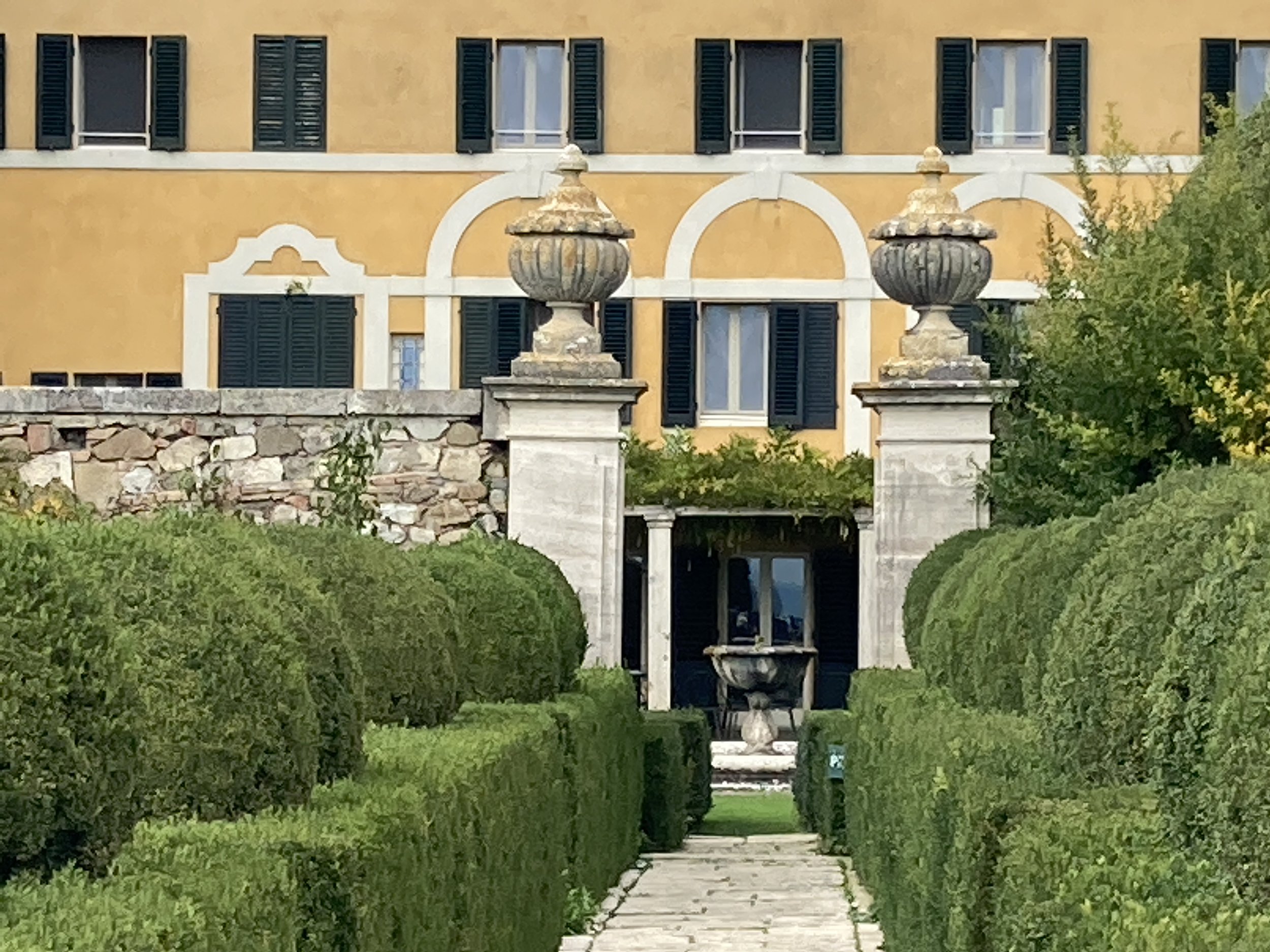
 Italian Antonio and wife Iris, a young American – Irish heiress, must have seemed crazy to their families and friends. The estate they purchased was run down, with rough dwellings and barren fields.   And yet, they had a vision.  Between 1924 and 1939 they restored the main building, turning it into their family home. They also reclaimed the land, developing it into fertile fields.  They built houses for tenant farmers, a school and a clinic for the workers and their families, and a dopolavoro (dopolavoro means “after work”, a place for the workers to socialize).  This level of social commitment and support for workers was unique at the time.  Eventually the estate grew to include farms, olive groves, and woodlands.  And then Iris Origo built a garden. 

 When I say garden I do not mean a small vegetable patch or a handful of flower beds.  To create her garden, Iris hired the English Architect Cecil Pinset to design an elegant space that blended Italian and English design and made the most of the views over the countryside.  100 years later the garden design is still perfect. 

Stone walls and a bit of fall color at La Foce

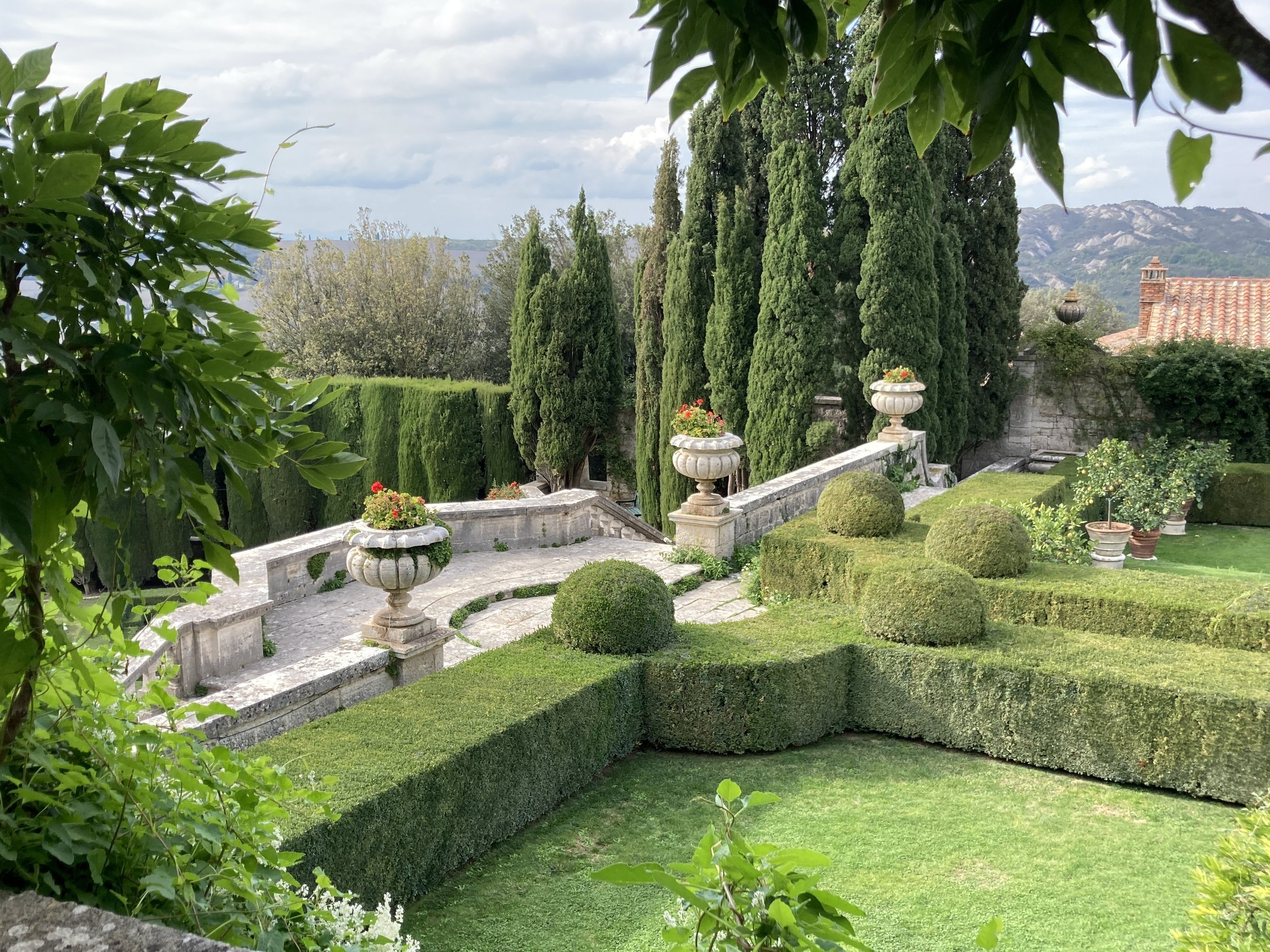
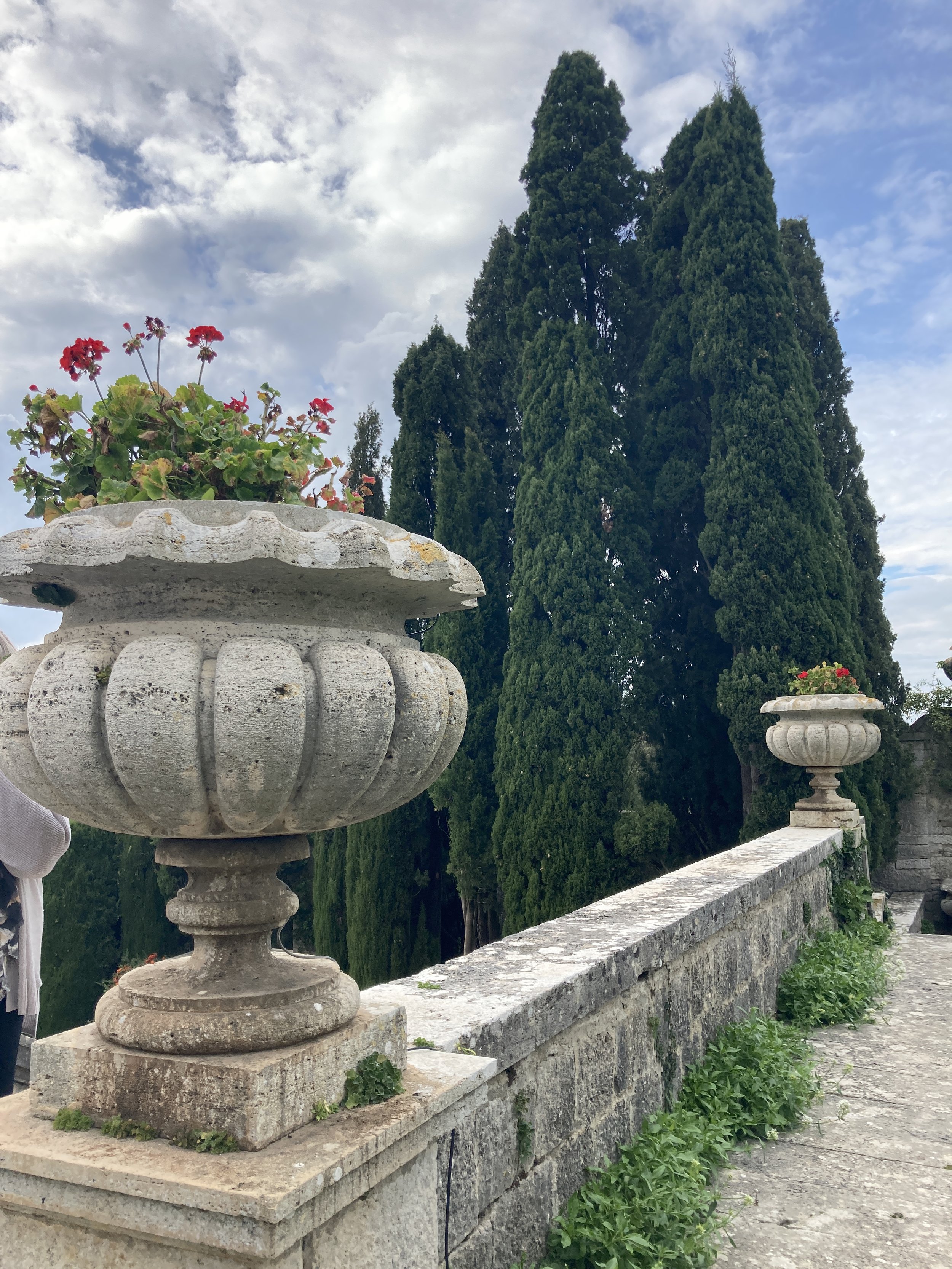
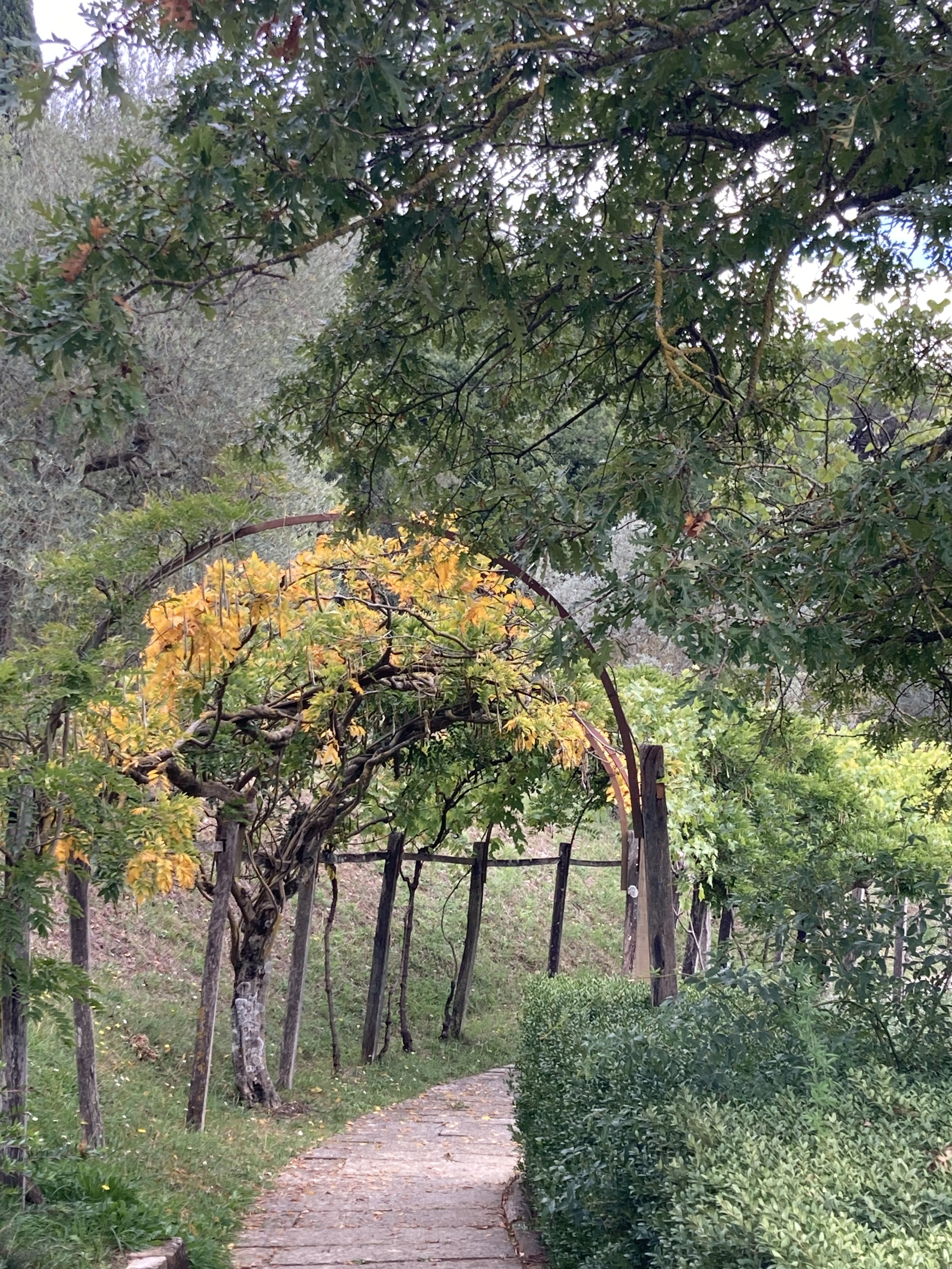
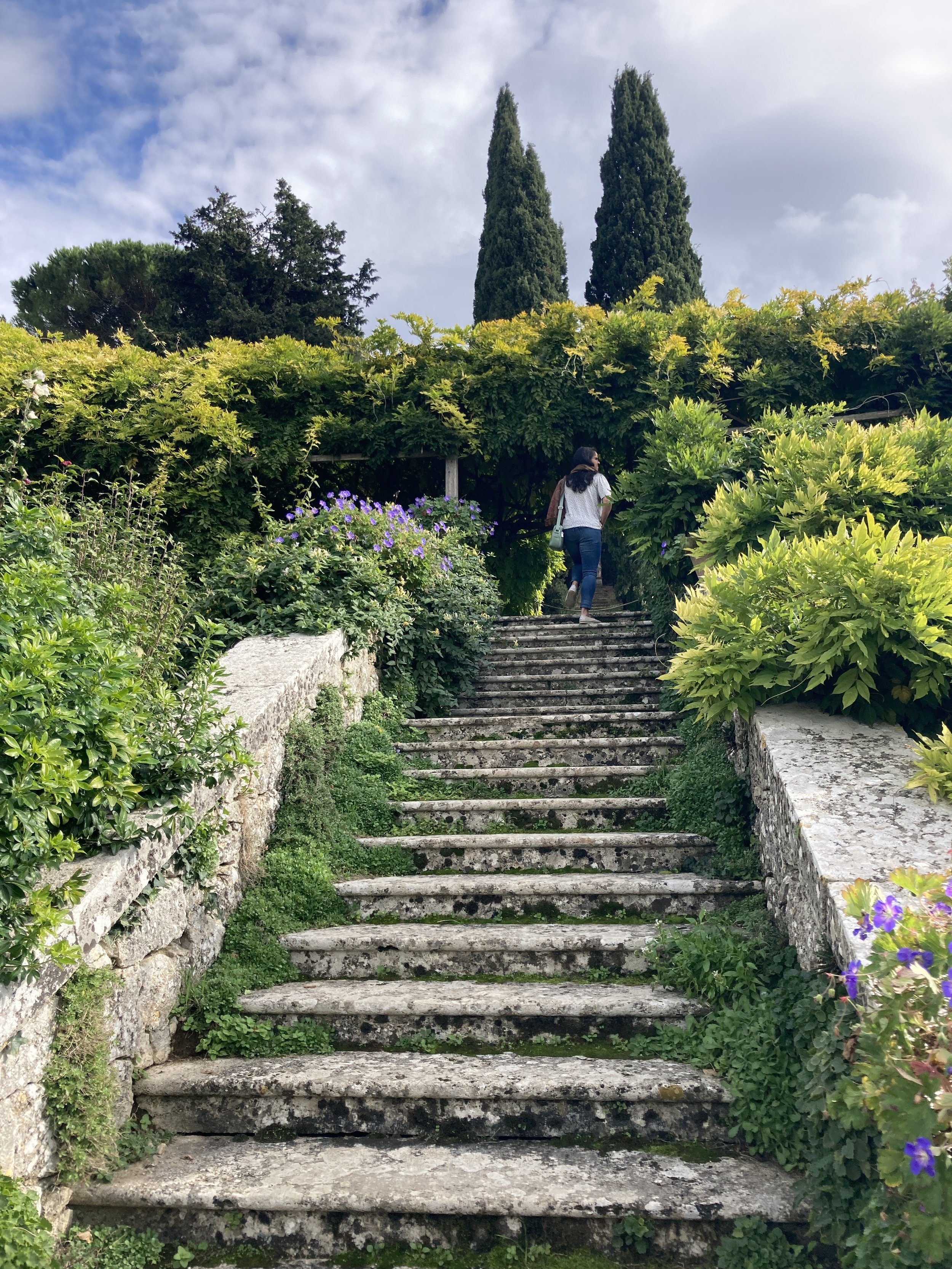
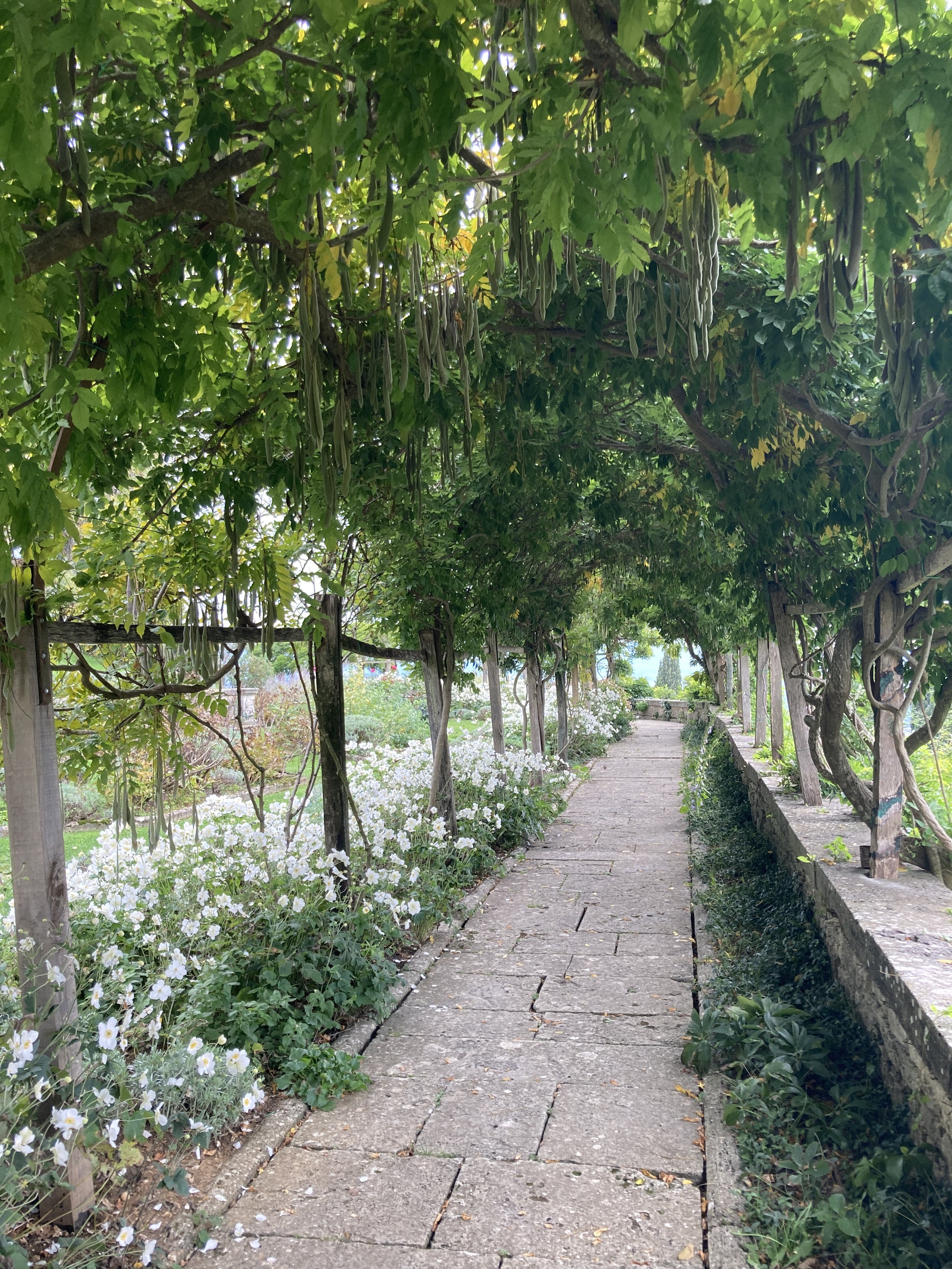
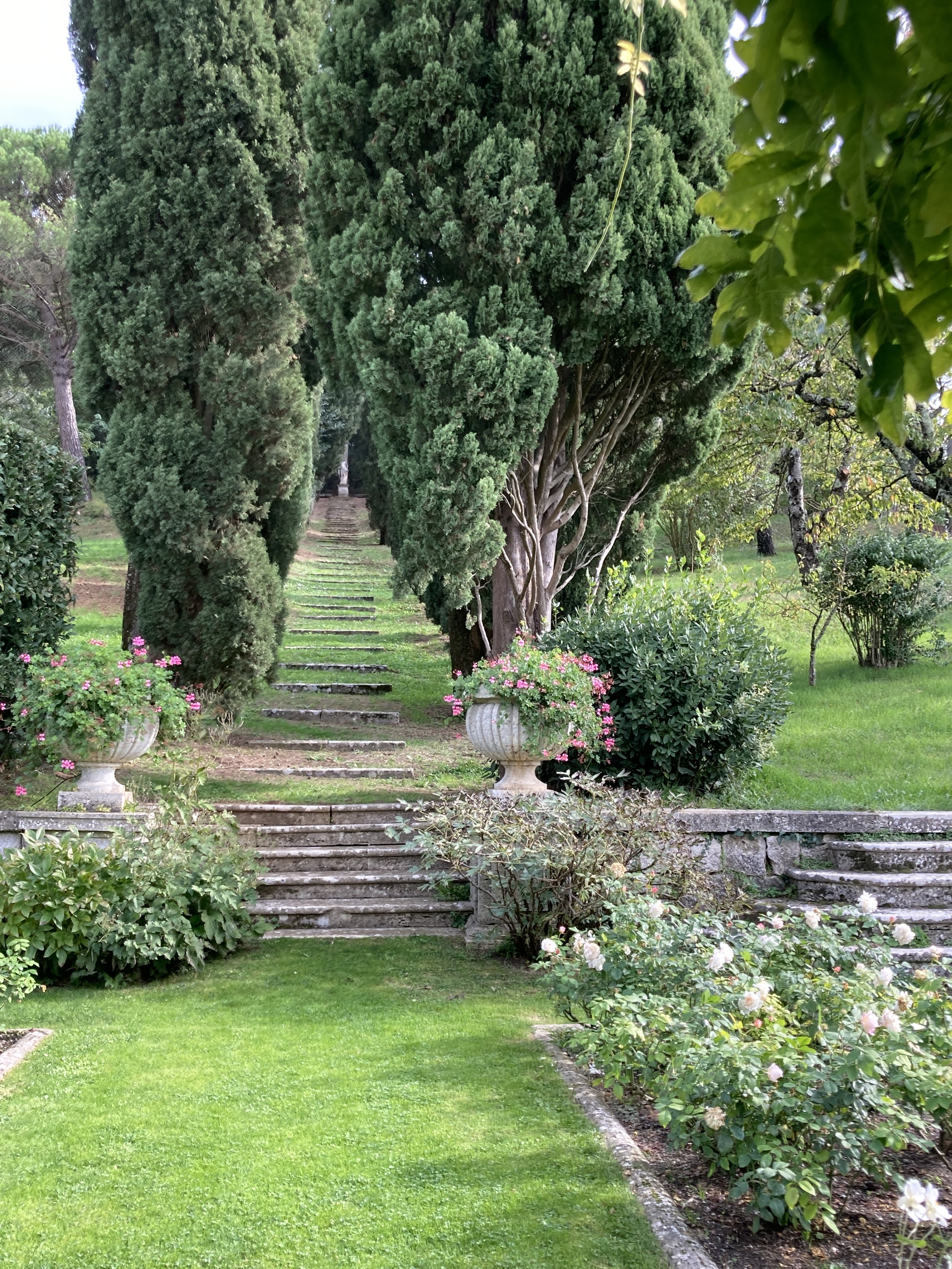
 The garden at La Foce blends formal green spaces defined by waist-high hedges, stone walls, flower beds, and a wooded hillside.  It includes an inviting series of terraces linked by stone stairways, a long arbor topped with wisteria, and beds of fragrant lavender.  Flowers spill from large stone urns and roses fill their very own garden bed.

4949FD22-7837-4FF6-9062-F90E12C21614.jpeg
54855A9E-9402-425D-BEED-DF4691EADD29.jpeg
4D7C80DF-9F65-4241-87FA-B81AF506D215.jpeg
14EA59C7-3B27-40A8-B1EE-8F7A811BF7F7.jpeg
8962BBD6-32D3-443E-89CF-4A4A22A195D6.jpeg
C355B33F-5ACD-45B9-8A7B-1AA43096D63D.jpeg

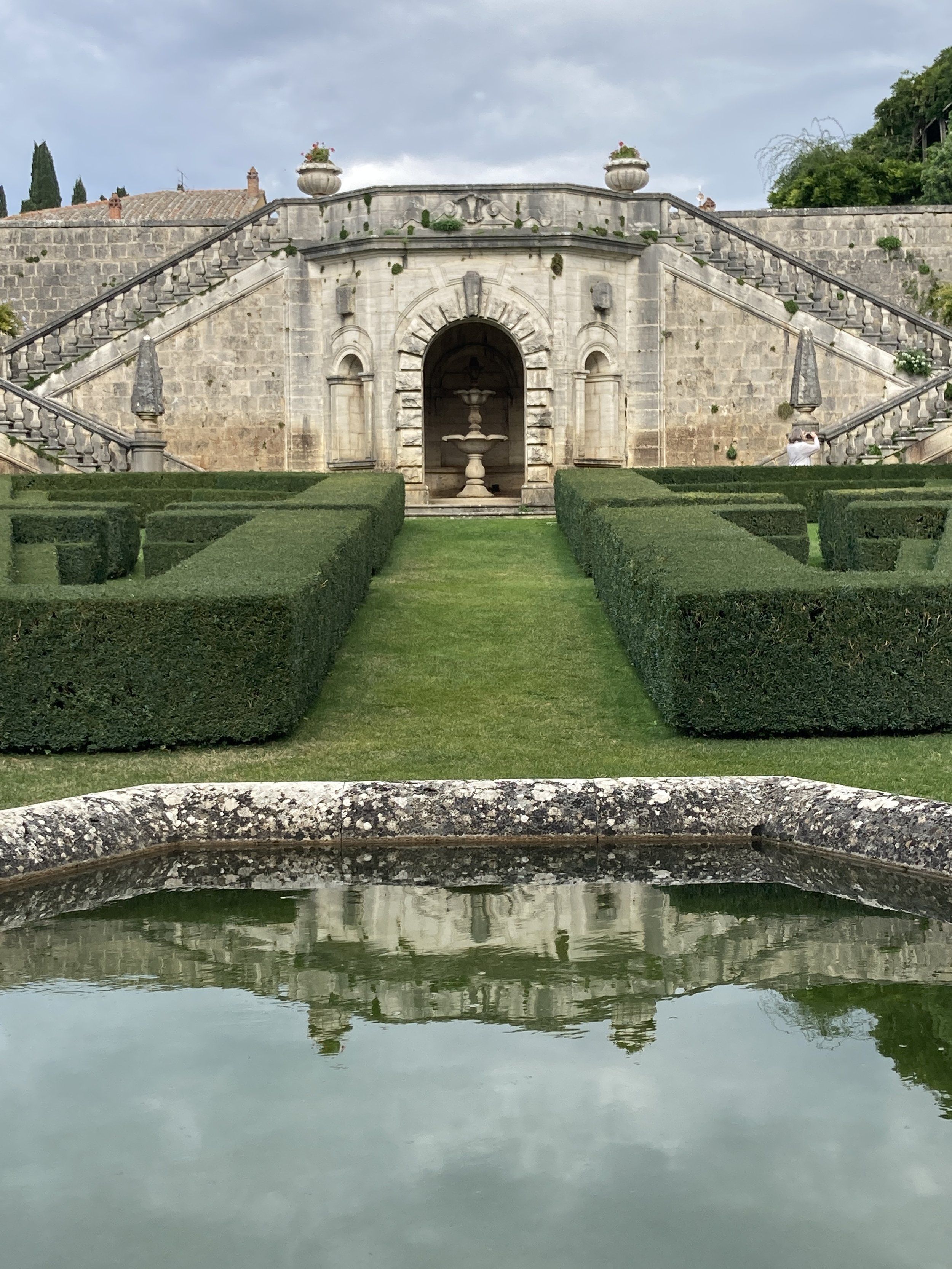
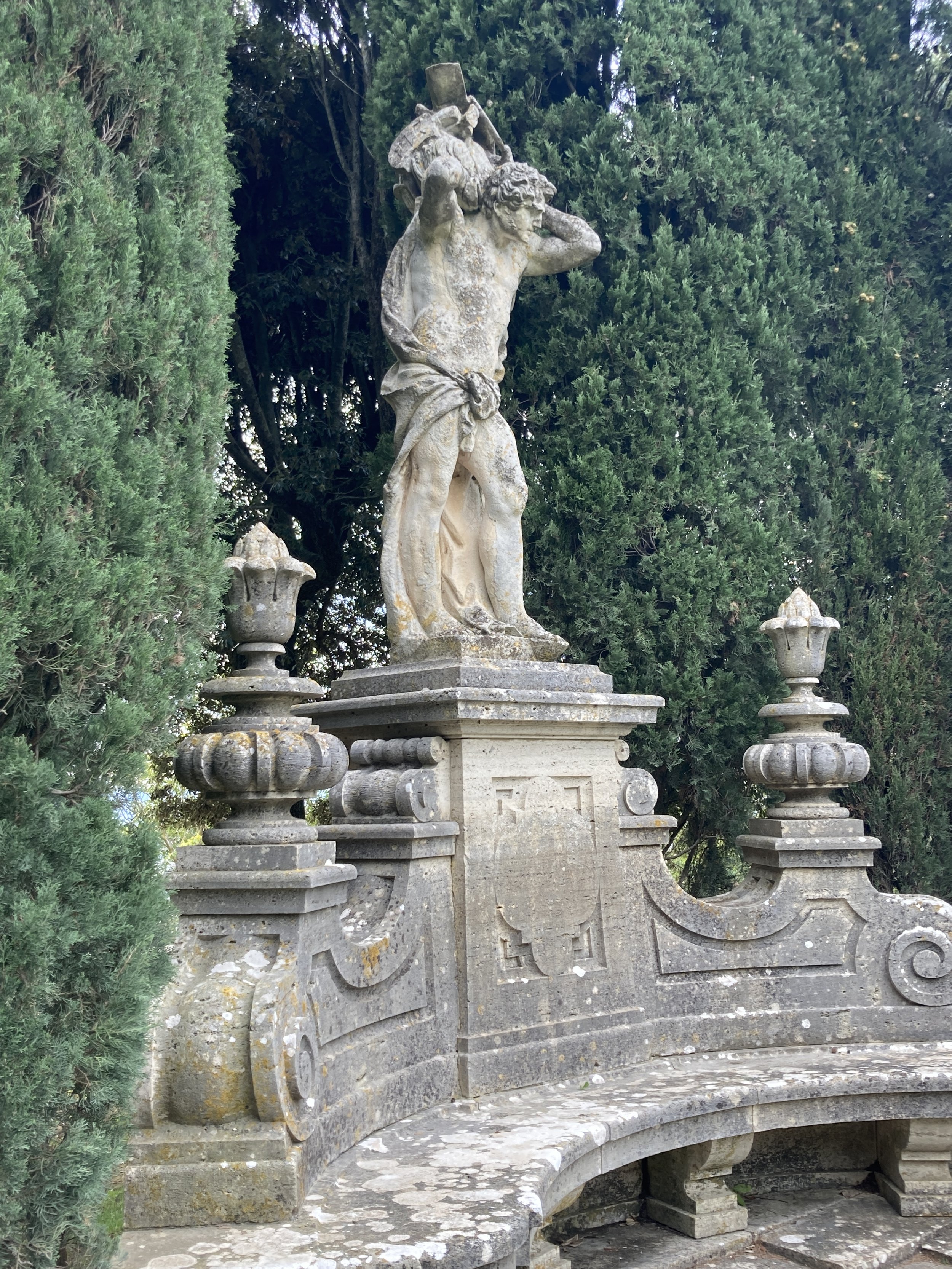
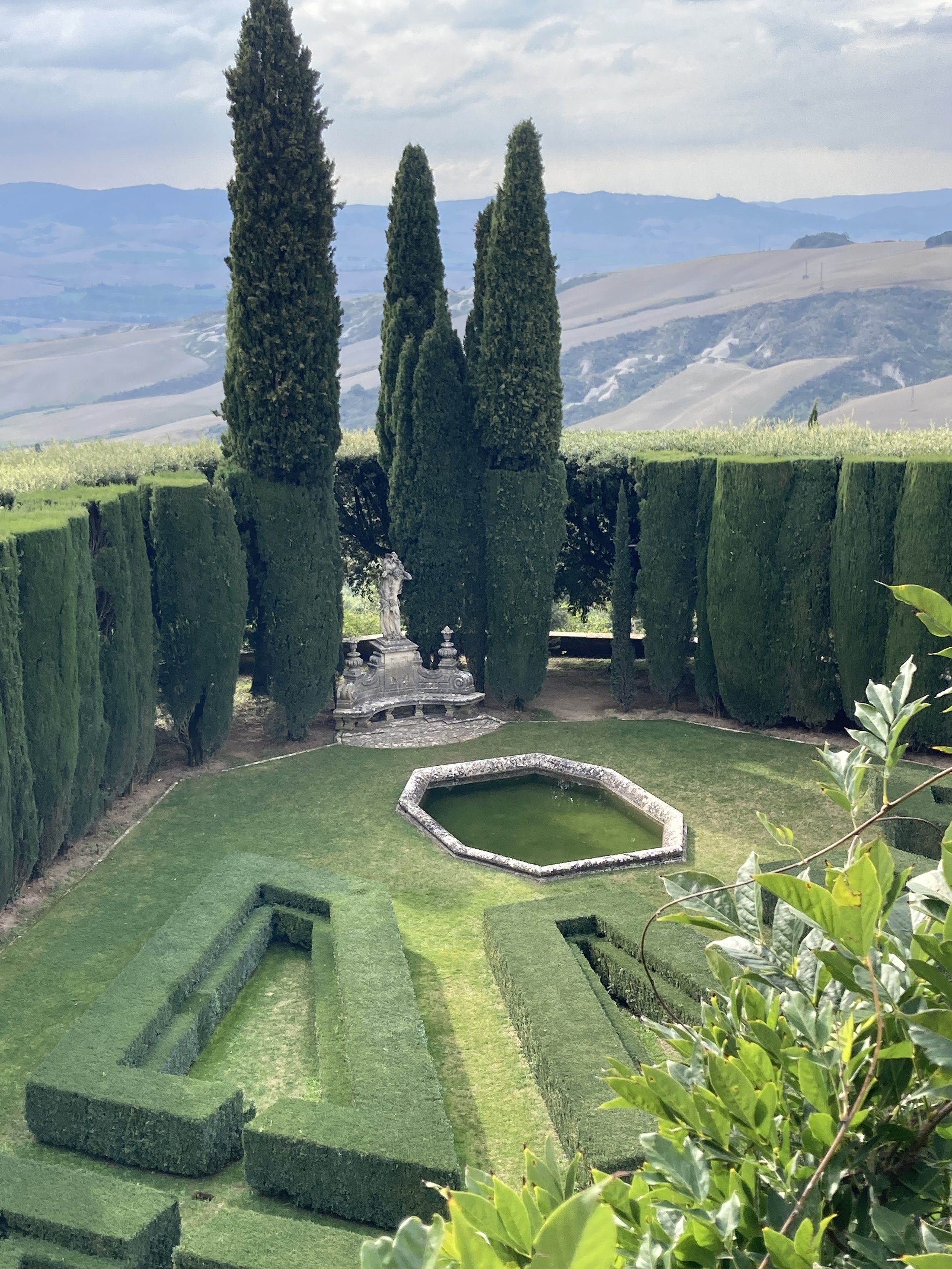
A graceful double staircase leads down to the lower garden with its angular hedge-rimmed beds, reflecting pool, and elaborate stone statuary bench.  Cypress trees and classic Italian umbrella pines are visible at the garden edges and atop the hillside.   

5CD3DC56-7555-4F07-BB51-FAF4133FD7A3.jpeg
9F5DAB32-D8CD-411B-8751-41E5A45E2E8F.jpeg
2F10BB44-BBC2-4B95-9CC3-31495A36B09D.jpeg

 And the views!  Off in the distance is the famous winding road, lined with cypress trees, that appears in so many photos.  The garden is designed to present an unmatched view of this iconic Tuscan scene.

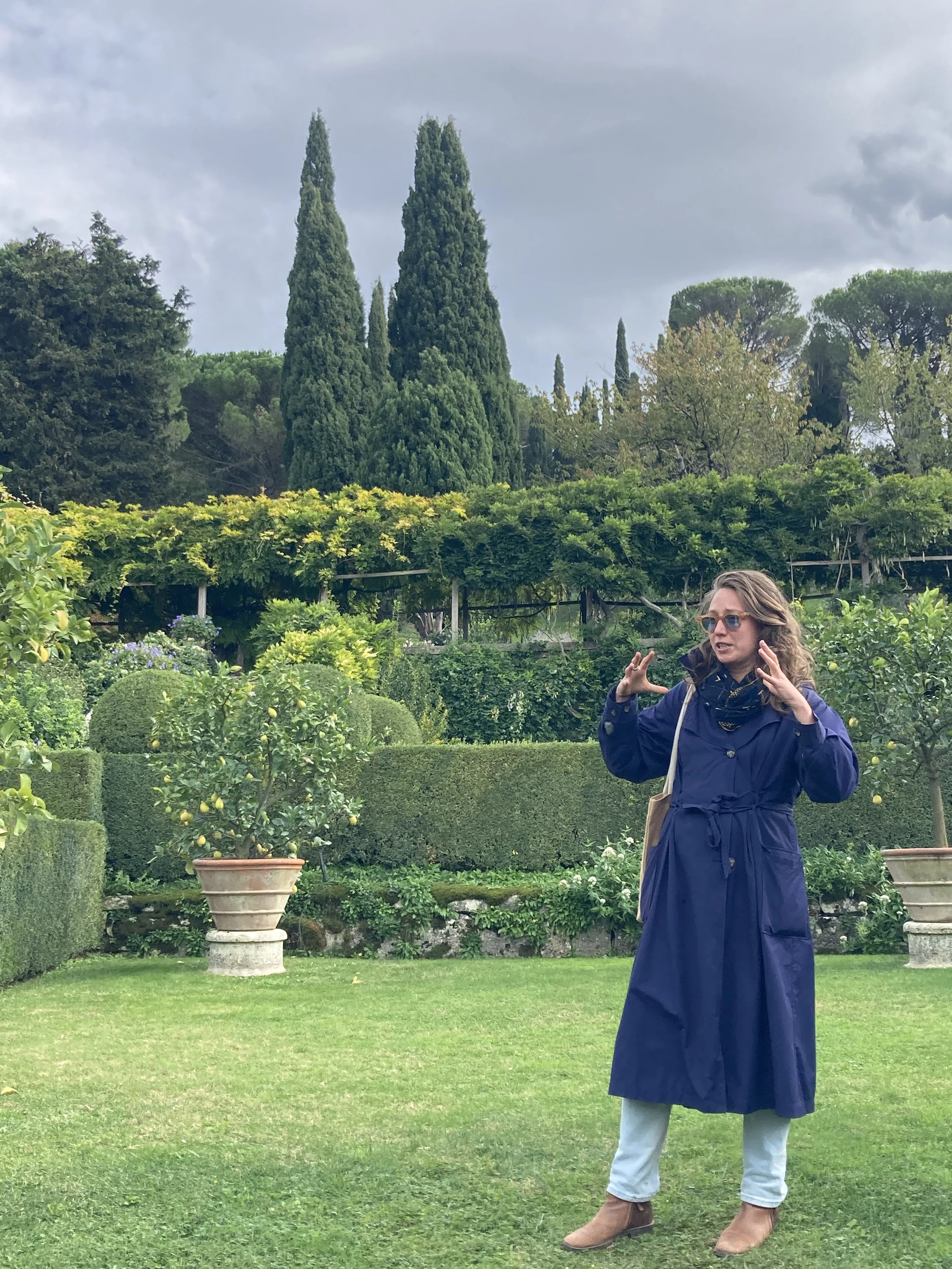
Our tour guide presented the history of both the land and the Origo family.

 The Origos lived at La Foce during the years of World War II.  That history is fascinating and well explained by the tour guides. 

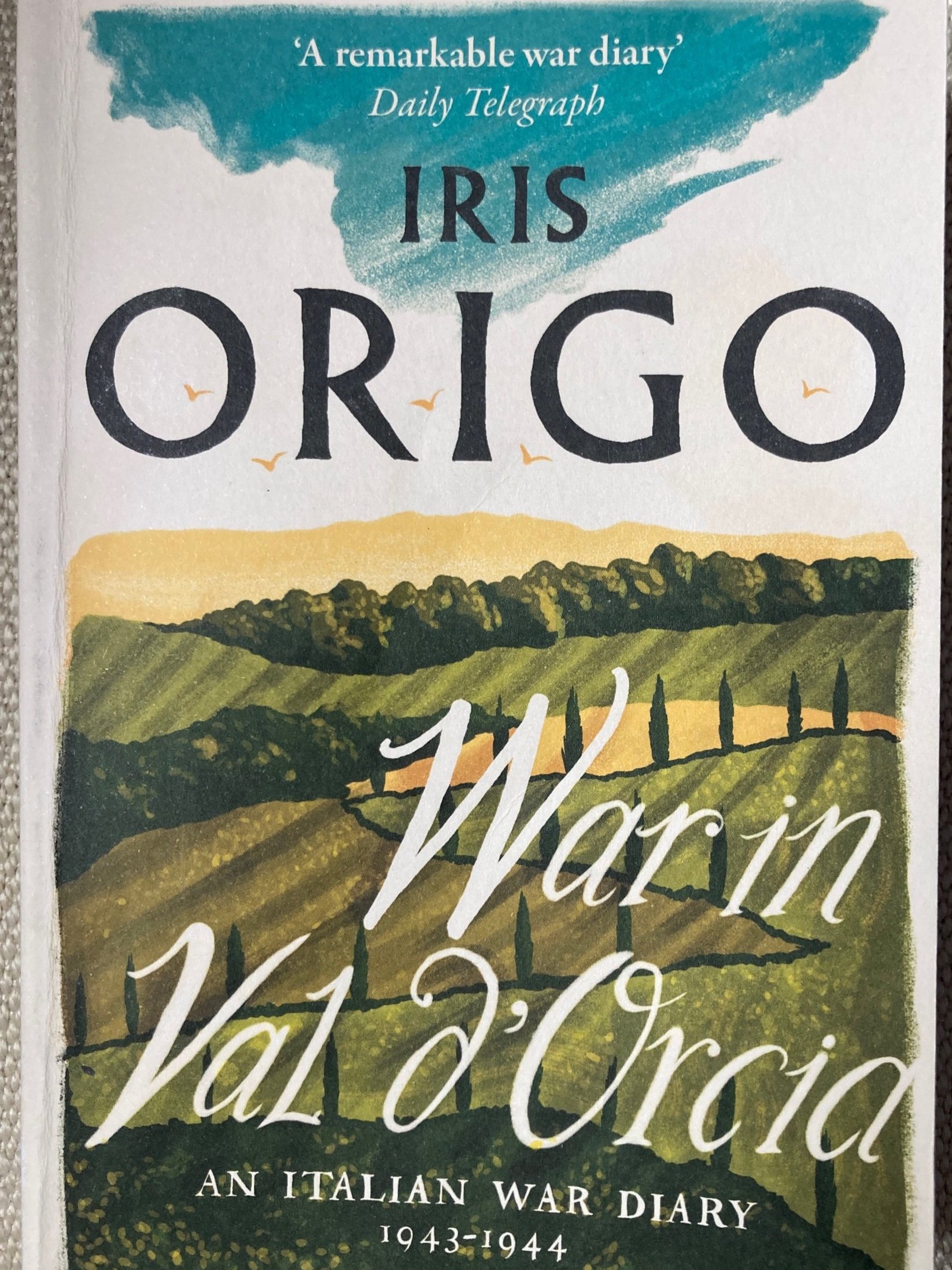
Iris Origo was a biographer and historian.  Her WWII diary, War in Val d’Orcia, tells of life at La Foce and the precarious road she walked as a British – American living in Italy during that time.  Despite a need to remain in the good graces of the Italian and German forces, La Foce provided shelter to orphaned children and children sent from the heavily bombed city of Torino during the war years.  It also, at considerable personal risk, sheltered downed Allied pilots and POW escapees.  It was a dangerous time, and the diary is fascinating reading in preparation for a visit to La Foce.  

After the war, Iris and Antonio remained at La Foce for the rest of their lives, raising two daughters on the estate.  The daughters, Benedetta and Donata, now in their 80’s, still reside on the property. Antonio and Iris, along with their son Gianni who died in childhood, are buried on the estate.  Sustaining such a large property is no easy task and after Iris’s death in 1988 a good deal of the surrounding land was sold. The Origo daughters continued to own the heart of the estate and over time converted the main home and many surrounding buildings into event spaces and luxury accommodations for guests. 

One of the guest houses on La Foce Estate

The Dopolavoro is now a restaurant serving produce and olive oil from La Foce.  Each summer the estate hosts a music festival in honor of Iris, a project begun by her grandson. Every season brings a new reason to visit.

 La Foce is a must see for garden lovers and history buffs visiting the Val d’Orcia.  The gardens can be visited on guided tours Wednesday afternoons and Sundays from March 26  –  November 1. Note that there are some closures for special events and tours must be reserved in advance. The home and outbuildings are not open on the tours – a good reason to book a vacation stay.  That’s on my wish list as is a lunch at Dopolavoro (reservations are a must) and a return visit in summertime to see those wisteria in bloom. 


website:  www.lafoce.com

The website has fabulous photos and a portal to make reservations for garden tours.  It is also great for getting a peek at the vacation lodgings and event spaces.  For more information on Iris Origo and La Foce, I recommend War in Val d’Orica and Images and Shadows, an autobiography (the current edition has an afterword by her granddaughter Katia Lysy).

IMG_2282.jpg
IMG_4491.jpeg
April 17, 2023 /Joanne Bartram
La Foce, #lafoce, Iris Origo, Tuscany, Italian Gardens
#italiangardens, #italytravel, Italian gardens, Italy travel, Tuscany

Pontremoli. A beautiful village with an interesting literary history.

The Booksellers of Pontremoli

March 13, 2023 by Joanne Bartram in #italytravel, Festivals Italy, Hill Towns Italy, Italian culture, Italy travel, Italy, Lunigiana

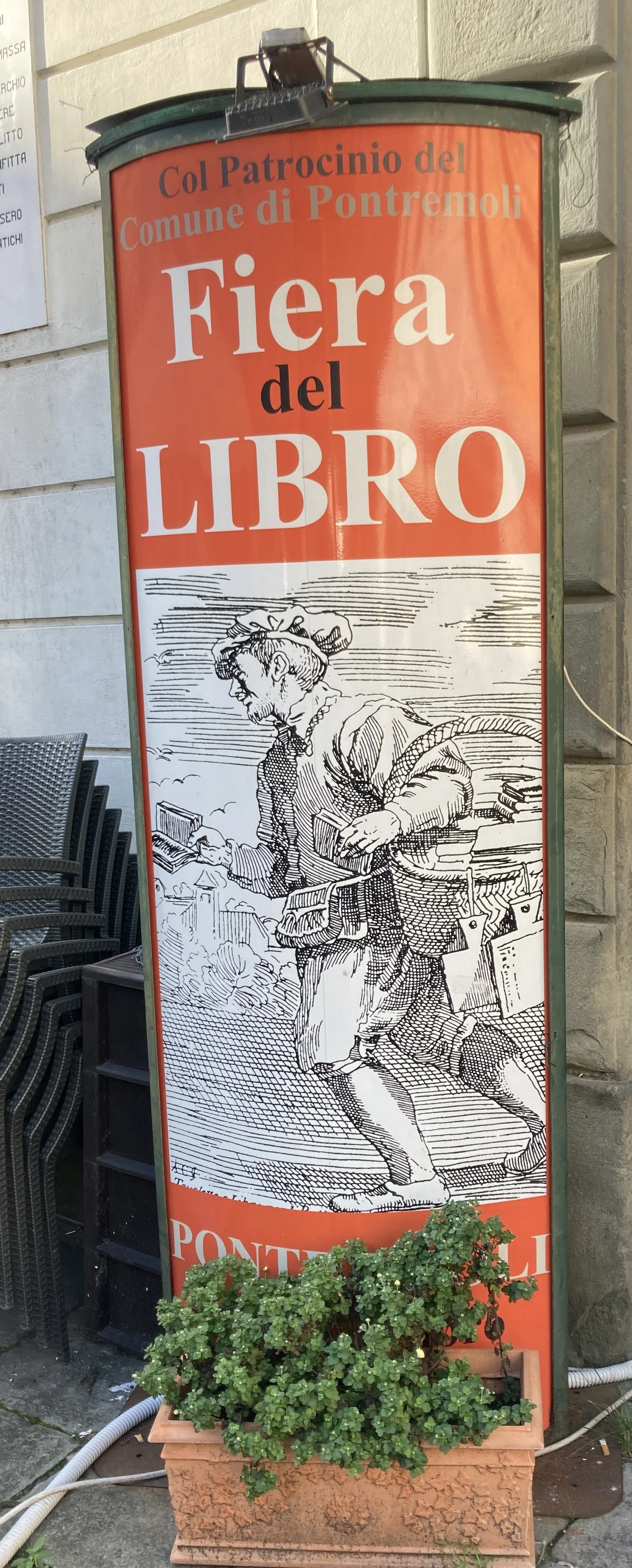
The image of an itinerant bookseller stands outside a bookshop in Pontremoli

Imagine a time, in the centuries before printing was established, when books where hard to come by.   This was certainly the situation long ago in the remote and mountainous areas of Northern Italy. Printing of books did not arrive to the area until the late 15th century. What a miracle those early books must have seemed!

In the 16th century, itinerant booksellers began to travel from town to town, carrying baskets full of books. They reached the small hamlets throughout northern Italy, even venturing all the way to Germany, setting up temporary stalls to sell books.

These traveling booksellers came from the Lunigiana region of northern Tuscany, particularly from the towns of Pontremoli and Montereggio.  The selling of books became a family business, a tradition passed down from generation to generation.  Over time the work of the booksellers became more established. Today, many bookstores in northern and central Italy can trace their roots back to Pontremoli’s traveling booksellers.

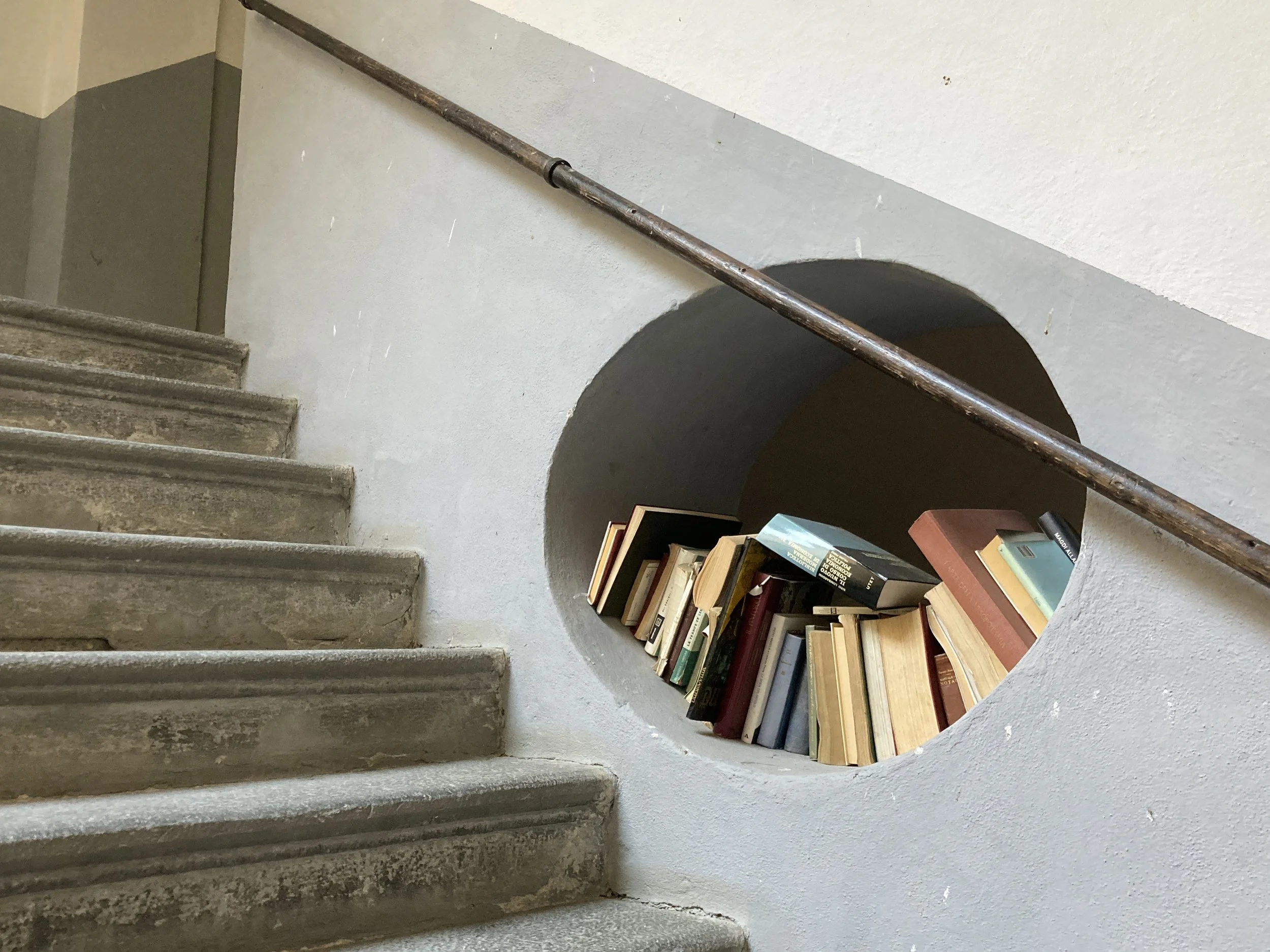
I first noticed the books of Pontremoli in this stairwell leading up to the apartment I was renting.

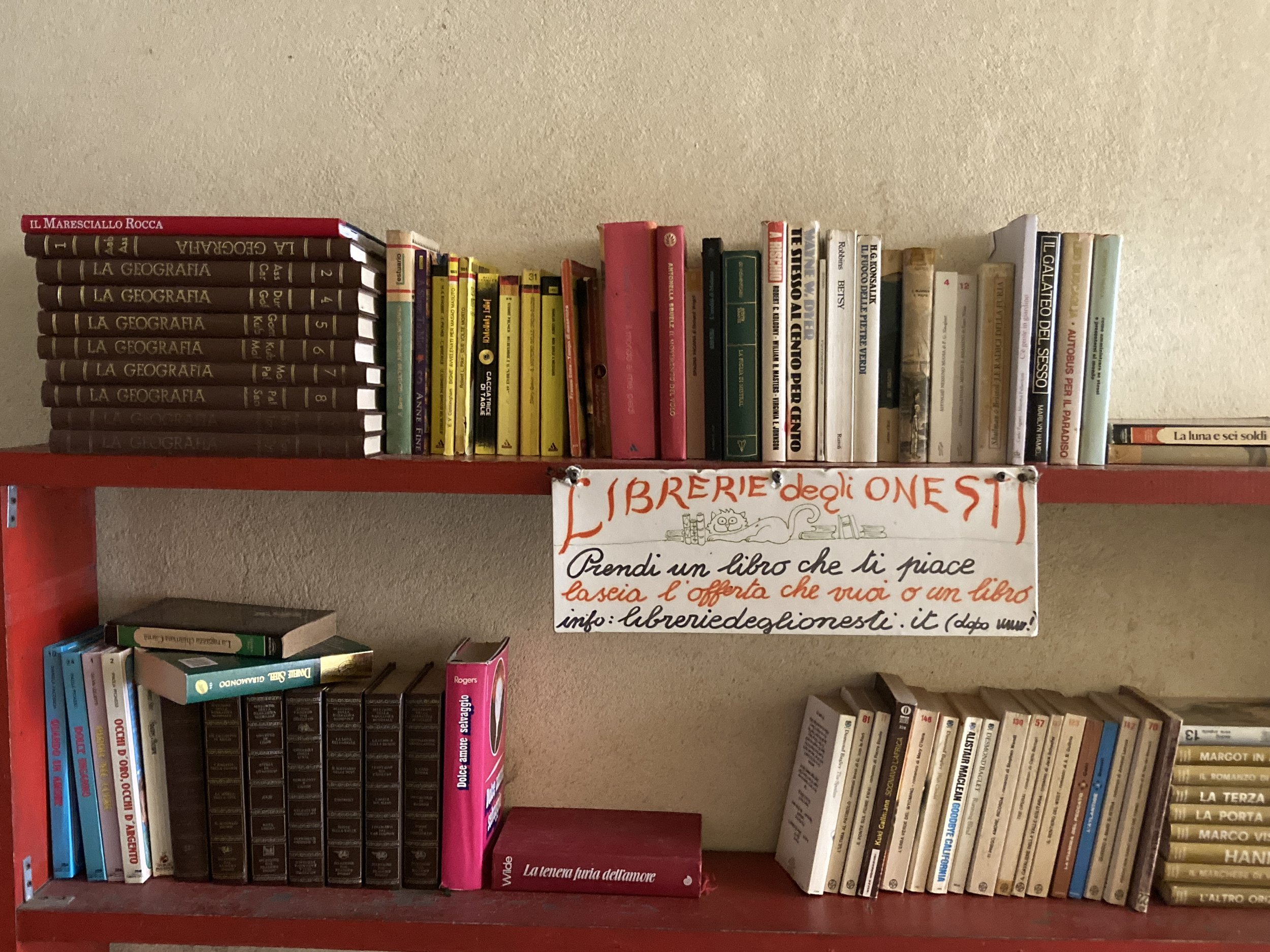
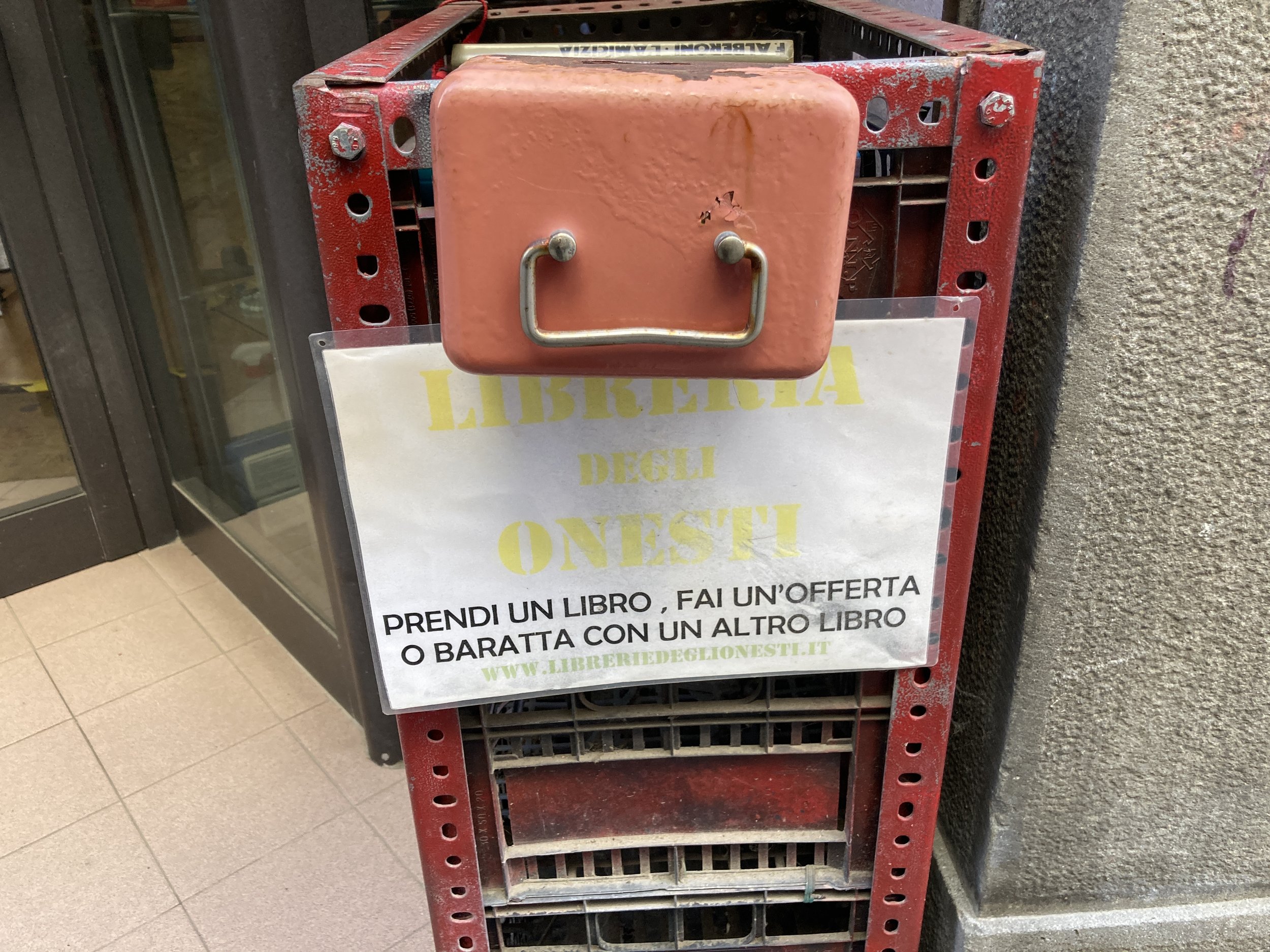
I didn’t know much about this history before I visited Pontremoli last fall.  I was immediately struck by the fact that books were everywhere.  Books filled nooks along the staircase in the Airbnb apartment where I stayed.  Books sat outside shops in small baskets, payment on the honor system.  Books lined shelves in cafes and restaurants.  There was also a large shop selling new and used books in Piazza della Repubblica, right in the heart of the historic center.  Pontremoli seemed to be a city of books.


9C69B372-51A5-4CC1-937D-D9A110A4F825.jpeg
EA1711BC-1F2A-438E-AB39-5FD5A5420E84.jpeg
F15276D3-4DAE-458C-8B80-38B6E3D4415E.jpeg

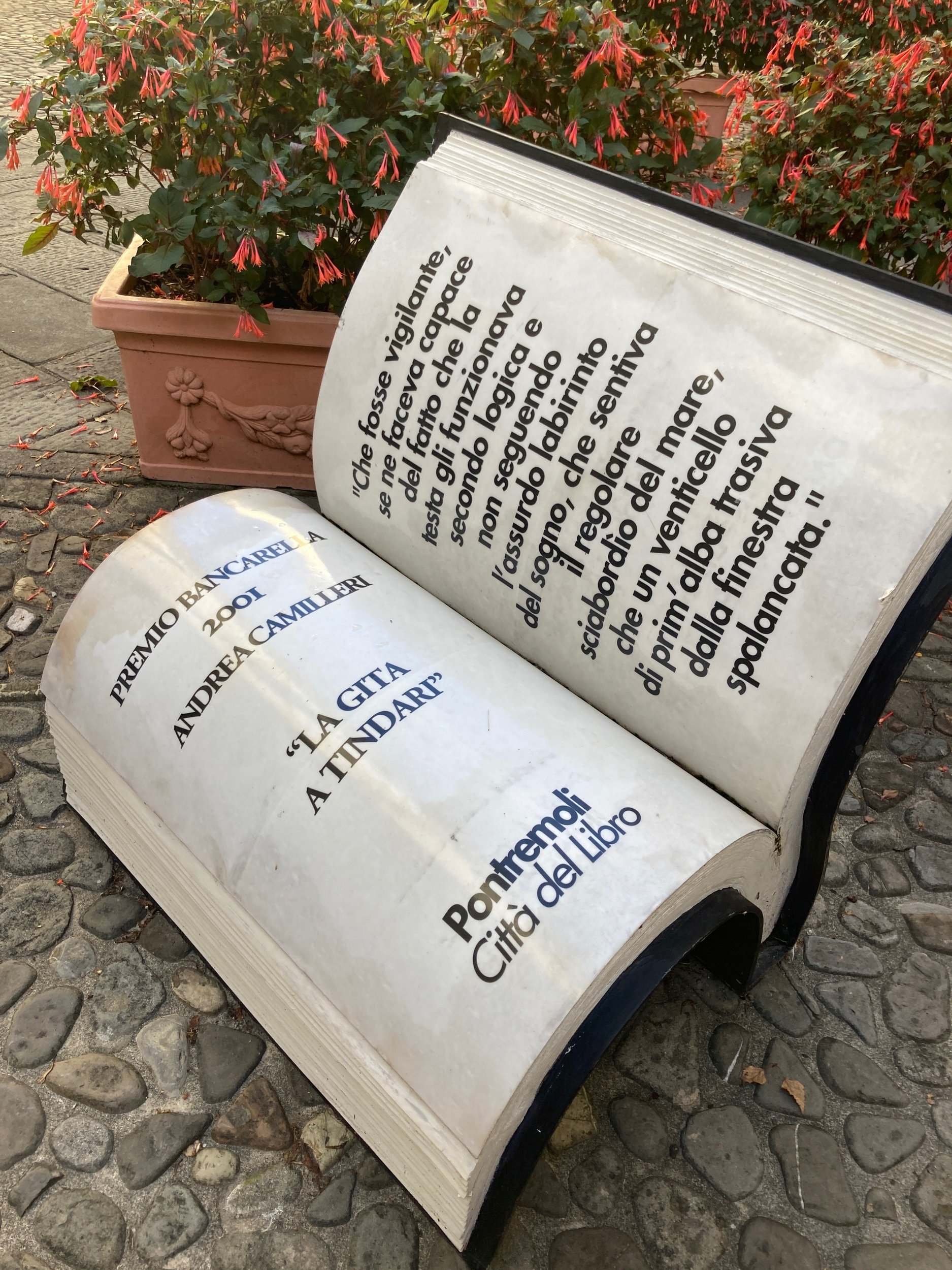
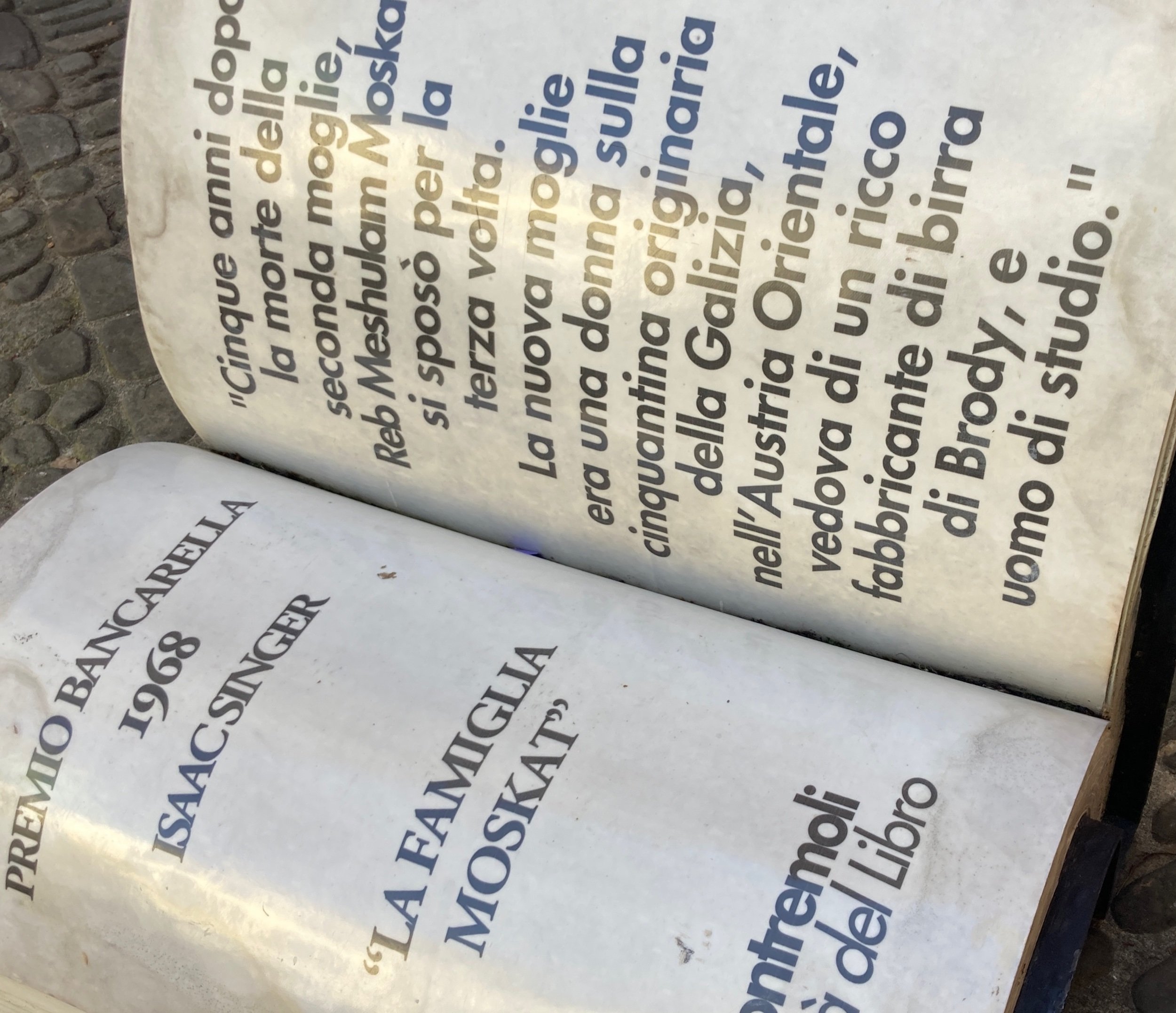
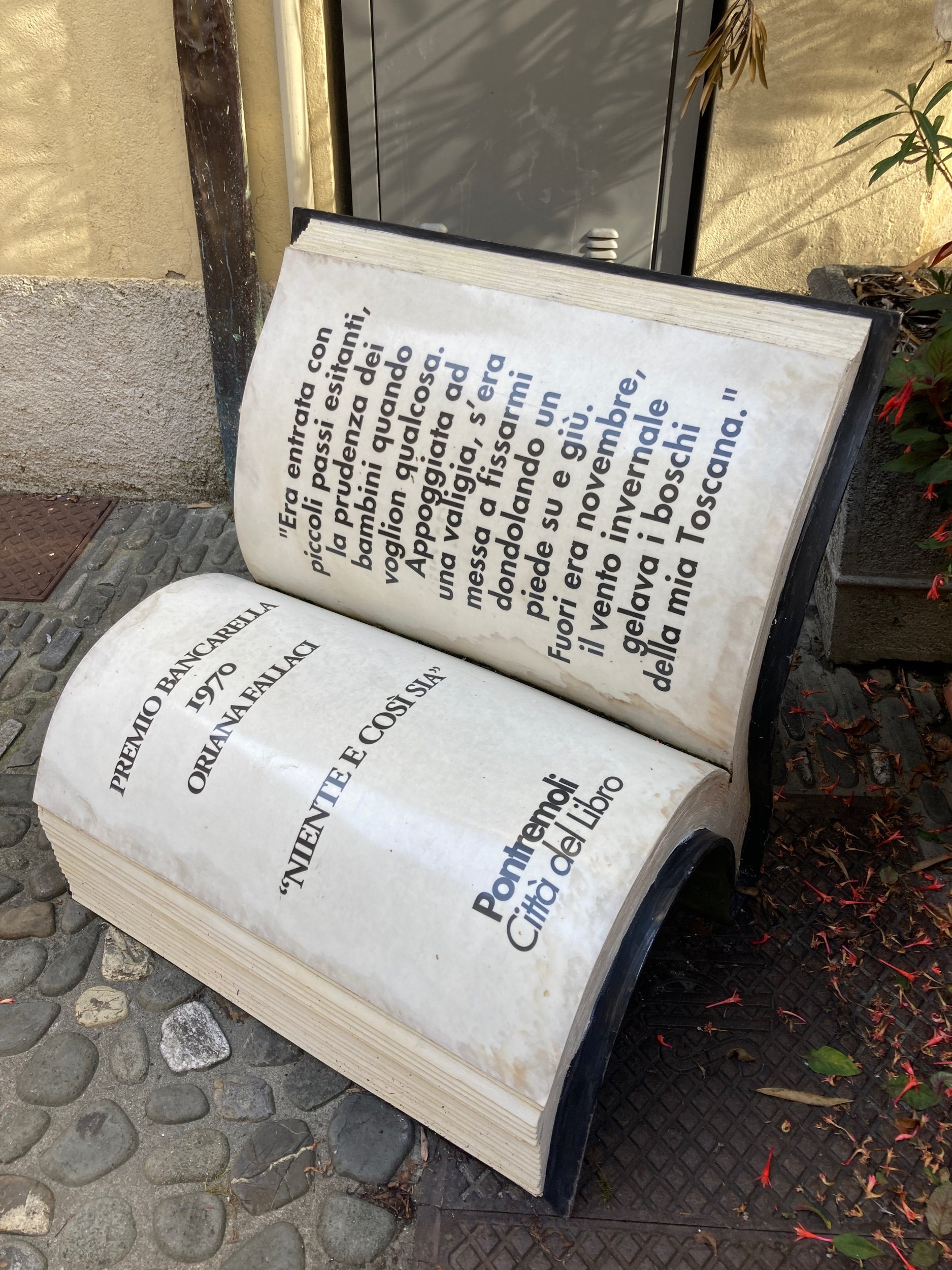
Just off Piazza della Repubblica was a courtyard filled with benches sculpted in the form of open books.  Each had a date, a title, an author’s name, and a snippet of text.  A similar book bench was found in the courtyard of the Piagnaro Castle high above town.  Curious!

IMG_0134.jpeg
IMG_0136.jpeg
IMG_0133.jpeg


New and used books displayed below an sign for the 2005 Premio Bancarella

A bit of investigation revealed that the book benches were related to an annual literary prize, The Premio Bancarella, awarded each summer in the city of Pontremoli. 

The prize has its roots in the city’s history of booksellers.  In fact, the Premio Bancarella is the only literary prize awarded by a committee made up exclusively of booksellers.  Unlike publishers and literary scholars, the booksellers know which books are popular with their customers, which ones are most in demand.  The prize is a connection from author to bookseller to reader.  And the term Bancarella, meaning stall, reflects those early booksellers who set up stalls in the smallest of towns.

Each year since 1952 a panel of booksellers has met to award the prize.  The first year the prize was awarded in nearby Montereggio. That year the winner was Hemingway for The Old Man and the Sea.  Since then the prize has been awarded each year in Pontremoli. The list of winners include Italian literary figures and authors from around the globe. 

In 2006 a category for books related to food was added, The Premio Bancarella della Cucina.  That may explain the large number of cookbooks found in the bookshop near where the prizes are awarded.

There are many things to love about Pontremoli, but the fact that the town is full of books is an added bonus.

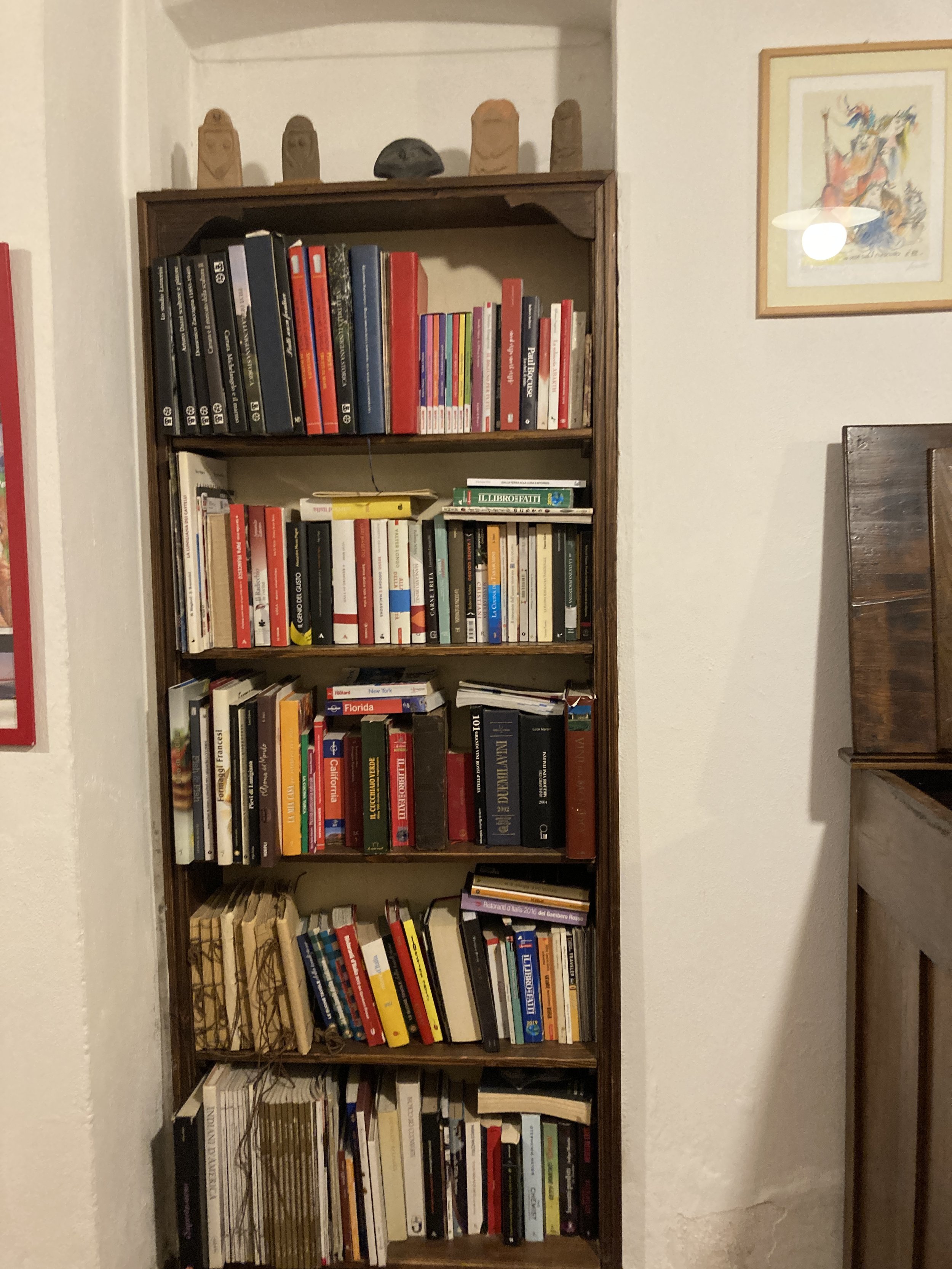
A glimpse inside a Pontremoli book shop selling new and used books in a variety of genres

March 13, 2023 /Joanne Bartram
Pontremoli, Premio Bancarella
#italytravel, Festivals Italy, Hill Towns Italy, Italian culture, Italy travel, Italy, Lunigiana

Farina di Castagne

February 27, 2023 by Joanne Bartram in Italian culture, Italian recipes, Italy travel, Living in Italy, Lunigiana, recipes, Tuscany

A list of the ingredients important in Italian cooking often includes olive oil, tomatoes, pancetta, artichokes, garlic, lemons, basil, Parmigiano Reggiano cheese, and balsamic vinegar.  But let’s not forget about a more humble ingredient - chestnuts (castagne or marroni in Italian).

In Tuscany, the mountains are full of chestnut trees.  It is no surprise then that the chestnut tree became a vital source of food, as well as of fuel and building material, especially during times of war, famine, and poverty. 

Abundant and nutritious, the chestnut became an essential ingredient in Italian “cucina povera”. That traditional continues to this day. Chestnuts are eaten roasted or steamed. They are also dried and ground into flour, farina di castagne, for use in breads, pastas, and sweets. 

Chestnut Roasting in Colognora di Pescaglia

Dishes made with farina di castagne appear on fall and winter menus.  With its naturally sweet and nutty flavor, chestnut flour has become one of my favorite ingredients for baking. 

 My fondness for these dishes began at a fall festival where I first tasted Necci. Necci are round and flat, somewhere between a crepe and a pancake in thickness.

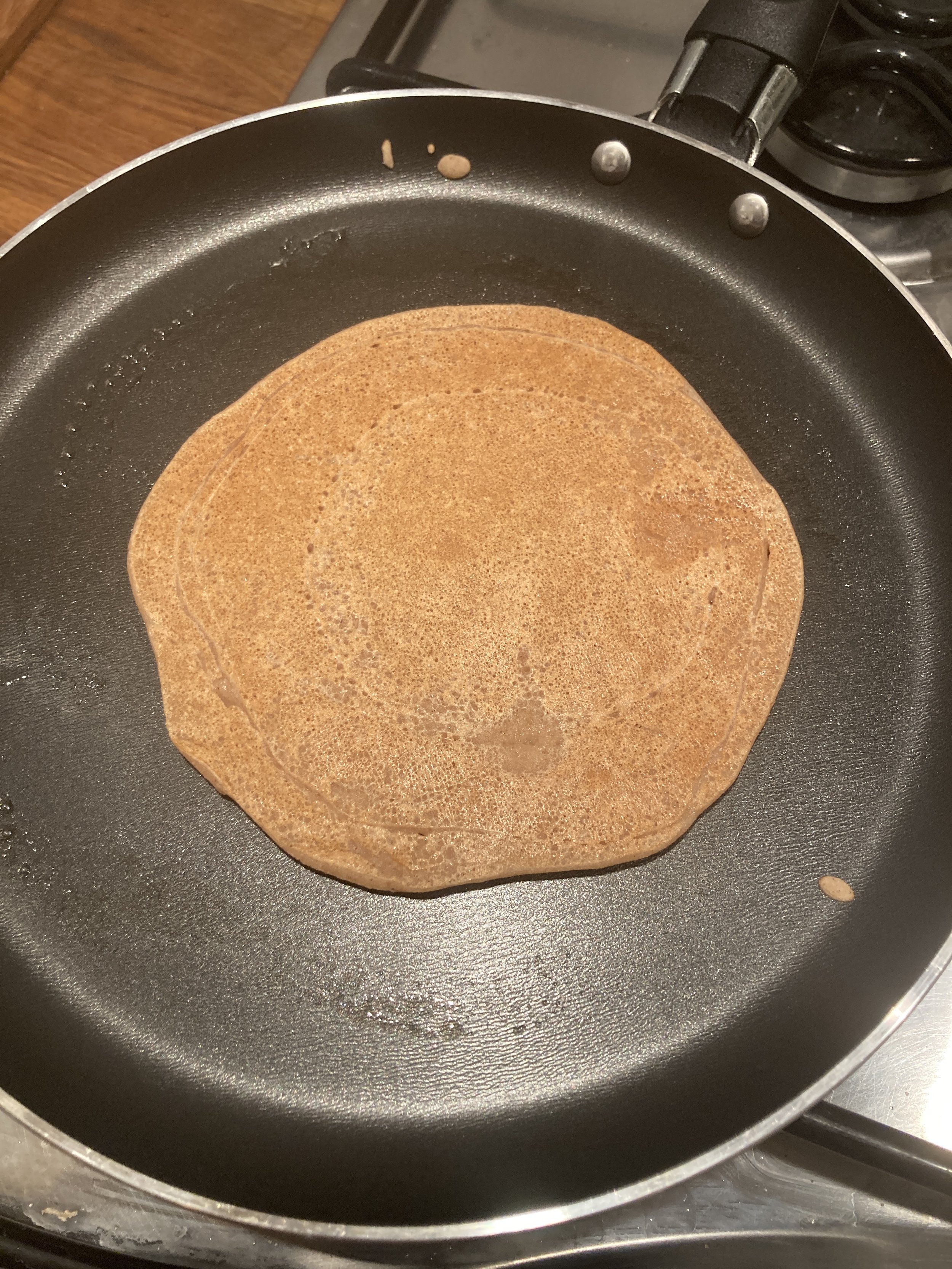
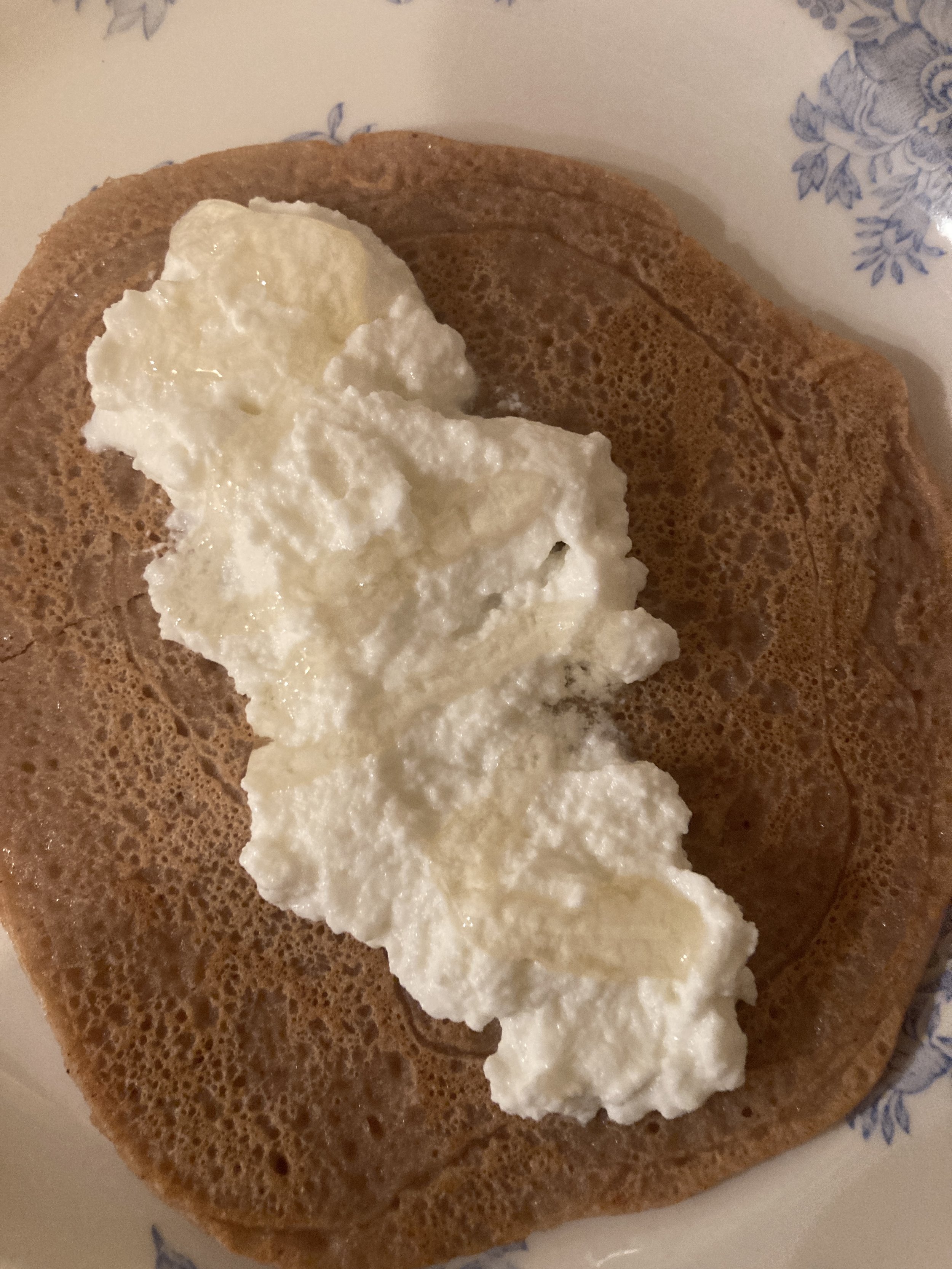
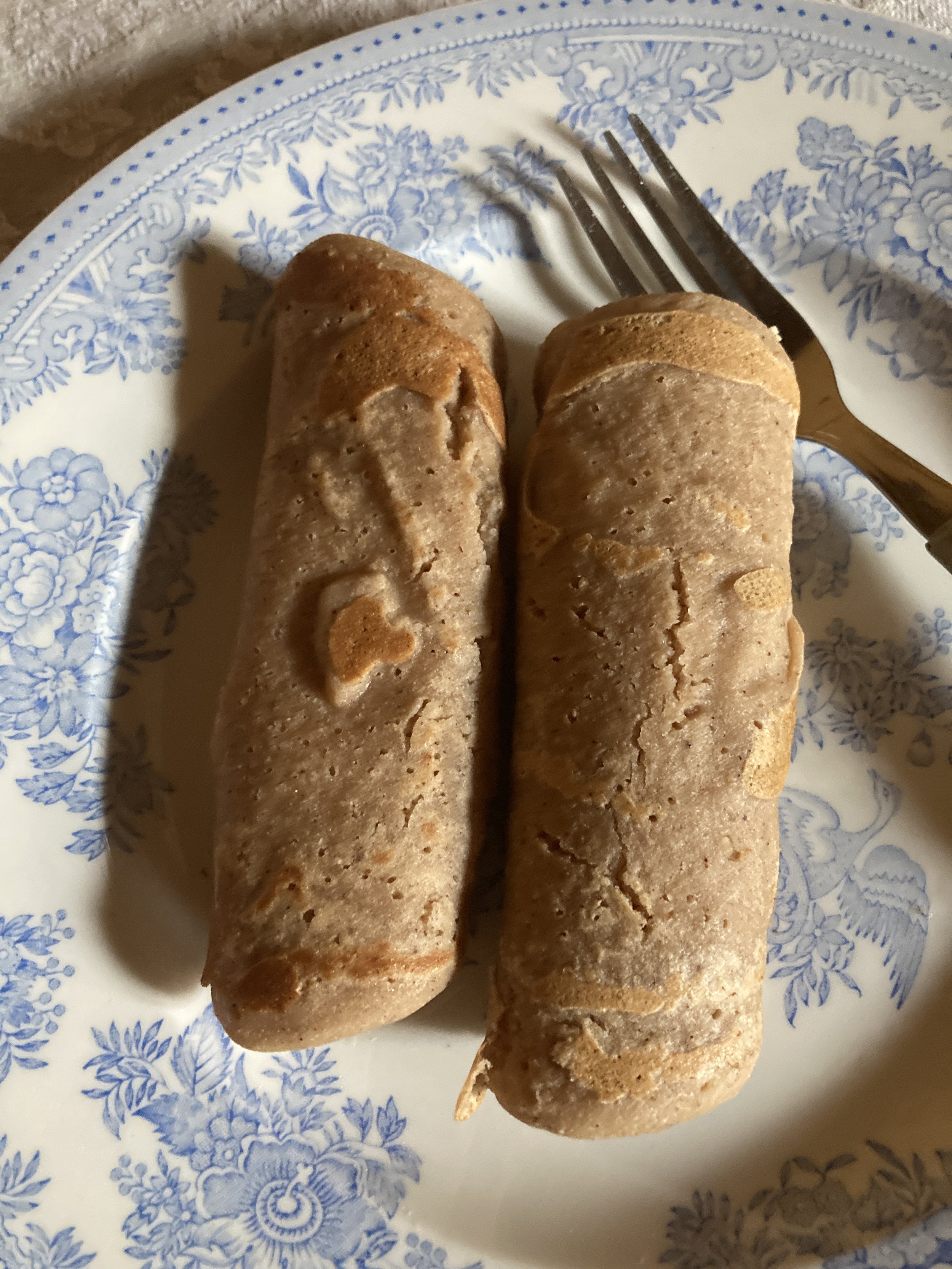
Like a crepe they can be rolled around a filling.  The batter is very simple -  just chestnut flour, water, and a pinch of salt.  Traditionally, necci were cooked between testi, round stones heated over a fire.  Today Necci are usually cooked between two long-handled, flat cast iron plates.  The warm necci are then filled, most commonly with fresh ricotta and a drizzle of honey.  Delicious! 

These round stones, called testi, were the traditional method used to cook Necci. To learn more about chestnuts, visit the Chestnut Museum in Colognora di Pescaglia where this photo was taken.

Frittelle di Castagne, little fried chestnut fritters, served as an appetizer alongside fresh ricotta in the town of Pontremoli.

Similar to Necci are Frittelle di Castagne, often found in the areas of Tuscany known as the Lunigiana and the Garfagnana, both hilly areas in the north. 

The batter is similar to Necci, but the preparation is different.  Small scoops of batter are fried in oil, creating a crisp outside and tender inside. 

While I think of frittelle as breakfast or dessert items, lightly sprinkled with sugar, they can also be served unsweetened as an appetizer with a bit of ricotta.  That’s how I first encountered them last fall in a restaurant in the town of Pontremoli.

I have been working on learning to make both Necci and Frittelle di Castagne at home. 

For Necci, simply combine 1 cup of chestnut flour (100-120 gm), sifted after measuring, with ¾ - 1 cup of warm water. Mix well.

Take a little taste of the batter – the sweetness will surprise you!  

Either a heavy crepe pan or a non-stick skillet works to cook the Necci.  Lightly butter the pan to prevent sticking, pour in about ¼ cup batter and spread with a fork or spoon to create a thin crepe.  Cook until set, flip, and cook on the second side. Fill while warm with a couple of tablespoons of ricotta, drizzle with a little honey, roll up and enjoy! Makes 4-5 Necci.

90B3AD38-7BA1-4C9D-9F43-A1C39294C47B.jpeg
415C4496-7A63-4821-97CB-70268C7A2103.jpeg
94DC0143-E1F9-43DC-BC1A-FD4BEA52A5E0.jpeg


For Frittelle di Castagne, combine 1 cup of chestnut flour (100-120gm), 1 teaspoon of baking powder, and a pinch of salt. Sift and add about 1 c. warm water (add about 3/4 of the water and then enough more to make a fairly thin batter). Mix well.  Heat vegetable oil in a frying pan, deep enough to cover the bottom of a pan and about half-way up the frittelle (I use ¼ c. oil in a small 8 in frying pan, frying 2-3 frittelle at a time).  Test the oil with a small drop of batter - it should have a lively sizzle and the batter should puff up slightly. Drop spoonfuls of batter into the hot oil, cook until the top is set and small bubbles appear, flip, and continue cooking until crisp and brown on both sides. Smaller is better for these fritters - small enough to cook through in just a couple of minutes and be crisp outside and not doughy inside.  Remove from the oil and place on a paper towel to drain.  Serve warm sprinkled with sugar or room temperature with a side of plain ricotta.   Makes about 18 - 20 small fritters.

Now that I’ve learned how to make these traditional Italian dishes, I am working on incorporating chestnut flour into some other baked goods. Stay tuned!


February 27, 2023 /Joanne Bartram
chestnuts in Italian cooking, castagne, Necci, Frittelle di Castagne, italian foods
Italian culture, Italian recipes, Italy travel, Living in Italy, Lunigiana, recipes, Tuscany

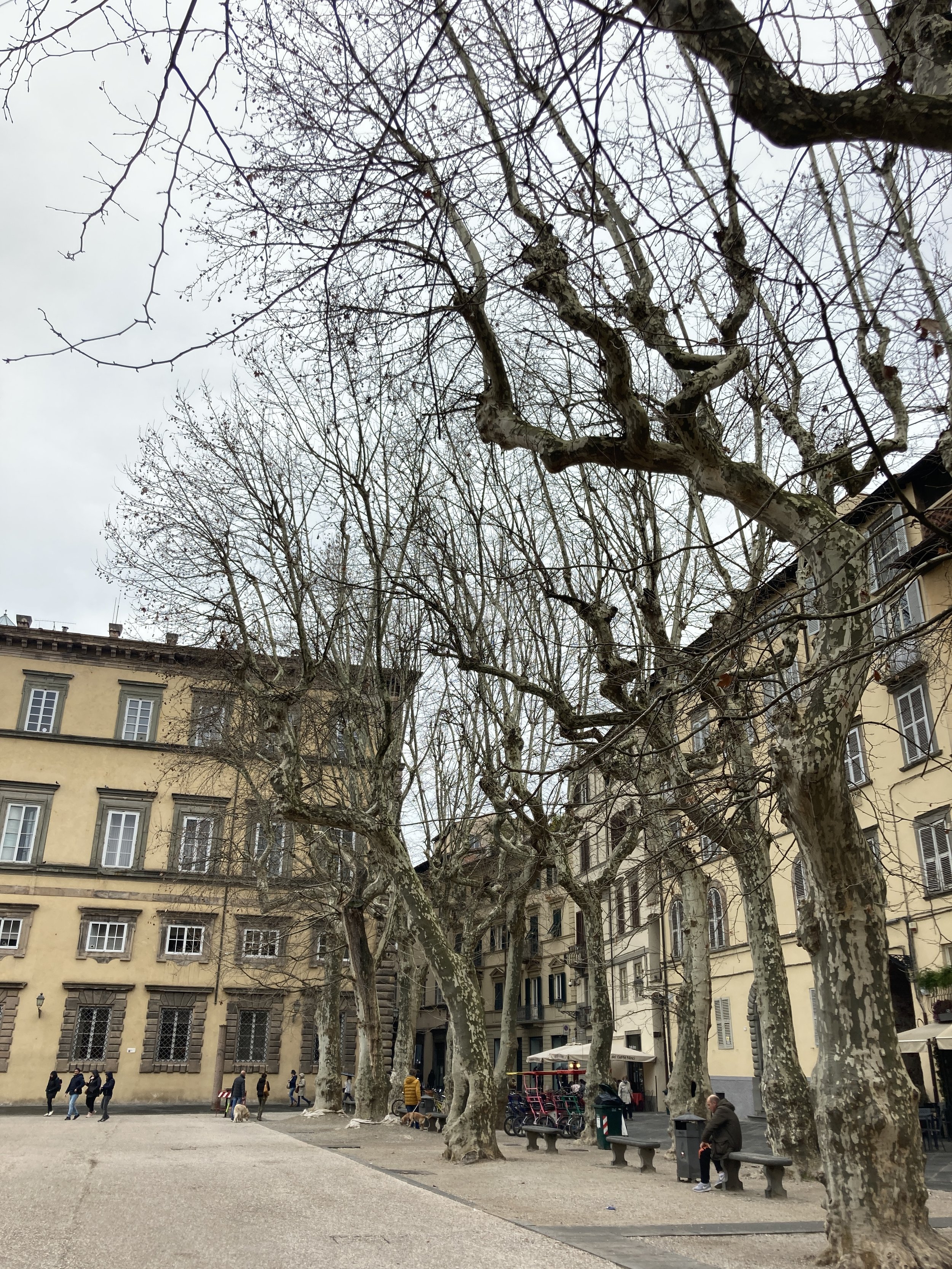
The trees are still bare in Piazza Napoleone

And The Travel Gods Laughed and Laughed

February 20, 2023 by Joanne Bartram in #lucca, Italy, Italy travel, Living in Italy, Lucca

After 7 weeks away, I am finally back in Italy.  I feel fortunate to have the best of two worlds - being able to spend weeks of time with family and friends in New Mexico and then returning to my home in Lucca for most of the year.  The only real drawback to this divided existence is the necessity for international travel.  Travel used to be fun, didn’t it?  Jumping on a plane and flying off to an adventure felt joyful.  But these days, well, the shine is mostly off the travel experience for me.  Now, airports and airplanes are simply a means to an end. 

This carousel is always one of the first stops I make on my return to Lucca

 Now that all the pandemic restrictions and testing requirements have ended it should be easier, right?  No more covid swabs 24 hours before a flight, no green pass needed, even vaccines are optional (though very important).  And yet, air travel hasn’t quite returned to normal (whatever normal is).  With strikes common in Europe, shortages of baggage handlers, reduced numbers of flights, and US system meltdowns, it all feels like a roll of the dice. 

 Silly me, I was actually looking forward to my return flights from Albuquerque to Florence. I booked way ahead, and because February flights are generally not full, I was able to find an inexpensive business class (or, as I think of it, Princess Class) fare for my return flights.  What a treat! I was anticipating smooth, pampered flying on the way back to Italy. 

 And that’s when the travel Gods began to laugh.   I had an early morning flight out of Albuquerque.  Up at 4 am, I was greeted by an unusually heavy snowfall.  Shoveling a path to the car at 5:30 am was not in my travel day plans!  Luckily my friends arrived to pick me up, I rolled my luggage down my newly shoveled path, and arrived at the airport in plenty of time.  I should have paid attention to those travel Gods tittering in the background.

A typical Lucchese window within an ancient brick wall with its window box full of flowers. Just one reason to love Lucca.

The flight was delayed a bit, and required deicing, but no worries as my layover in Houston was long.  I thought the travel Gods had had their fun and that they were done with me. Not a chance. I will skip the details and just sum up the rest of my travels.  2 hour delay out of Houston waiting on “mechanical clearance paperwork”.  The delay was prolonged when, just as we put our seatbelts on and were ready to roll, a passenger demanded to be let off the plane!  Did you know that when that happens the airline must search for the passenger’s checked luggage and remove it from the flight?  Shocking that a person would force a planeload of people to endure a further delay because she was upset that her rebooked connection was in – gasp – economy class!  She simply could not tolerate that and so off the plane she went.  Another 45 minutes of delay. 

I will say that the United flight crew was fantastic on that flight. They were just as frustrated as the rest of us about the delays, but they didn’t let that stop them from being gracious and helpful. Of course, the long delay meant a missed connection and longer layover in Munich.  Booked on a later flight into Florence, I finally arrived, but, and you can anticipate this next bit, my luggage did not. Thankfully my airtag let me know exactly where the bags were and allowed me to track them until they arrived in Florence. The next day and a half was spent in my apartment waiting for the luggage to be delivered.  They never say in advance when the courier will arrive but if you are not home, well, back to Florence goes the luggage.  And so I waited.

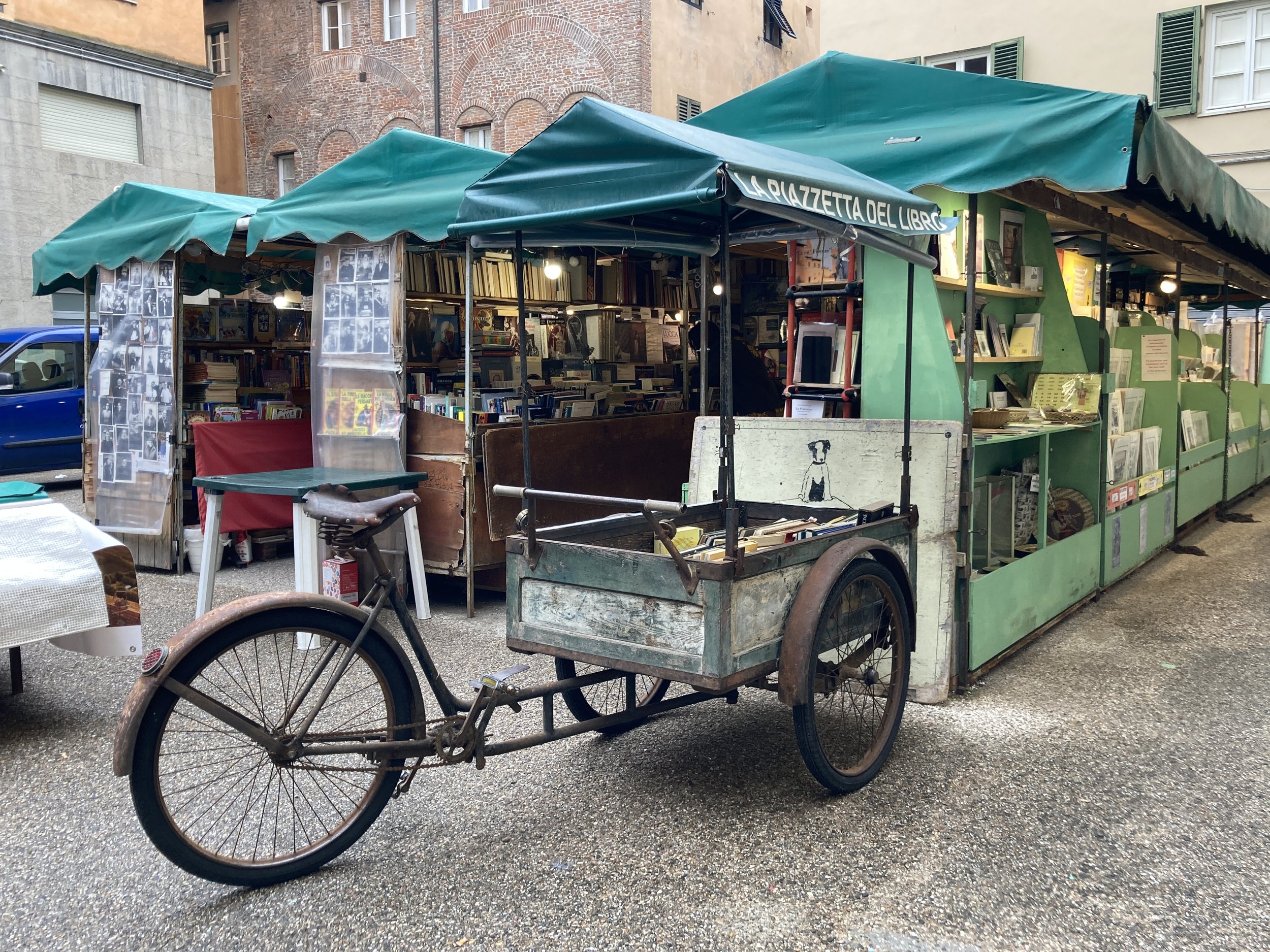
The small piazza of the Booksellers, Lucca

 All I really wanted to do my first days back in Lucca was to get out and walk through town.  I had favorite places to see, changes to find, signs of spring to search for, and the need to just reconnect with all the beauty of this city.  Sitting at home was definitely not what I had planned.  The travel Gods seemed to still be laughing at me! Don’t get me wrong - I am immensely grateful for a safe arrival and know that the frustration of this flight is a minor inconvenience in the greater scheme of things. But still … waiting for that luggage to come was torture.

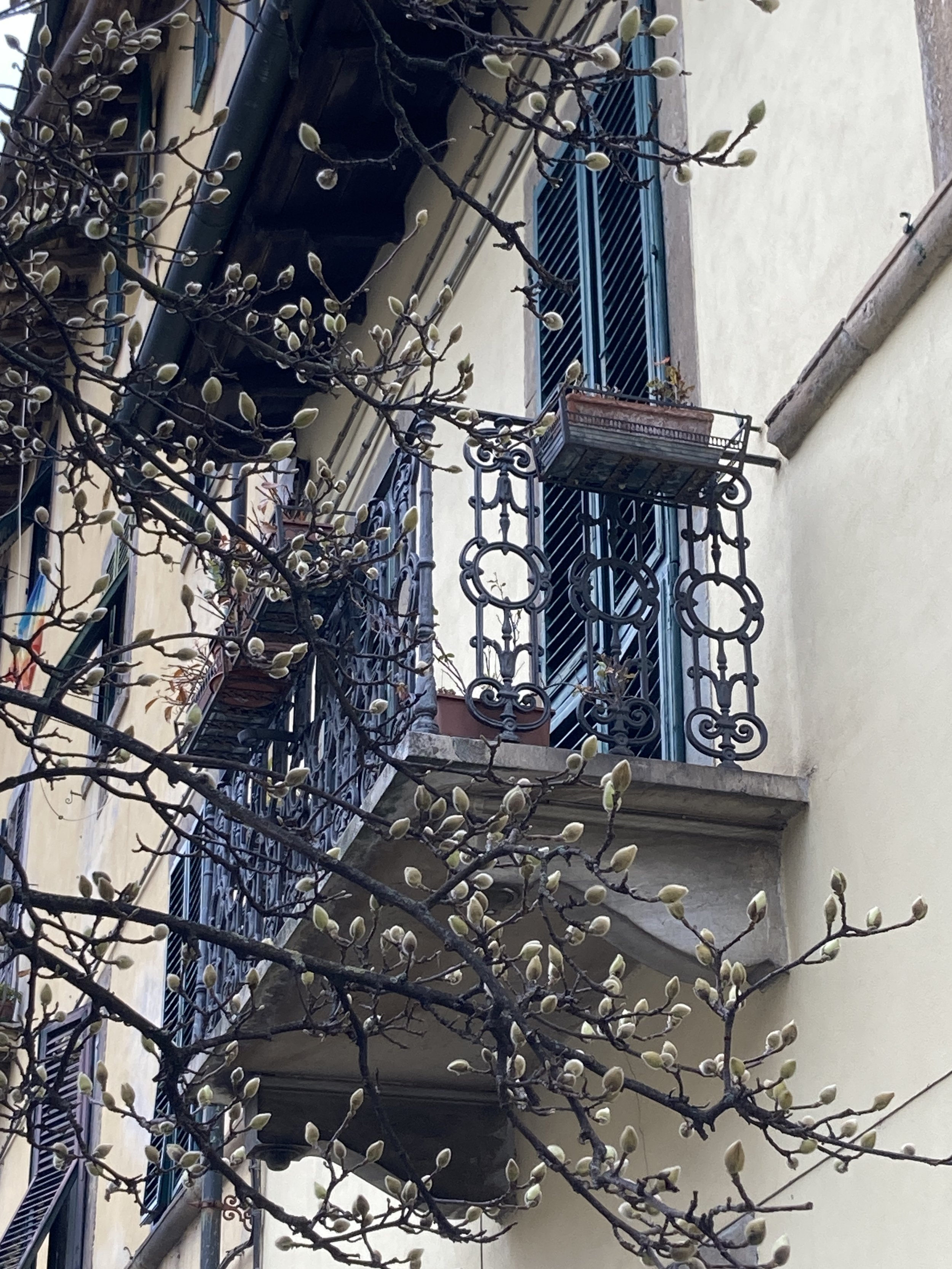
But then the luggage was delivered and I was free to roam about Lucca.  And what did I find on my initial wanderings?   The weather is still cold and the trees mostly bare but starkly beautiful.  The first fuzzy buds are out on the magnolia trees on Corso Garibaldi, a sure sign that spring is coming. 

The magnolias are budding!

How I will miss these fun windows at Chocolat, now sadly closed.

My favorite little sweet shop in Chiasso Barletti, Chocolat, has sadly closed. Where will I find the little chocolate Easter chickens that I buy each spring?  I’ve heard that the owners will soon open another shop in that location, hopefully continuing their tradition of ever changing fun window displays.

The Santa Zita Café has moved just across Piazza San Frediano.  I can’t wait to go inside for a morning coffee or an evening aperitivo. 

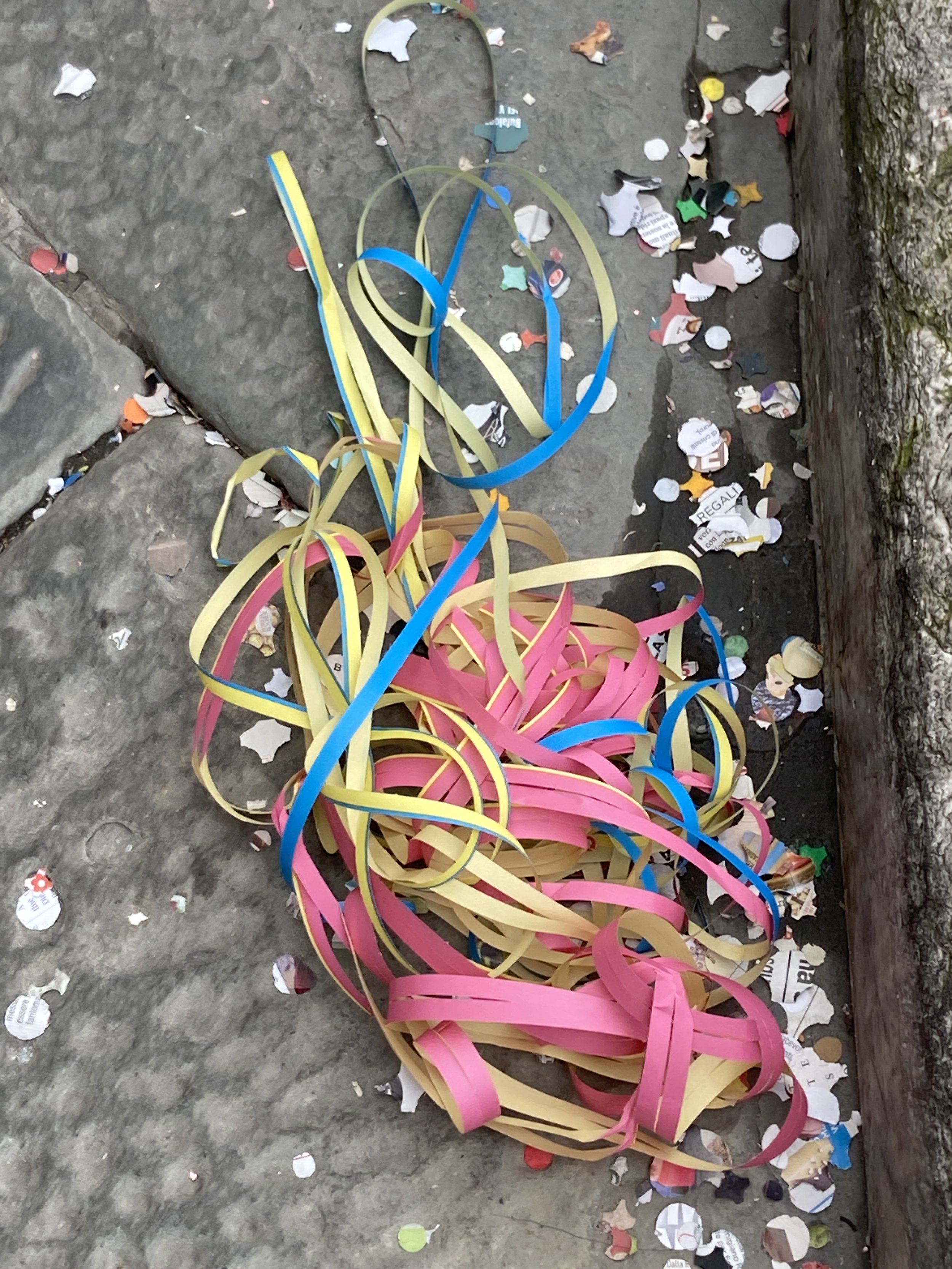
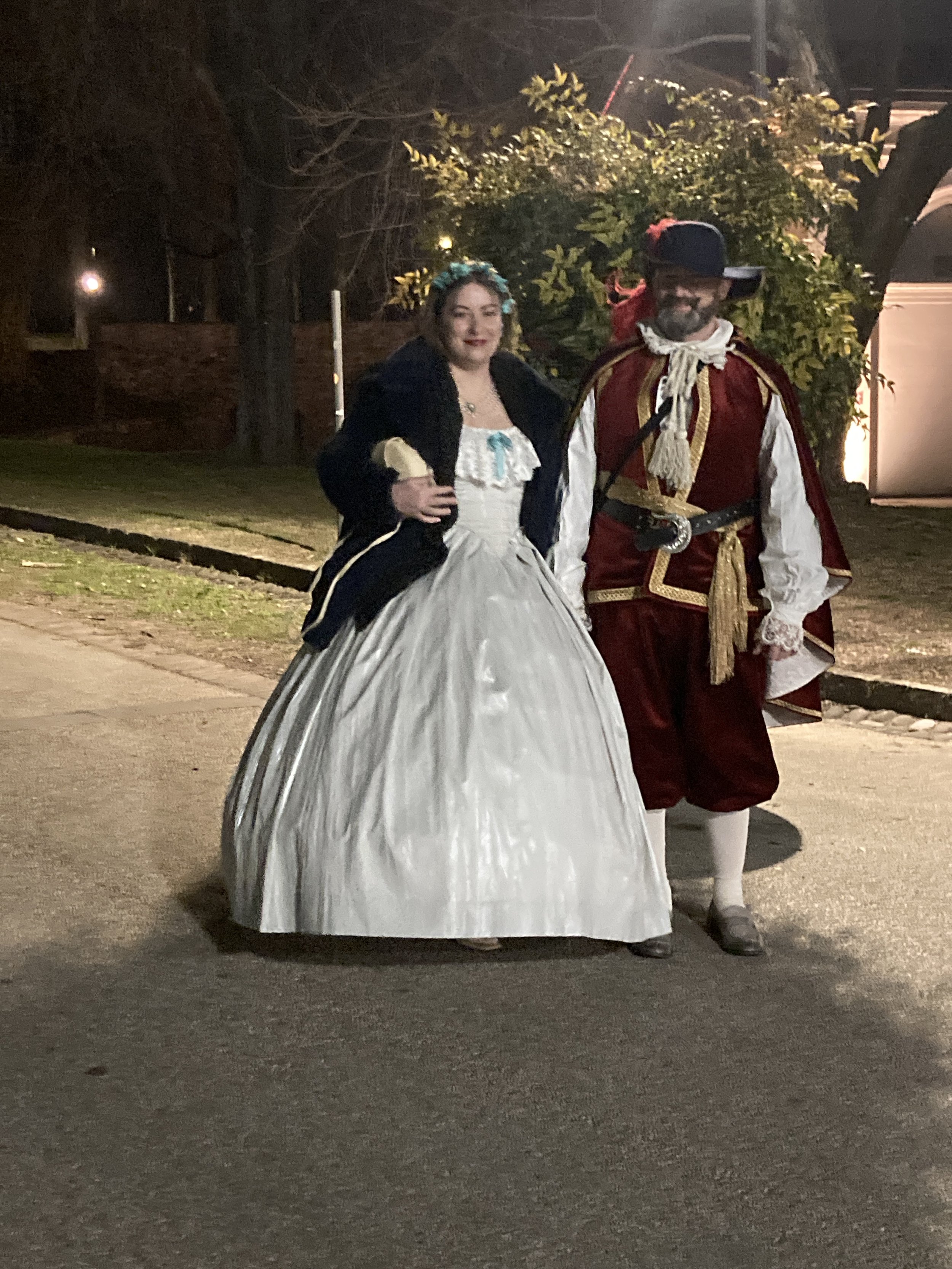
Carnevale events are still going on, the evidence found in colorful confetti on the streets and costumed ball goers last Saturday evening. 

58B752C8-530F-46A3-82B0-E01D9A6FA39C.jpeg
34C55447-10B6-4606-800E-7B740FDF8676.jpeg
D622BA38-4671-4844-8290-F60E1FF454A1.jpeg

Most of all Lucca still presents all the things I most love – the sound of Italian spoken in the streets, colorful window boxes, medieval streetscapes, the tall Torre Guinigi just around the corner from me, ancient brickwork, street musicians, the stalls of the booksellers, the monthly Antiques Market.   Add in the friends I’ve made here and the warm, gracious Italians that fill the city and I instantly feel at home.  It’s good to be back.


February 20, 2023 /Joanne Bartram
Lucca
#lucca, Italy, Italy travel, Living in Italy, Lucca
  • Newer
  • Older

Powered by Squarespace