Two Parts Italy

Exploring Italy, travel, and living a flavorful life

  • Blog
  • About This Blog
  • Start Here
  • Recent Posts
  • Archives by Topic
  • Subscribe
  • Contact me

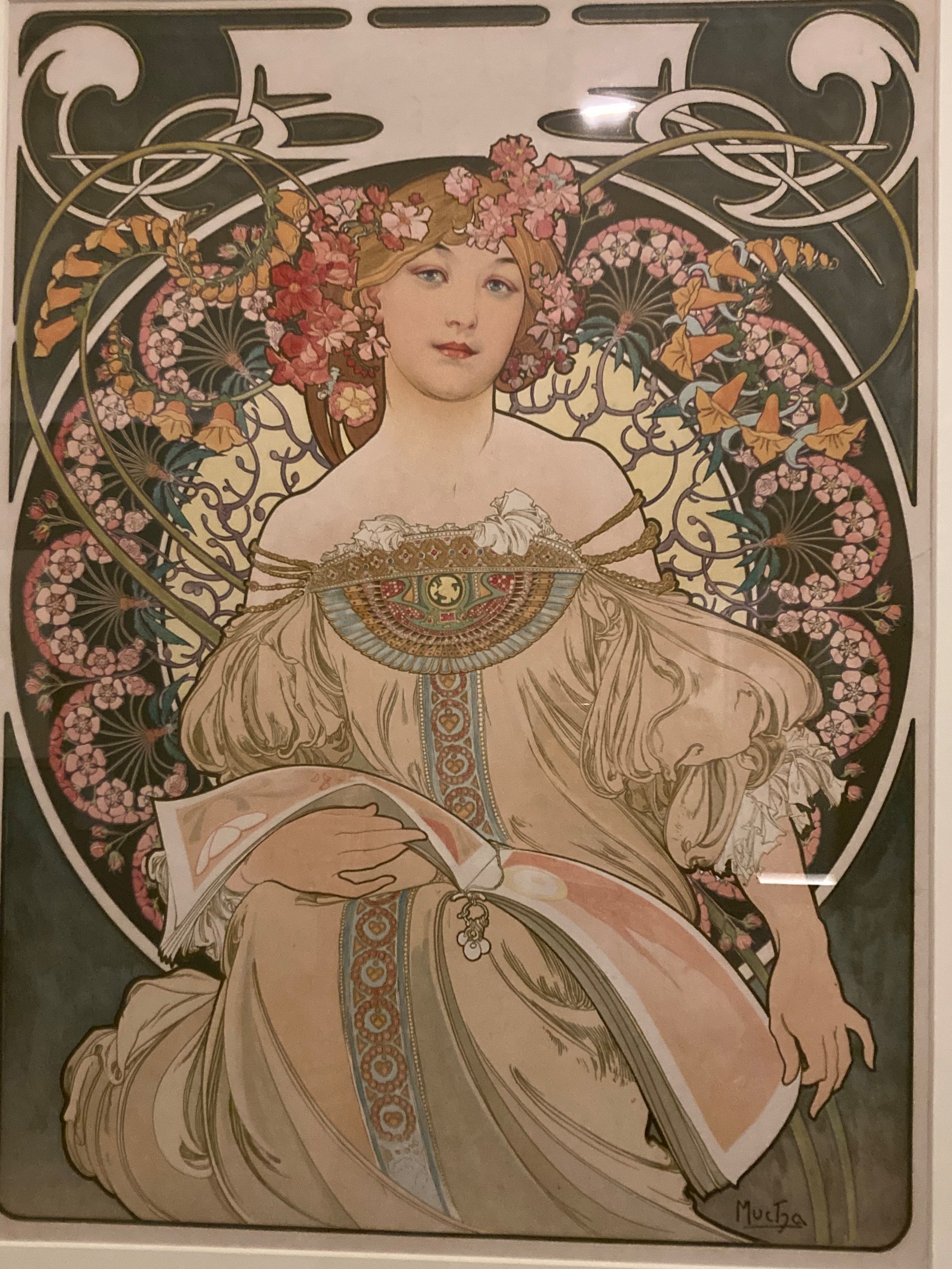
Daydream Alphonse Mucha, 1897.

Art Nouveau in Florence

November 13, 2023 by Joanne Bartram in #florence, Florence, Italian art architecture, Italy travel

 Classic art is everywhere in Florence.   It’s there in intimate chapels and majestic cathedrals, in museums small and large, in civic buildings and Medici palaces. Outside there are fountains, sculptures, fabulous doors, and art tucked above doorways.  It is impossible to be in Florence and not encounter classic art.

 In addition to the classics, it is not unusual to find more contemporary art in the city, both in galleries and as temporary exhibits.   One such exhibit, currently on display in the museum of the Ospedale degli Innocenti, features the works of Alphonse Mucha.

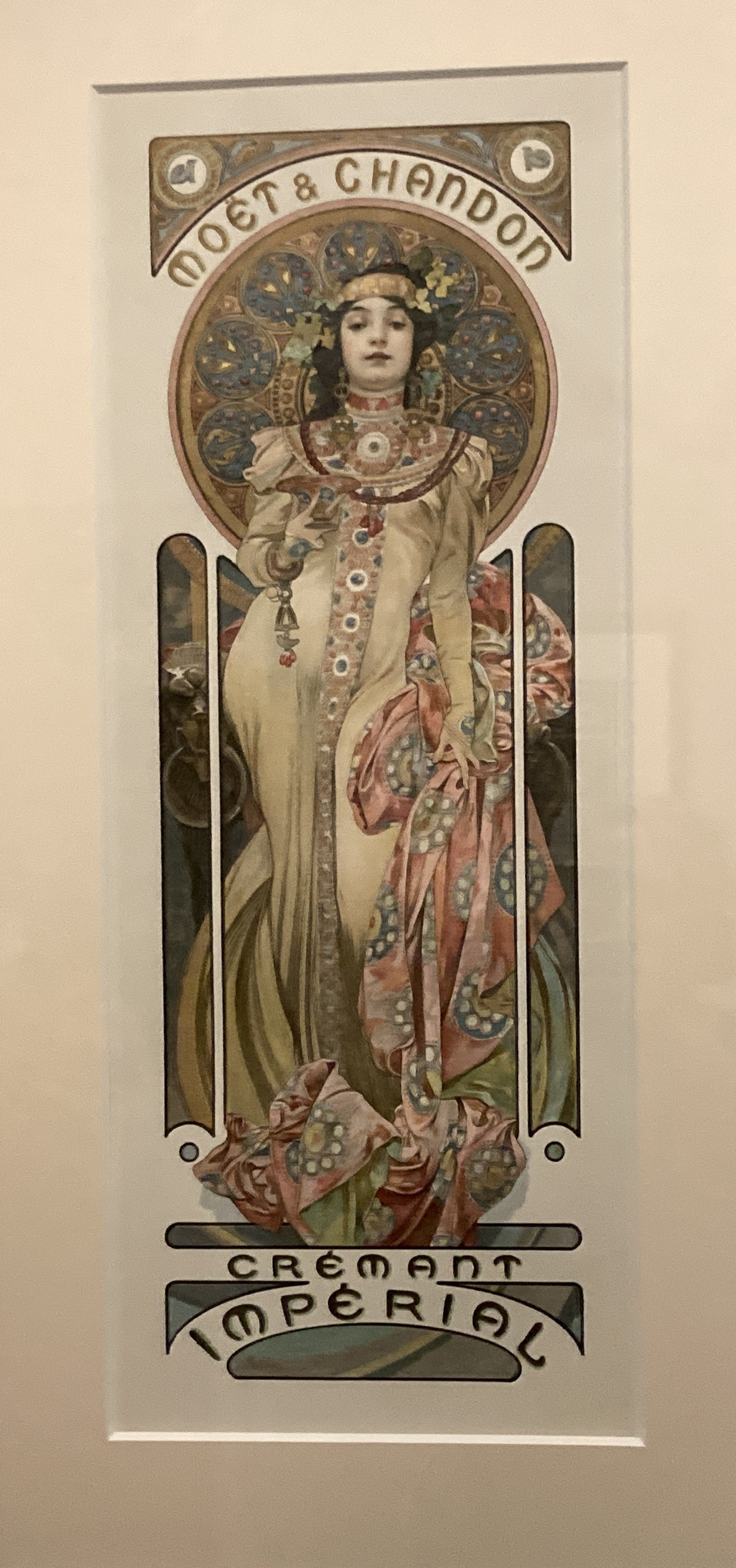
 Mucha worked in Paris in the years just before and after 1900 - the Art Nouveau period.  He worked primarily as an illustrator and graphic designer but also with photography, painting, and jewelry design.  He remains one of the most influential and well-known Art Nouveau artists (though he never described himself with that label).

Mucha created theater posters and programs, magazine and book illustrations, and advertising designs.  His work from that period include the many theater posters he designed for plays starring Sarah Bernhardt.

IMG_6428.jpeg
IMG_6432.jpeg

A Mucha illustration advertising beer


Women are the subjects of Mucha’s illustrations - young, flawless, and dressed in beautiful clothing. No classic goddesses here - these are lively and sensuous ladies.

Mucha surrounds his female subjects with arches, circles, and curves.  Flowers appear in many ways – in the background, as hair decorations, and as intricate border designs.  The colors are beautiful, - soft, warm, complex, floral. 

D5DD5C97-9D3A-47B5-ADB5-BB769613CEF8_1_201_a.jpeg
33DC8C43-230E-46E2-A914-60C2CC732CF9.jpeg
5850AD7F-8318-41E4-AD87-4EEAB180B3D6.jpeg

The exhibit in Florence has several components, including multimedia experiences. At the beginning is a short film, in Italian with English subtitles, plus a timeline. Together, they set the stage for viewing Mucha’s work. 

The poster display begins with his Bernhardt theater posters – large works with fabulous costumes unique to each play.  

Moving through the exhibit you find advertising posters, other forms of advertising (perfume bottles, boxes, menus, fans), and decorative posters.

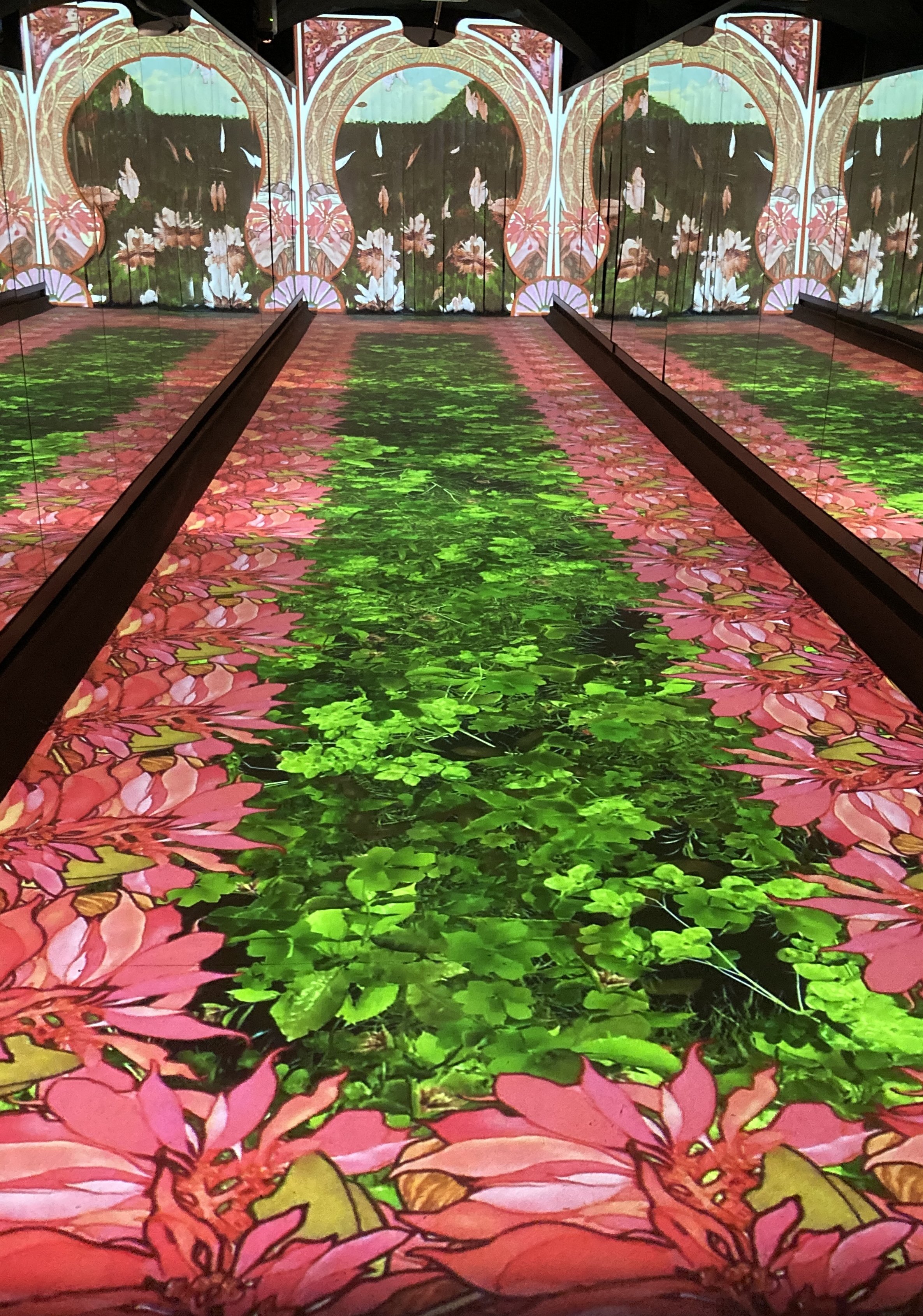
One fascinating part of the exhibit is an immersive experience. A long hallway, flanked by mirrors, filled with ever-changing projections of Mucha’s floral designs. The flowers shift and change creating explosions of color. At the far end are large projections of his works.  It’s a visually beautiful experience that puts the viewer right in the middle of a Mucha illustration. (I’ll post a short video clip on the Two Parts Italy Facebook page).

B63203D4-EED1-4A00-9679-62B3043D2241_1_201_a.jpeg
7D617F84-41A9-434A-ADD5-74A7F60B1AAF.jpeg
377D486C-EA50-4E79-9E4B-1EEC514CB6E4_1_201_a.jpeg

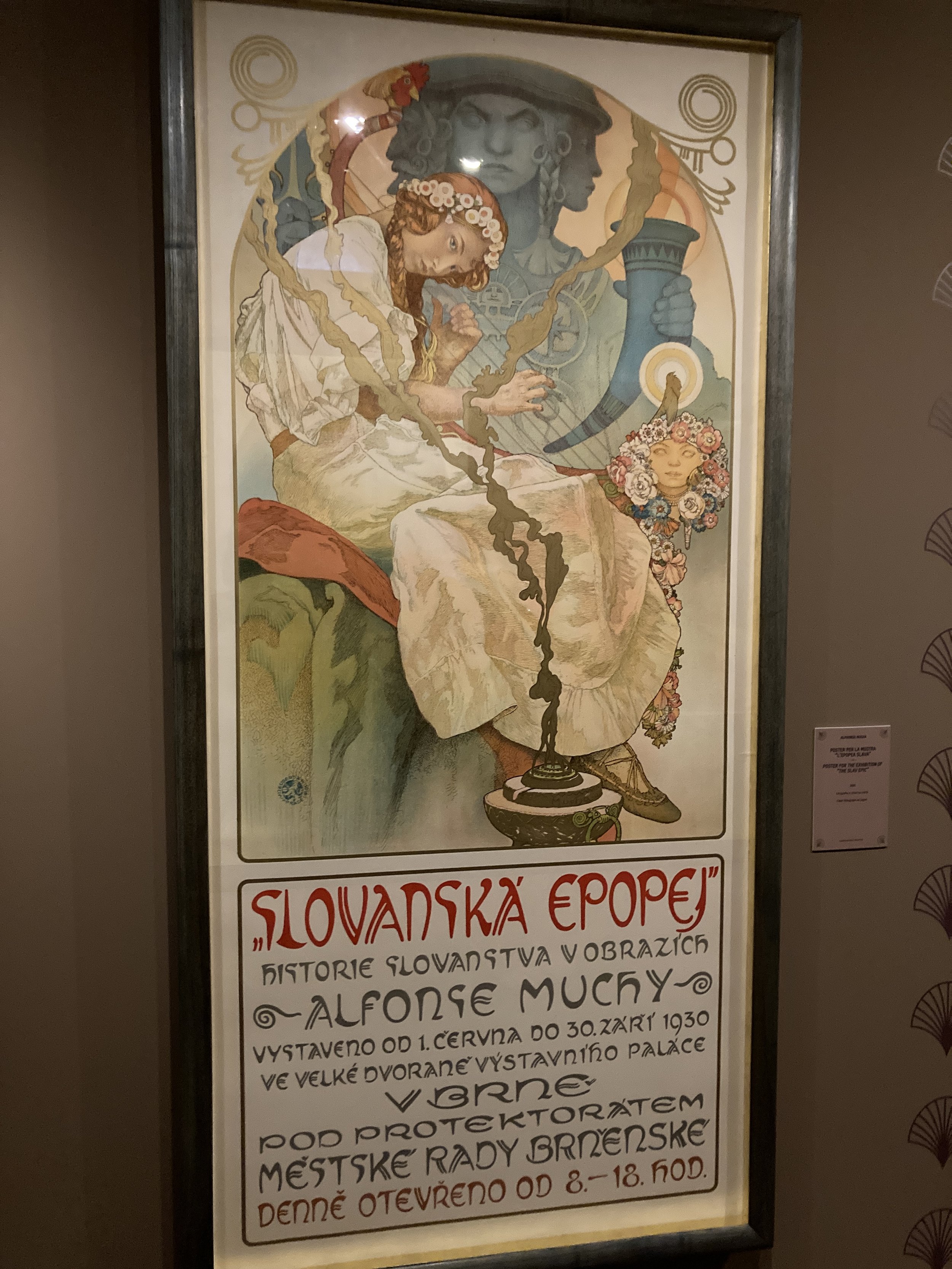
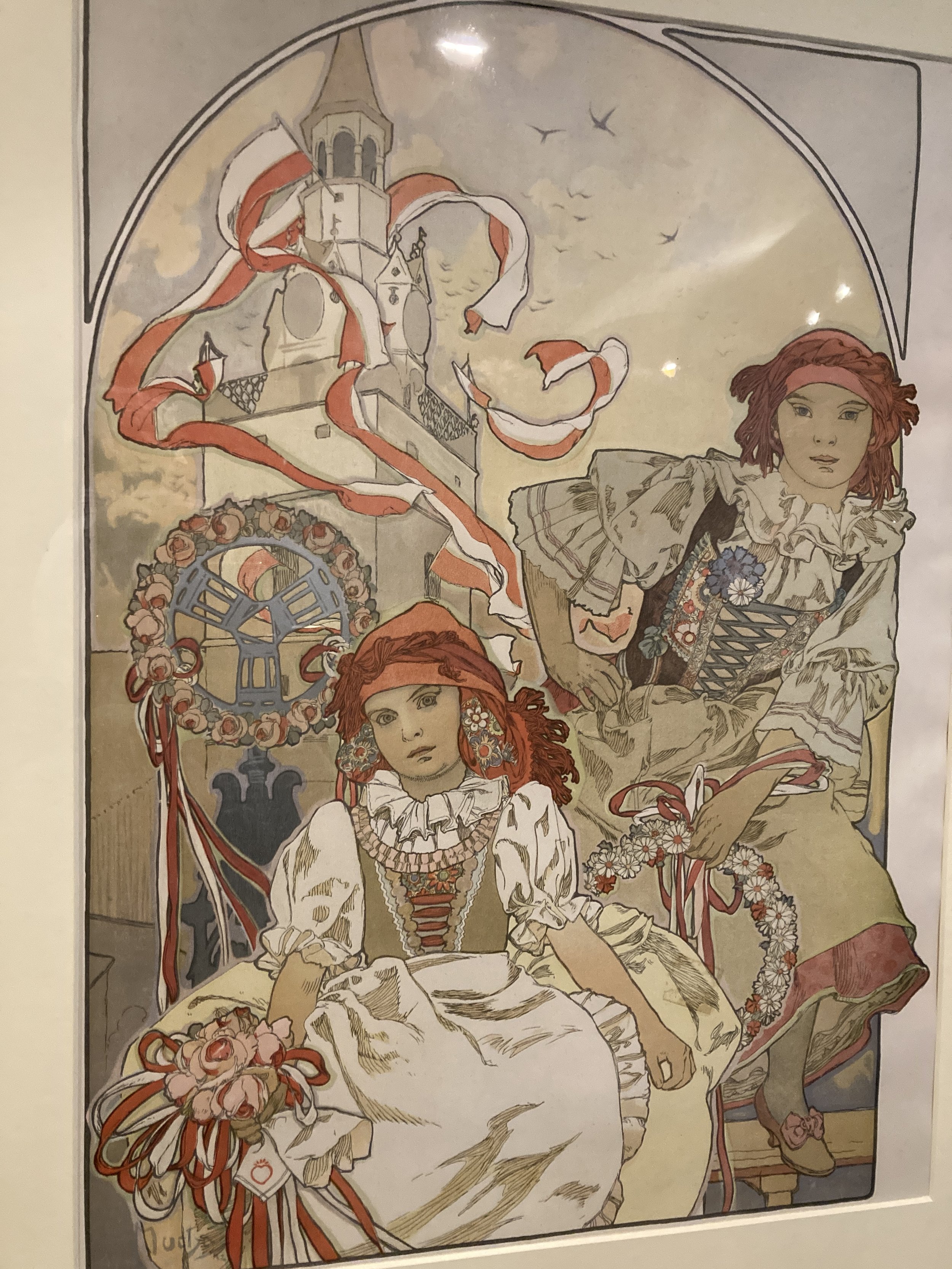
 Not all of Mucha’s works were of beautiful and serene women dressed in alluring clothing.   His posters also reflect his commitment to all Slavic peoples, their customs and their struggles.

86C208A2-540C-4734-B9C1-F4B72226ECE4.jpeg
F4063B9A-57E3-44D3-A689-F861A48985EB.jpeg
58D2EF50-324D-449E-BA40-87707E144E56.jpeg

Mucha considered his most important work to be his Slav Epic, a series of huge paintings telling the history of the Slavic people.  The project was completed over 18 years and then donated to the city of Prague.
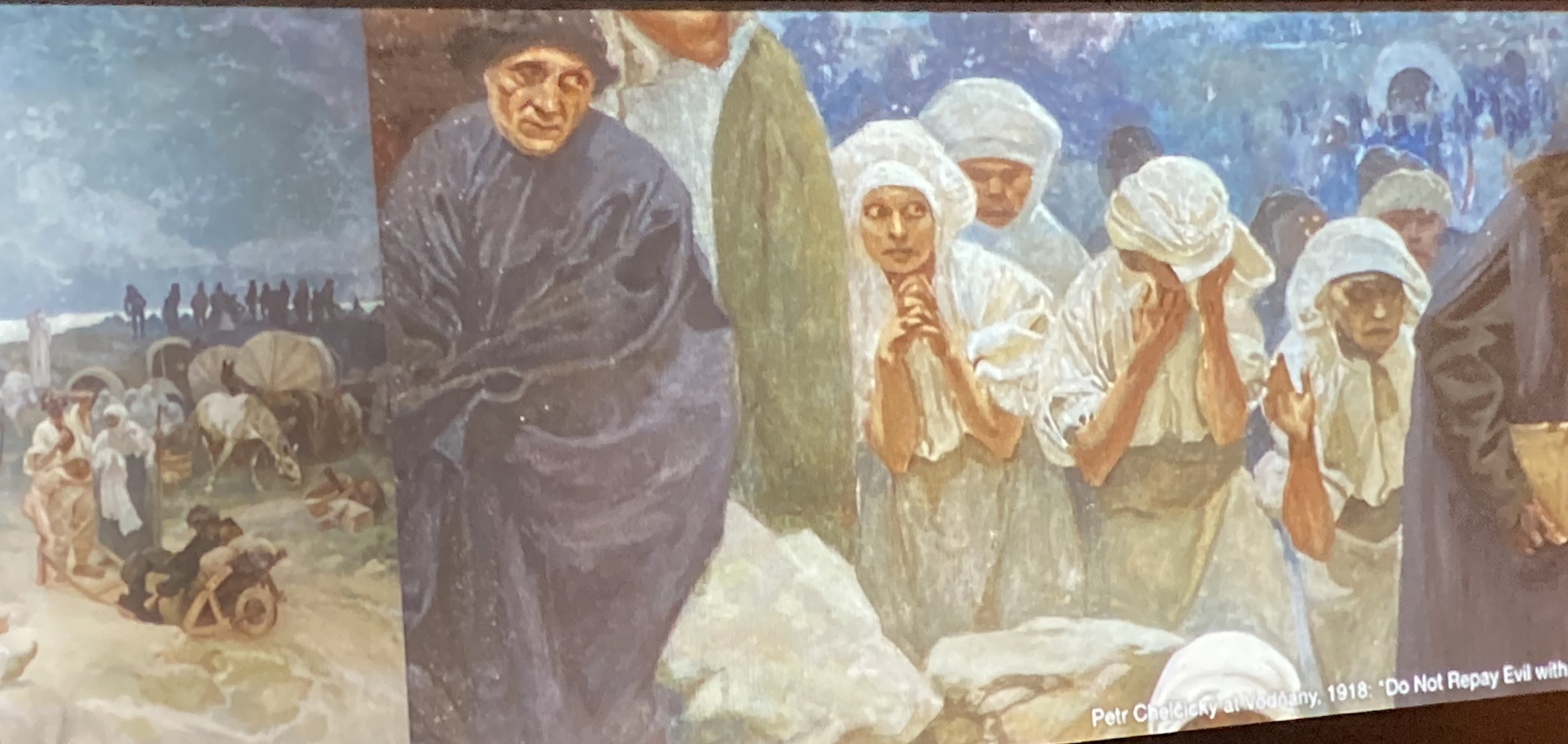
Panel from the Slav Epic

Mucha’s political beliefs, commitment to the independence of the Slavic people, and participation in the Czech Freemasons led to his arrest by the Nazis in 1939.  He was in his 70’s at the time of his arrest and, even though he was released after a few weeks, he died of pneumonia shortly after.  The Nazis also removed his Slav Epic works and they remained hidden for many years.  They are now on display in Prague. Reproductions of several panels are included in the exhibit in Florence.

 The Mucha exhibit will be in Florence through April 7, 2024.  The museum is open daily from 9:30 am to 7 pm with some exceptions (be sure to check on-line for changes to this schedule). A not-to be-missed experience for those who are interested in Art Nouveau.




November 13, 2023 /Joanne Bartram
Mucha, Alphonse Mucha, Mucha exhibit Florence, Art Nouveau, #artnouveauinflorence
#florence, Florence, Italian art architecture, Italy travel

Villa Monastero, Varenna

Varenna and Villa Monastero

October 23, 2023 by Joanne Bartram in #italiangardens, #italytravel, Italian art architecture, Italian gardens, Italian Lakes, Lake Como

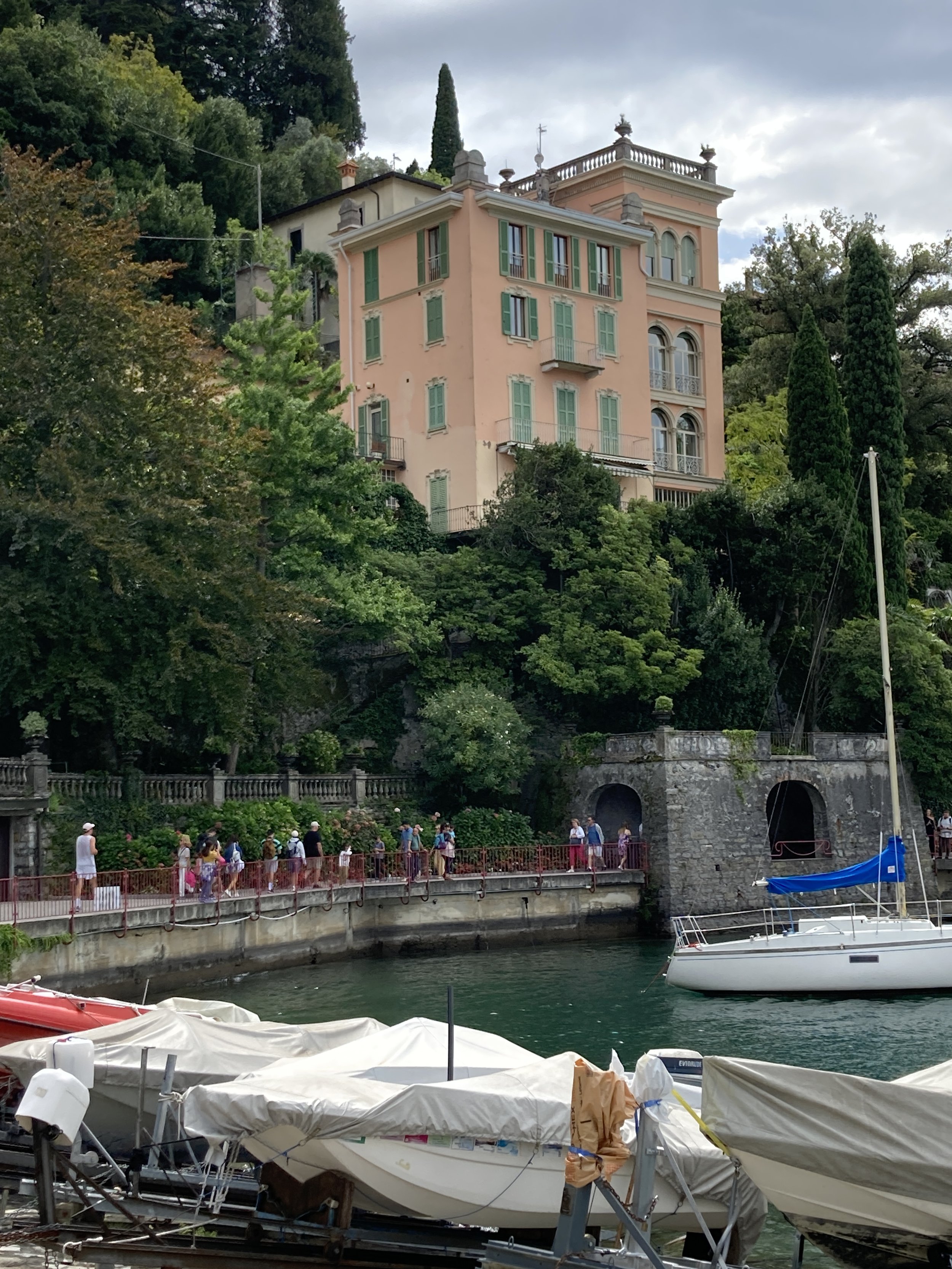
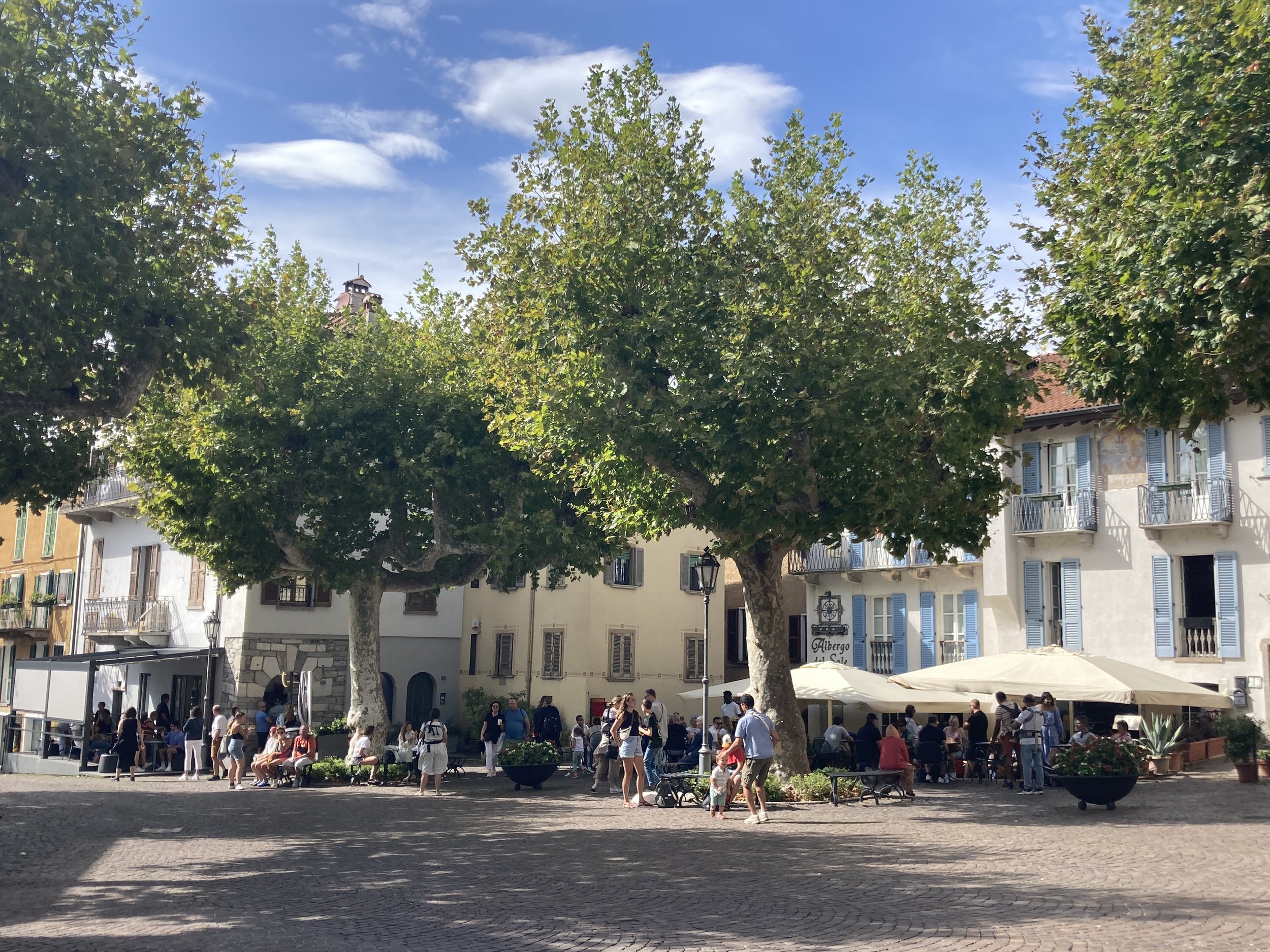
A busy August day in Varenna

There is a lot to love about the town of Varenna on Lake Como’s eastern shore.  Smaller and less glamorous than nearby Bellagio, Varenna still has echoes of the simple fishing village it once was.  Quieter than some of the mid-lake towns, it is less crowded, has spectacular scenery and offers lots of opportunities to explore history, art, and nature. 

 Don’t get me wrong, there are still tourists here (especially in July and August) and the stretch of town along the small harbor can get busy.  But the crowds disappear just a few steps away from the harbor and after the last ferry leaves!

 I think of Varenna as having 3 parts.  To the north end of town, well above the lakefront, is the train station.  The ability to arrive by train is one of Varenna’s advantages, especially for those staying in town.  Most visitors arrive via ferry from one of the other lake towns and the ferry dock is also at the north end of town. I enjoyed my ferry ride from my base in Argegno across the lake to Varenna, there is just something special about those boat trips!

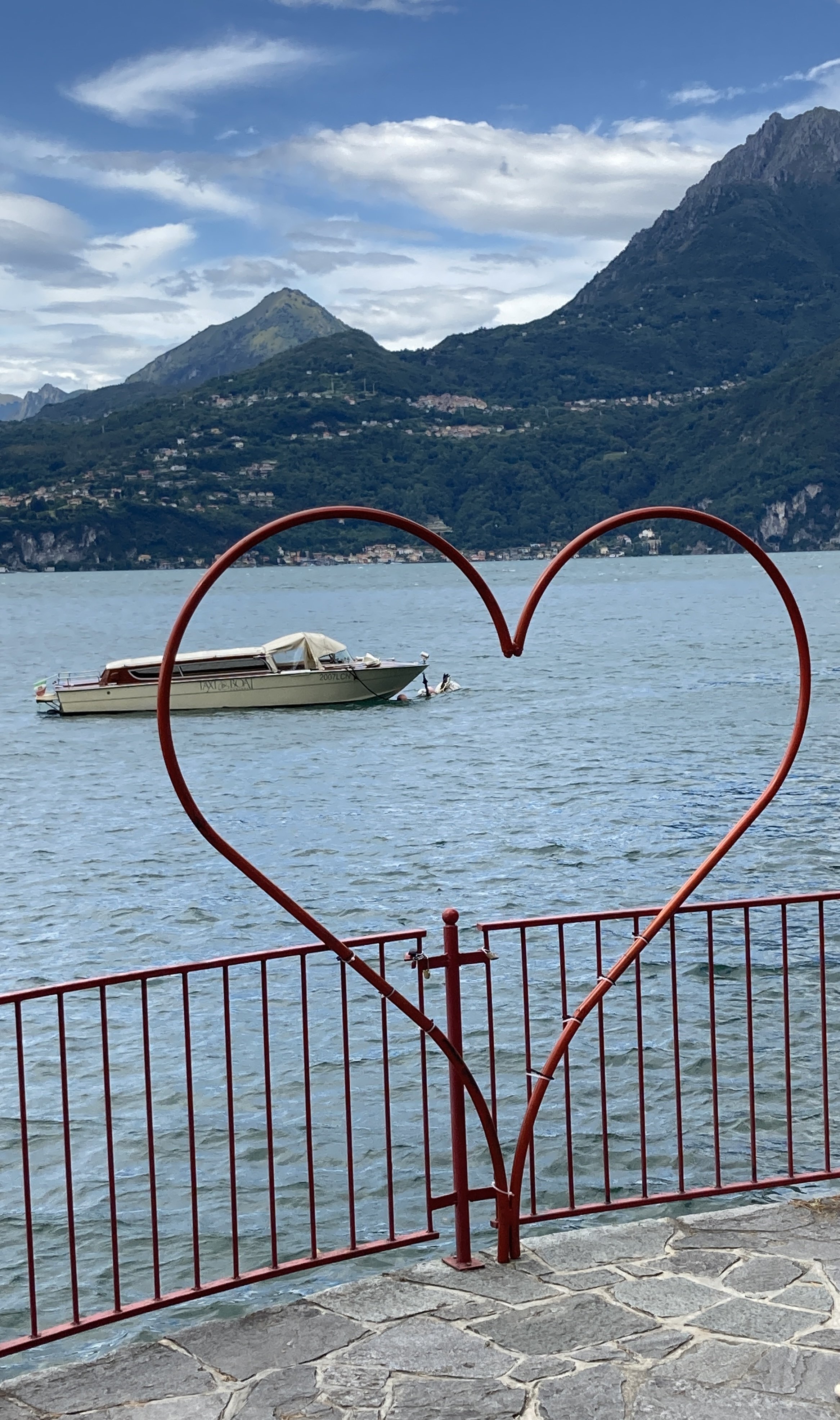
The Passegiata degli Innamorati, Varenna

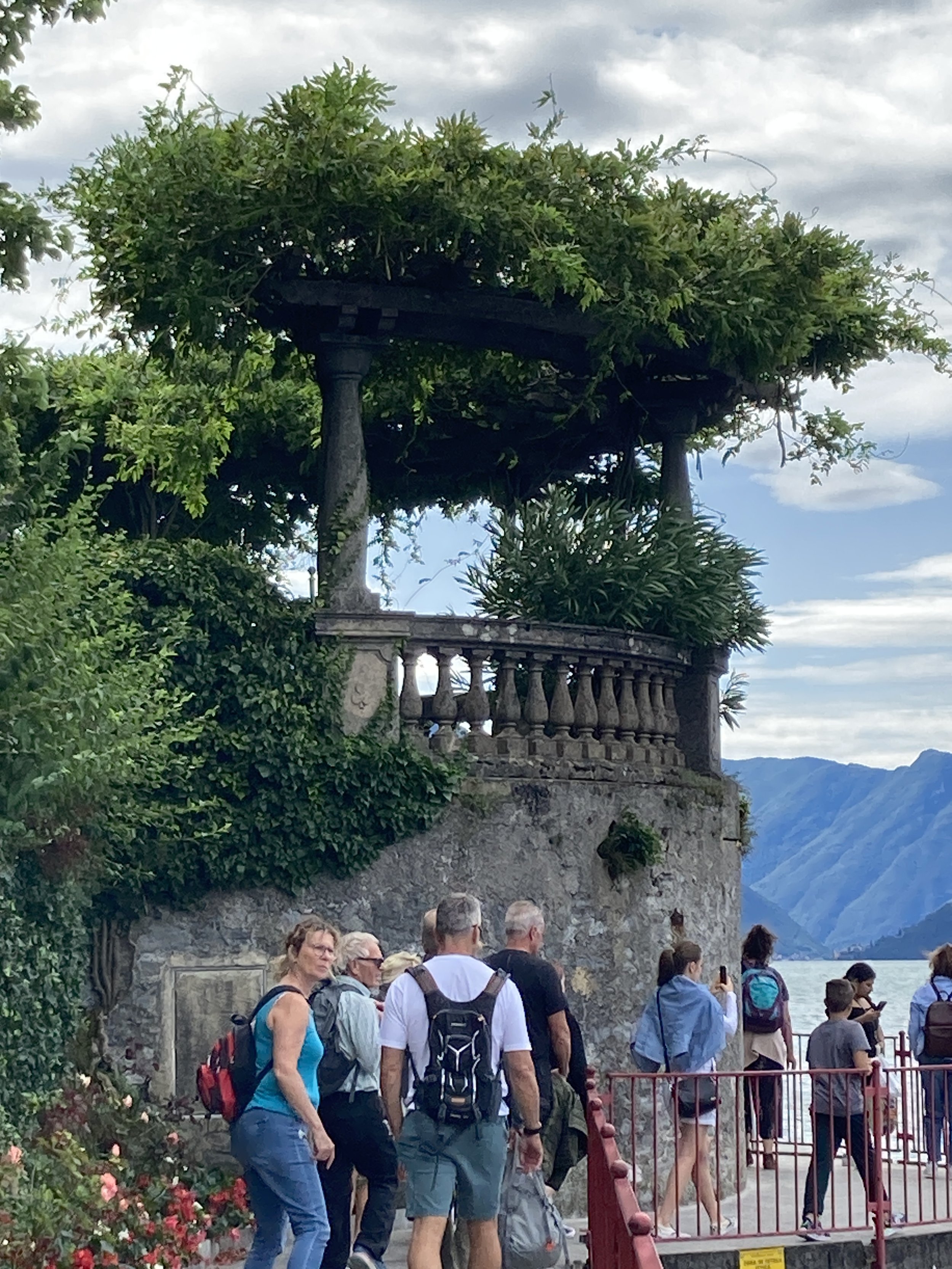
 From the ferry dock, to the south, is the second part of town, the fishing village.  The two areas are connected by one of Lake Como’s best walks - the Passegiata degli Innamorati (the Lover’s Walk).  This passarella (walkway) is dramatic – a long pathway balanced right above the shore.  You will know it by its red railings and the big red heart at a viewpoint along the way.   Along the passarella are windswept trees, greenery, stone walls, flowers, villas, and big views.  You may even be serenaded by an accordion player as you pass by.

58863746-5AA4-48A5-A593-506ED187F423.jpeg
7F1C5D88-886F-4F1C-8C03-25CCEEB05DEE.jpeg
040819E1-AF8E-4305-A80C-FBC0B0CA24E5.jpeg
04EC937C-FC5C-41D3-BC72-2AF811D62C02_1_201_a.jpeg

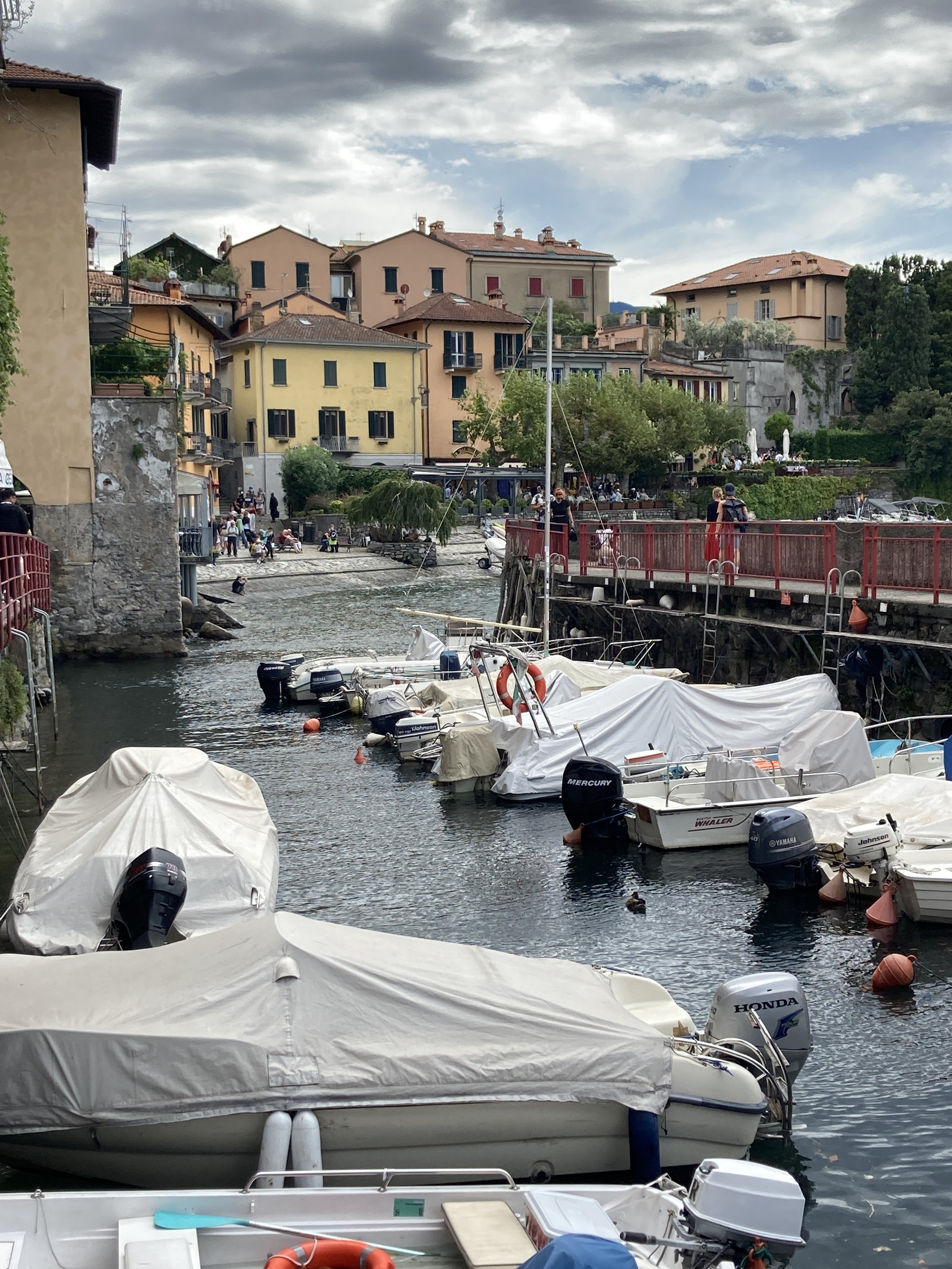
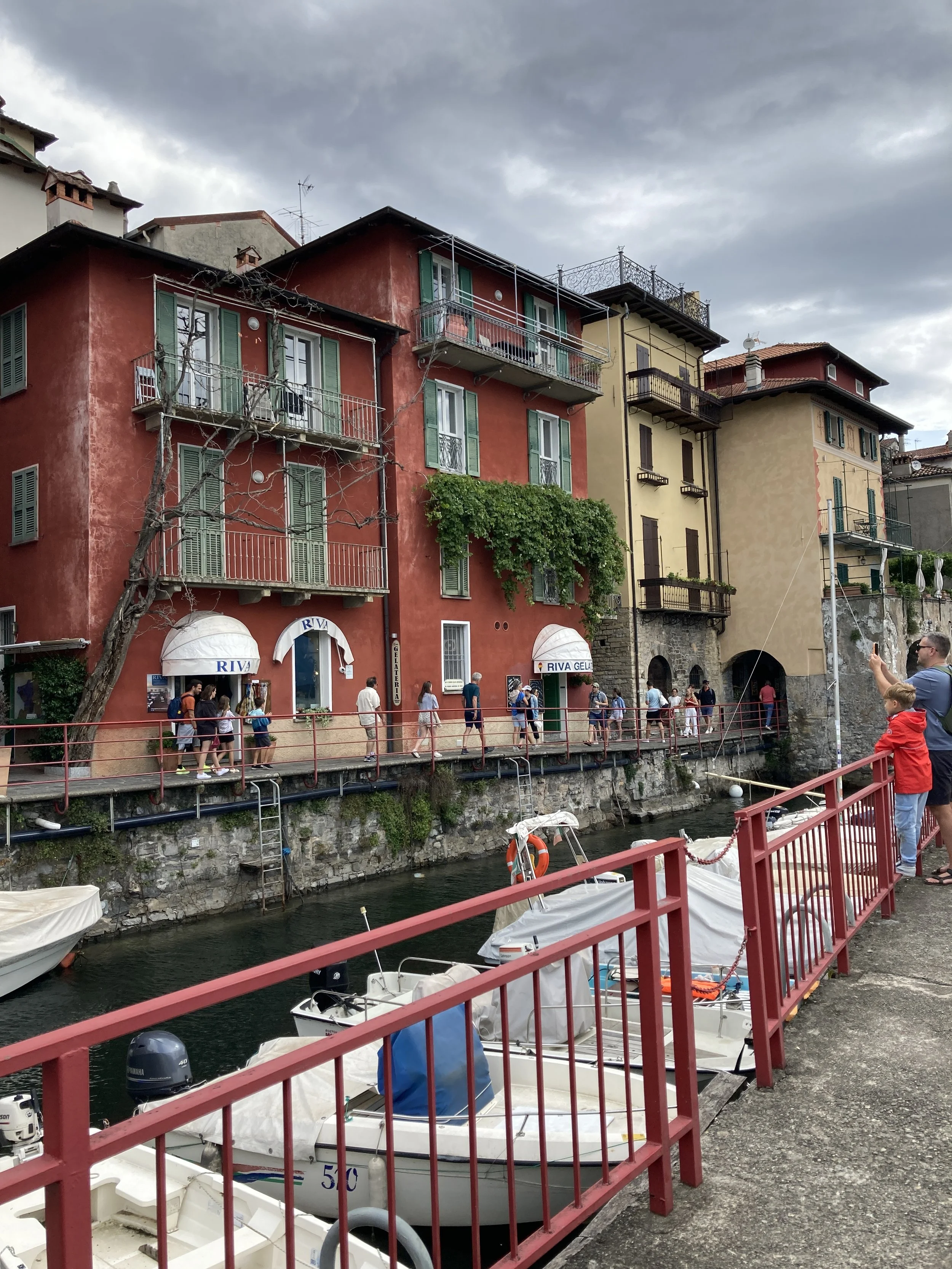
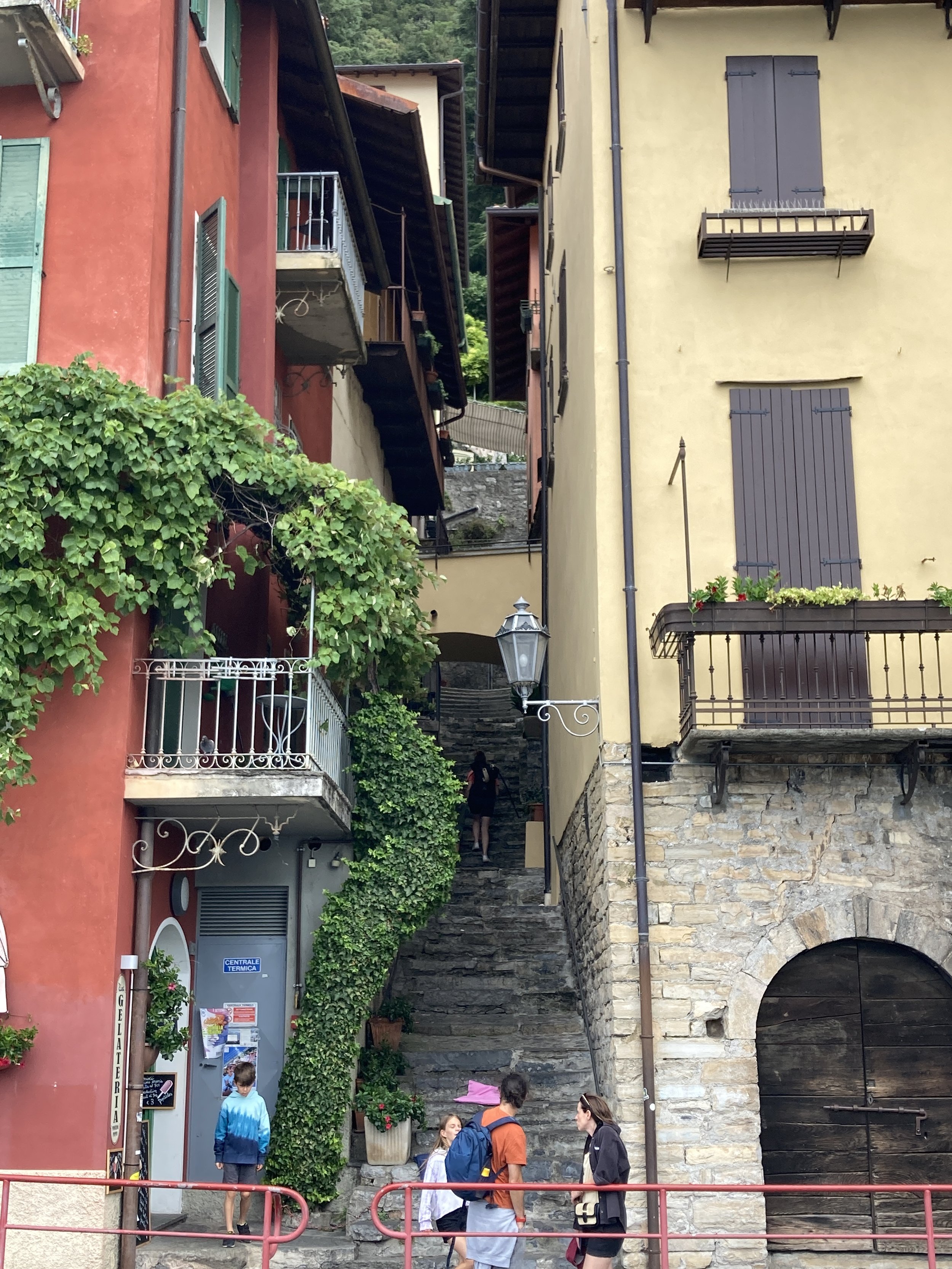
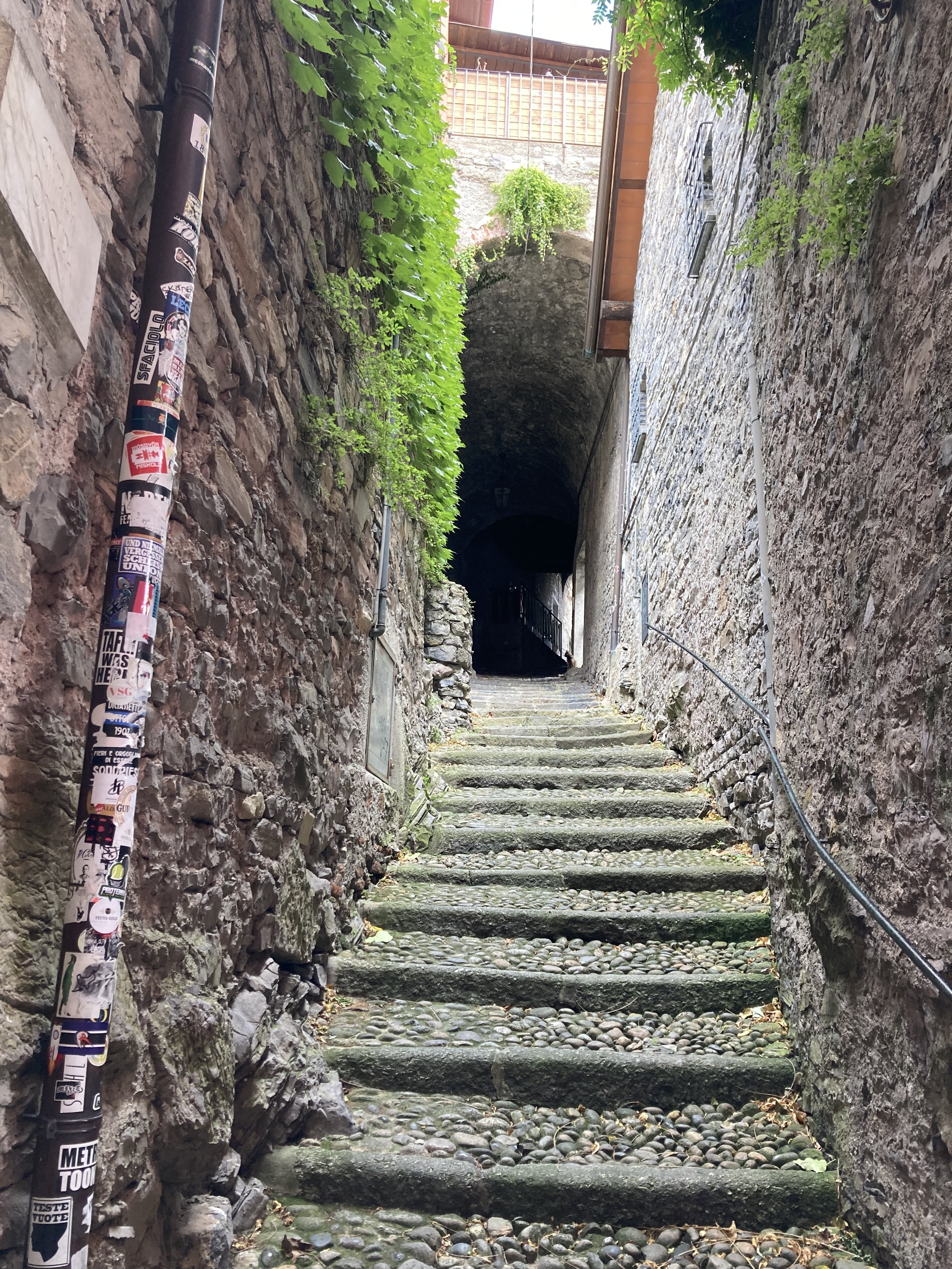
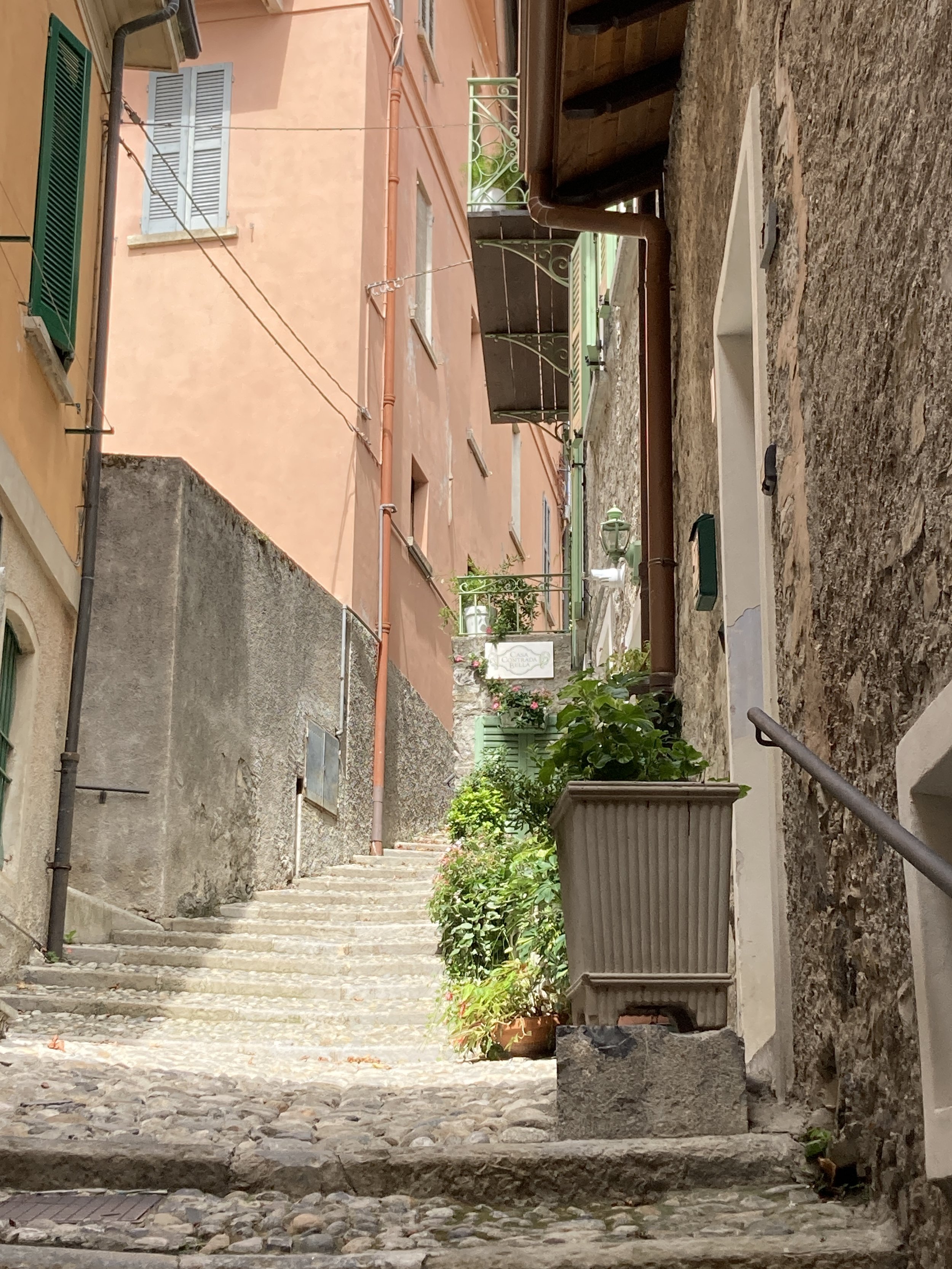
At the end of the walkway lies a tiny harbor full of small fishing boats and then the lakeside village.  This is the southwestern part of Varenna.  The village has nice shops, artisans, restaurants, cafes and some wonderful views over the lake.  It also has some of those typical Lake Como alleys, called contrade, with steep steps leading up to Varenna’s third part – the “upper village” and the town’s main piazza.

2E7CA3C8-0698-4375-95B1-FED9E36B6177.jpeg
60834D8D-3612-48CA-90D3-7A42039E1BA8.jpeg
8ACEF47D-1E37-4F9D-921A-53049FD49DA4.jpeg

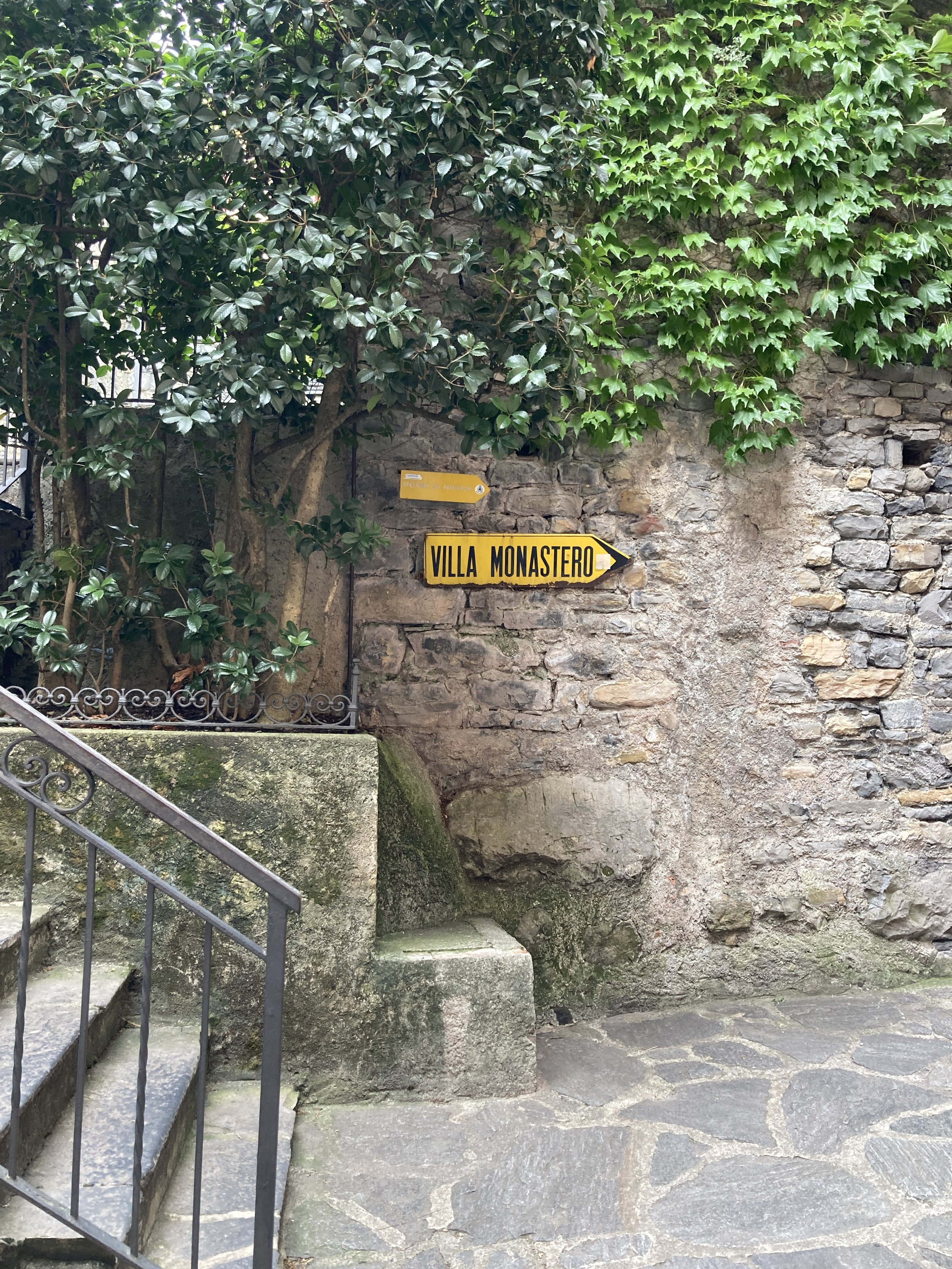
Rather than going straight up to the main piazza, I prefer to take a more circuitous walk.   By continuing south along the Riva Garibaldi and east along Contrade del Prestino you pass by the luxurious hotel Du Lac.  Once a villa, now turned into an elegant hotel, it has fantastic views from its terrace restaurant and bar.  Just past the hotel are more contrade leading up towards Piazza San Giorgio, the main square in Varenna, and the Villa Monastero. 

BDD99760-9D0D-4F34-957F-46F807741C17.jpeg
270DC8D1-0E9E-43A1-B80D-E76A3939857F.jpeg
9E06ACF6-506A-4A3D-AEE8-C5E541FA7865.jpeg

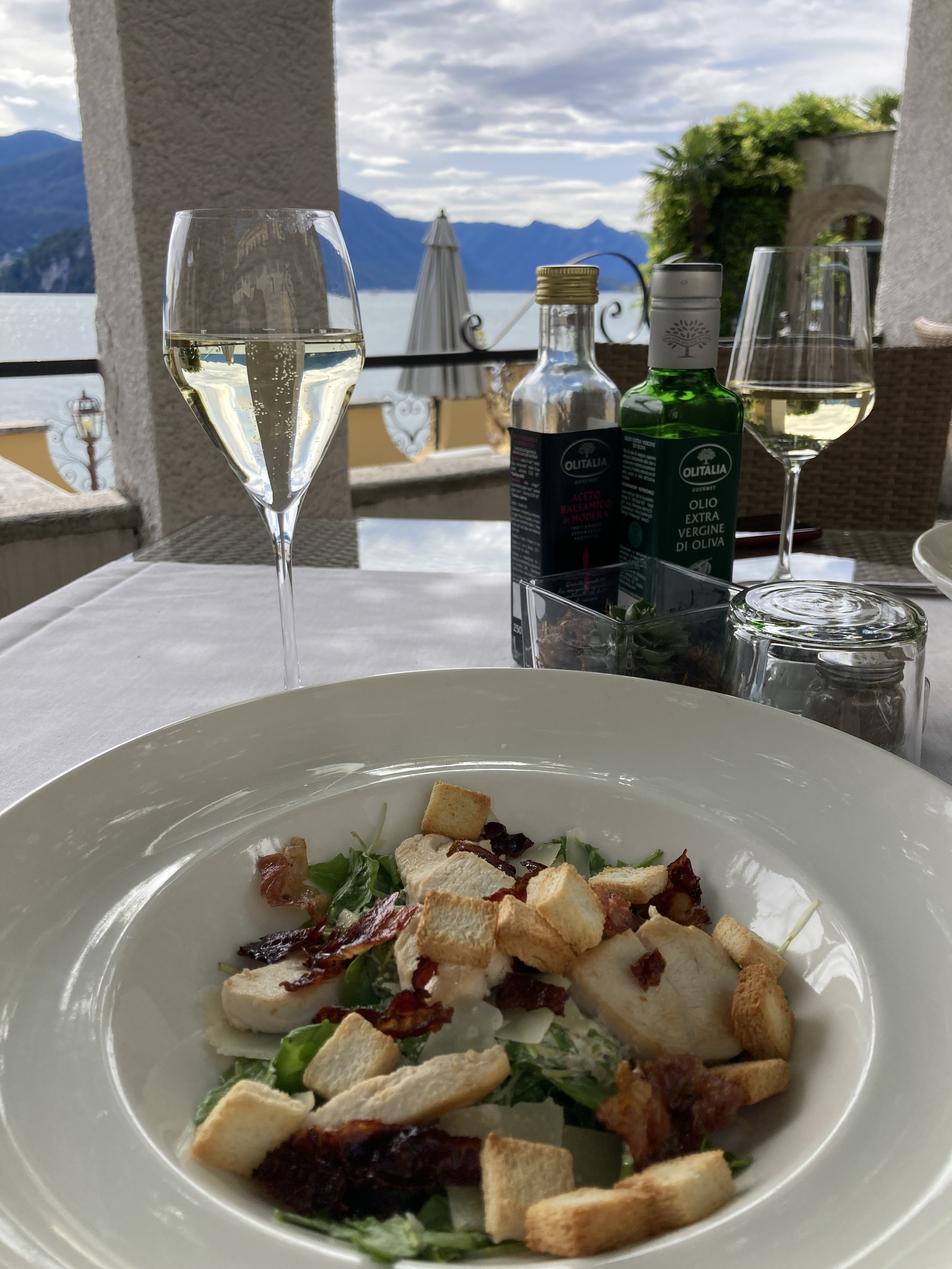
A good lunch spot along the way is the Bar Giardini, part of the Hotel Royal Victoria, reached by heading up Contrada della Fontana. Dining under the loggia, wisteria overhead, sipping a glass of wine (this is vacation after all) while gazing at the lake and the mountains beyond made for a quiet, peaceful, and elegant break in the middle of my day in Varenna.  Lunch here was a splurge but worth it!

372429F7-D923-44A5-9B90-56FA0245B02F.jpeg
0CC9C0FF-F2AF-40CE-AB0D-0EA12C9DEF7E.jpeg
722C0E1F-FA5E-407C-91A9-DB2E84947333.jpeg

Piazza San Georgio

In the upper village sits Varenna’s main square, the pretty and shady Piazza San Giorgio. Across from the piazza is the 14th century Chiesa di San Georgio with its tall bell tower.

 Continuing east (away from the waterfront) up Via IV Novembre is the Tourist Information Office, a good place to stop for a city map.  Further along was the main goal for my one day visit to Varenna - the Villa Monastero.  Visiting gardens, especially in Italy, is one of my favorite things to do.  I came across this one almost 30 years ago on my first trip to Italy. I was looking forward to a return visit.

Villa Monastero, Varenna

The villa, which began as a Cistercian Monastery in the 12th century, later became a private home.  The last owners donated it and today it is a public museum and botanical garden.  

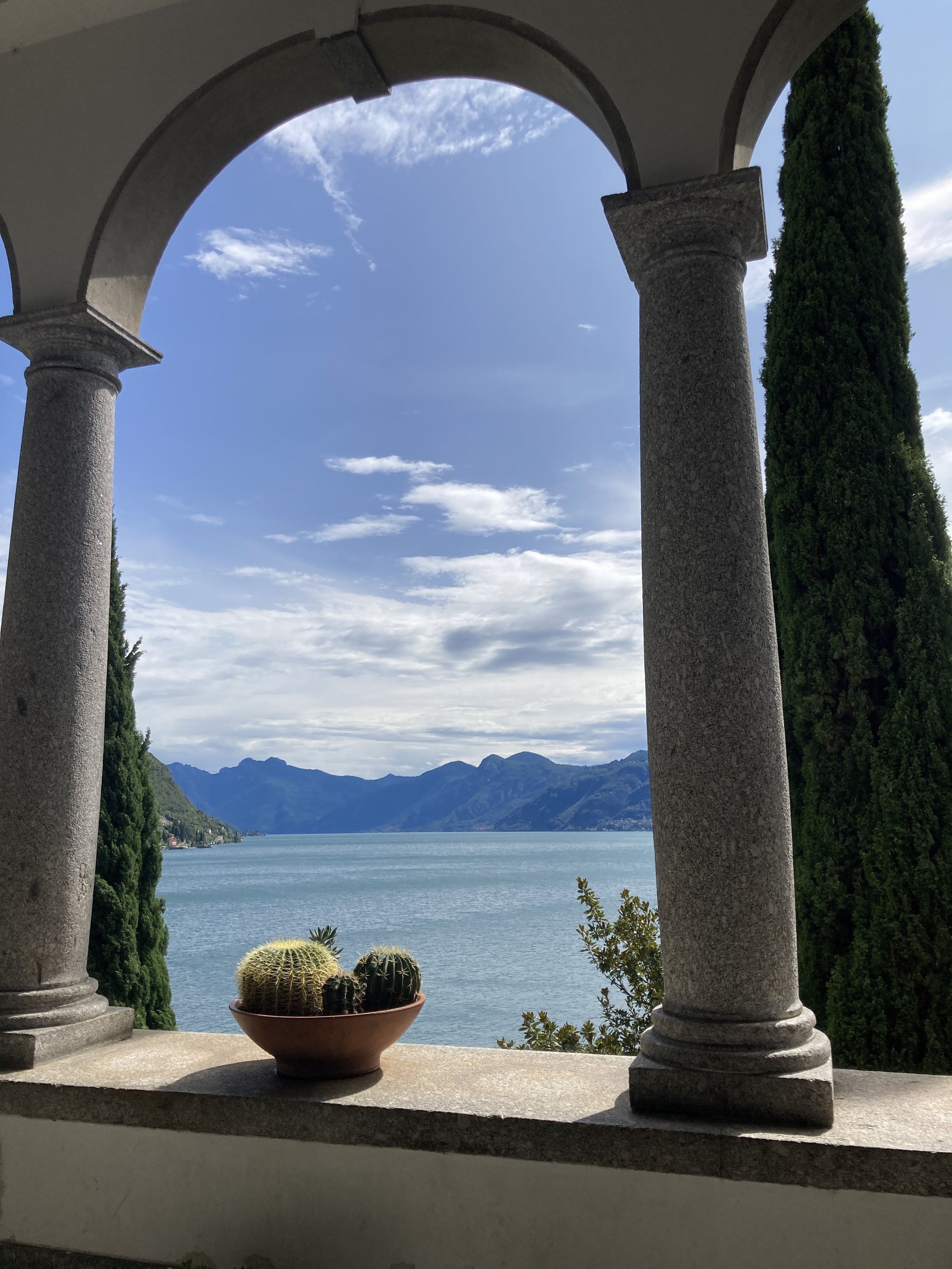
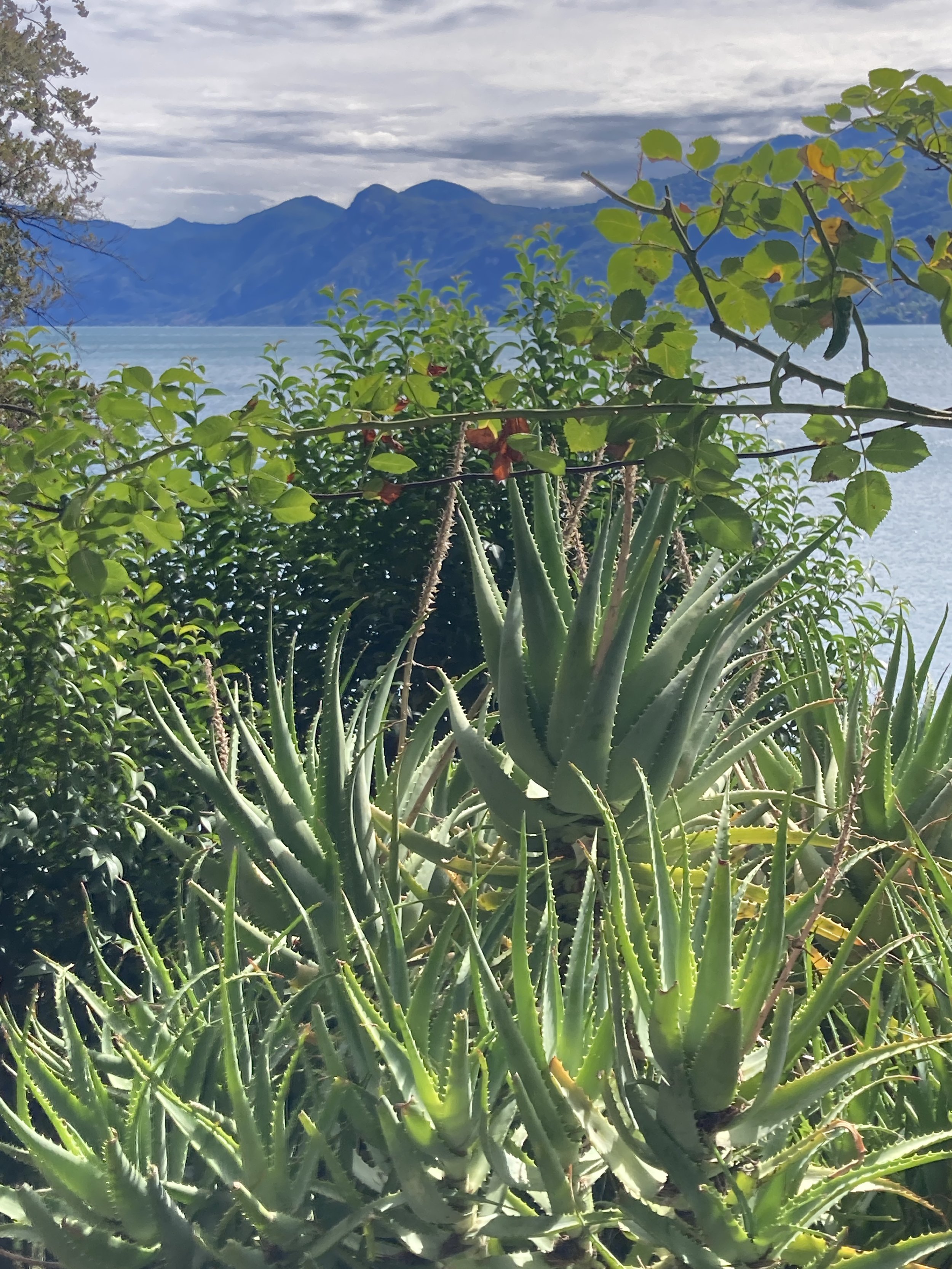
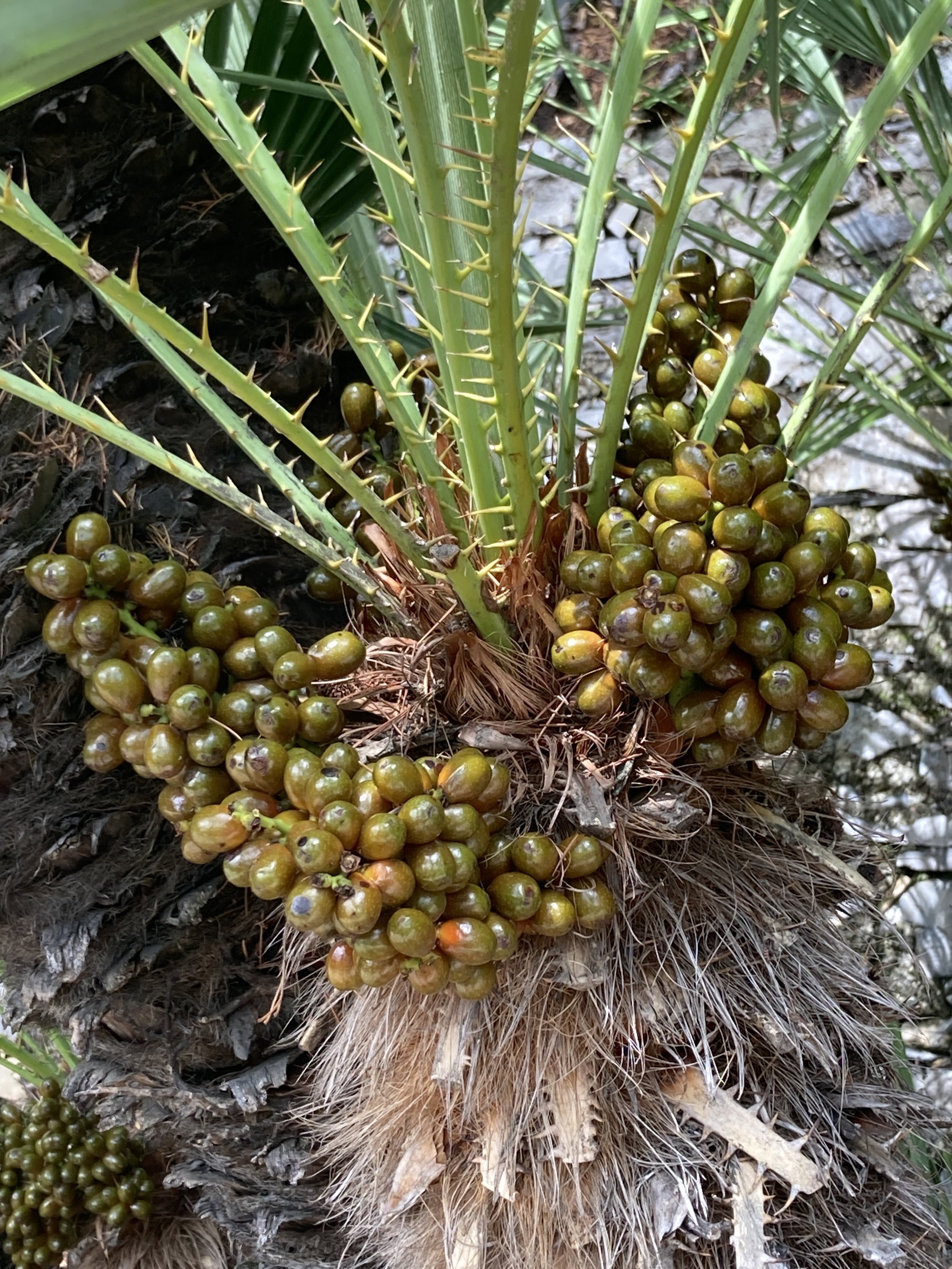
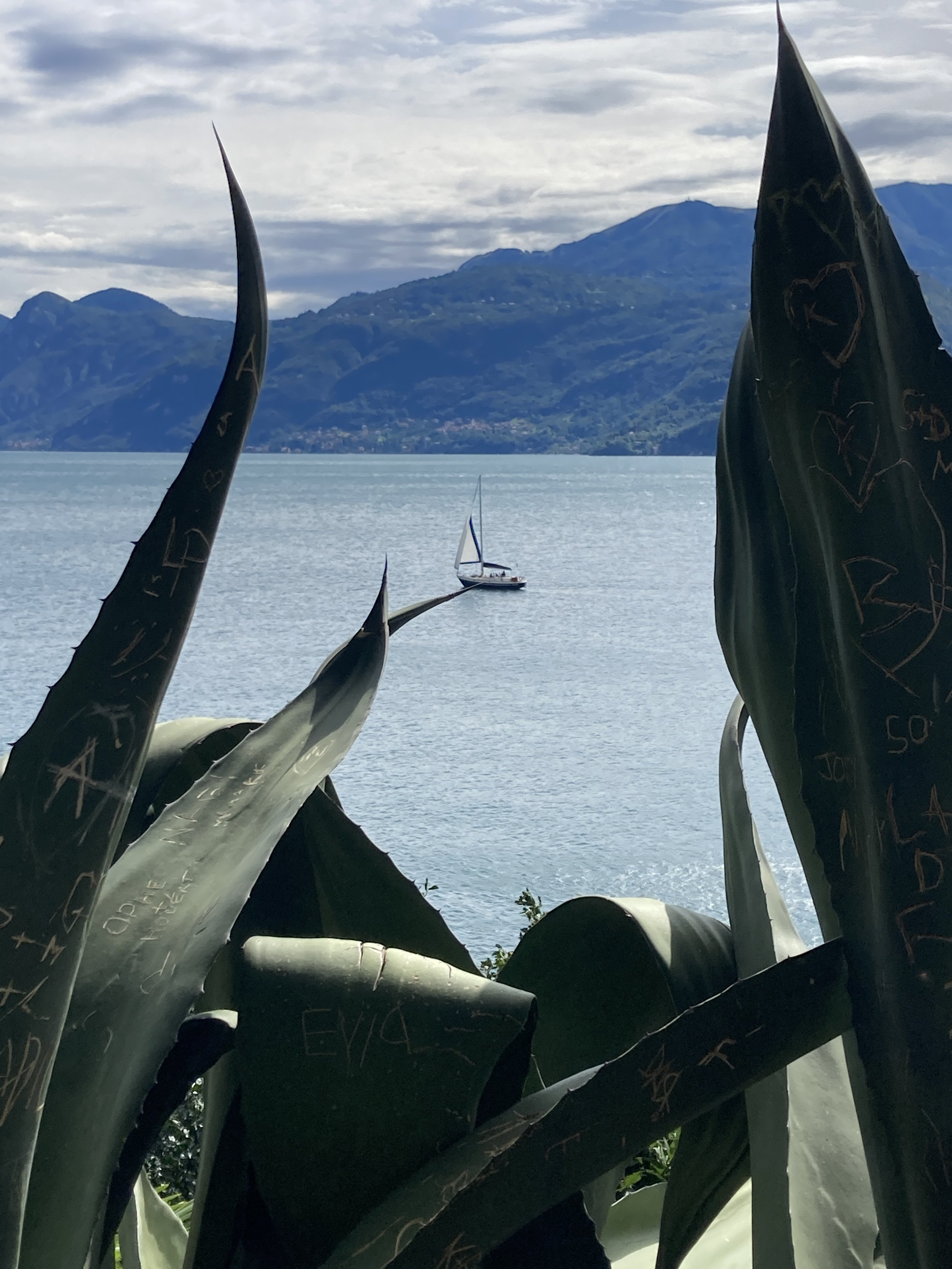
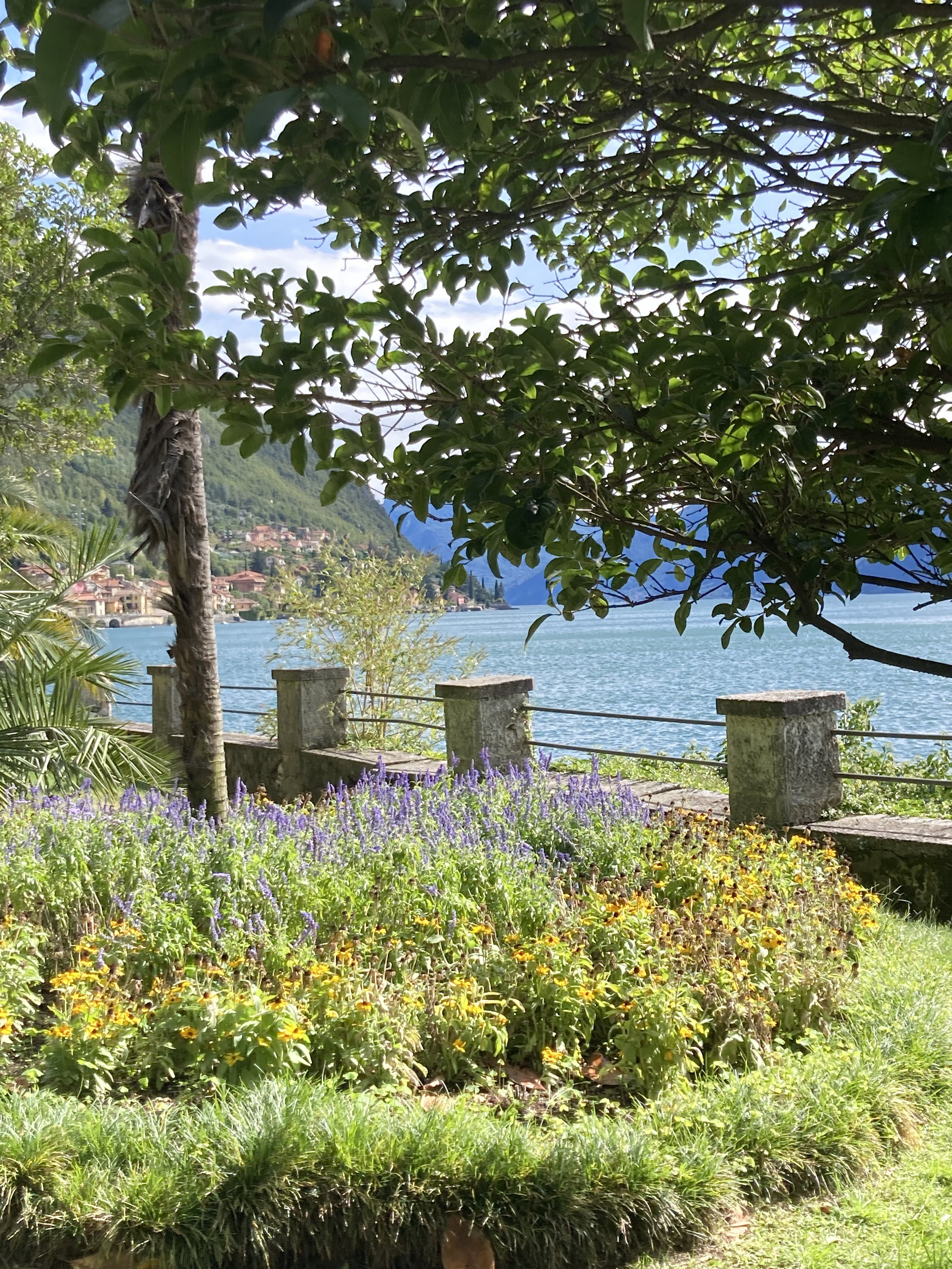
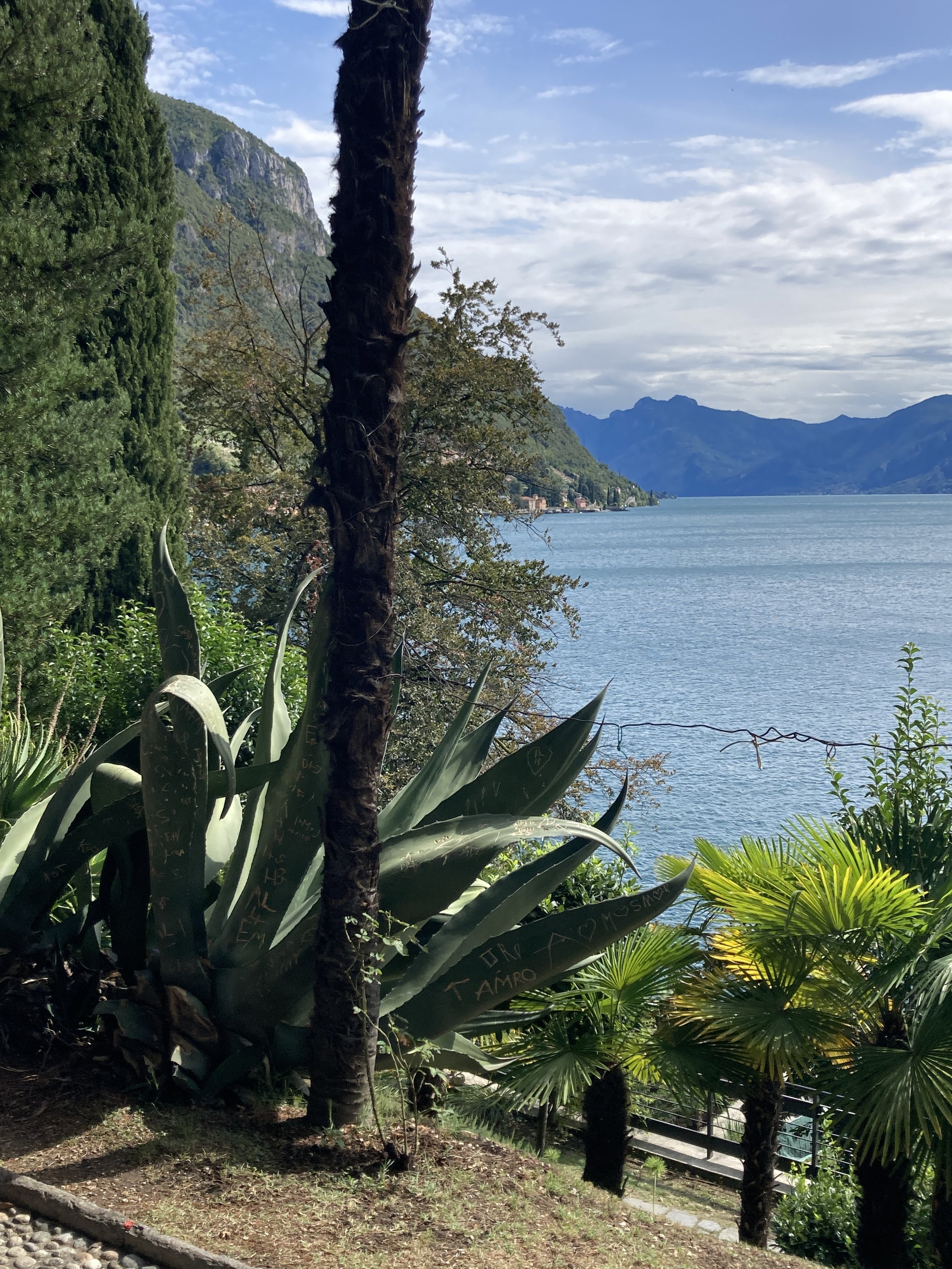
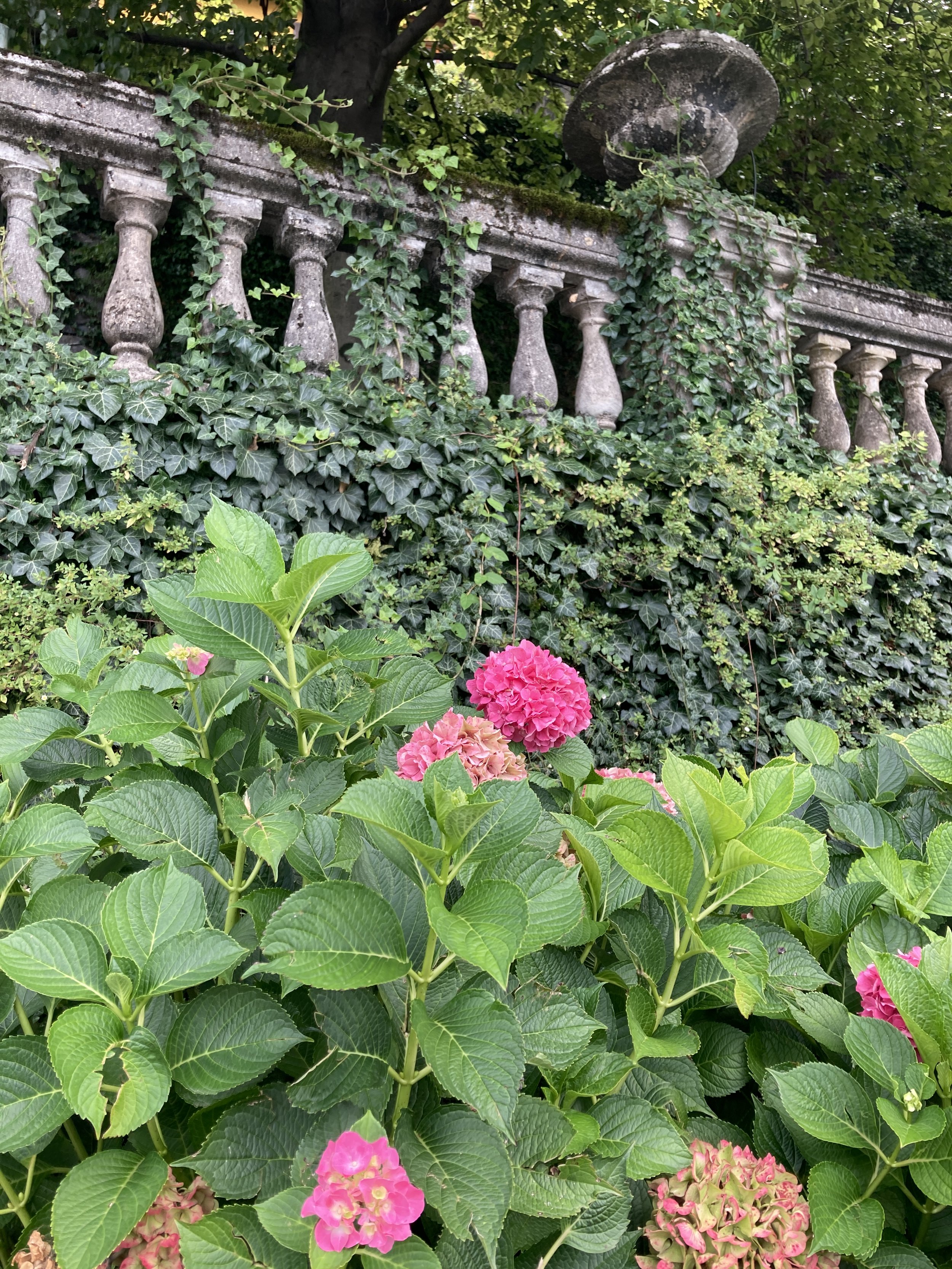
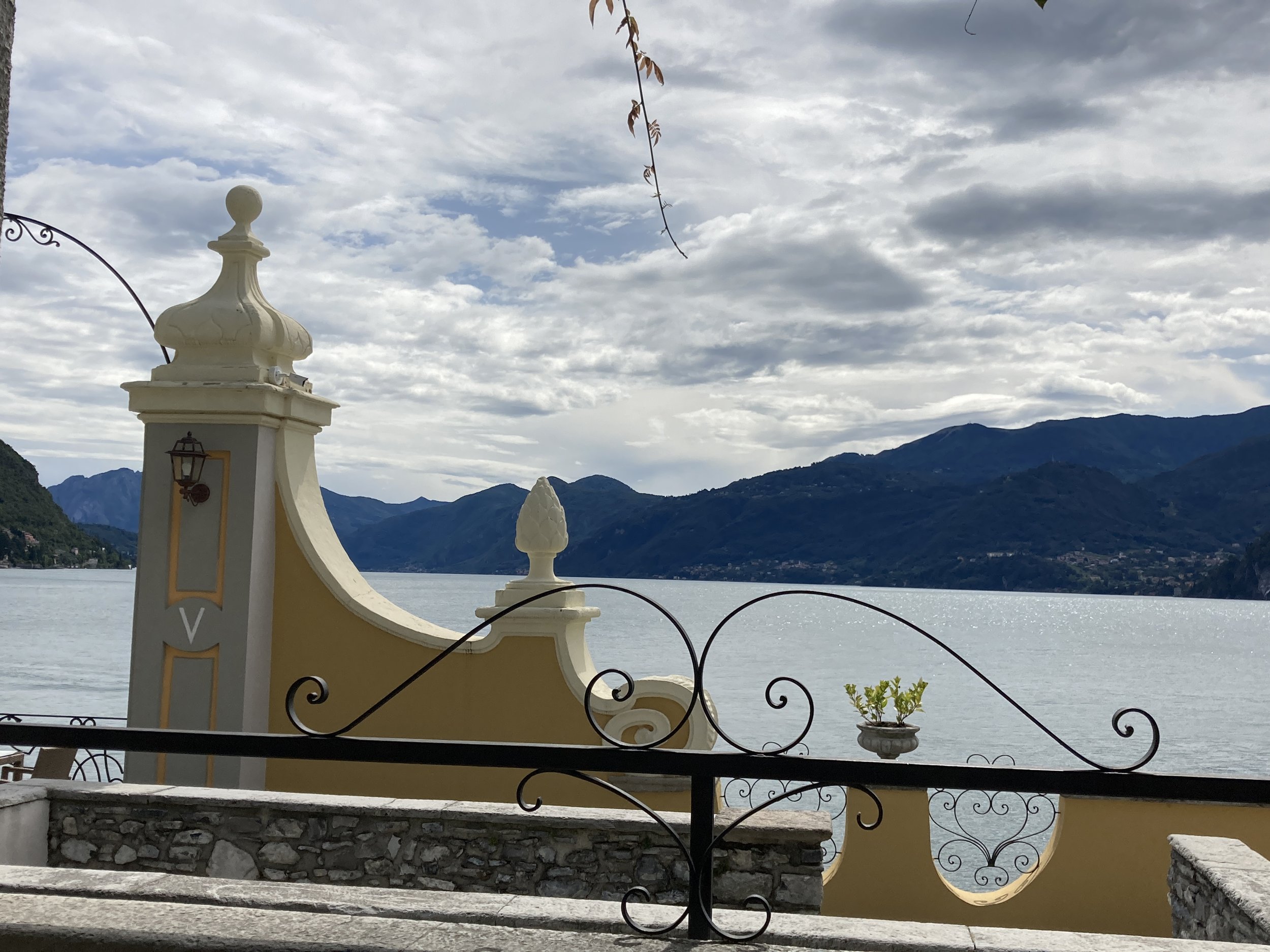
The garden, which has evolved over more than a century, meanders for about a mile along the lake.  The plants, many quite unusual, have come from all over the world.  There are evergreen trees, giant cacti, palms, citrus trees, vines and flowers.  The combination of colors, sizes, forms and textures creates a truly special garden.

91927445-CF0C-4A6F-A774-9E2B797AAACC.jpeg
5A12023F-659C-4BD2-BAE4-81BAEDE83D4D.jpeg
6F6631FF-E10E-4ADF-A69F-80FE42CA10A8.jpeg
4CE0987B-66AC-4920-8A76-59B668F4B052.jpeg
C05DCDBB-1619-4272-9A25-96C645F5B6B0.jpeg
67D92709-37D0-437C-B59C-BC36D701C3C0.jpeg

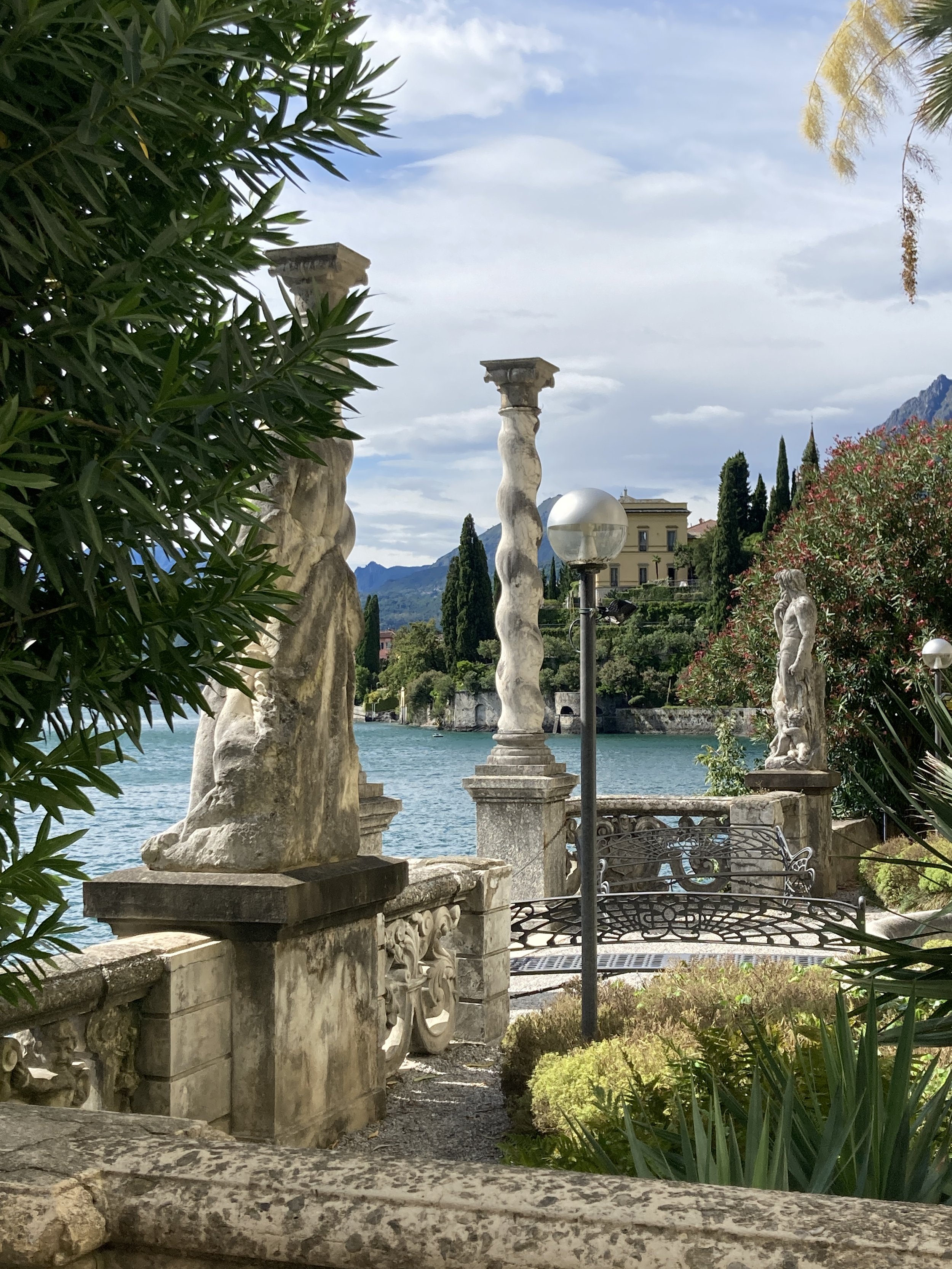
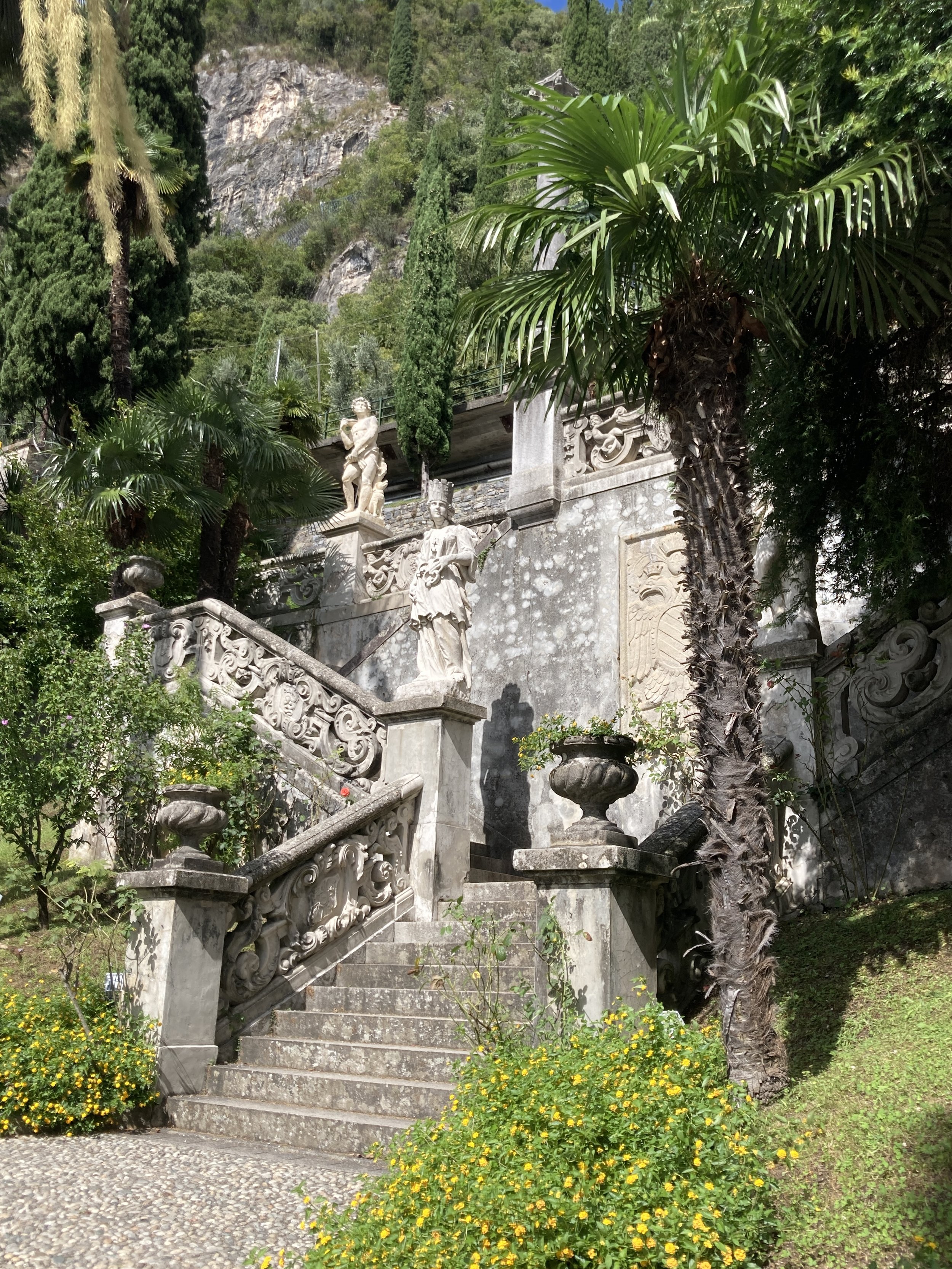
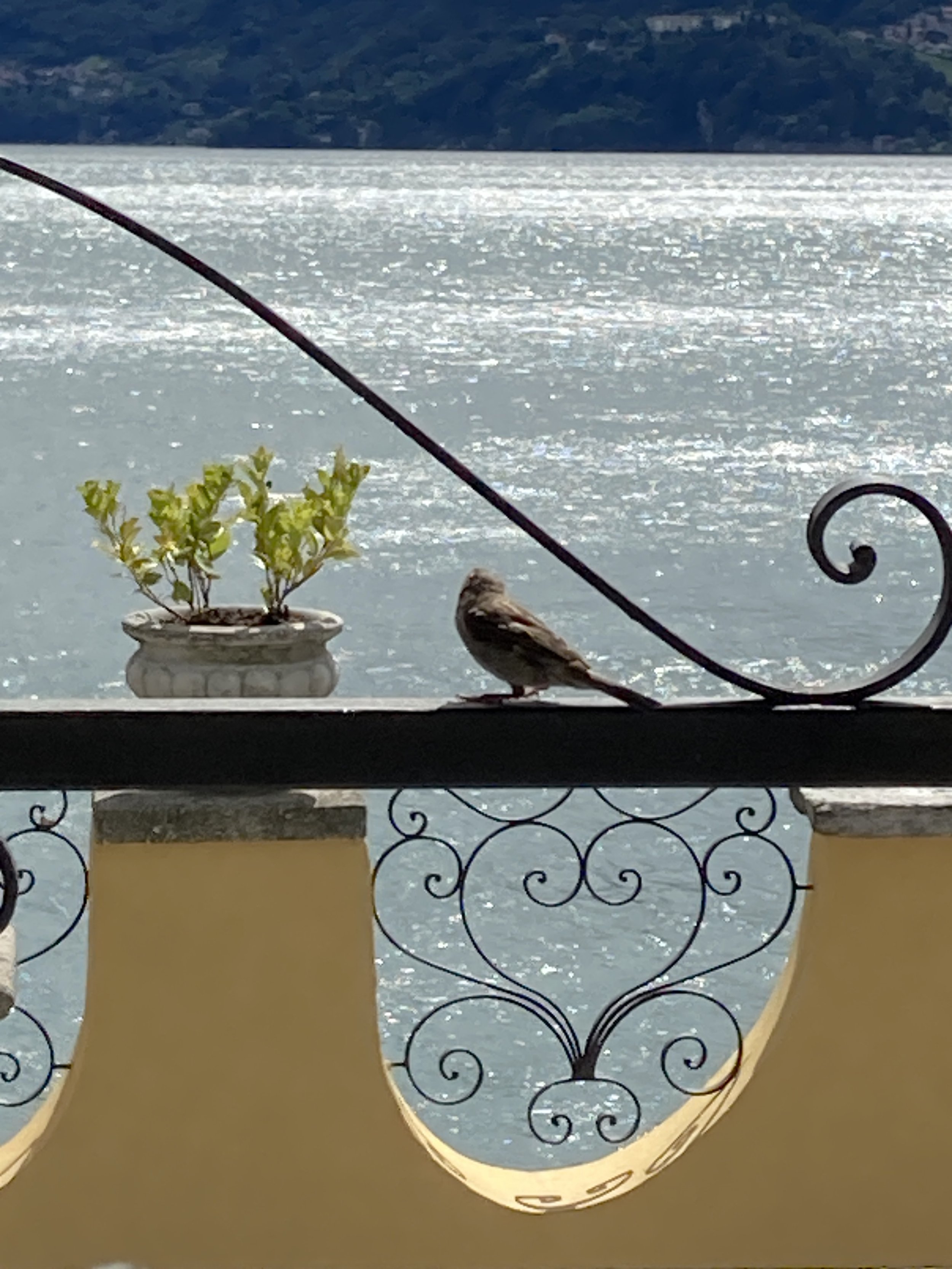
 The garden is more than just plants. It’s an architectural and artistic wonder as well.  The setting includes terraces, fountains, sculptures, ornately carved balustrades, ironwork, and breathtaking views. 

 I spent so much time in the garden that there wasn’t time to explore the villa museum.  That will call me back to Varenna on a future trip.

website: villamonastero.eu


October 23, 2023 /Joanne Bartram
Villa Monastero, Varenna
#italiangardens, #italytravel, Italian art architecture, Italian gardens, Italian Lakes, Lake Como

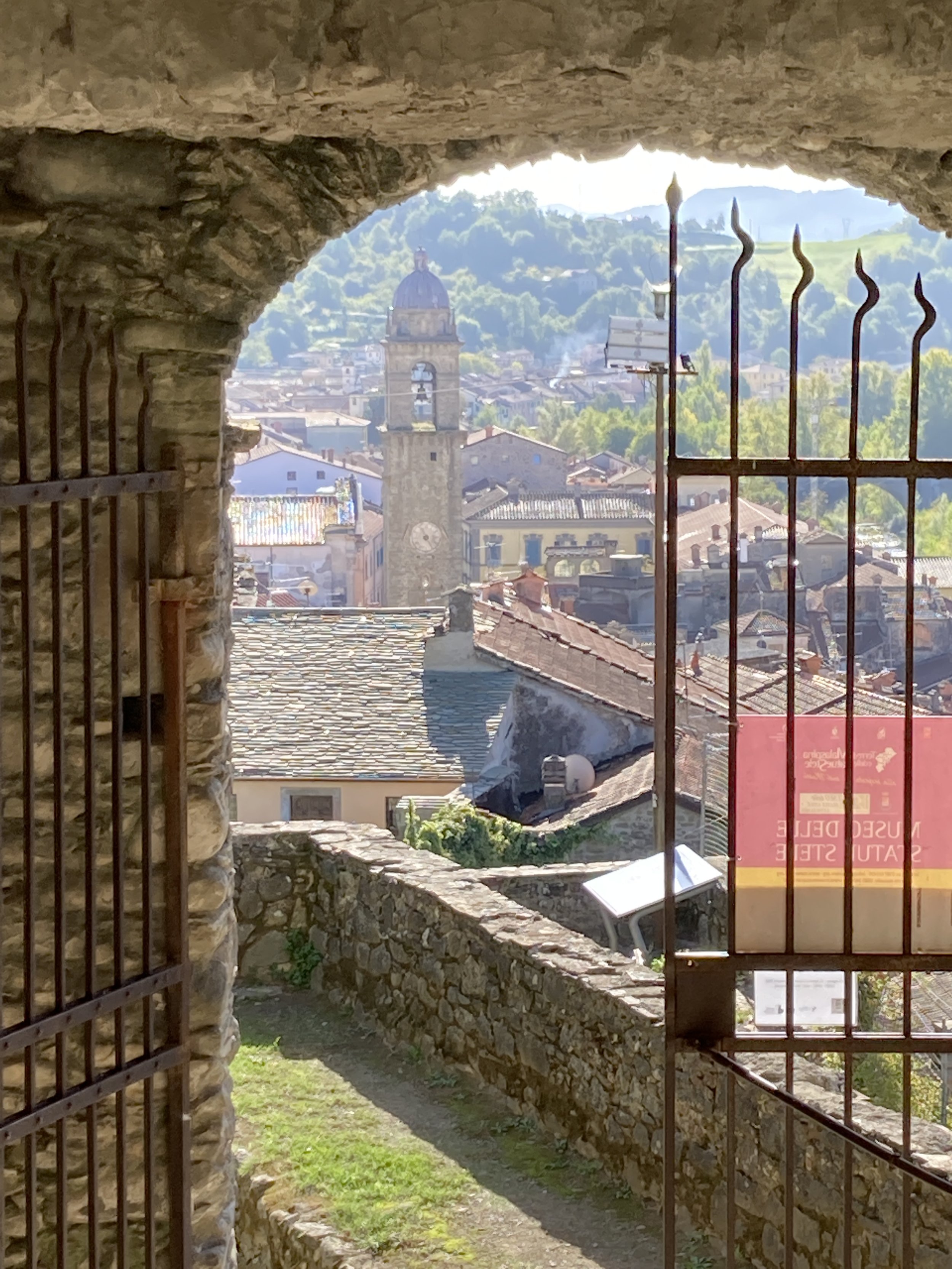
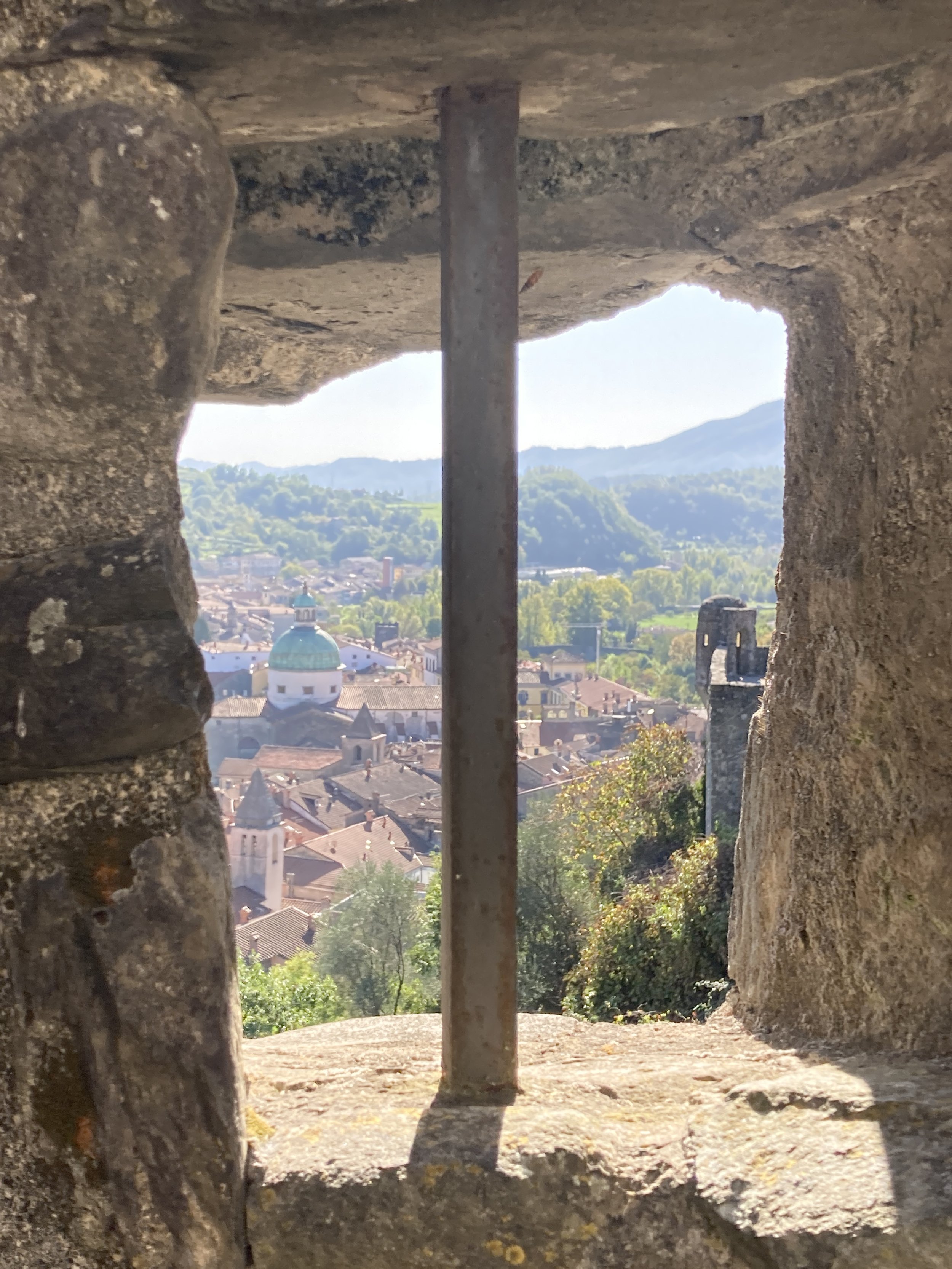
A view of Pontremoli from the Castello del Piagnaro

Pontremoli: A Walk, A Castle, and Prehistoric Rock Carvings

January 30, 2023 by Joanne Bartram in #italytravel, #medievalitaly, Italian art architecture, Italy travel, Italy, Liguria, Lunigiana, Museums Italy, Tuscany

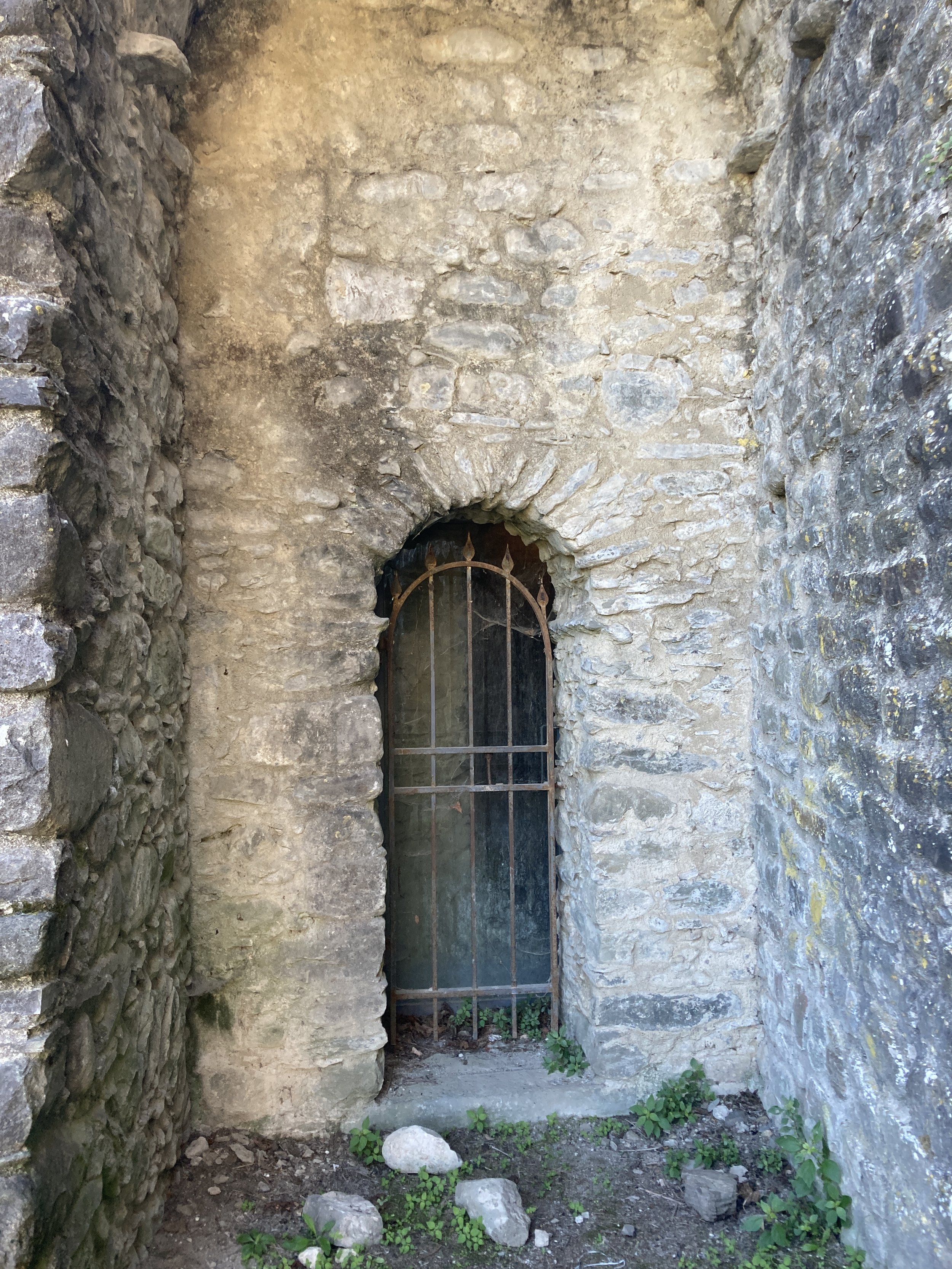
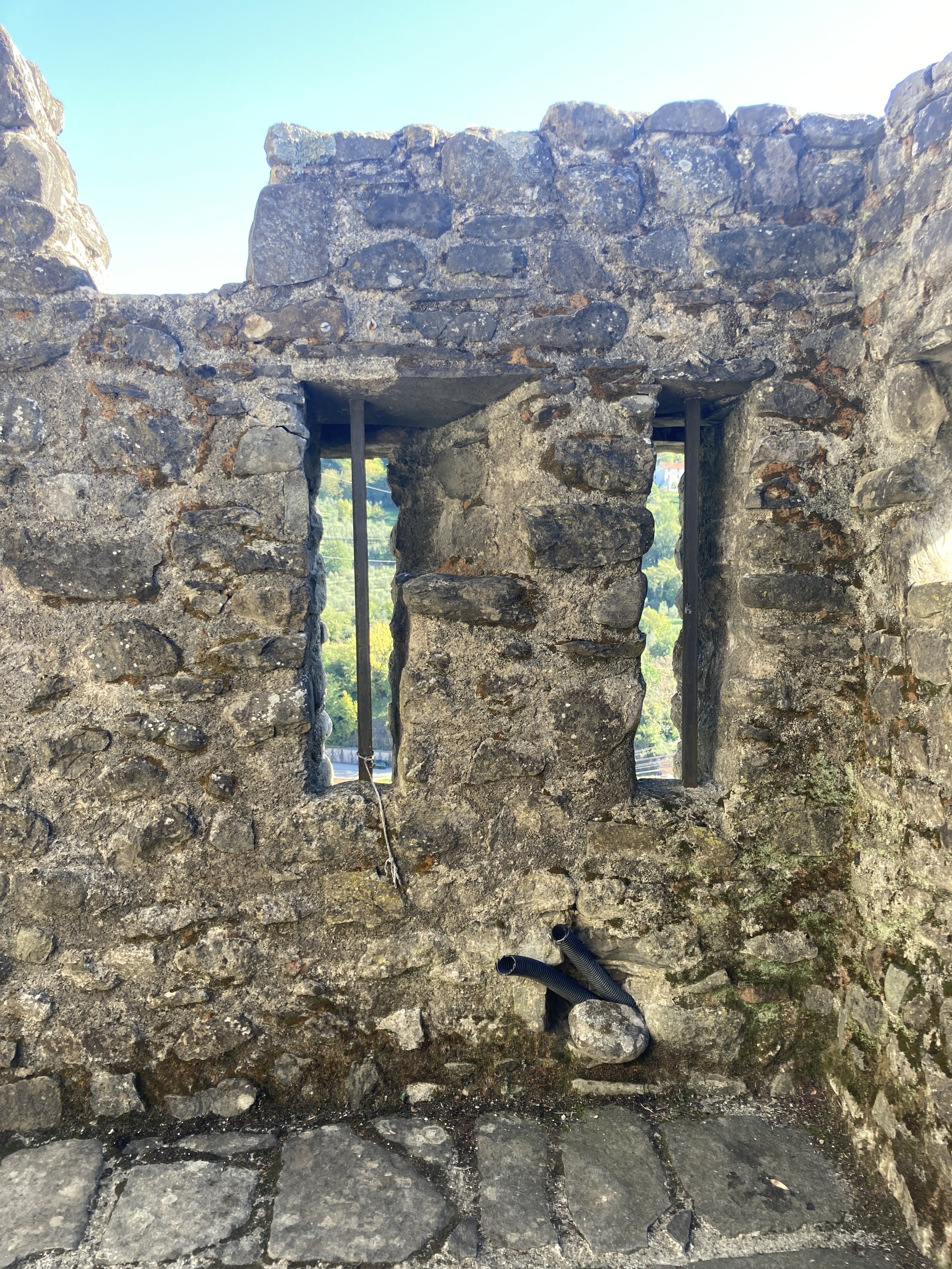
The Lunigiana region reaches from the northern part of Tuscany into Liguria, all the way to the coast. It is a unique area, quite different from the classic images of Italy. No grand cathedrals, huge museums, or rolling vineyards here. The region is mountainous, forested, and crossed by rivers. There are no large cities to be found, instead there are small medieval hamlets, many with ancient towers and castles. Some of the castles lie in ruins, complete or partial, but a few are remarkably well preserved.

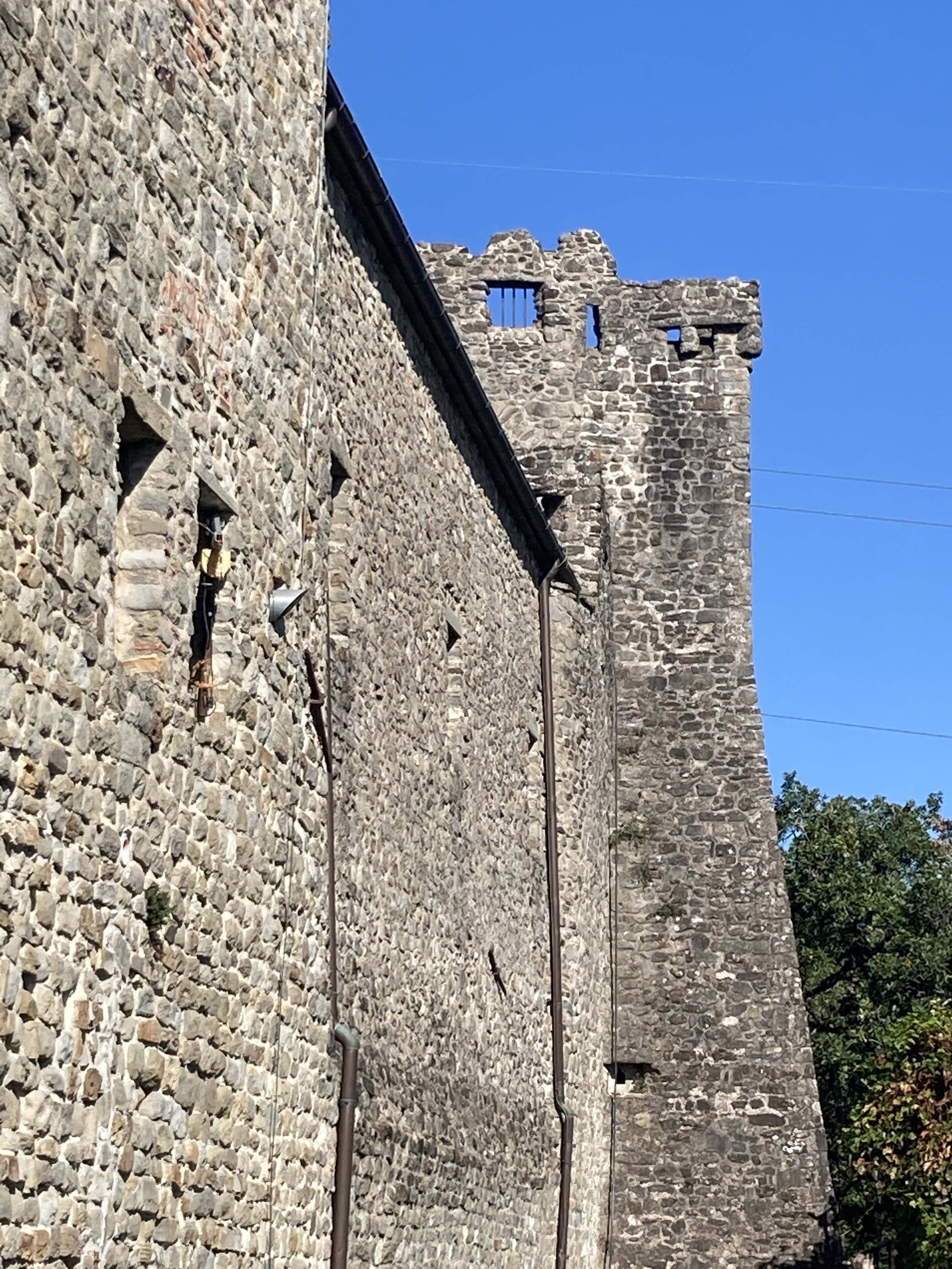
Castello del Piagnaro, Pontremoli

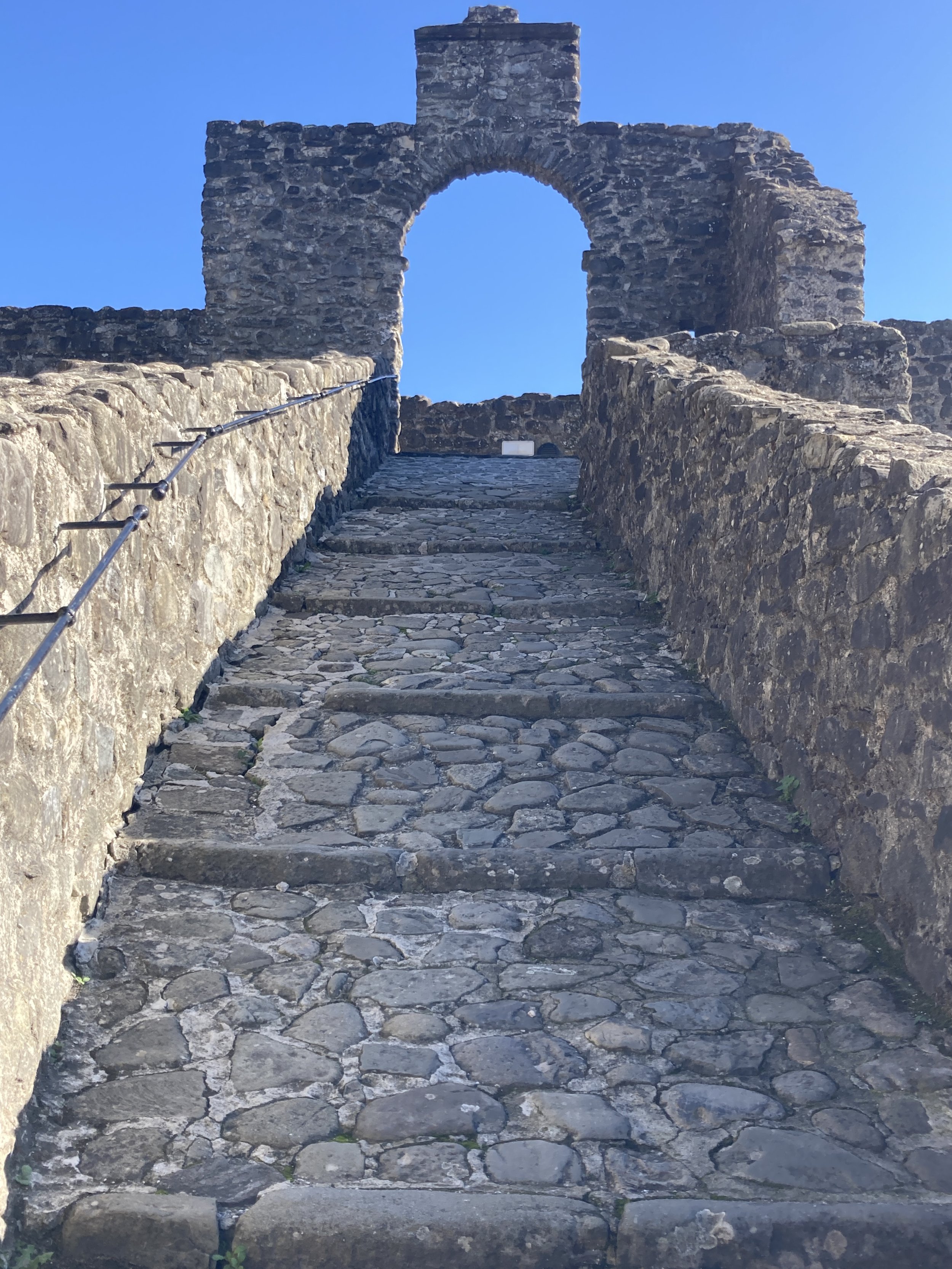
One such castle is the Castello del Piagnaro in the town of Pontremoli. The castle dates from the 10th century, with cycles of expansion, destruction, and rebuilding over the ensuing centuries. Some components of the Castello have been lost to time, a drawbridge for example, and some elements are as new as the 15th century tower (if something that old can really be called new).

Today the restored castle compound stands guard high above Pontremoli and welcomes visitors to both the castle interior and the Museum of the Stele Statues of the Lunigiana which is housed within its ancient walls.

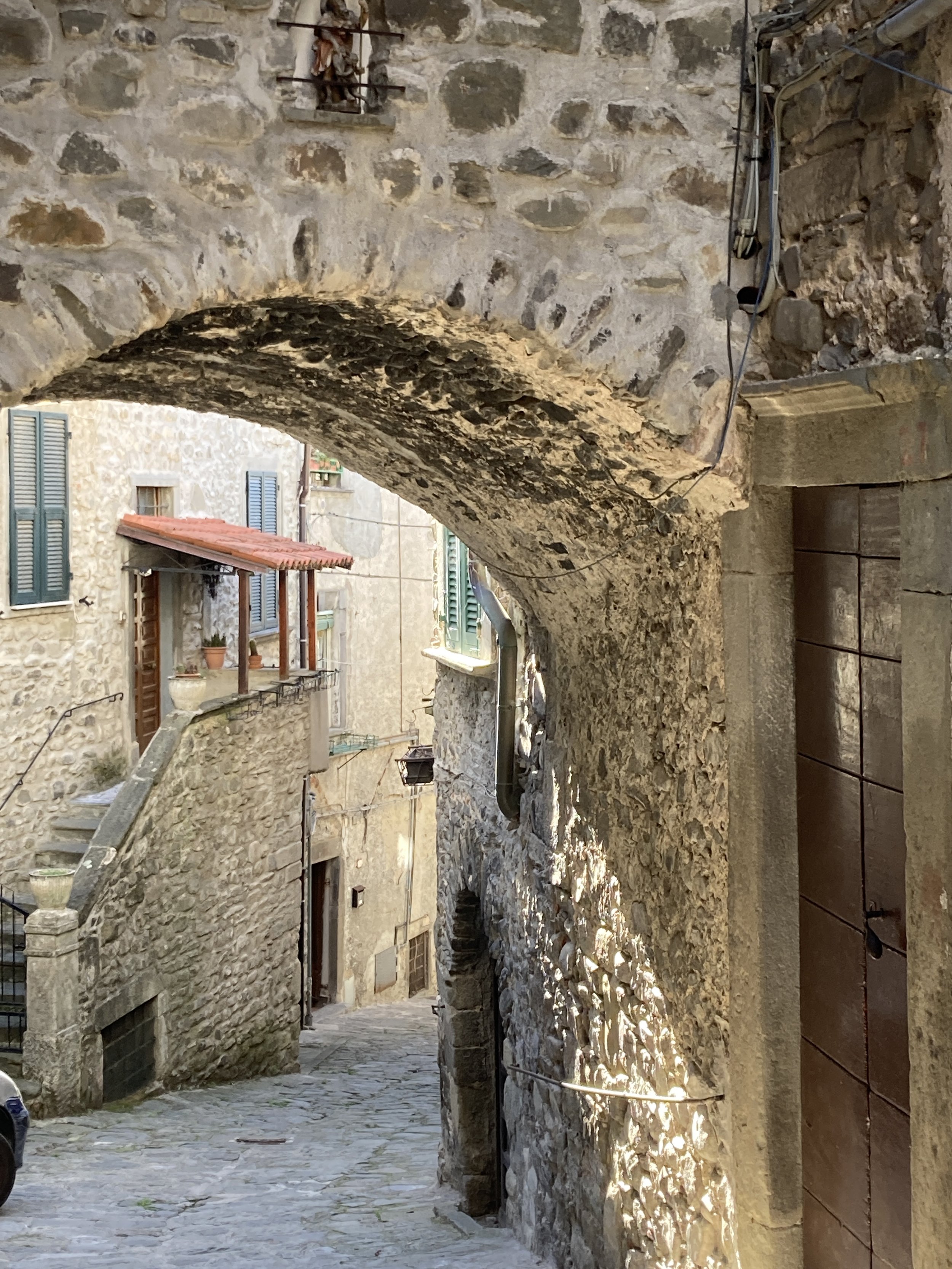
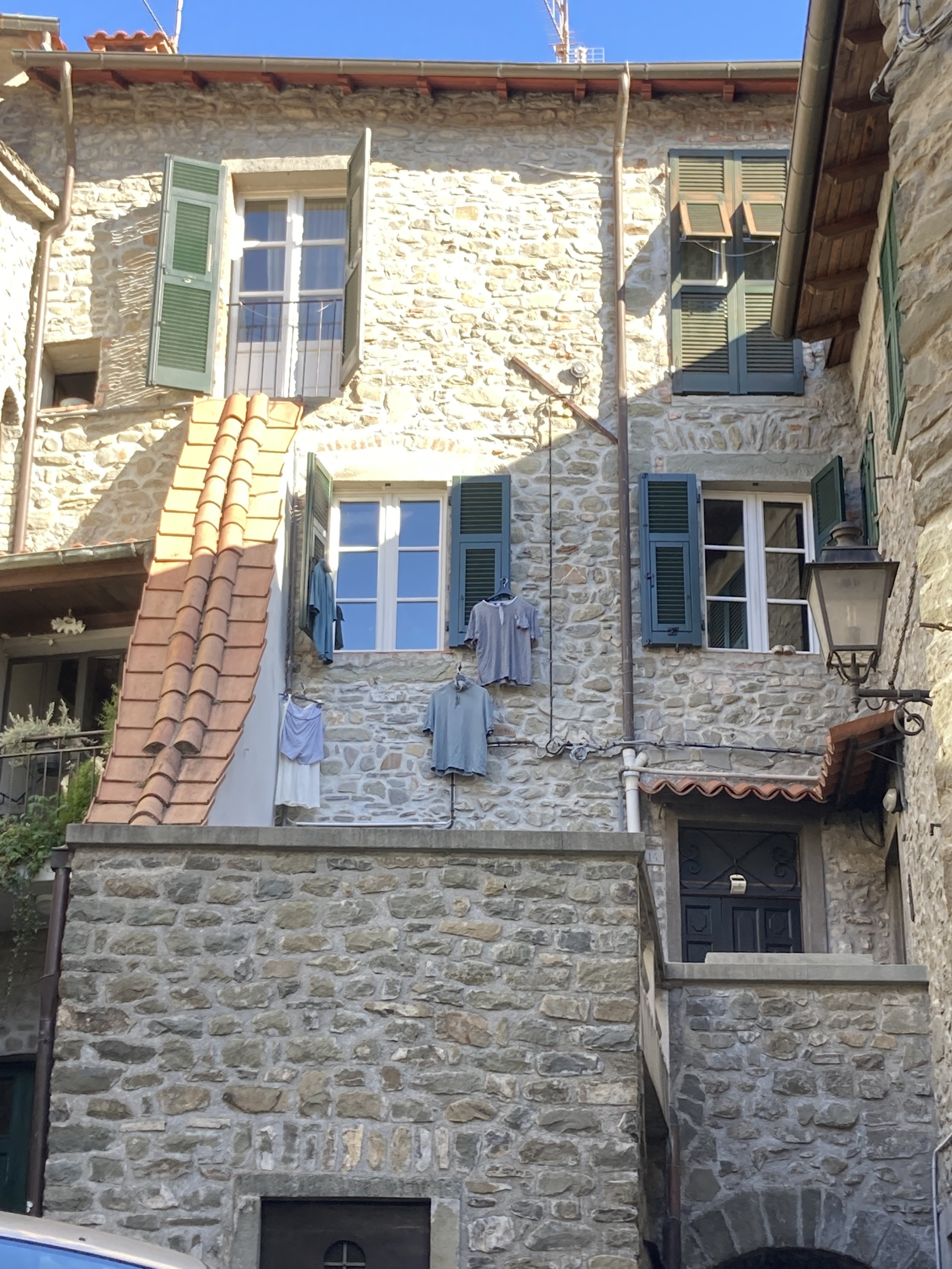
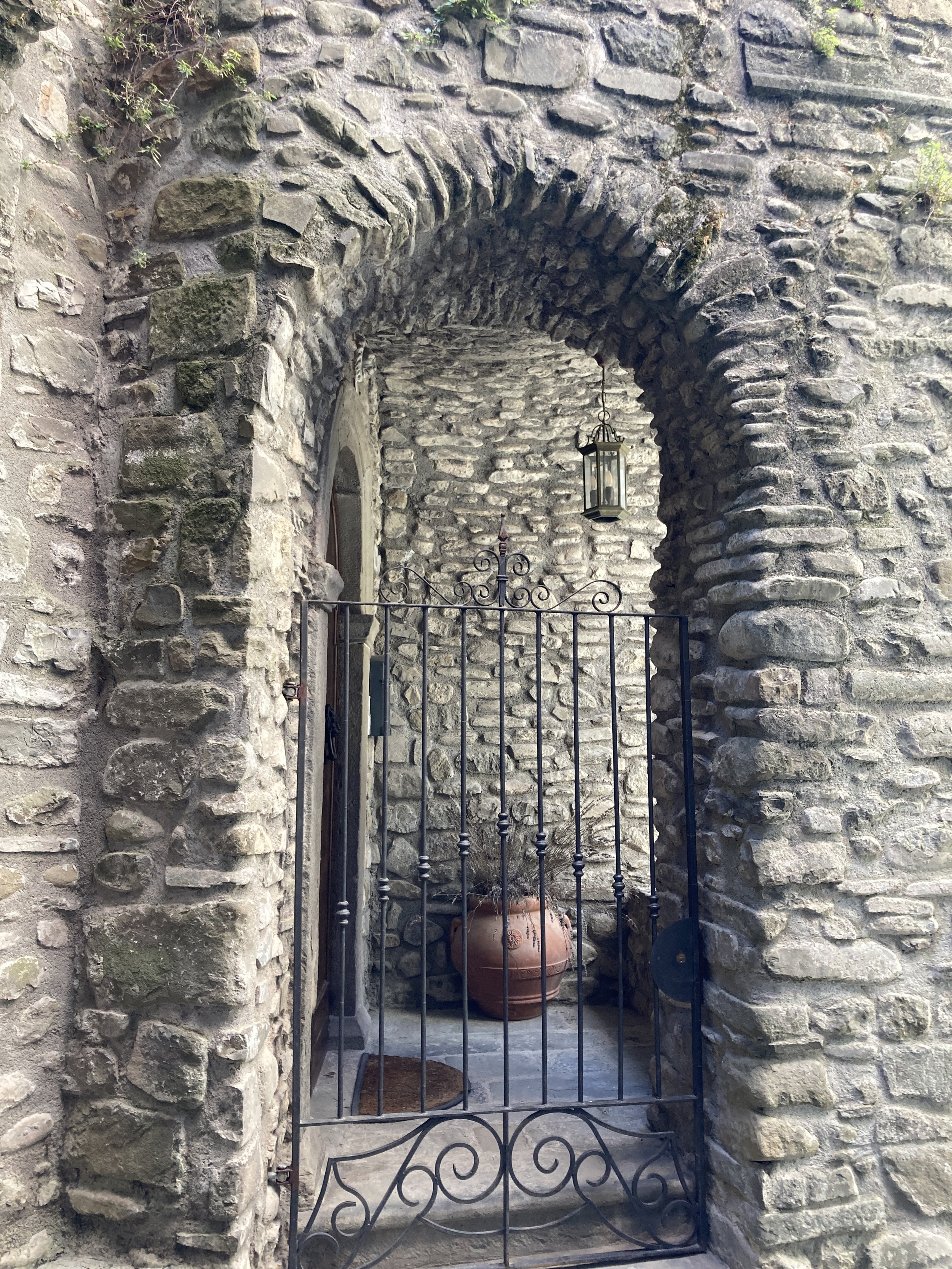
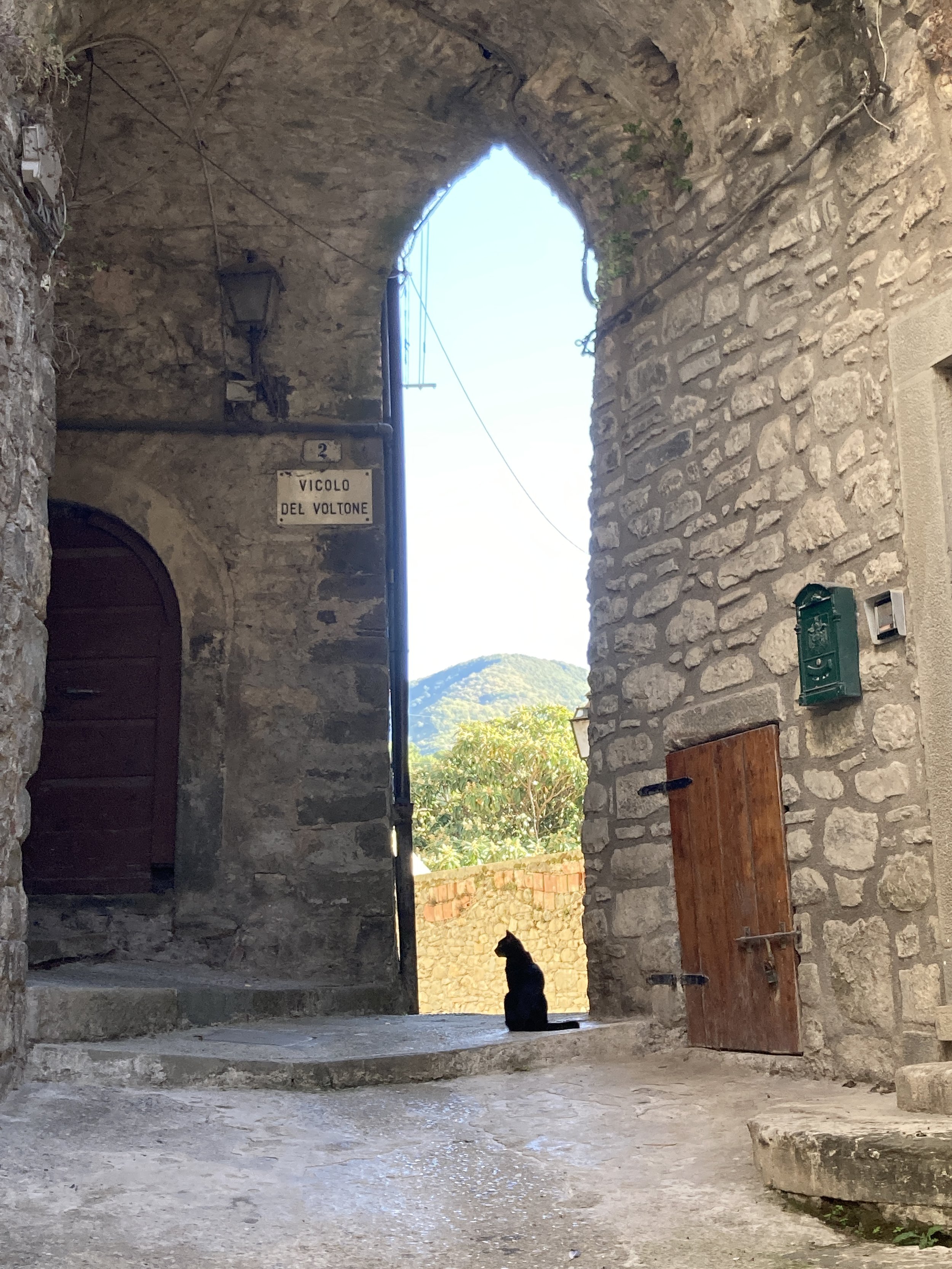
Half the joy of seeing the castle is the walk to it from the historic center of Pontremoli. The walk begins from the small main street and winds up even smaller alleys to the castle. Along the way are small shops, medieval buildings, arches, gates, views, and the occasional cat.

9A276F32-C6DB-4FED-96BA-3507878AB48A.jpeg
659FCDA5-CE13-4D2D-8786-92BA97582636.jpeg
1A5FFBBD-F8DB-4ACF-8582-A3F4EDF23CA8.jpeg
200453F8-50A1-4FD6-A4B2-86EDFA1E66A3.jpeg

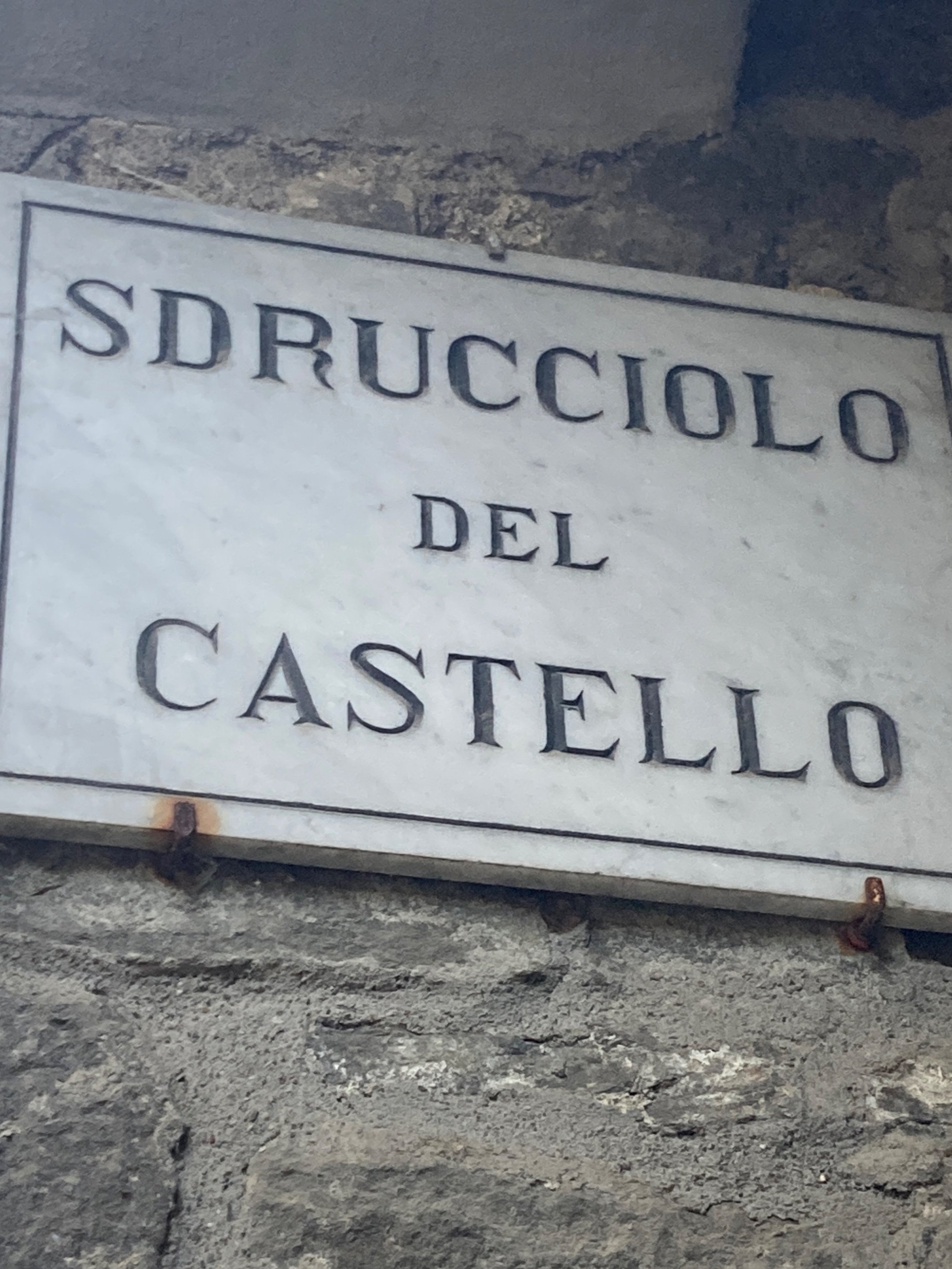
This sign marks a steep little alley that leads to the castle.

The walk winds uphill, but it is not terribly steep. For a less inspiring, but less strenuous, way to the castle take the elevator from Porta Parma at the north end of town directly to the castle grounds. I found the hike up to be definitely worth the effort. With stops along the way to admire the ancient buildings, chat with local residents, and enjoy the views to the town below it was a walk I would not have missed!

There is a ticket office just inside the castle gates where a combined ticket for the museum and castle can be purchased for 7 euro (4 euro for those over 65). From the ticket office you can enter the museum directly or cross to the castle entrance.

62B1FF37-1DC2-441A-AA0B-FD77579C836C.jpeg
E7C694A0-9052-40AF-93C5-BC94DF9BB1A6.jpeg
7DF251FE-919C-4BC7-B65F-1F76E67210E7.jpeg

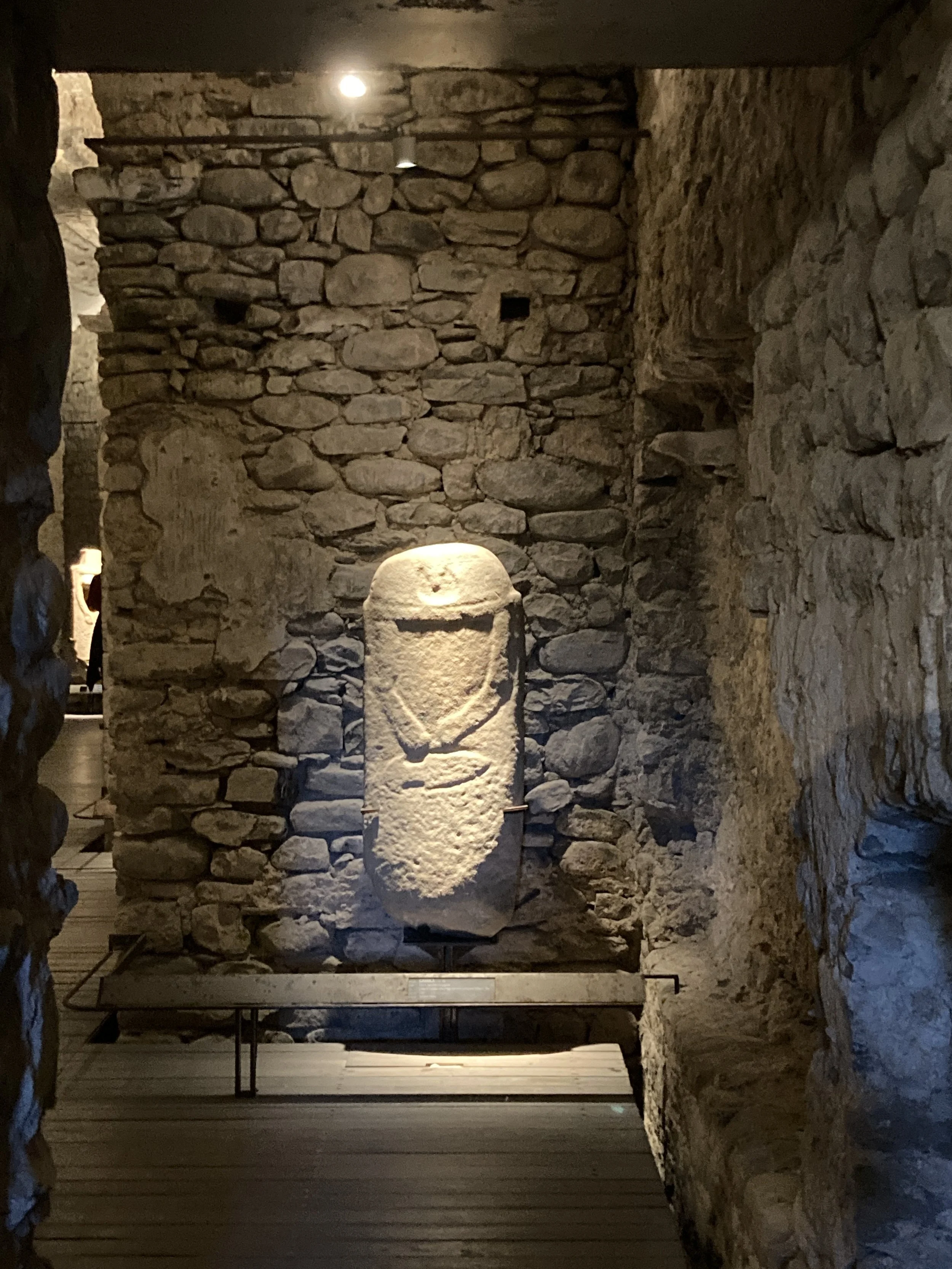
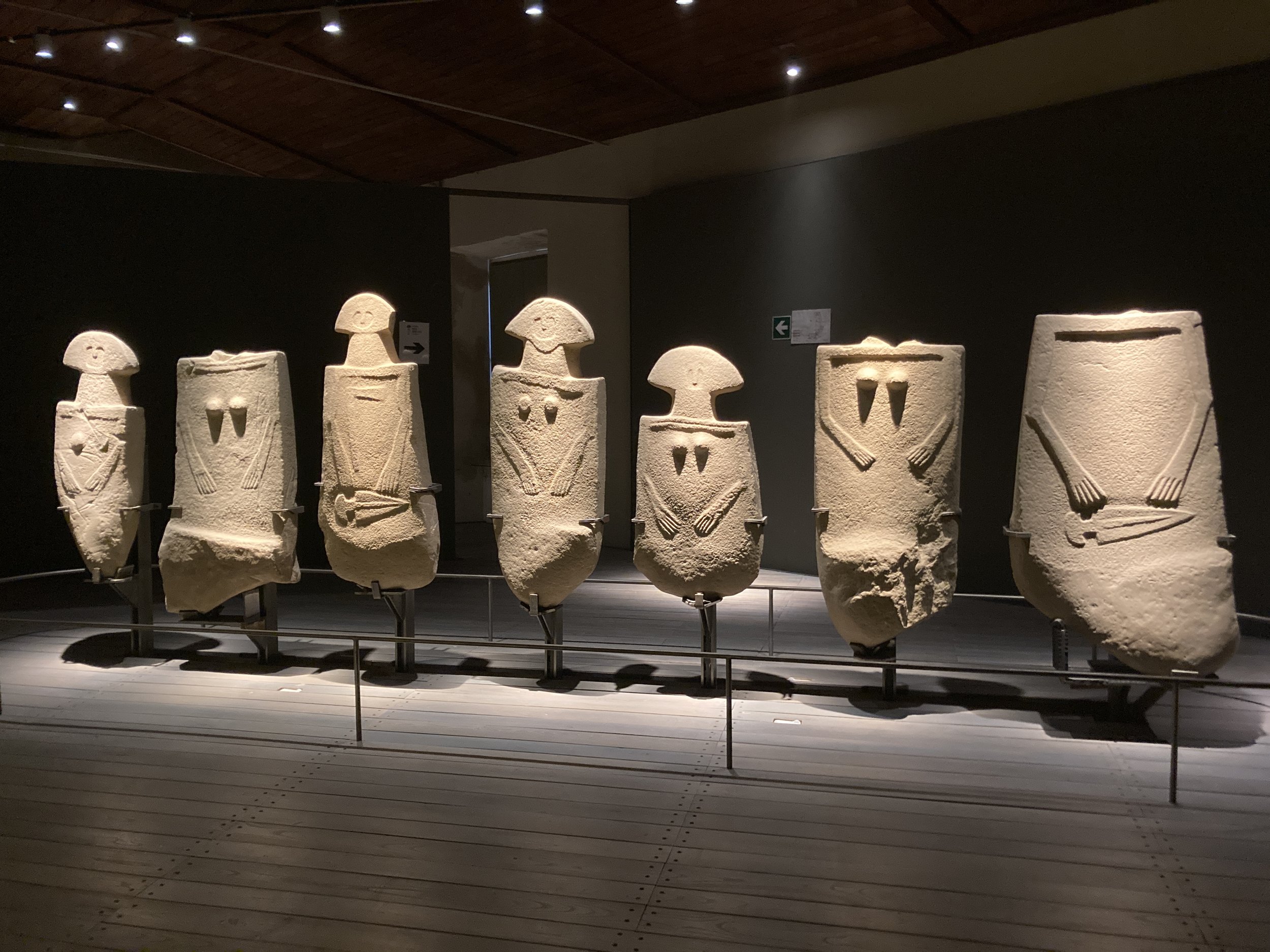
The museum is fascinating. Stele (not to be confused with the similar Italian word stelle which has a different meaning all together) are prehistoric carvings, representing human figures, found throughout the Lunigiana region. They have been housed in the castle museum since 1975 and are truly a treasure.

Both male and female figures are represented. The males seem to be warriors, armed with knives. The women, bare breasted, are adorned with necklaces. The dark rooms and dramatic lighting show the pieces off perfectly.

After the stele, it is time to wander through the castle. And I do mean wander - there are many rooms, courtyards, staircases, and roof top terraces to explore. Amazingly, there were no guards or “keep out” signs to be found, just freedom to explore and to wonder what life must have been like for the people who occupied this building over the centuries.

0C3C0097-1438-45E7-94BA-CEA027C996B9.jpeg
8763BF5E-8568-4D2E-A7AA-8EC30BB296F0.jpeg
76AEB383-52BA-42CD-8565-159560922197.jpeg
721EE119-4A82-4888-AD09-E1E9502039D7.jpeg
43136409-7E87-4E26-A9E4-24F4EDE50082.jpeg
7642380A-98F8-4C12-9F10-C20513323235.jpeg

Perched high up on this hill, the castle offers spectacular views down the hill to the city and river below. Walking back down to the village, along a different small alley than on the way up, provides for another scenic walk through the oldest portions of Pontremoli.

A visit to Pontremoli, and a hike up to the castle, provides a wonderful contrast to the more touristed places in Tuscany and Liguria. It’s a special experience!

January 30, 2023 /Joanne Bartram
Pontremoli, castles in italy, italian castles, Castello del Piagnaro
#italytravel, #medievalitaly, Italian art architecture, Italy travel, Italy, Liguria, Lunigiana, Museums Italy, Tuscany

Cripta Rasponi e Giardini Pensile, Ravenna

The Rasponi Gardens in Ravenna

November 07, 2022 by Joanne Bartram in #italytravel, #ravenna, Italian art architecture, Italian gardens, Italy travel

With all of the important historic sights and stunning mosaics to see in Ravenna it is important to take some time out. A stop for a coffee or a leisurely lunch provides time to reflect and organize one’s impressions and memories. Even better is to stop by a pretty garden for a few moments of quiet between all the monuments. On a recent trip to Ravenna, two small gardens provided a much needed break in my sightseeing. Both were created by the Rasponi family, who were important economic and political forces in the years between the 1500’s and 1800’s.

Giardino delle Erbe Dimenticate (also called Giardino Rasponi), Ravenna

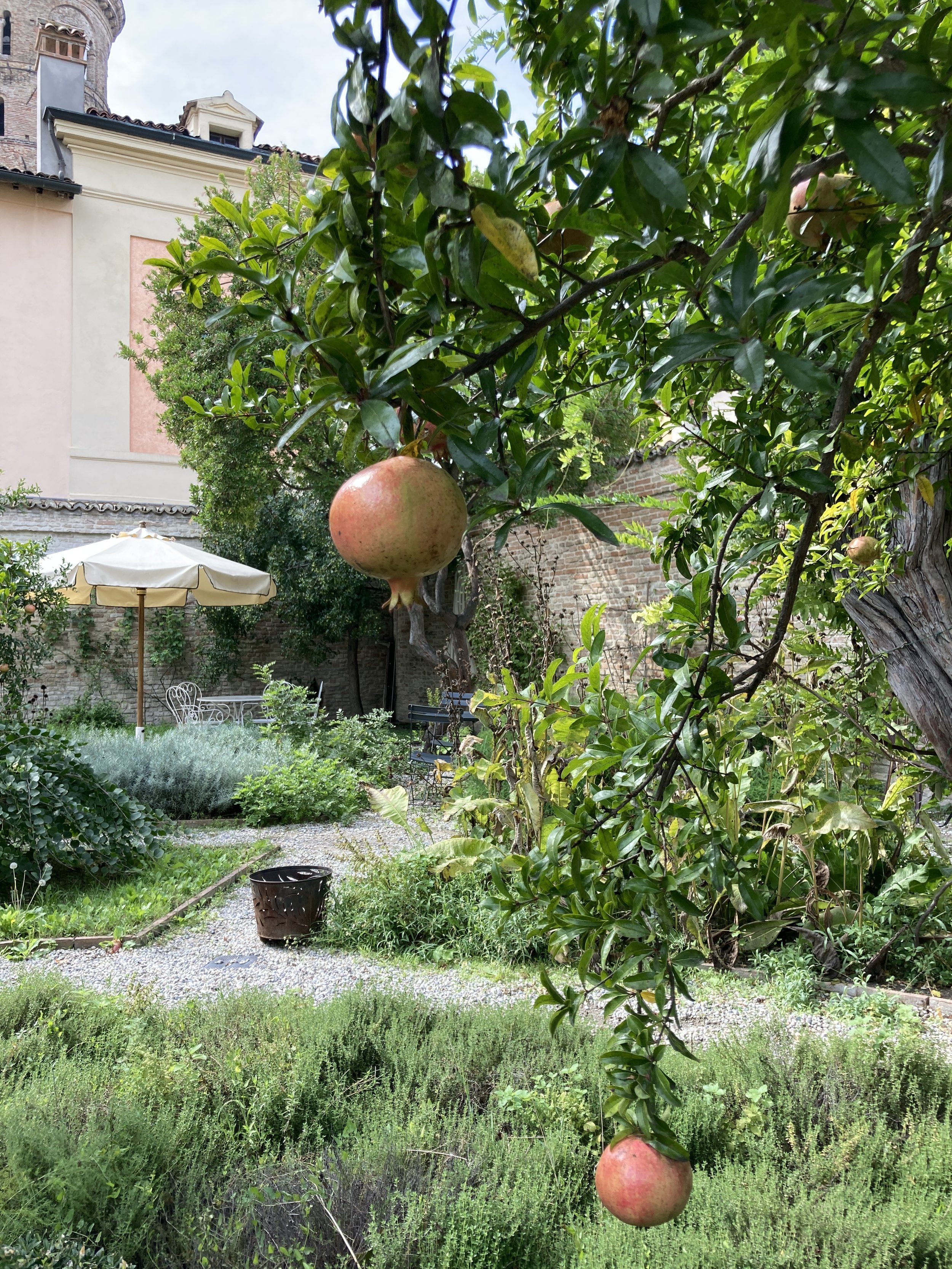
The first garden was a purely accidental find. While walking across town I spotted a sign for a botanic garden just off Piazza J.F. Kennedy and behind the Palazzo Rasponi dalle Teste. Inside was the sweetest small space called the Giardino delle Erbe Dimenticate (The Forgotten Herb Garden). Originally a walled garden for the oldest Rasponi palazzo in Ravenna, it was recently restored and now serves as a public space. It is not a big garden, just large enough to have a central fountain surrounded by flower and herb beds. Pomegranate and apple trees provide shade. Small tables are scattered throughout - perfect spots for a break from sightseeing or for a bit of lunch from the cafe at the front of the garden. These little almost-hidden spots are some of the most enchanting places to discover.

9113AAC6-6A0B-4D8F-BB08-42C4119AD778.jpeg
999DF77A-7DC0-4CBB-84FE-2F46EC74E112.jpeg

The second garden space was the Giardini Pensili (Hanging Gardens). The gardens, along with the Rasponi Crypt, are the oldest surviving parts of another Palazzo Rasponi, dating from the late 1700’s, most of which was destroyed by fire in the 1920’s. Today the gardens and crypt lie within the Palazzo della Provincia complex in Piazza San Francesco, not far from Dante’s tomb. The gardens are spread over several terraces which climb up around the central tower housing the crypt. The first garden is on the ground floor and set around a large 3-tiered central fountain. There are hedges and trees and a wonderful feeling of serenity here. From the entry garden, a path leads to the crypt.

The lowest level of the Giardini Pensili (Hanging Gardens)

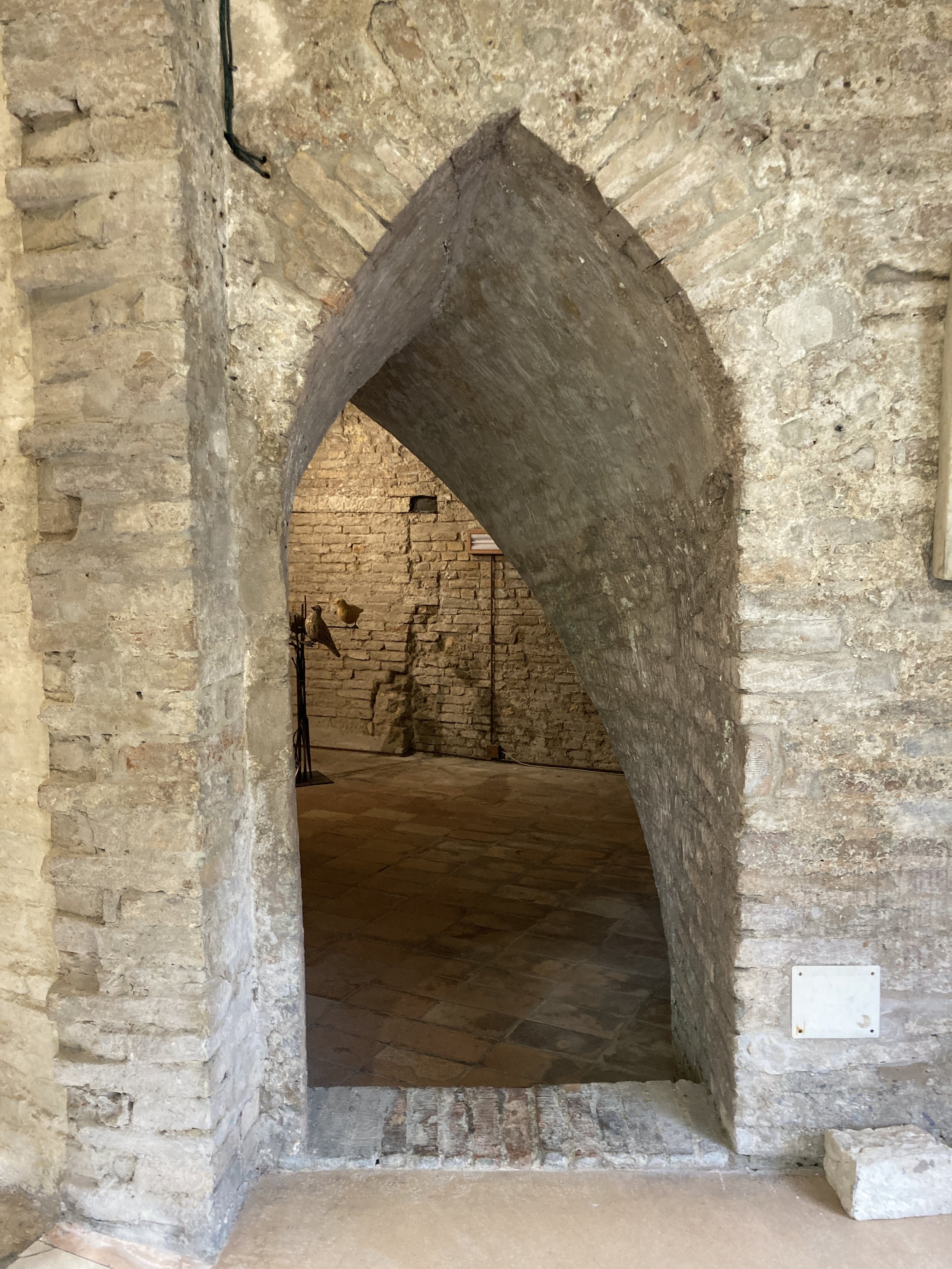
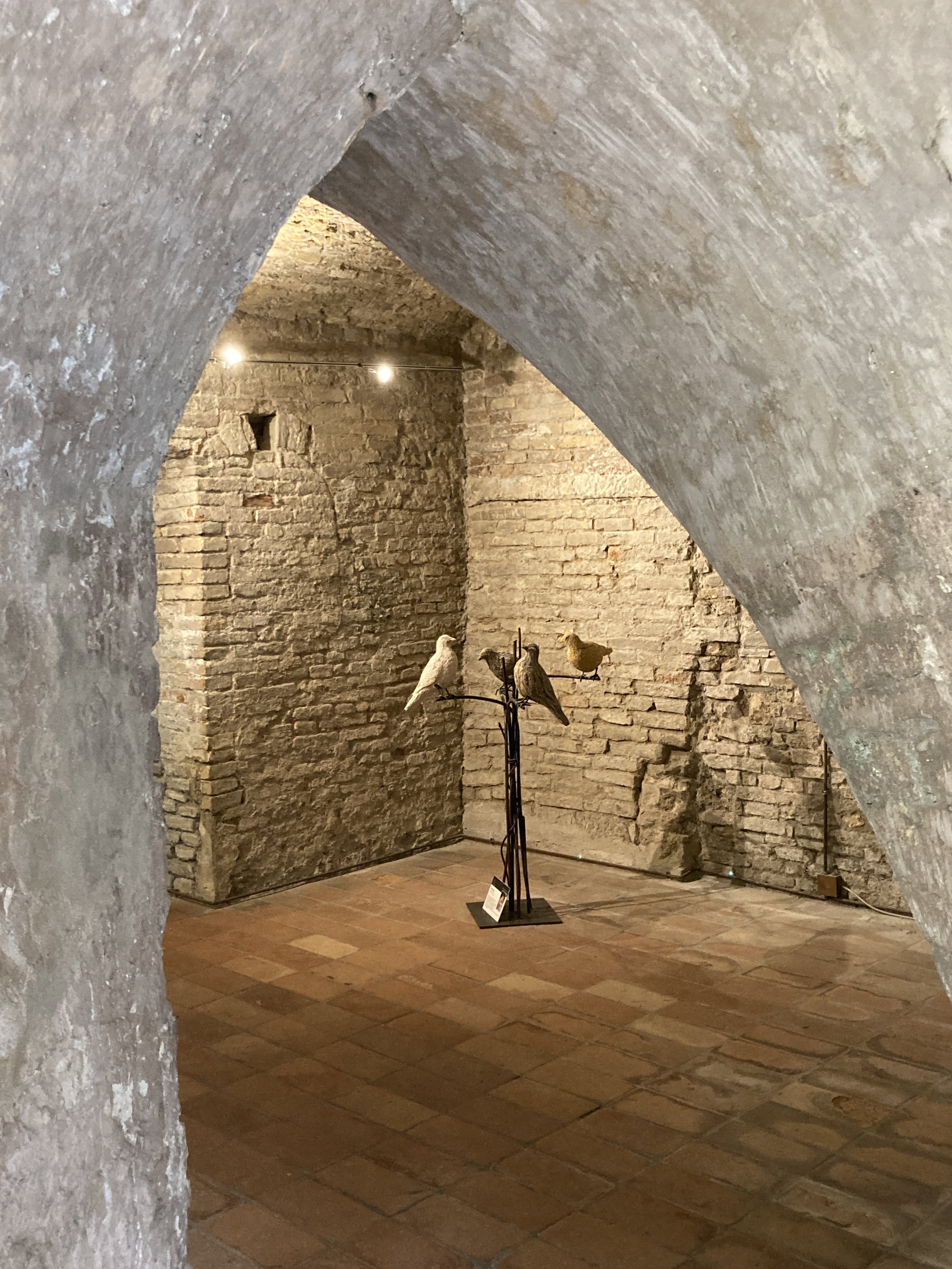
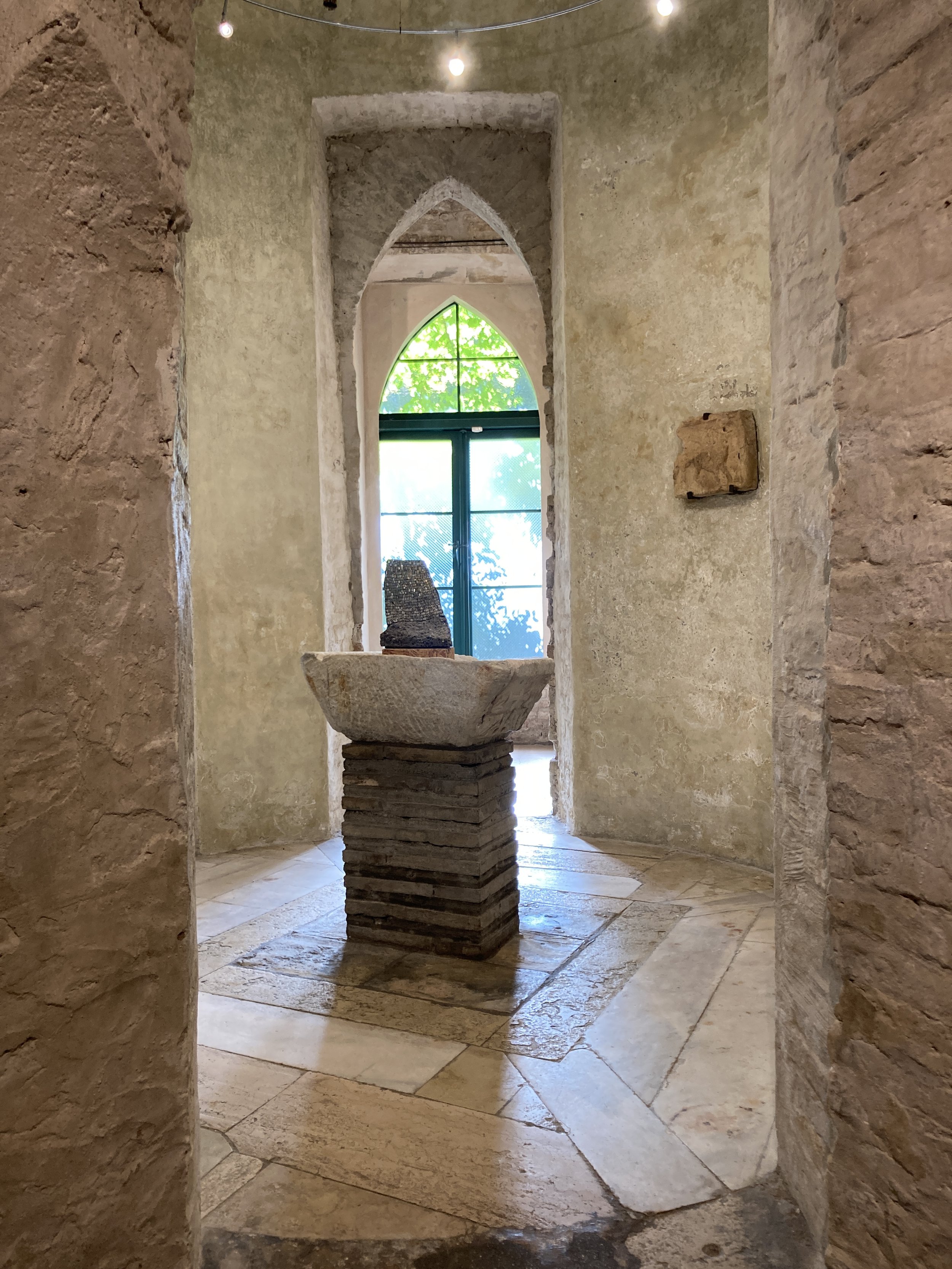
The crypt most likely served as a small family chapel, it was never used as a burial space. It has wonderful curved brick walls with deep arches between several small rooms. The floors contain some ancient mosaics. Today small art pieces are on display.

8E08CD9E-61D9-4D98-9D66-38843A1EC159.jpeg
6F6F6F38-58E8-43AD-ADE3-891F7C003C1E.jpeg
7ADC348D-6A33-4CCE-9728-B6AFB752E170.jpeg

Outside the crypt, a staircase leads to the next level of the gardens. Here is a wonderful, restful spot - a shaded arbor with views over the lower garden. What a cool and refreshing spot this must have provided the long ago Rasponi family. Or perhaps it was under this shade that Lord Byron sat with his lover, the Contessa Guiccioli, when he was in Ravenna. The arbor certainly has a romantic air about it.

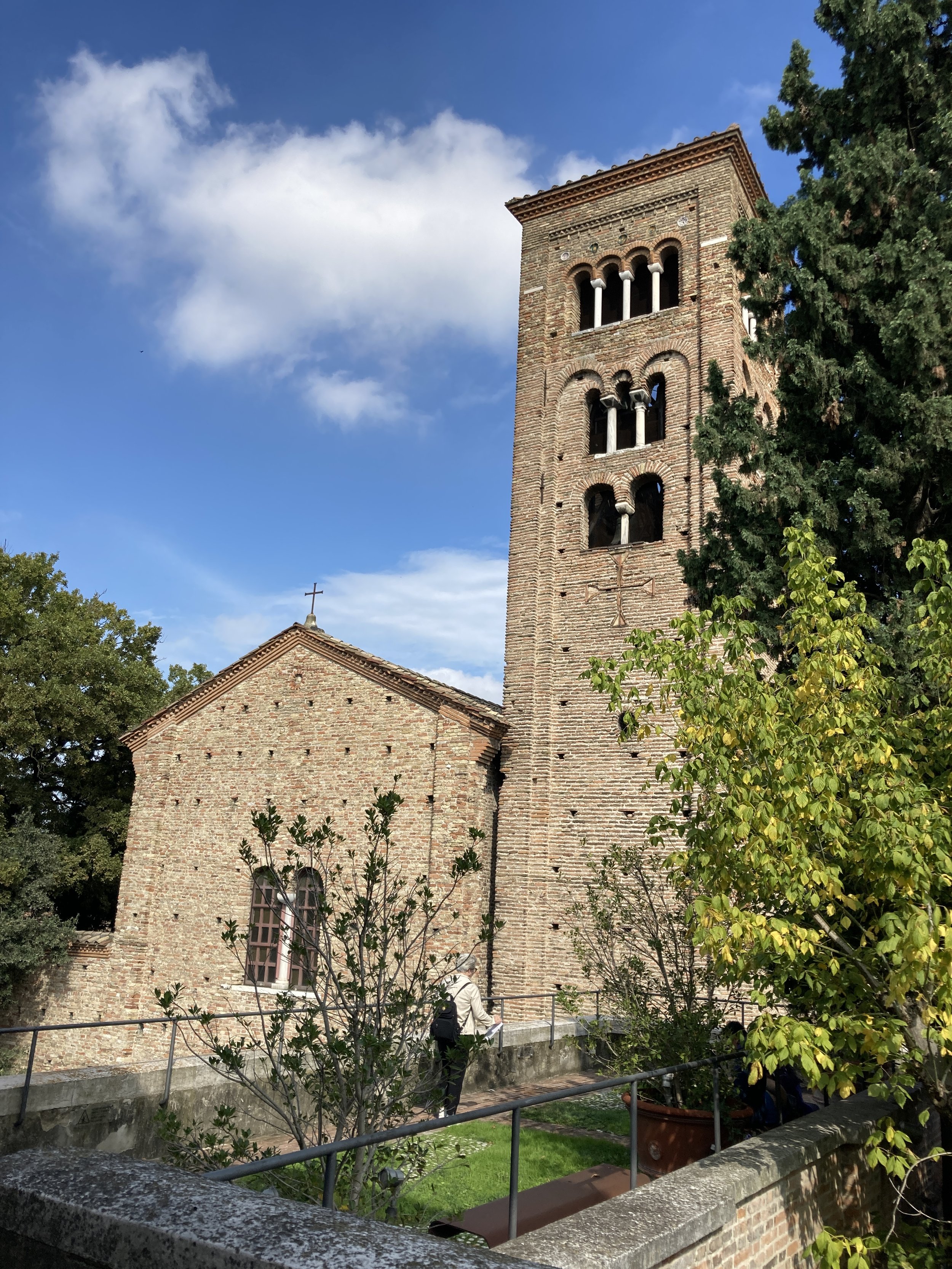
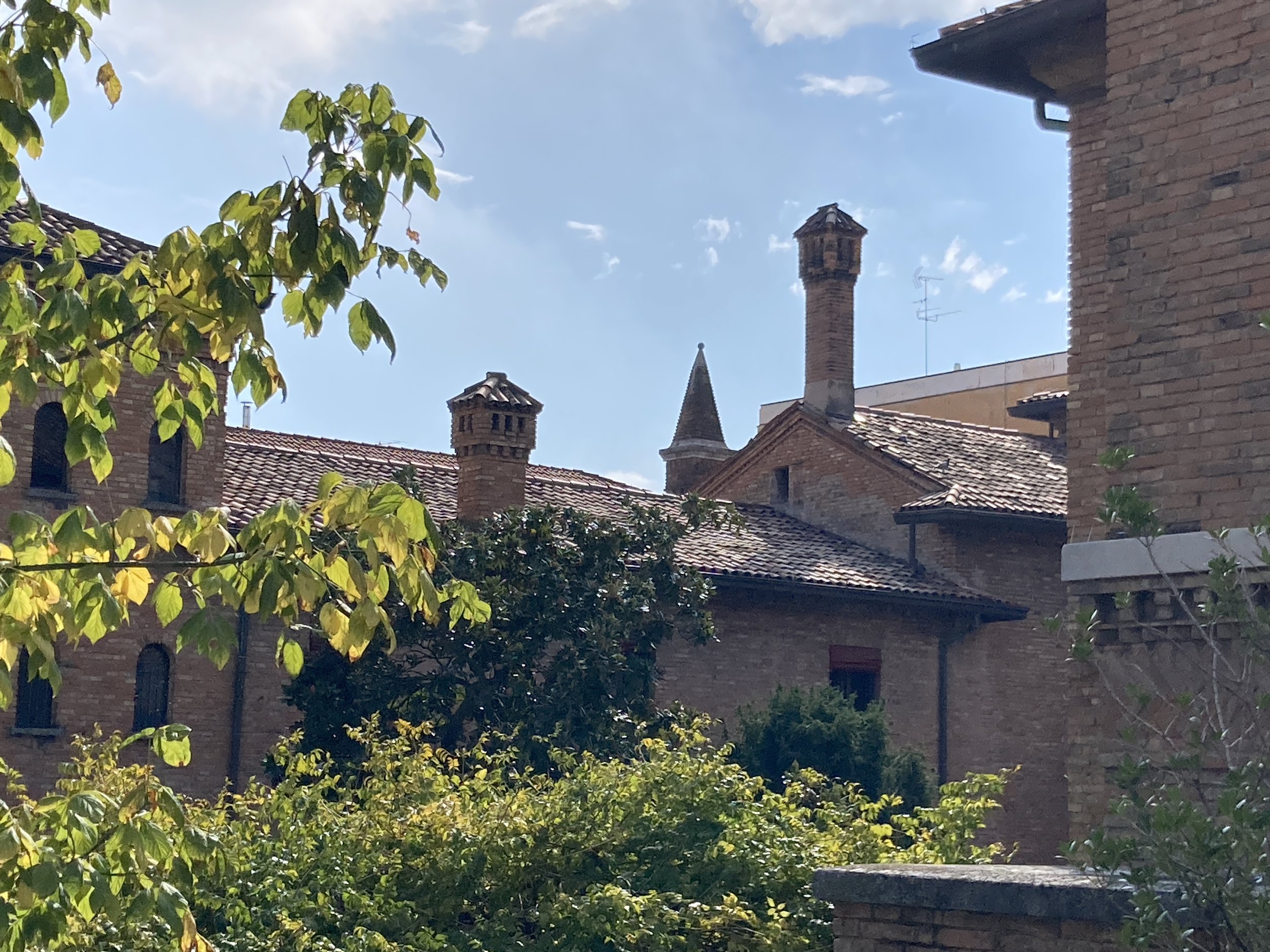
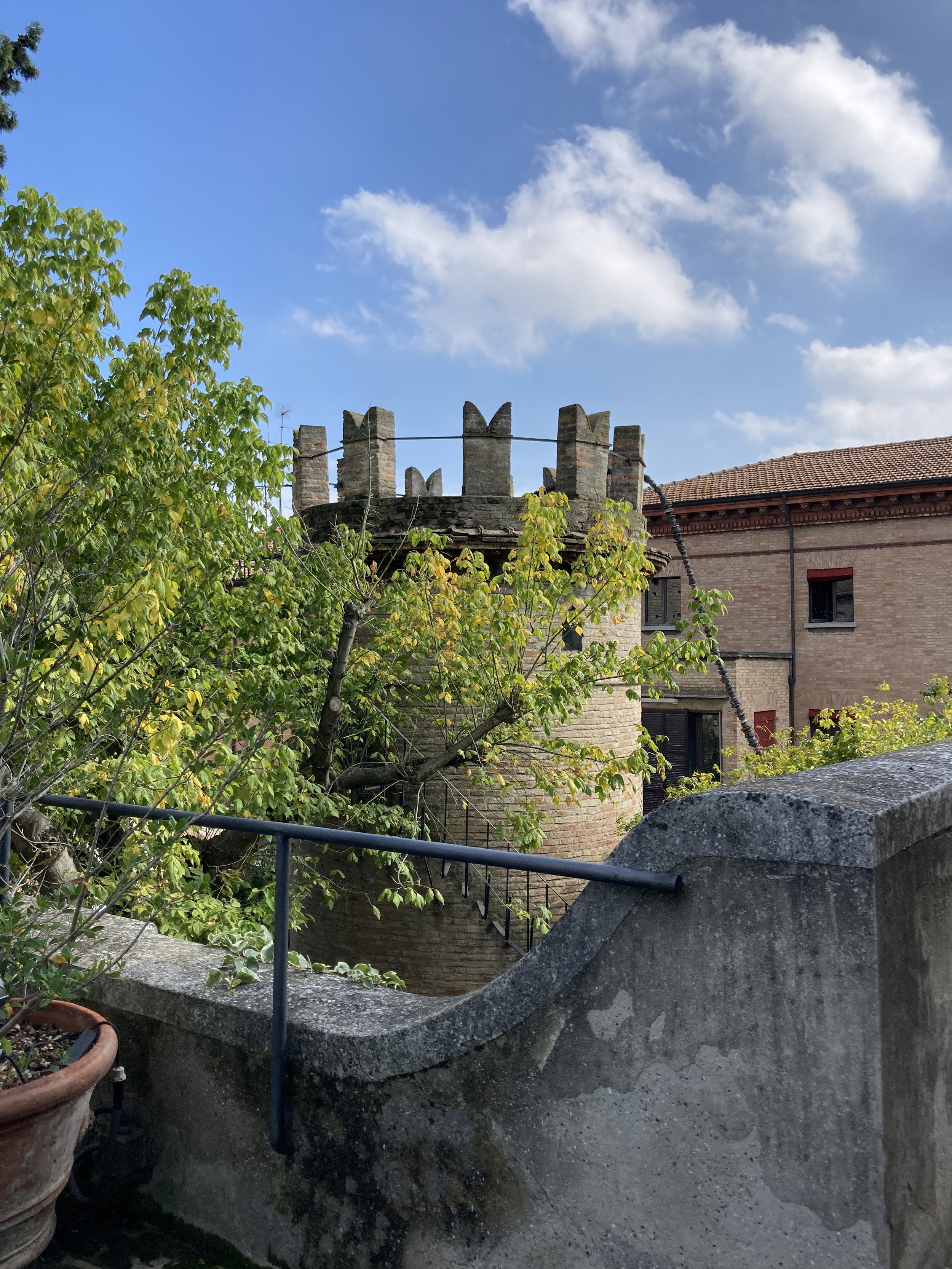
The top level of the gardens shift the view from the interior of the complex to the outside world. The Basilica of San Francesco and its campanile (bell tower), along with distant views of rooftops and towers, can be seen from this open platform with its interesting ground cover of grass and white rock. There is also a great view of the merlons atop the tower which houses the crypt (the merlons are the M-shaped brick pillars at the very top of many towers and castles).

BF61DFC7-4EF9-4CD3-B38A-9B64532DCA97.jpeg
CC051145-8588-497E-85F7-49F304AF44E1.jpeg
7F2964D5-EEF2-42C7-8DF7-74B762AAFF5B.jpeg

The climb down from the top gives a different perspective on the gardens and the tower housing the crypt.

Just outside the complex is a perfect place for another break - the Caffè Pasticceria Palumbo, set just under the portico in Piazza San Francesco.

November 07, 2022 /Joanne Bartram
Rasponi gardens, Giardino Pensile Ravenna, #ravennagardens, #rasponigardens
#italytravel, #ravenna, Italian art architecture, Italian gardens, Italy travel

Ravenna Part Two: Basilica di San Vitale and the Galla Placidia Mausoleum

October 24, 2022 by Joanne Bartram in #italytravel, #mosaicsravenna, #ravenna, Emilia-Romagna, Italian Art, Italian art architecture, Italian culture, Italy, Italy travel, Museums Italy

This week, more about Ravenna and another two of the city’s important historical sites. One is quite small and the other much larger.

First, the smaller of the two, the Mausoleum of Galla Placidia. Galla Placidia, born around 390 AD, was the daughter of a Roman Emperor (Theodosius I) and wife to both Ataulf, king of the Visigoths, and the Roman Emperor Constantius III. She was also the mother of an emperor. She was powerful in her own right, playing a major role in Roman life and politics. Her contributions to society included construction and restoration of churches, including the mausoleum named for her in Ravenna. Although it is called a mausoleum, the building was used as a chapel and it is not Galla Placidia’s final resting place.

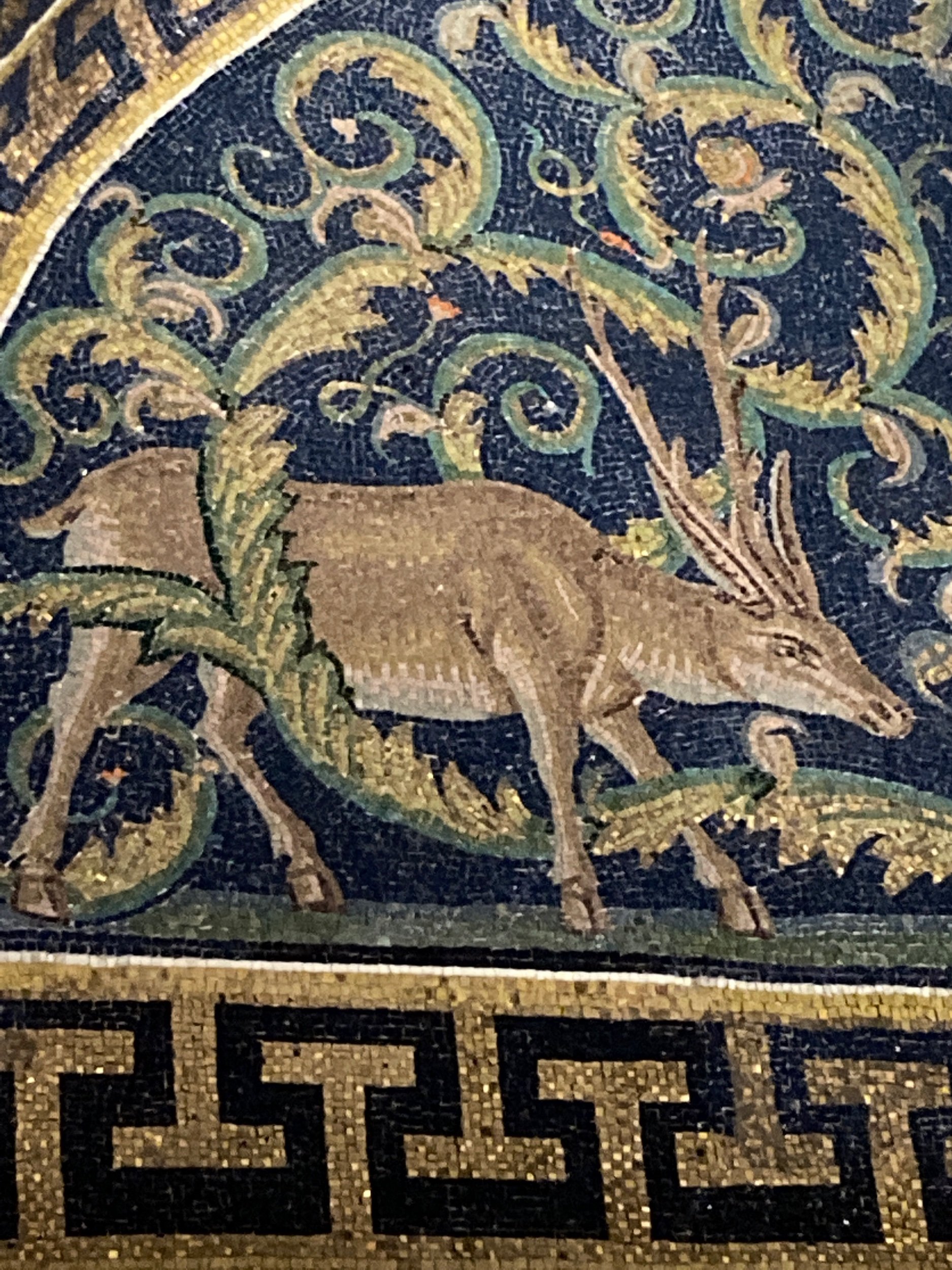
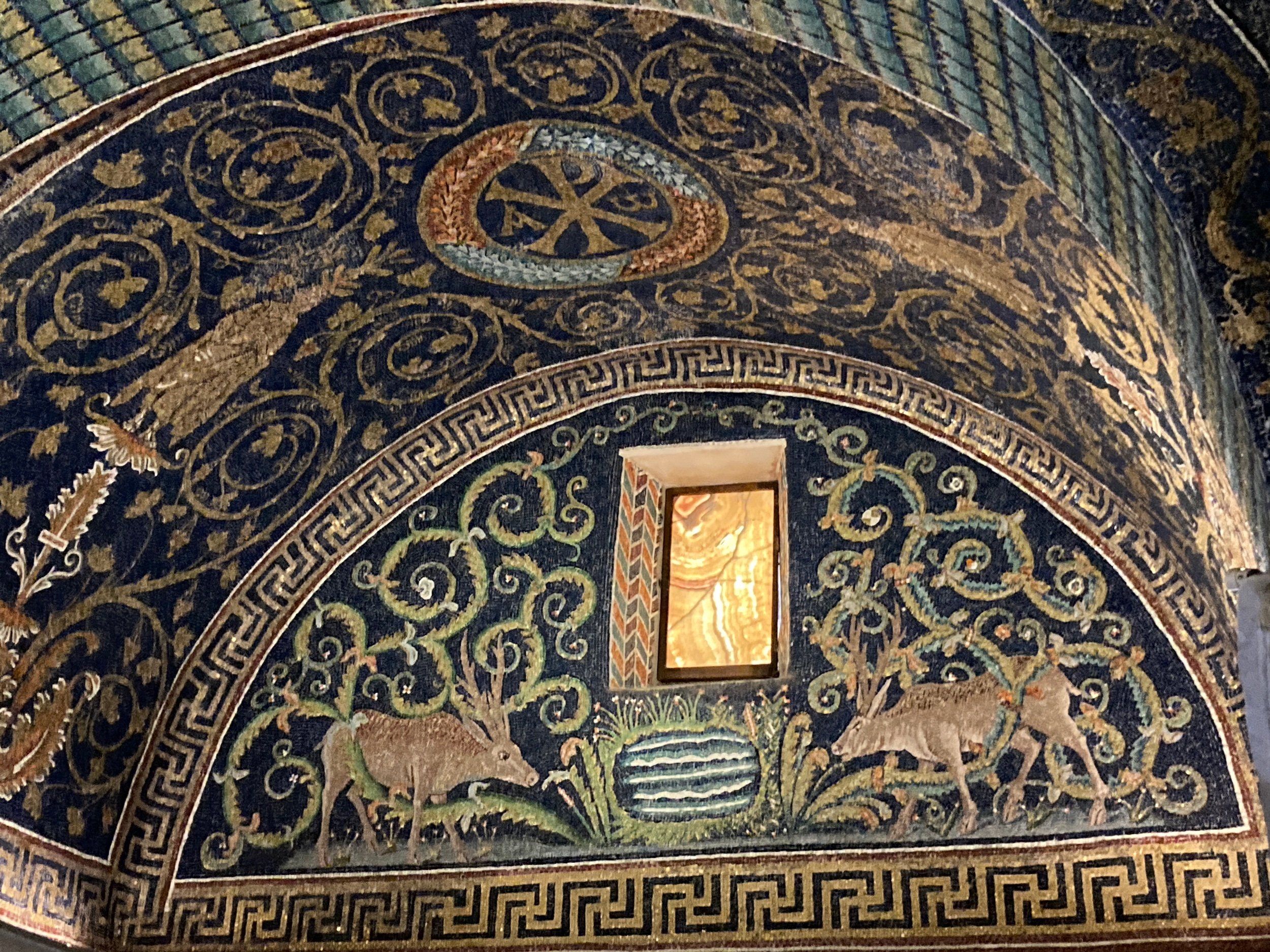
The mausoleum is small and intimate, constructed in the shape of a cross. Plain on the outside, it is stunningly beautiful inside - full of mosaics in dazzling blues and greens, touches of red, and white robed prophets. All of the upper portions of the interior, including the dome, the vaults, and the arches, are filled with brilliant detail and symbolism. There are starry skies, flowers and vines, animals, and a host of religious figures.

IMG_8900.jpeg
IMG_8895.jpeg

So much beauty in such a small space is breathtaking. The intimate size is welcoming and It feels a bit like a spiritual hug.

Detail of one of the lunettes, the Mausoleum of Galla Placidia

I didn’t imagine anything could compare, and yet, just across the grassy field, lies the Basilica of San Vitale…..

The Basilica of San Vitale, Ravenna

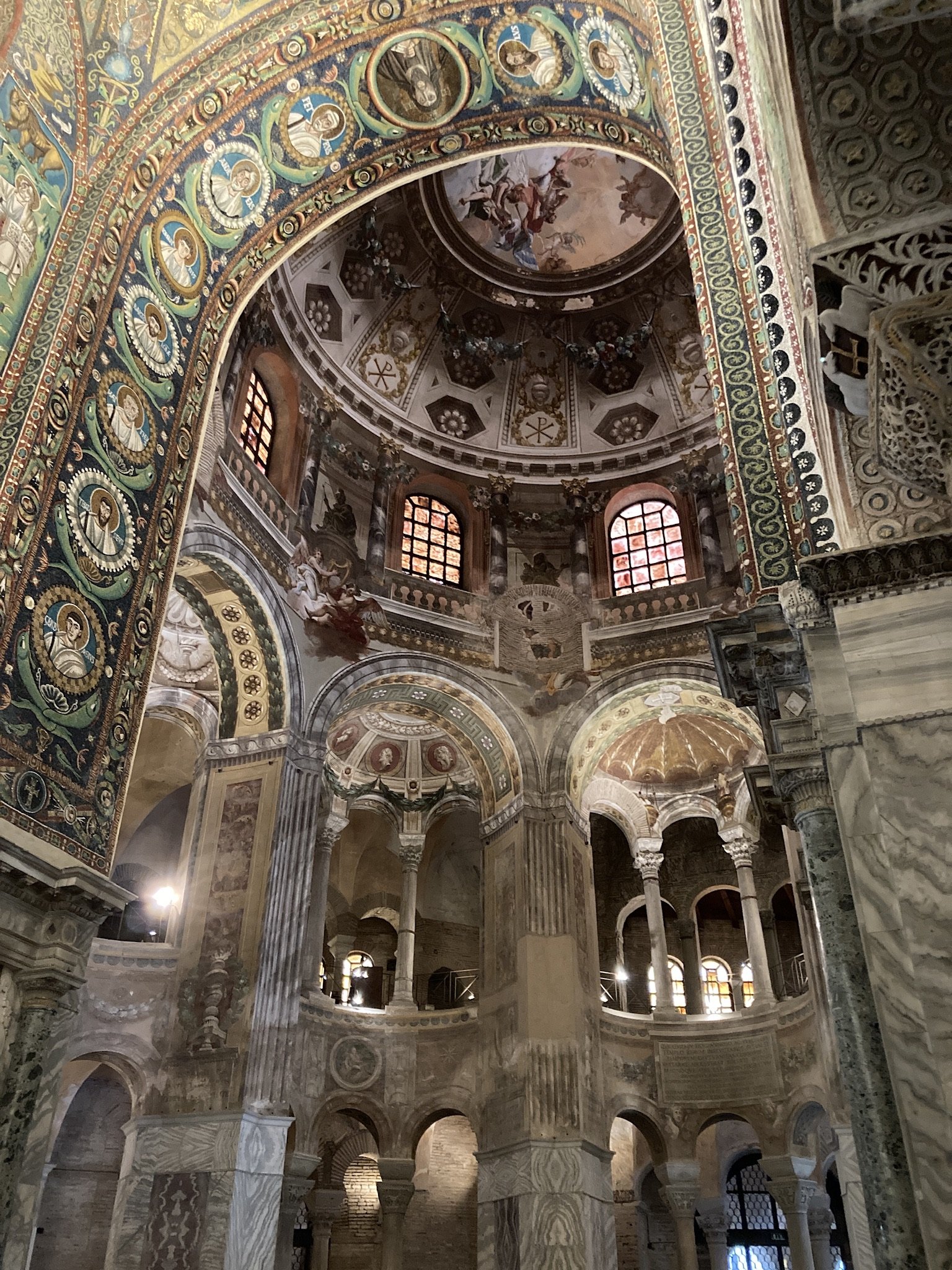
The much larger Basilica of San Vitale is different - less intimate, the building more angular outside with more distinct spaces inside. With decoration that goes from floor to ceiling it is hard to know where to look first.

Interior, Basilica of San Vitale, Ravenna


The mosaics are somehow less soft and more crisp, the imagery more clear. Where the Galla Placidia enchants you in to a mystic spirituality the San Vito demands you step up and take note.

Is one more beautiful than the other? Absolutely not, the Basilica is just as amazing but in a different way.

IMG_8964.jpeg
IMG_8946.jpeg

The Basilica’s website says that “getting out of San Vitale is not getting out of a church, is like being torn from a mother’s womb. You have to close your eyes because the light blinds (even if it’s not sunny), the voices deafen (even if people are not there), the world pushes and impacts”. I cannot argue. Stepping inside is to be transported to another world and on leaving it is quite a shock to discover the same old cacophonous world outside. It is that beautiful and enveloping.

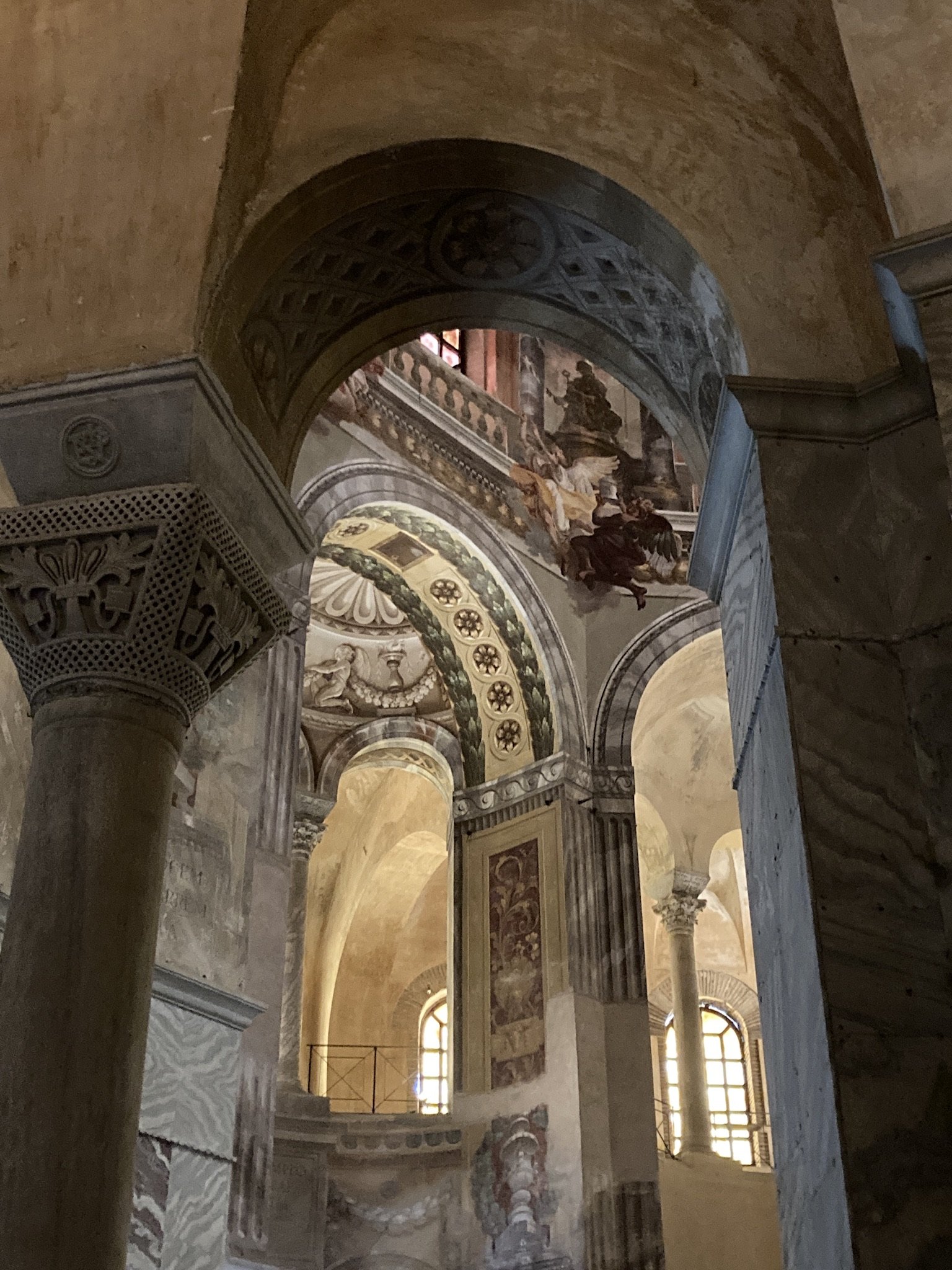
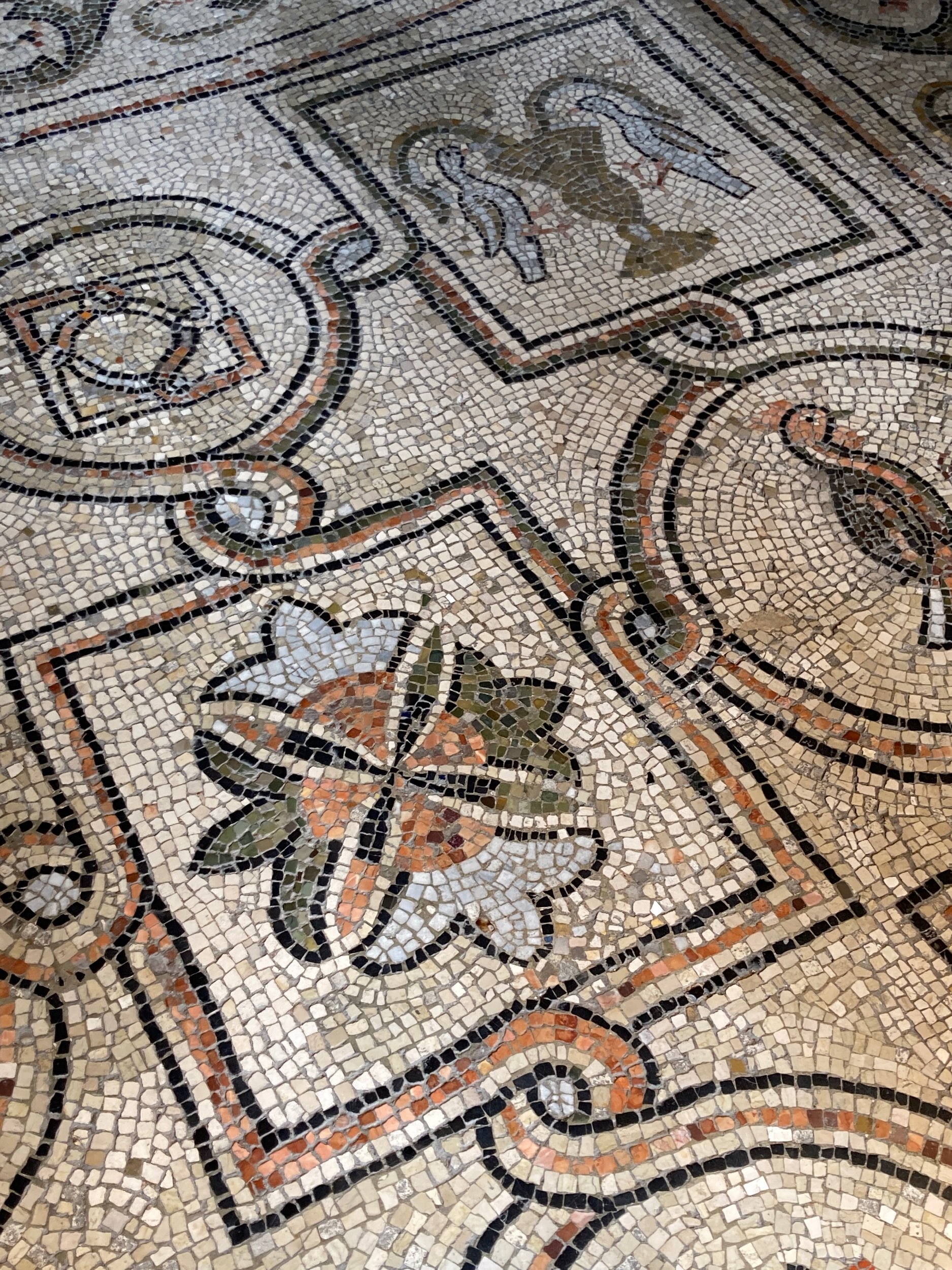
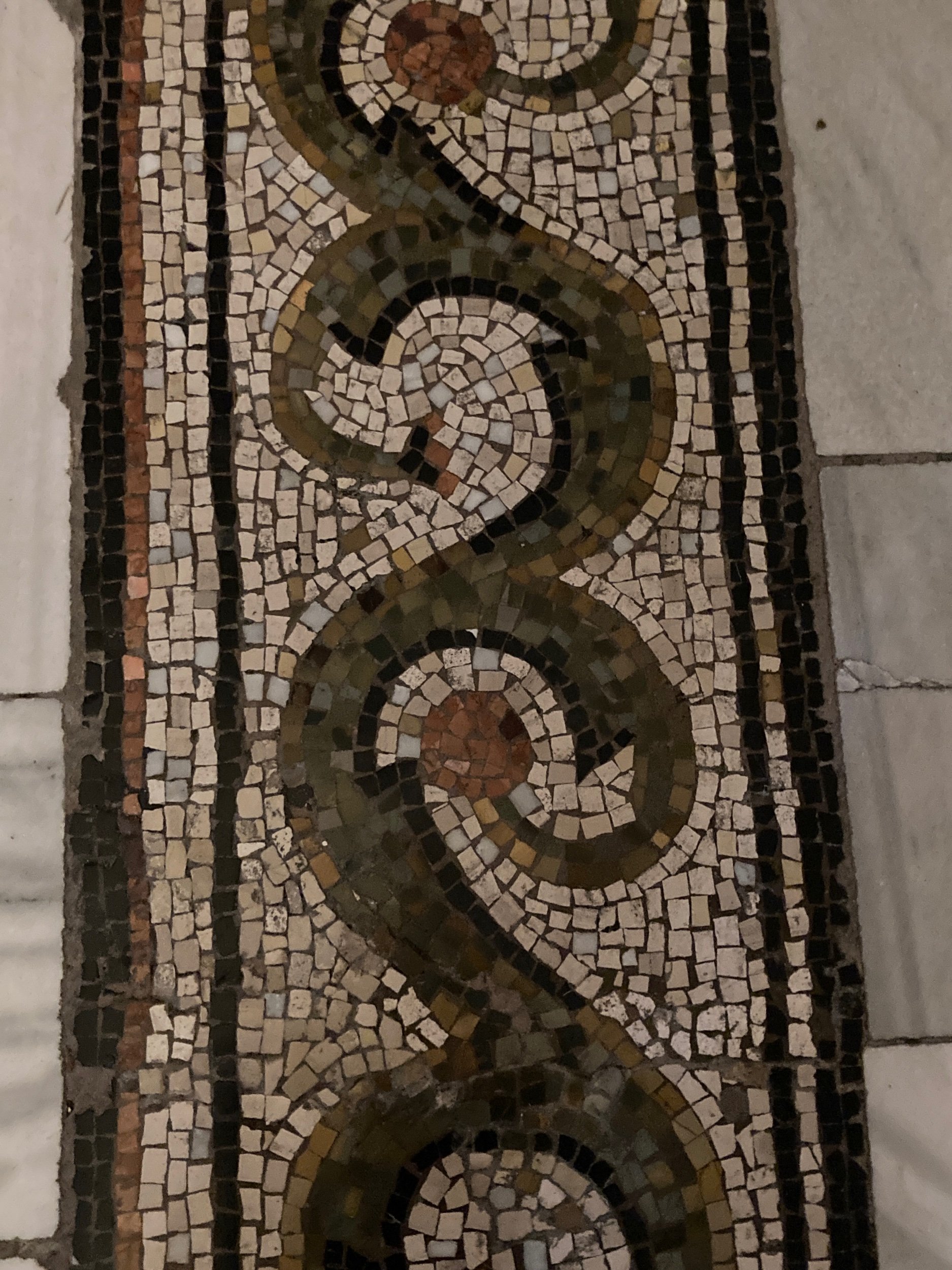
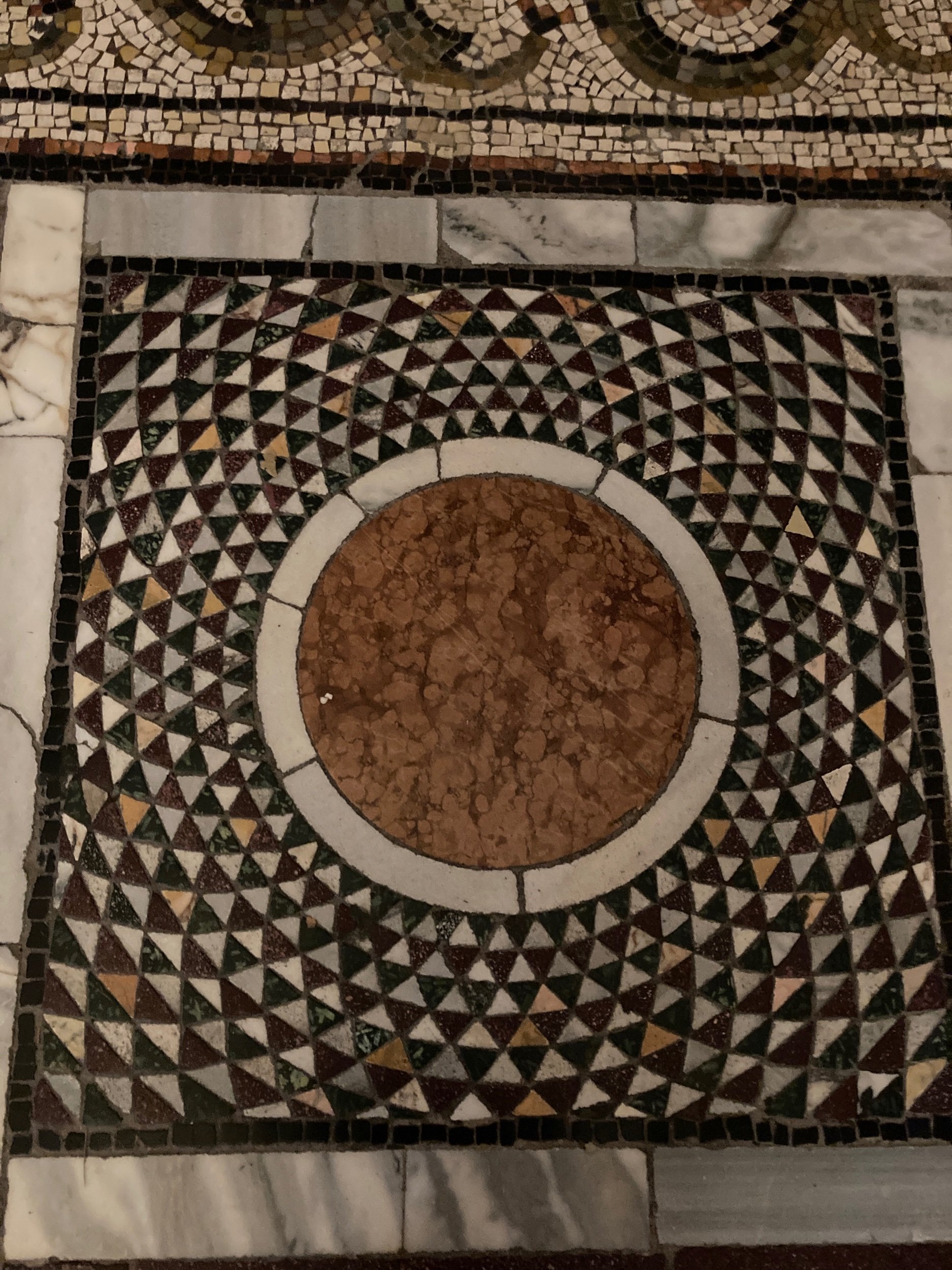
The exterior of the Basilica is octagonal, unusual for a basilica, with buttresses. Inside there are huge columns, a central dome, two stories filled with arches and smaller columns (with some of the arches with painted ceilings rather than mosaics), and several alcoves. Pale translucent windows filter the light. Mosaic floors (detail below) are filled with pattern and muted color.

IMG_8983.jpeg
IMG_8971.jpeg
IMG_8970.jpeg

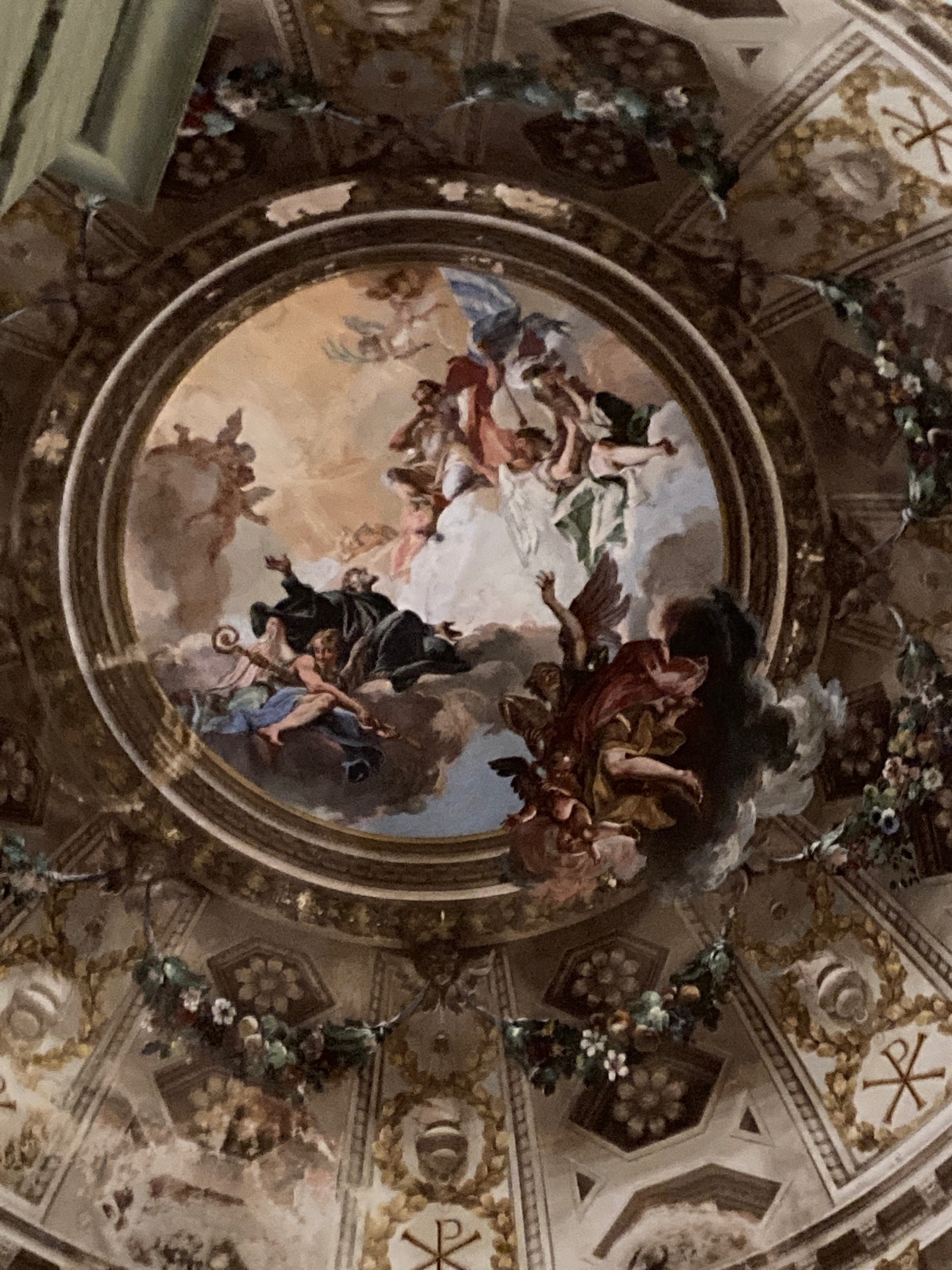
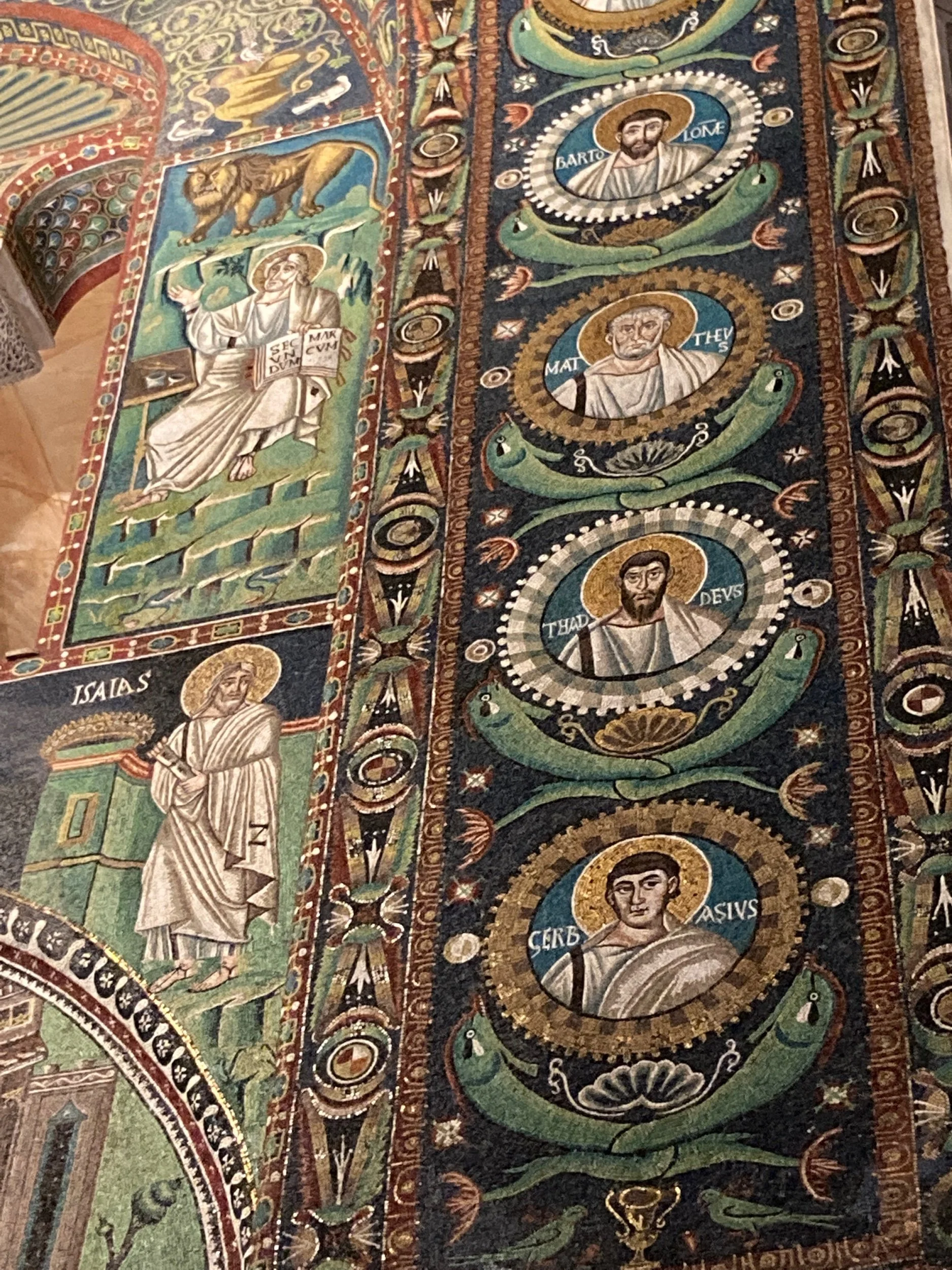
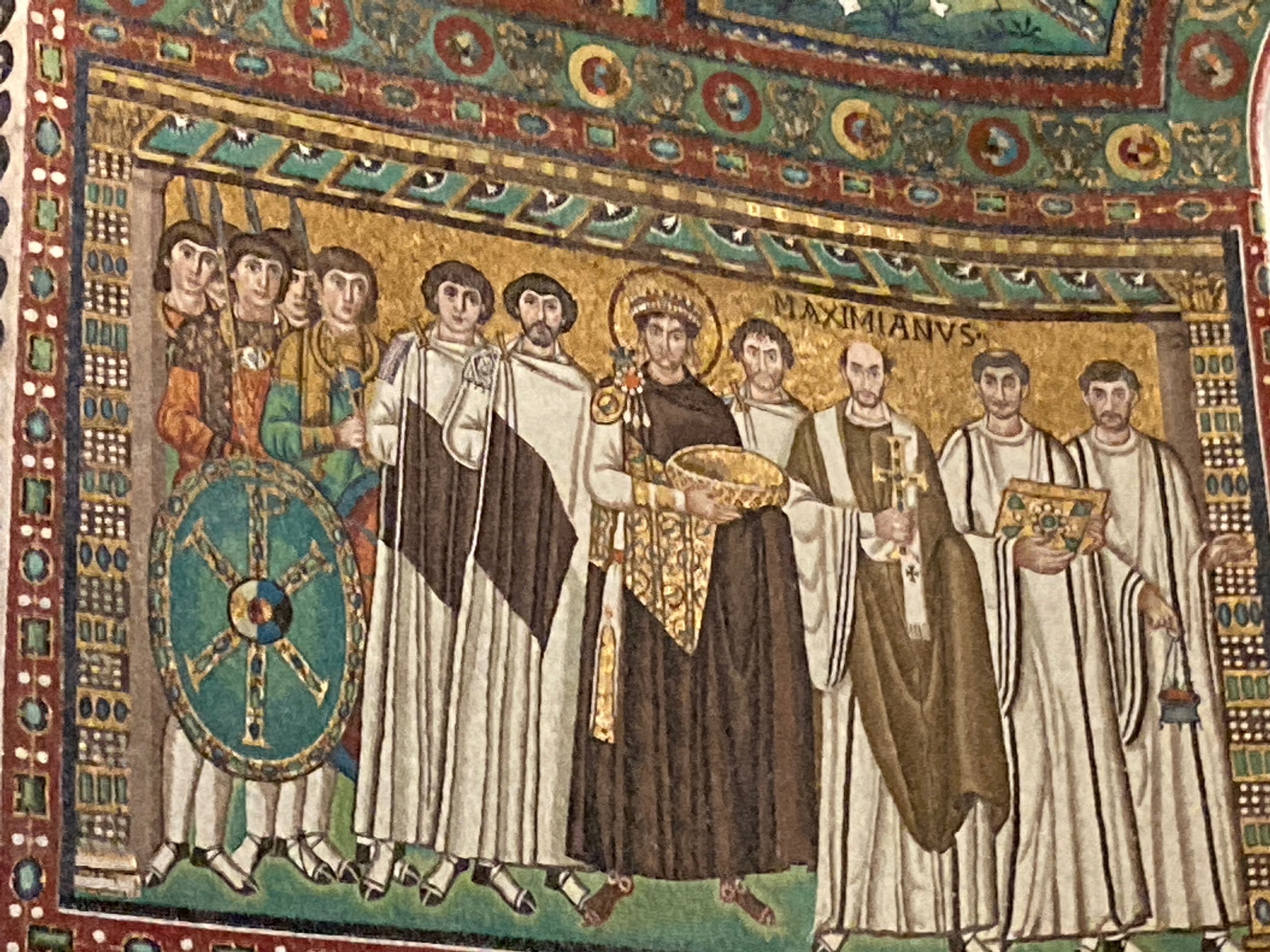
And the mosaics! The dominant color here is a soft green, with plenty of gold too. And almost every surface is decorated in mosaic scenes, even the arched entrances into each alcove. Bible scenes, saints, angels and apostles are everywhere.

IMG_8956.jpeg
IMG_8976.jpeg
IMG_8958.jpeg
IMG_8978.jpeg

With all of the mosaic filled churches in Ravenna, it is impressive that each has its own character and beauty. I couldn’t begin to choose a favorite among them. Put them all together and it is easy to see why Ravenna is filled with UNESCO World Heritage sites. What a treasure!

October 24, 2022 /Joanne Bartram
Galla Placidia, San Vitale Ravenna, Mosaics Ravenna, Italy Mosaics, #gallaplacidia, #sanvitaleravenna, #mosaicheaven
#italytravel, #mosaicsravenna, #ravenna, Emilia-Romagna, Italian Art, Italian art architecture, Italian culture, Italy, Italy travel, Museums Italy
  • Newer
  • Older

Powered by Squarespace