Two Parts Italy

Exploring Italy, travel, and living a flavorful life

  • Blog
  • About This Blog
  • Start Here
  • Recent Posts
  • Archives by Topic
  • Subscribe
  • Contact me

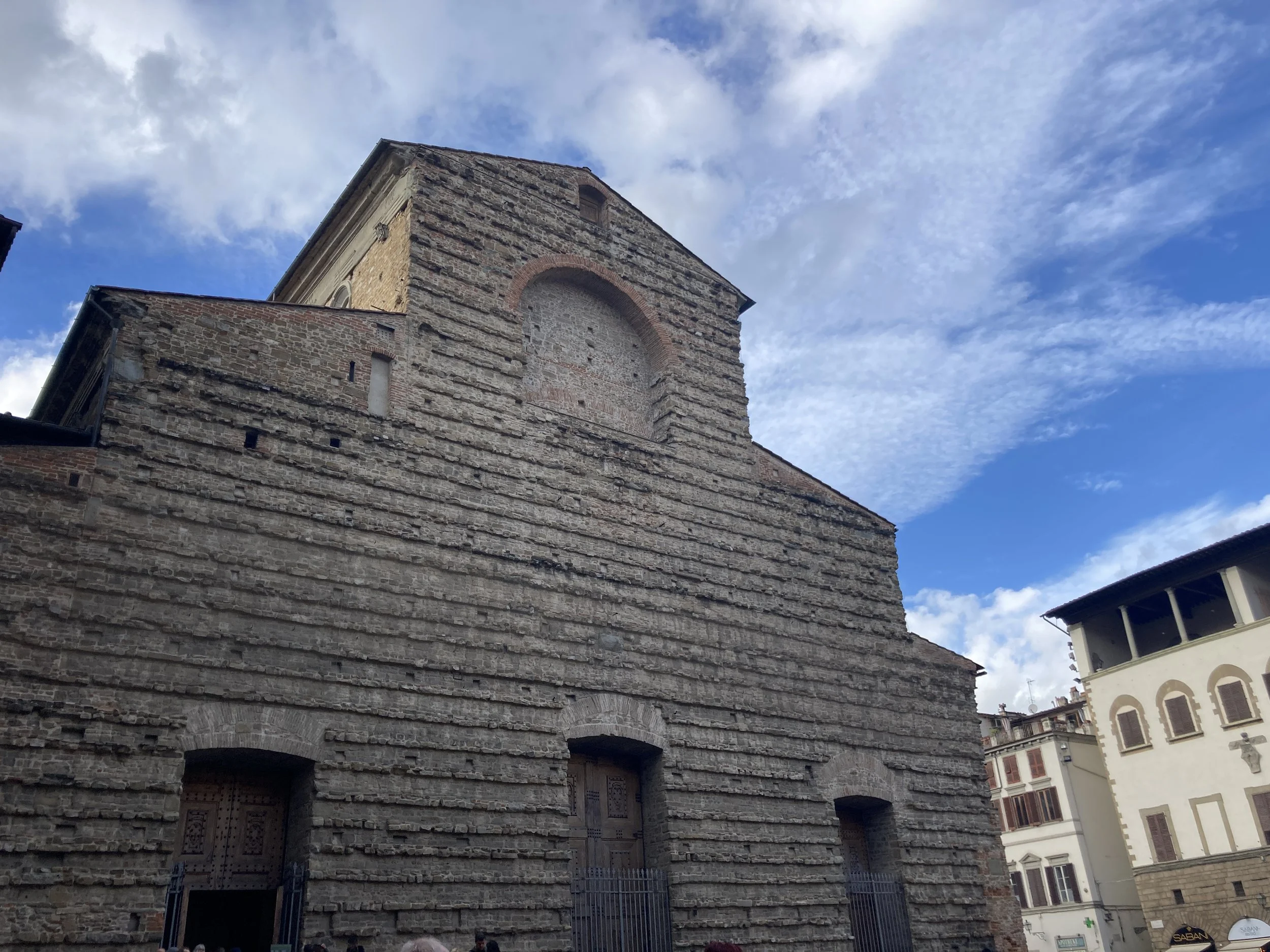
Basilica of San Lorenzo, Florence.

The Basilica of San Lorenzo in Florence

January 29, 2024 by Joanne Bartram in #florence, #italytravel, #medievalitaly, Churches Italy, Florence, Italian art architecture, Italian culture, Italy travel, Tuscany

It’s hard to have a favorite church in Florence.  It may even be wrong to choose a favorite considering the number of historic and significant churches in the city.  The Duomo, officially the Church of Santa Maria del Fiore, with its magnificent façade and campanile, is famous for good reason.  Consider Santa Maria Novella, Santa Croce, Santissima Annunziata – and those are just the basilicas inside the historic center.  Add in smaller churches, chapels, baptisteries, oratorios, bell towers and wonderful churches outside the center and, well, it would take years to explore them all.  How could anyone choose a favorite?

Tomb of Berta Moltke Hwitfeldt, Corbelli Chapel, Basilica of San Lorenzo

 And yet, I do have a couple of favorites.   One is the Basilica of San Lorenzo, whose 4th century origins make it the oldest church in Florence.  Redesigned by Brunelleschi in the 15th century, and completed after his death, it was the parish church of the Medici family, many of whom are buried there.
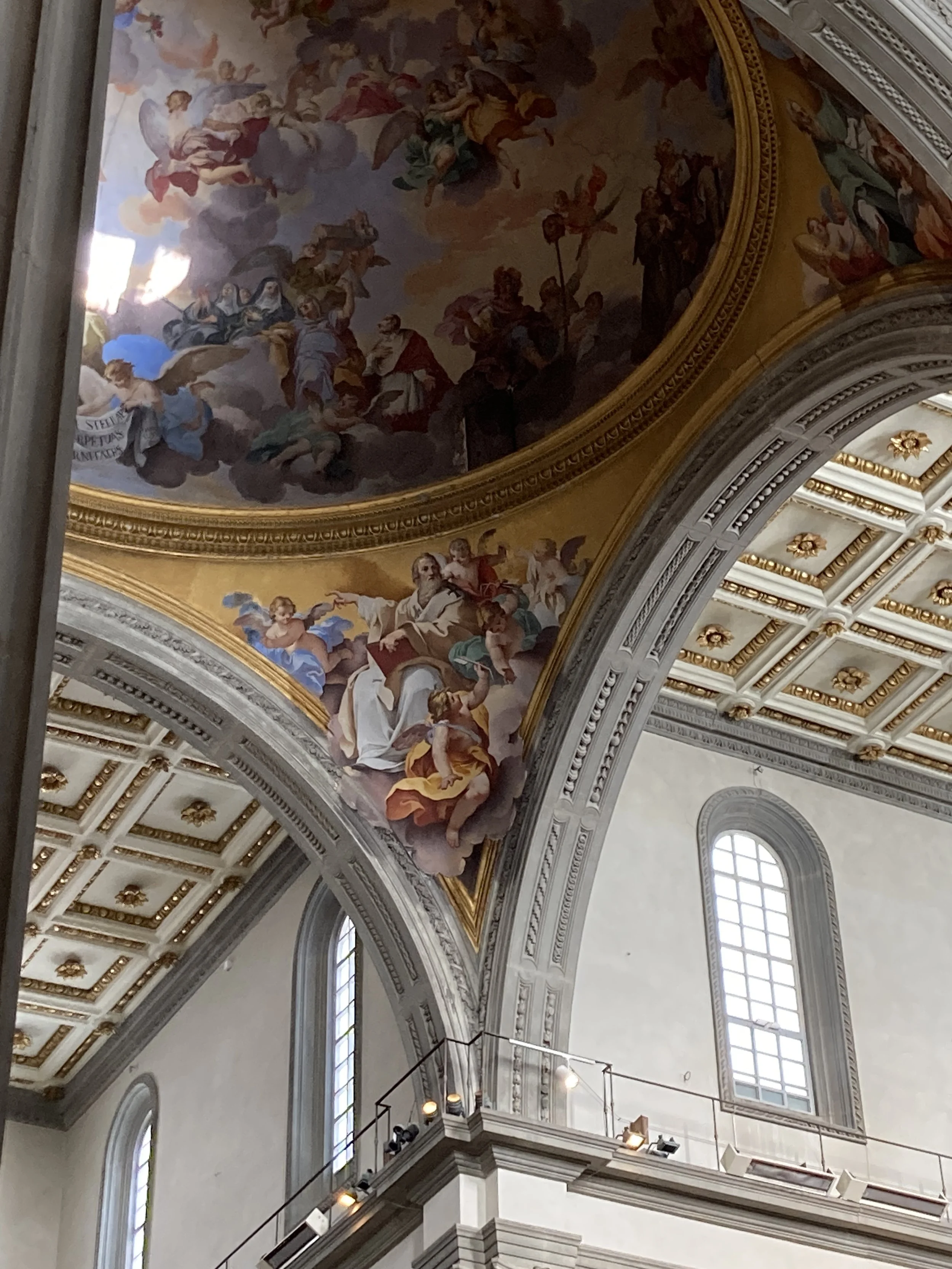
Detail, Basilica of San Lorenzo, Florence

 San Lorenzo is more than just a church – the complex also has a museum, the Laurentian Library, and the Medici Chapels.  Underneath the Medici chapels is a recently discovered hidden room with rough sketches by Michelangelo covering the walls. Right now it’s the hottest attraction in town but it was not yet opened during my November stay in Florence. The library is not always open, and a special ticket is needed for the Medici Chapel.  The entire complex is a bit too much for one visit.

On my recent off-season stay in Florence, I stopped by on the spur of the moment and purchased a ticket which included only the cloister and church, both of which were uncrowded and just right for a short visit.

What is it that makes the San Lorenzo Basilica one of my favorites?   It starts with the rough stone exterior.  Unlike the polished marble façade of the Duomo, the San Lorenzo stands unadorned and underdressed.  It was meant to have a white marble façade, designed by Michelangelo at the request of the Medici Pope Leo X.   But the pope died, the money dried up, and the façade was never installed. 

Inside, the basilica feels quiet and peaceful with its simple geometric floor anchoring graceful arches and columns in gray Pietra Serena (Serene Stone).  The high, round, windows let in light through their clear glass.  Even the ceiling, with its gold edged squares and central medallions (look for the Medici coat of arms) feels calming. Unlike more ornate churches (such as my other favorite, the very Baroque Santissima Annunziata), San Lorenzo has low contrast colors and finishes. This allows it to feel open and airy. The Basilica is a soothing space that supports quiet contemplation and an uncluttered mind. 

Another reason to love this church is the way in which it showcases the work of Donatello.  His two ornately carved pulpits, raised high atop marble columns in the center of the church, are considered his final masterpieces.
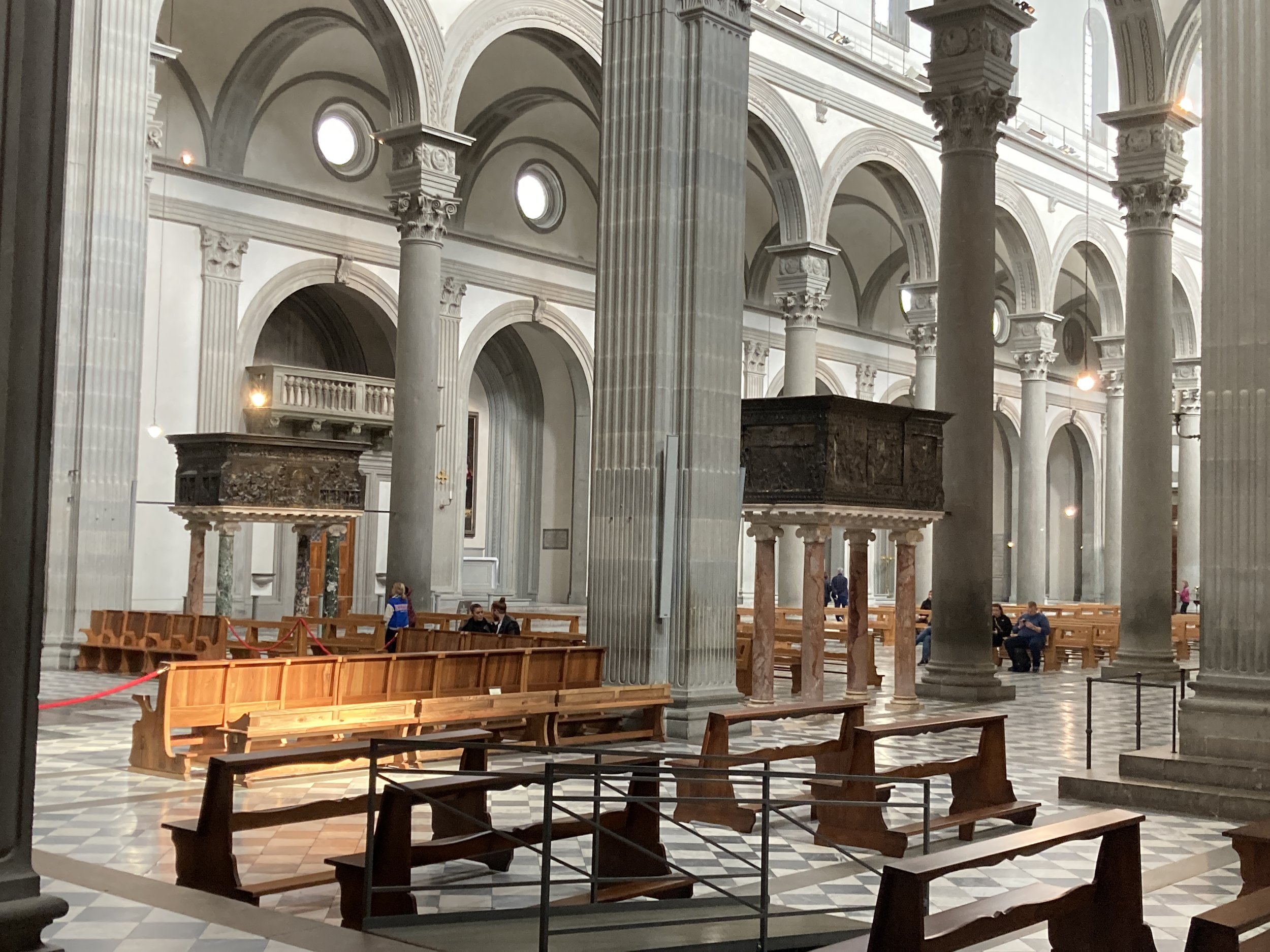
Donatello’s pulpits , Basilica of San Lorenzo

The church holds many remarkable pieces of art, but not so many as to be overwhelming.  There are sculptures, including graceful tomb markers, and some significant paintings, many of which sit in small side chapels.
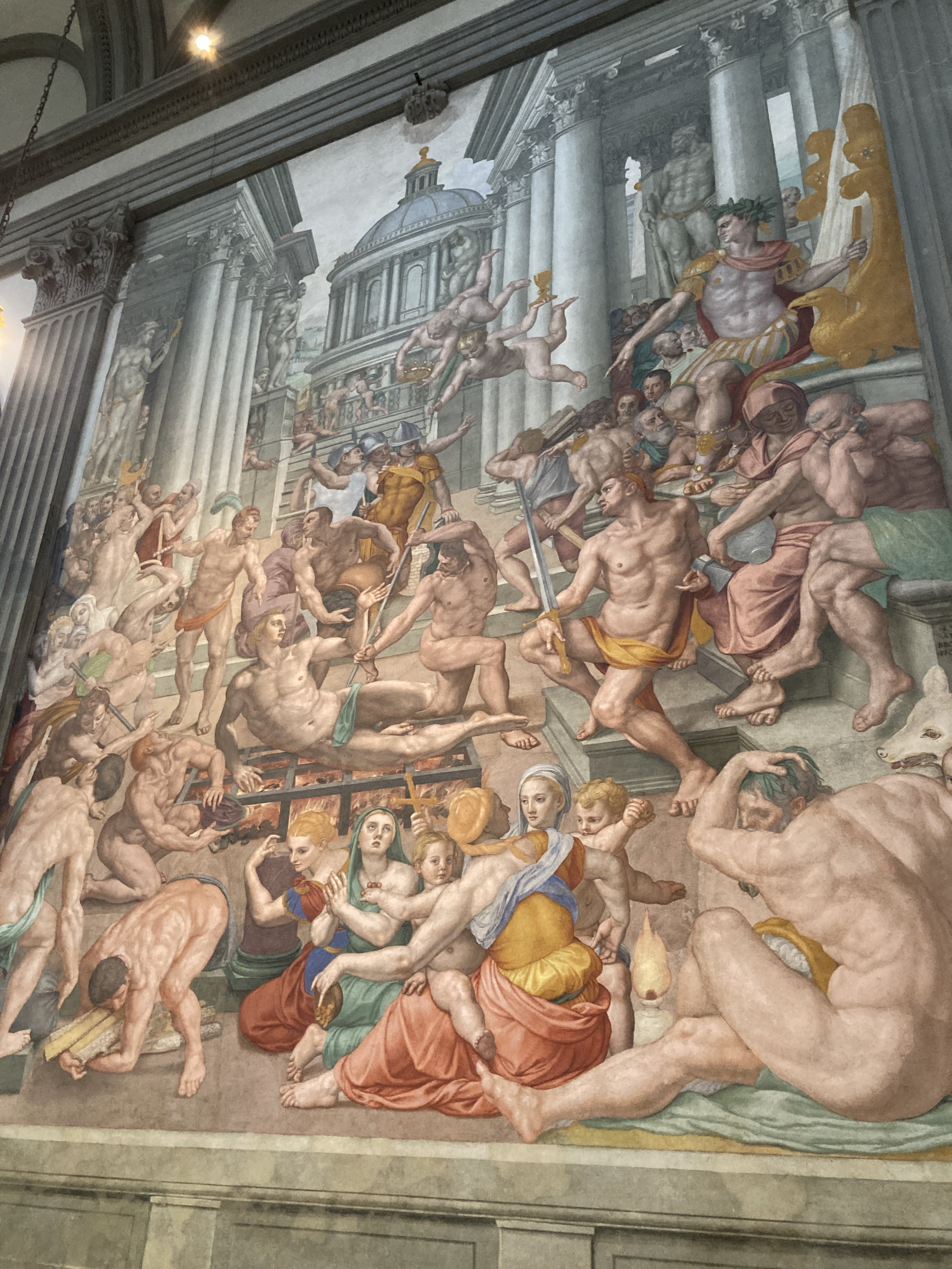
Bronzino’s The Martyrdom of St. Lawrence

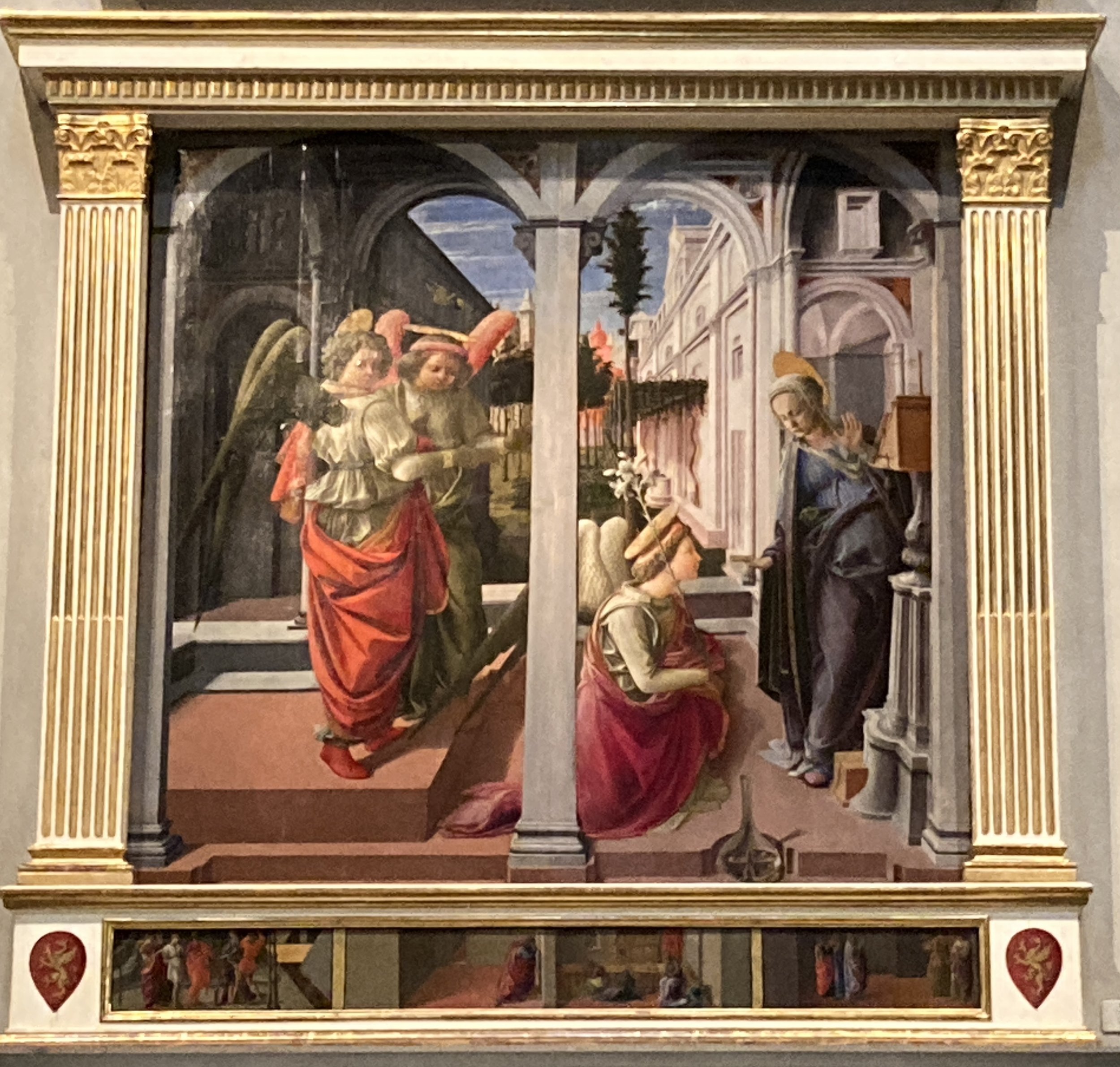
Perhaps the two most well-known paintings are an Annunciation by Filippo Lippi (below, right) and the Betrothal of the Virgin by Rosso Fiorentino (below, left).  Two very different styles, both captivating.   

BDE79584-8F80-47E8-81DD-5A0C9B04510C_1_201_a.jpeg
2A67D836-A358-4A1A-BD0B-42BDDE455A1A_1_201_a.jpeg

Old Sacristy, Basilica of San Lorenzo

The biggest reason for my love of this church is the small Sagrestia Vecchia (Old Sacristy).  Designed by Brunelleschi, it was the only portion of the church completed before his death.  His perfectly proportioned design incorporates a square room with a ribbed dome on top, several graceful arches, and the same gray and white colors of the main church. 

 Opposite the entry into the sacristy is a small marble altar, its design in white marble is in keeping with the simplicity of the rest of Brunelleschi’s design.  Above the altar, in a smaller dome, is a remarkable blue and gold night sky.  There has been some debate about the date represented by the constellations pictured.  Initially it was thought to represent the day the altar was consecrated in July of 1422.  Newer theories give the date as July 6, 1439, the date of the accord uniting the Eastern and Western branches of Christianity.  Whichever date is correct, the constellations unite the sacristy with the heavens.

The constellations above the altar in the Old Sacristy, Basilica of San Lorenzo

 In the center of the sacristy is the tomb of a Giovanni di Bicci de’Medici and his wife Piccarda Bueri.  It was Giovanni who founded the Medici bank and set the stage for the Medici era in Florence.  This seems like a fitting place for him to rest.
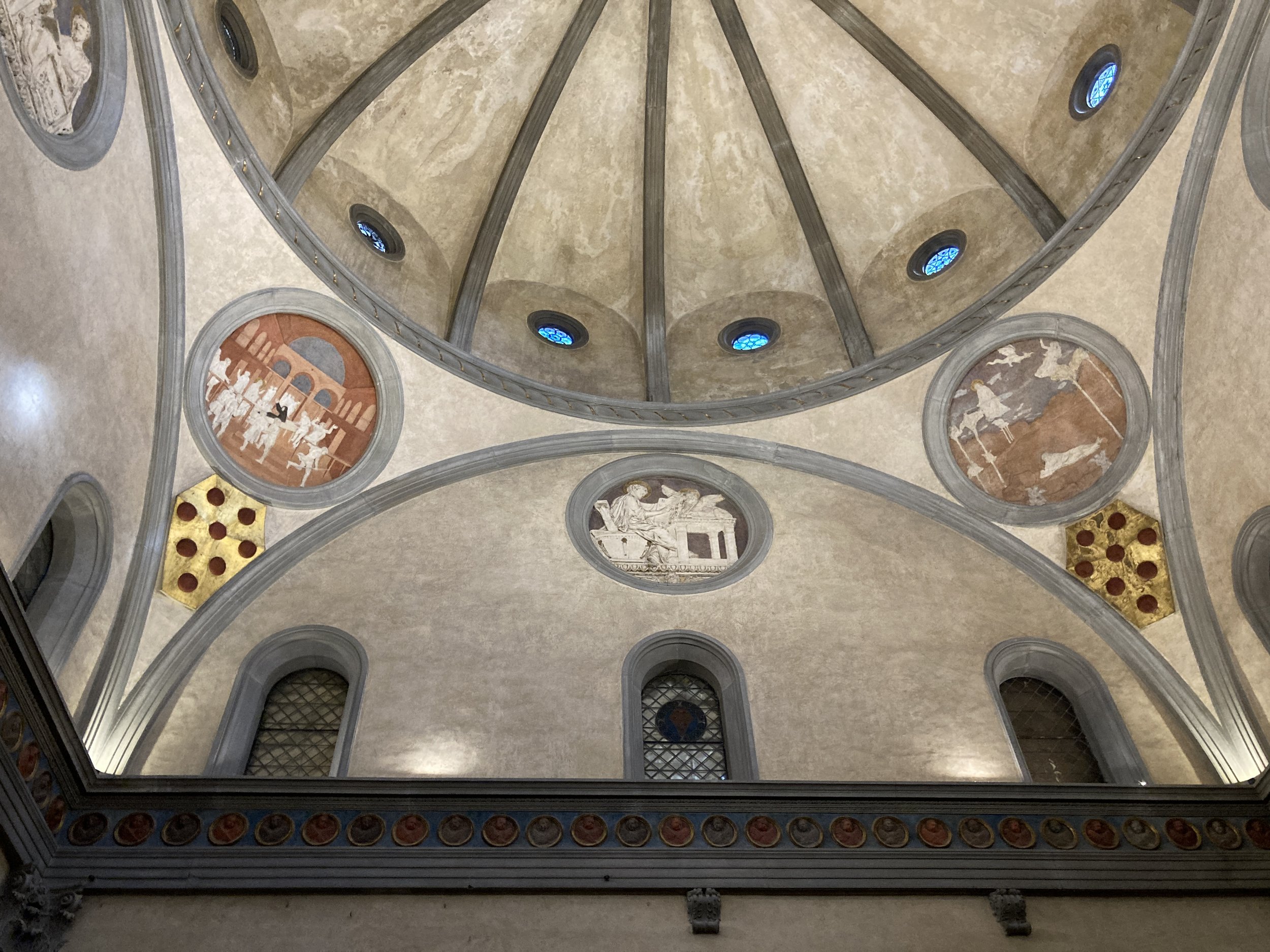
Not part of Brunelleschi’s original design, several elements were later added by Donatello at the request of the Medicis.  These include a series of tondi (round decorations) which lie below the dome.  The 4 in the corners represent the life of Saint John the Evangelist.  


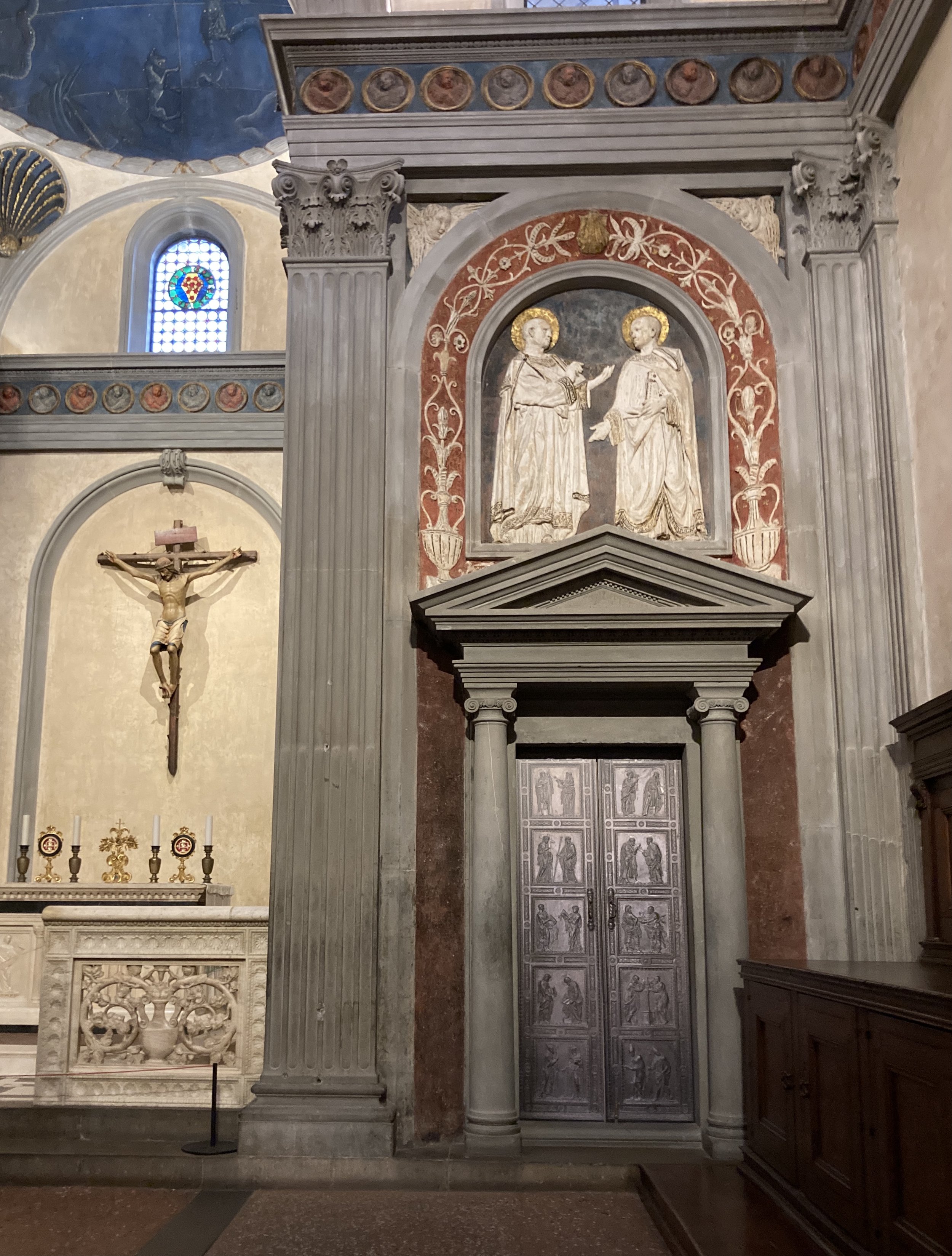
Detail, Donatello’s bronze doors, Old Sacristy

Donatello also designed the two bronze doors that flank the altar.

Apostles to the left, martyrs on the right.

The large reliefs above the doors, with St. Cosmos and St. Damian on the right and St. Stephen and St. Lawrence on the left, are also the work of Donatello.

(Note: There is also a New Sacristy but it is not accessible from inside the church, only from the Medici Chapels)


One of the relief decorations by Donatello above the bronze doors in the Old Sacristy.


The Basilica of San Lorenzo is not the largest or most ornate church in Florence.  It wears no colorful marble facade. But it is stunning in its simplicity and is of great historical and architectual importance. When visiting, don’t miss the literature with a QR code which links to an audio guide. The audio descriptions greatly enhanced any visit.

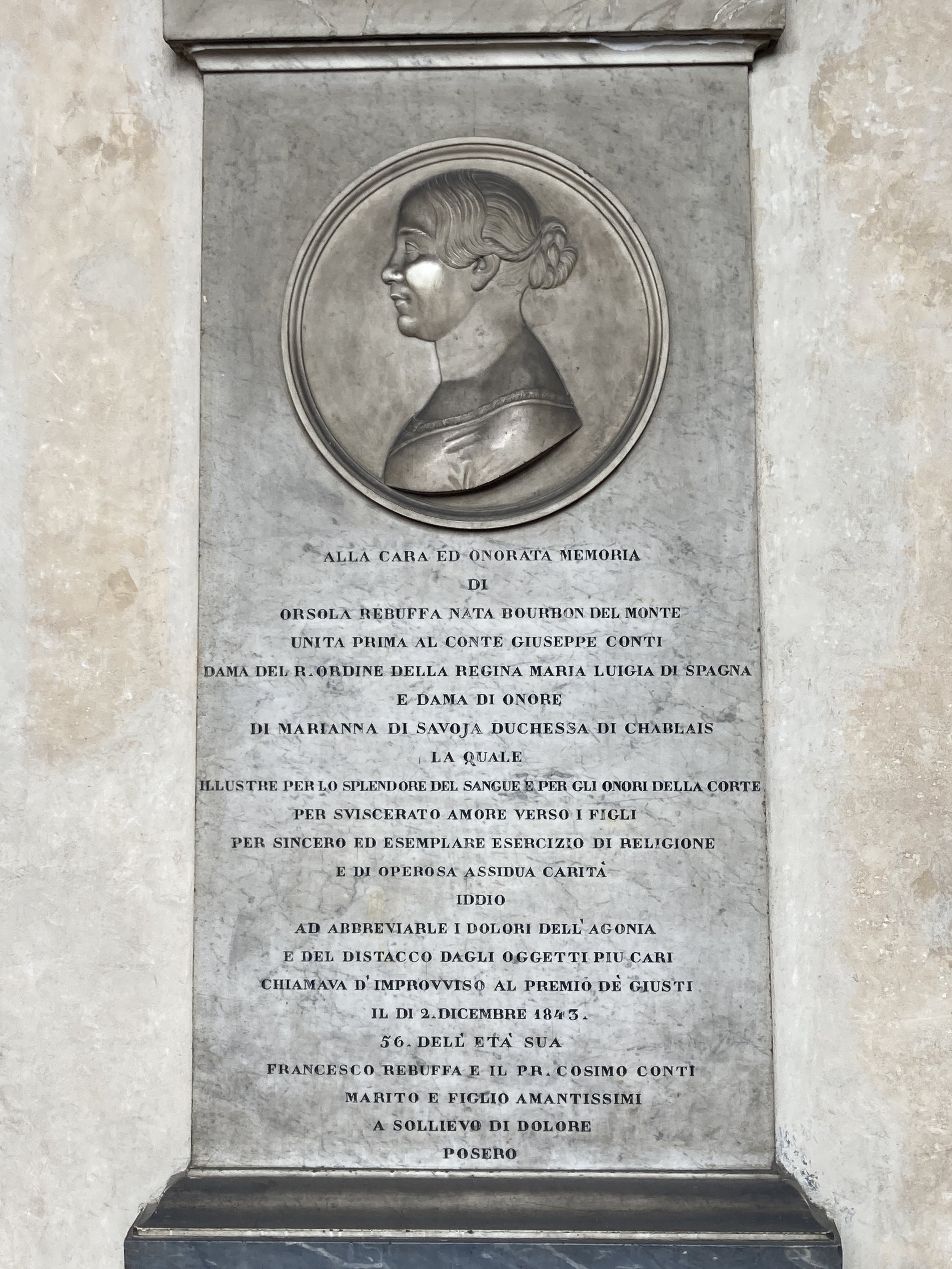
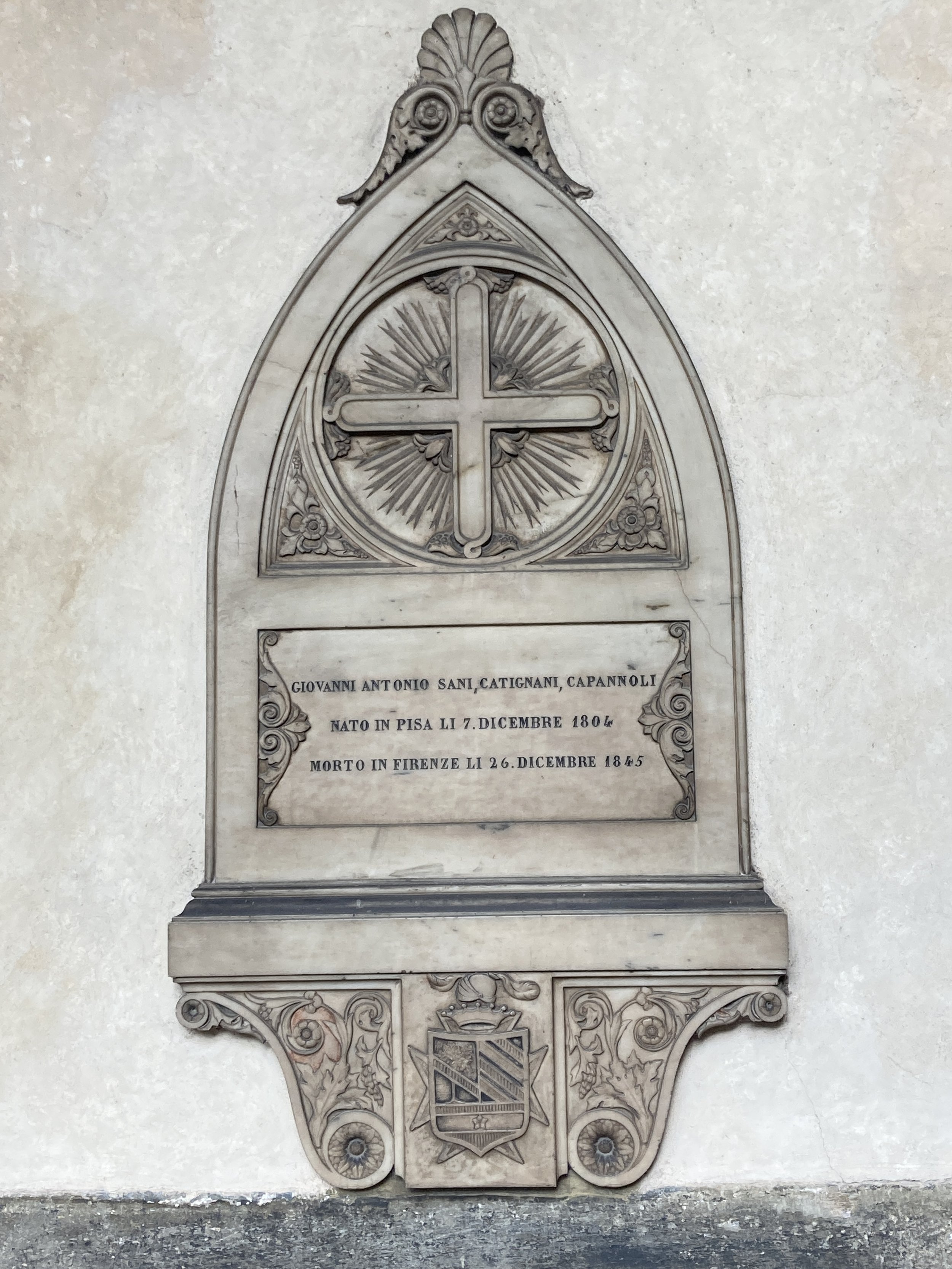
Entry and Exit to the church is through the cloisters.  This green space, surrounded by a two-story loggia, is a destination all of its own. The lower floor of the loggia surrounds a neatly kept space with low hedges and a big central tree.  Under the arches is a walkway with walls filled with memorials to long ago Florentines.  It’s a moving space embracing both the quiet of the church and views out into the “real world” of Florence.  You can almost hear the rustling robes of those long ago monks as they walk through the cloister.
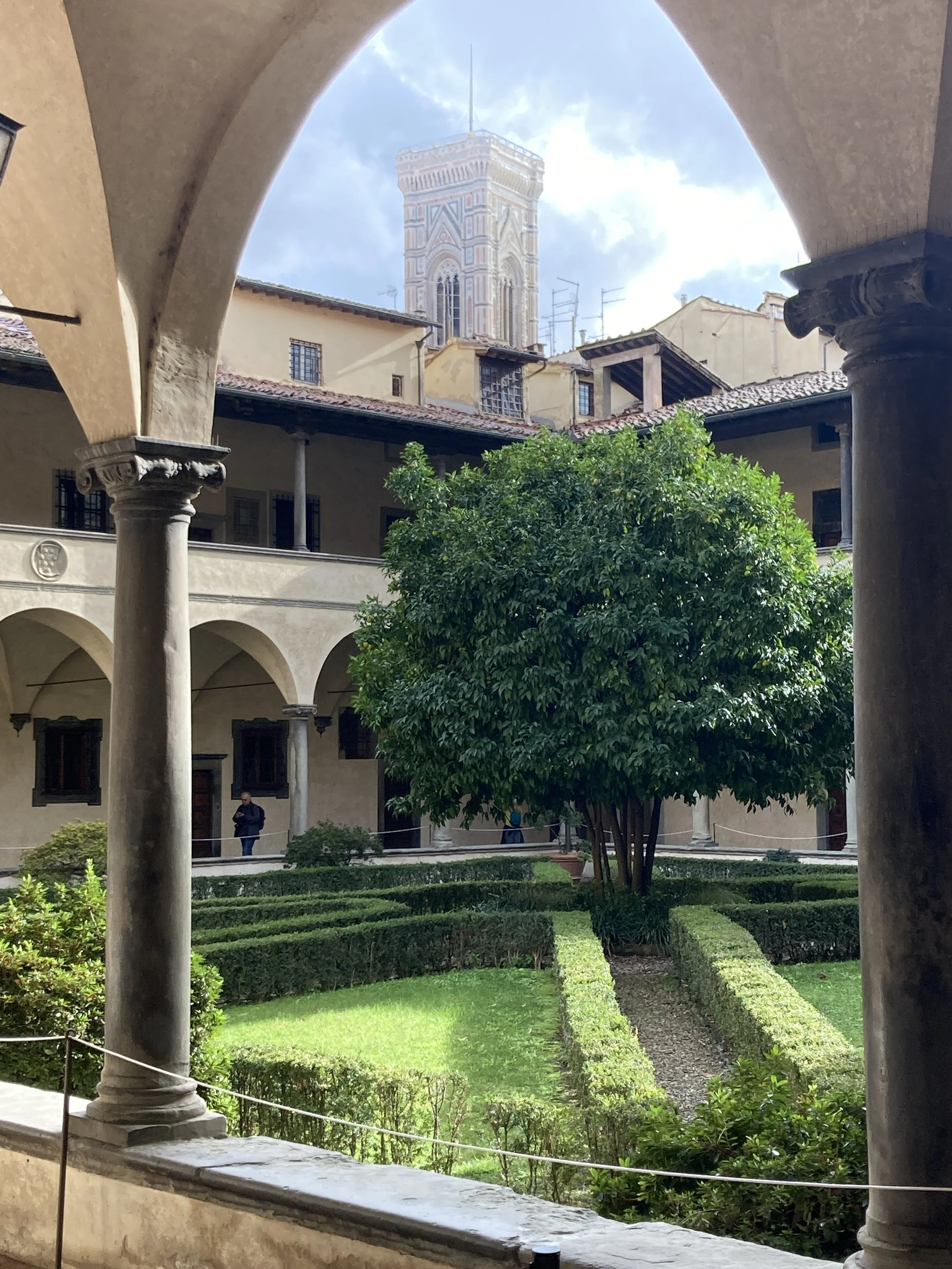
Cloister, Basilica of San Lorenzo
748FC455-2804-4D11-A170-32C8A4F9BDD6.jpeg
5343E7A4-1C72-41FD-9E54-5149601E7ADD.jpeg
81959226-65B3-448A-8D77-A556BC6DAFC3.jpeg

 Hungry afterwards?  Just outside the front entry is a wonderful lunch spot – the Trattoria San Lorenzo.  A perfect way to end a visit to the church, enjoy a meal, and have time to organize memories of the basilica.
January 29, 2024 /Joanne Bartram
San Lorenzo, Basilica San Lorenzo, Florence Churches, Medici Church, Brunelleschi Florence, Donatello Florence
#florence, #italytravel, #medievalitaly, Churches Italy, Florence, Italian art architecture, Italian culture, Italy travel, Tuscany
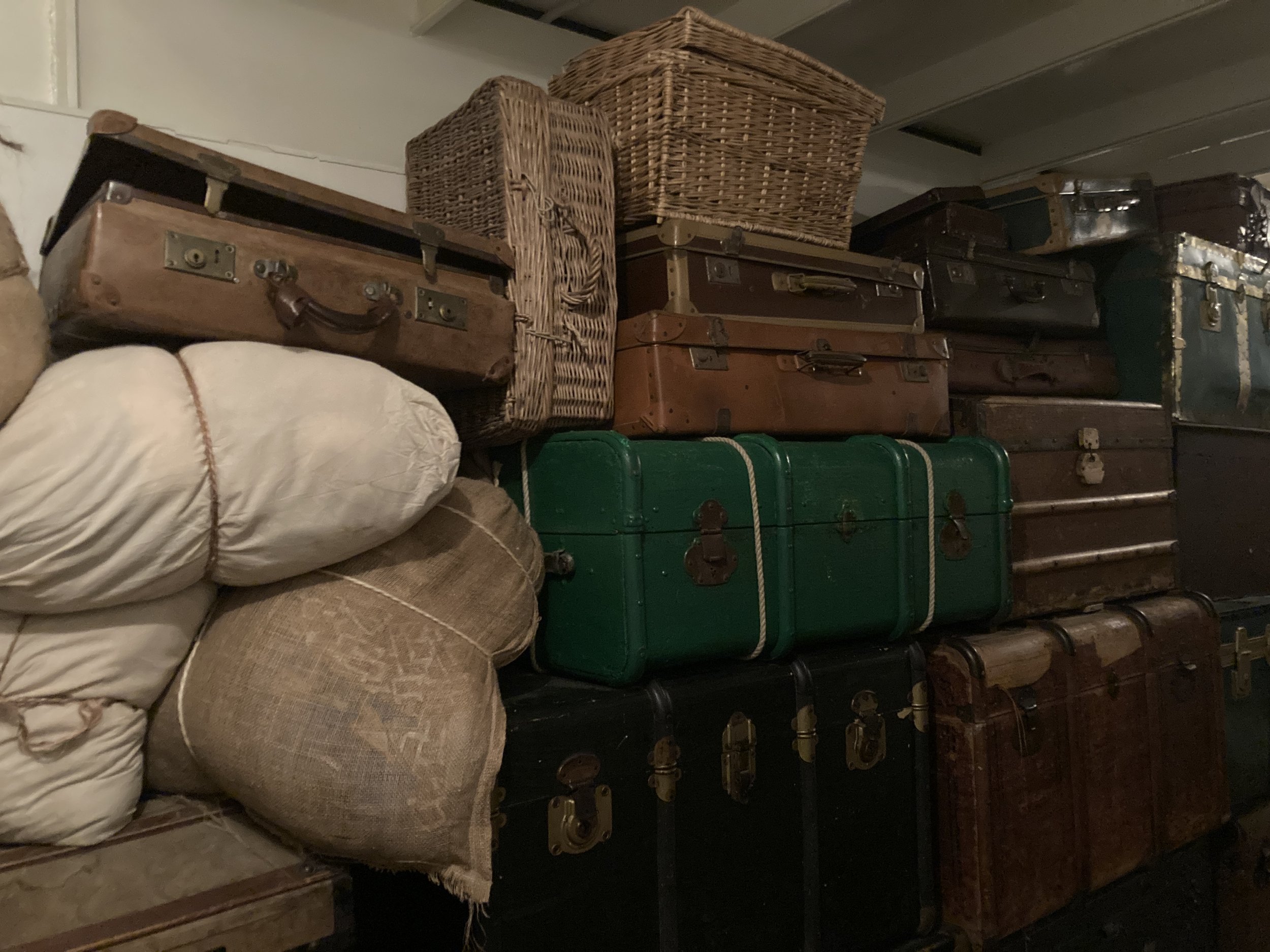
Immigrant luggage heading to the US (photo taken at the Maritime Museum, Genoa)

The Everything in 1 Carry-on Bag Myth

January 22, 2024 by Joanne Bartram in Italy travel, Travel, travel gear

I've read at least 100 articles about the virtues of fitting everything needed for a trip of any length, from 2 days to 2 months, into a single carry-on bag. I've read and reread them. I've tried to follow this advice, really I have.  I can almost do it too. I pare down to the essentials, I compress and I cram and I get the suitcase shut only to find that it is then too heavy for me to lift into an overhead bin.

Oh, the sense of failure that has plagued me each time I've packed, realizing at the last minute that I would not get everything into one carry-on sized bag that I could lift.

Varenna, Lake Como. This is the kind of terrain that requires traveling as light as possible

And then one day I realized that it's all a myth.  Who determined that we should only travel with a carry-on? It makes great sense if you are moving frequently between cities, dragging bags along cobblestones, hauling them onto a train every few days, trekking in the Alps. I get that. Packing light is definitely a good strategy. And of course the risk of a delayed bag must be considered - that alone can be a good reason to take only a carry-on bag.

But, while flying without checking bags may be ideal, some of us have a travel style that does not fit, or at least does not demand, a carry-on only strategy. That’s especially true when a trip involves a stay in a single city, no need to bring luggage on public transportation, and no schlepping of bags over rough terrain. Not that I am advocating huge suitcases and over-packing, I am just suggesting that there may be a middle road.

How I would love to arrive in Rome on a non-stop flight from the US. But from my base in New Mexico that just isn’t possible.

One big reason that carry-on only may not work relates to where the trip begins. When flights start from a major airport, with a direct connection to one’s destination, and a large plane, it’s fairly easy to manage with only a carry-on. I do envy those direct flights from the east coast to Rome! But my trips most often begin from a non-hub city which means a minimum of two legs with at least one leg on a small regional jet. Some of those smaller jets have overhead bins that are too small for even a mid-sized bag. That leads to the dreaded announcement that everyone needs to gate check their carry-on bag. The problem here is the wait for the gate checked bag to be unloaded. Those extra 15 minutes or so at the jet bridge can make a tight connection problematic and can even lead to a missed connection. Much better to check a bag all the way through to a final destination and avoid the gate check worry if flying on a small regional jet.

While I'm not particularly high maintenance, I do have some travel essentials and the older I get the more my list of essentials seems to grow. Eye glasses, medications, KT tape for sore knees, a sun hat, lots of ibuprofen, an umbrella, and comfortable shoes are all must and take up extra space. I can pare down clothing and do laundry during a trip. I am just fine with only 2 pairs of shoes.  Forget about dressy clothing. But I do want to look pulled together and have some variety in clothing, especially on a trip that includes some special events or a stay in a more sophisticated city. Some longer trips require bridging two seasons and a wide range of temperatures. Winter trips may require boots and other cold weather gear. It just isn’t always possible to fit everything needed into a carry-on bag.

Paris, December 2022. So cold! Packing included long underwear, gloves, boots, scarfs, warm sweaters, hats. No way would just a carry-on bag have worked especially on the regional jet between Florence and Paris !

Many people these days travel with medical equipment. They may bring a CPAP machine, folding cane, or other bulky supplies. And while US carriers generally allow an extra carry-on bag for medical equipment, many foreign carriers do not. In that case the CPAP machine goes into the one allowed carry-on bag, leaving less room for clothing and other essentials which must go into a checked bag.

So, I have finally decided to ditch the guilt and embrace a packing style that lies somewhere between a single carry-on bag and setting off for the continent with 3 steamer trunks.

Here are some of my self-imposed packing "rules"

My favorite bag to check is this relatively small Eagle Creek.

Rule #1 is that I must be able to handle my luggage by myself. If it’s too heavy, too bulky, or too numerous to manage on my own, it’s a mistake whether I have one bag or two. Yes, a kind, tall stranger may volunteer to lift a bag onto a train or into an airplane overhead compartment for me, but that is never something I count on. Nor would I ever expect a travel companion to do my heavy lifting. My bags, my responsibility. As for those folks struggling up train steps with oversize bags, expecting the nearest young man to lift the heavy bag for them, or juggling two huge suitcases down a narrow train aisle …. well, I simply shake my head and hope they’ve learned a lesson for a future trip.

Next rule: I am never tempted to go big just because a bag is being checked. My usual checked bag is an older and rather petite 22x14x8 inch Eagle Creek.  It actually meets carry-on standards for most airlines but works perfectly to check. This means I still need to be discriminating about what I pack. I can easily handle this not-too-big bag, along with my small carry on, when negotiating airports or even trains (see rule #1).  And once I’ve checked it at the airport, I have only a smaller carry-on and my “personal item” to contend with.

I love getting a message via my AirTag letting me know that my checked bag has safely arrived and will be waiting for me inthe baggage area.

A recent addition to my list of musts is to add an AirTag to any checked bag. This is a new travel essential. It was a big help when my checked bag did not arrive on time at the end of my recent flights from Italy to the US. The air tag confirmed that the bag was still in Frankfurt even when the airline’s tracking system told me it had arrived with me to the US. Knowing the bag’s location made tracking it down much easier. It arrived 2 days later with the AirTag sending me an update on its location every step of the way.

A small wheeled bag works as my carry-on to hold essentials and things I am reluctant to check. This includes a change of clothes (or two) in case the checked bag is delayed, jewelry, laptop, all medications, and other absolute essentials. It choose one just big enough to carry all of the items above, plus a travel CPAP, and yet not be too heavy to lift into the overhead. 14-16 inches high seems to be a perfect height for a roll-aboard bag. Having these essentials ensures that my trip will be off to a good start even if my checked bag should be delayed.

Some travelers prefer a duffel type carry-on without wheels. They are definitely easier to fit into overhead compartments. But I have no interest in lugging around a duffel. Give me spinner wheels any day! I also appreciate a rigid handle so that I have the option to slip a personal item over the handle of my carry-on, making for one-hand-free movement. The carry-on bag will go in the overhead compartment, so it is important to avoid putting anything needed during the flight into this bag.

IMG_4787.JPG

I'm all about organizing both my checked bag and my carry-on. I love Eagle Creek Specter compression bags!  They are practically weightless and go a long way toward reducing the bulkiness of clothing. I love these so much that I often give them as gifts to my traveling friends.

In addition to a small carry-on bag, most US and European airlines allow a personal item such as a purse, small backpack, or satchel. I am not a fan of backpacks, mostly because I’ve been whacked in the head with someone else’s backpack during the boarding process all too often. I much prefer a purse or tote bag. Into this goes anything needed during a flight. My list always includes: a pashmina, antibacterial wipes, an overnight kit with medications and any toiletries that I will need in flight, a couple of face masks. I also put in a magazine, noise cancelling earbuds, phone, a small case with chargers, cords and adapters, tissues, prescription glasses, a snack, mints, and a tiny cross-body purse. A small thermos, which I fill with coffee or tea after going through security for a bit of in-flight comfort, also tucks into my tote bag. My passport holder is clipped into an internal zip pocket.  The tote goes under the seat and so is easy to access during the flight. 

I am a bit embarrassed to admit how many personal items / totes I have owned over the years. It seems I am always on a search for the perfect one and have bought (and set aside) many more than I will own up to. Some were too large, or too heavy, too structured, some too narrow or without enough pockets.

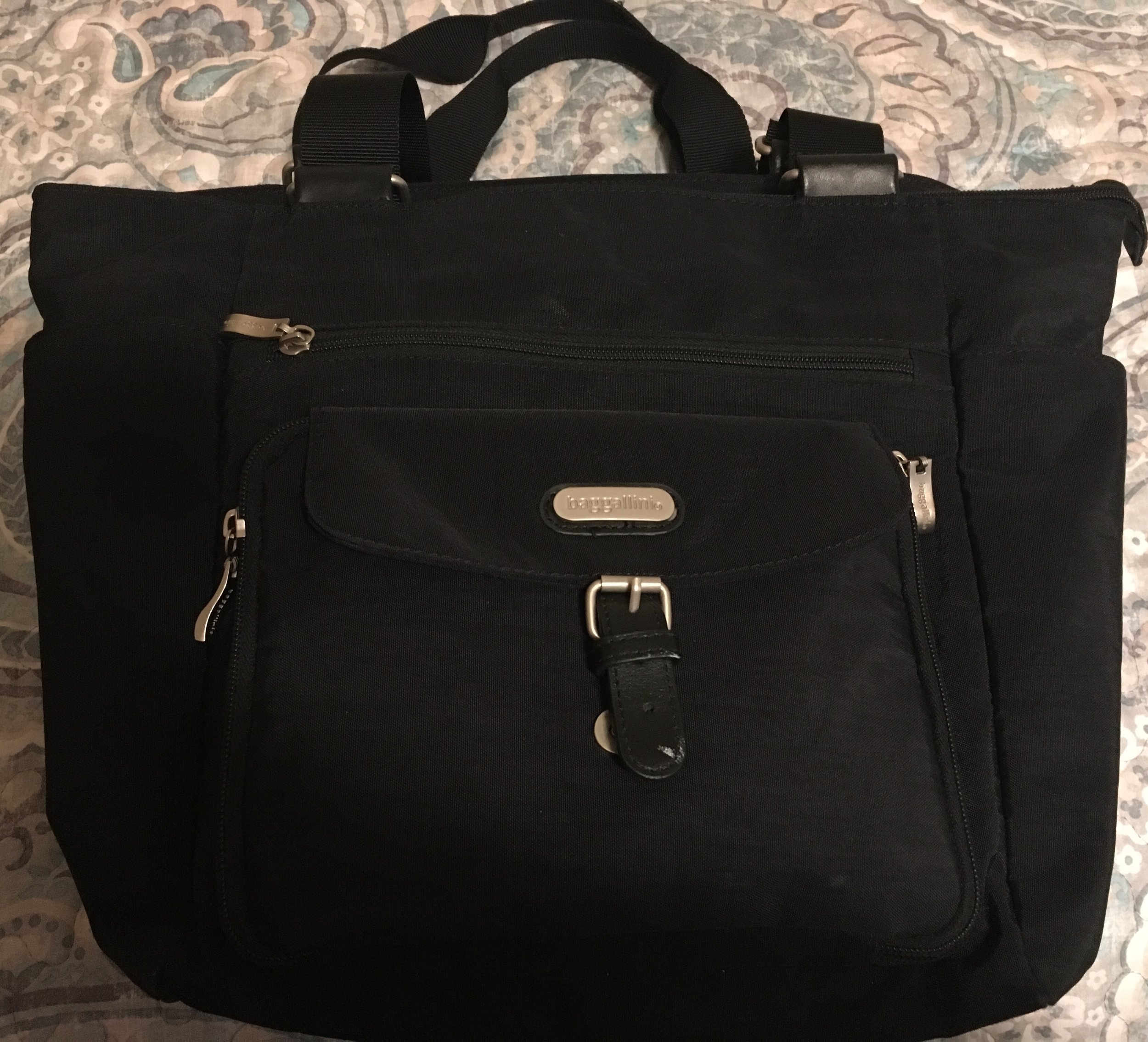
Despite having several still tucked away in my closet, the bag I almost always end up using as my personal item is my Baggallini tote. It is lightweight, flexible, has lots of organizing pockets inside and out, an internal zipper compartment for a passport, two exterior pockets that fit a thermos or water bottle, and it fits easily under even the smallest of airplane seats. It also has a luggage sleeve, something I consider essential. Mine is nearly 10 years old and still looks new. It has the best combination of being light weight, functional, and just the right size of any tote bag I’ve found.

I will head back to Italy in a couple of weeks with a checked bag armed with an AirTag for tracking. My little roll-aboard will go in the overhead and my Baggallini tote will be under my seat. Since I will have a car to take me straight to my Lucca apartment from the airport, no train travel involved, the extra bag is not a problem.

More power to the travelers who can go carry-on only. I admit that I still envy you but I have learned to be ok with my need for a checked bag.

Time to start packing!

January 22, 2024 /Joanne Bartram
travel to italy, travel gear
Italy travel, Travel, travel gear

January 2019. Can you spot the snow dusting the roof tiles?

Welcome to 2024

January 01, 2024 by Joanne Bartram in Italy travel, Living in Italy, #italy2024

Happy New Year !

 When a new year rolls around I always find myself reflecting on Januarys past and toasting to Januarys yet to come. That is especially true this year as I begin my 6th year of having a home in Italy and 8th year of writing Two Parts Italy. Time really does fly!

On January 1st of 2017 Two Parts Italy posted for the first time. I was fairly newly retired and headed to Italy to celebrate the new year with my friend (and then co-author) Judy. We wrote that first post from a lovely vacation apartment in Lucca. Writing remains my best ever (non-paying) job, a true passion project, and gives me a great excuse to keep traveling. Today, I spend most of the year in Lucca - something I didn’t even dare dream of in 2017.

January of 2018 was the start of my first full year of living in Italy.  There was so much involved in that move.  First, selling my home in New Mexico and finding an apartment in Lucca. Next, a visa and navigating the process of obtaining a permesso di soggiorno.  Settling into an apartment was part of the fun, but boy those 38 steep steps proved to be brutal!   Still, there was something magical at having arrived during the holiday season. Lucca was beautiful. Cold, but beautiful.
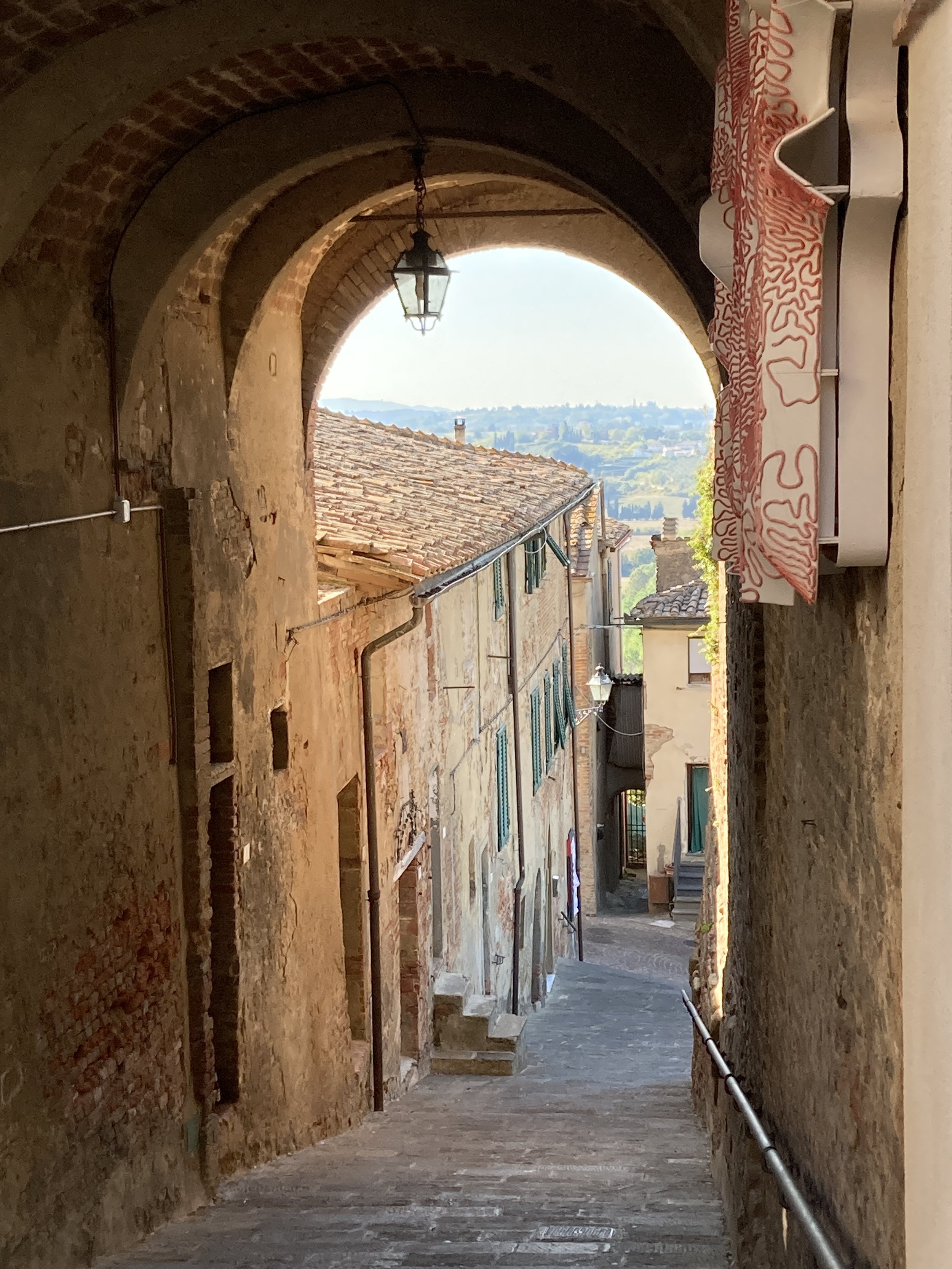
January 2020 in Rome. There was no a hint of what the year would bring.

January 2020 brought a move to a new, smaller apartment in Lucca, this time on the ground floor. It is where I still live today.  That January was also a time of blissful ignorance as there was no hint that a worldwide pandemic would soon up end our lives. A few days in Rome would be my last travel for quite a while. Covid hit Italy especially hard that year. It was not easy to live with the restrictions or with the worry.  And yet, I found more things to love about Italy during that time.  Above all, the community spirit, along with the Italian belief that it would all be ok, was inspiring. 

Restrictions and mask wearing were still routine in Italy in January of 2021.  But the arrival of vaccines brought both hope and, by spring, a loosening of restrictions.  By summer it was even possible to travel again, but those were complicated travel times.  Remember pre-flight covid testing, vaccine cards, green passes, and a general feeling of angst around crowded airports and flights ? Not to mention the months when Americans could not enter Italy. My permesso meant I could continue to stay in Lucca.

Camoglie, Liguria. June 2022

 In January of 2022 I wrote that my goal for the new year was to begin to travel again.  Not a resolution, but a plan. That year brought trips to the US and several small excursions within Italy. 

Better yet, in spring and summer, I had visits from several fully vaccinated friends. My daughter and 2 oldest grandchildren (also fully vaccinated) came to Italy for two weeks of fun along the Ligurian coast that summer.   We still wore masks in crowds and on trains, but life was returning to normal (or at least to the new normal). Fall brought more friends and an October week at Agriturismo Cretaiole in the Val d’Orcia, one of my very favorite places in Tuscany.

Galleries Lafayette, Paris. December 2022

A trip to Paris in December of 2022 was a wonderful way to wrap up the year.  Travel goals met!


Docked in Cologne on a Viking River Cruise. March, 2023

January of 2023 brought new travel goals.  Big ones! In the spring, I joined friends on a river cruise along the Rhine.  It felt pretty daring, and a bit risky post-covid, to go on a cruise. But I love the Viking river cruises and it had been a very long time since my last one. Balancing risk with benefit became, and remains, a component of both travel and every day life. Full disclosure – it was a wonderful cruise and all reasonable health precautions were taken on board.  And yet, I came home with my first ever bout of Covid.  Luckily up-to-date vaccines meant a relatively mild case and thankfully none of my traveling companions got sick.

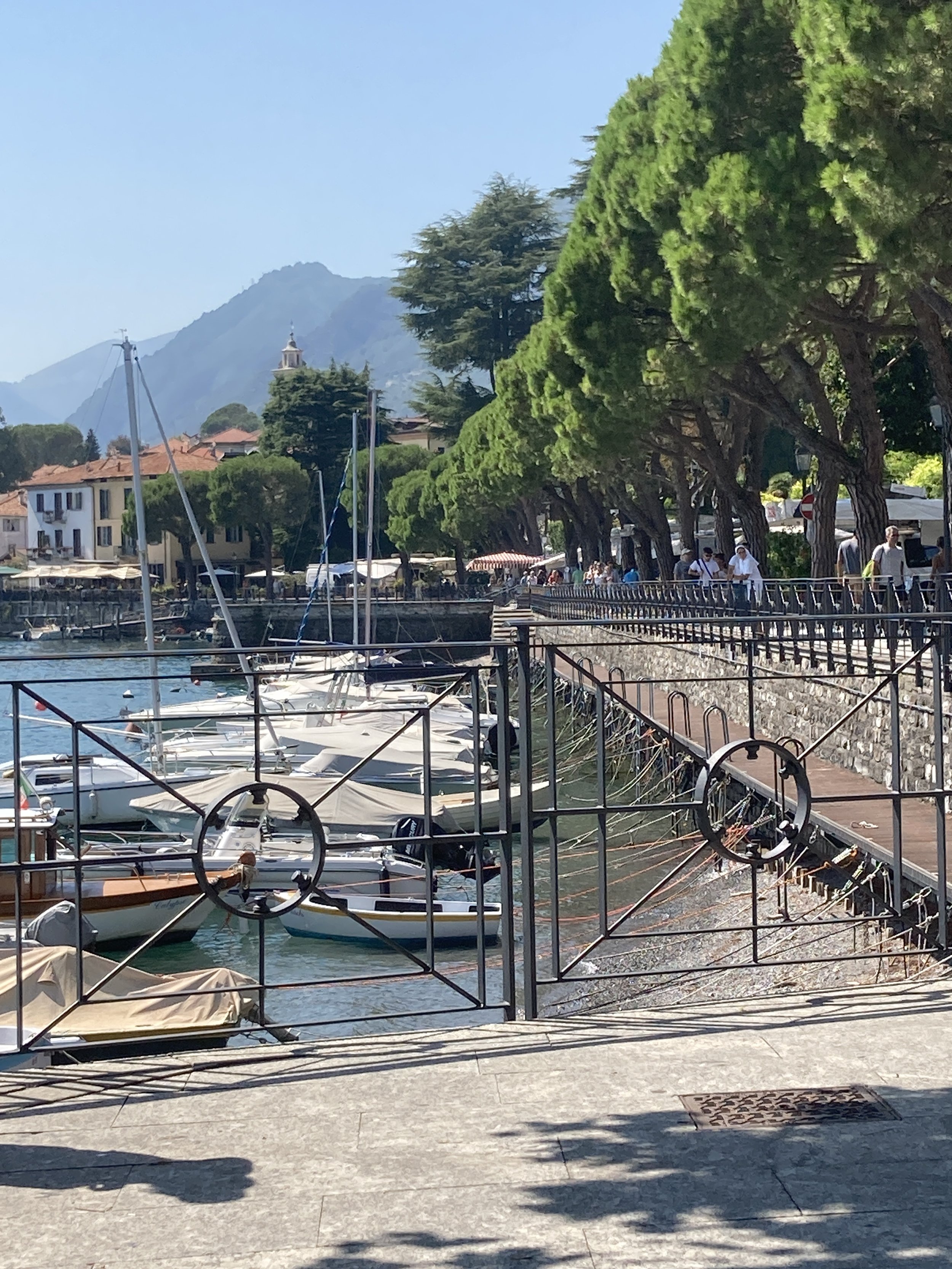
To be honest, travel has not returned to pre-covid ease.  Between delays, cancellations, strikes, and missing luggage, travel is more stressful than ever.  And, contrary to popular belief, not all Italian trains run on time, something that became obvious in August when raced to make train connections returning from some time at Lake Como! And yet, for me, the urge to travel outweighs any of the negatives.

9EEEABC2-57A0-46C6-A6A5-DD2F74D13097.jpeg
3C2C6374-EBBE-4785-8EA6-978E5823FB68_1_201_a.jpeg
7B89A5BE-A2AB-471E-AEE0-6958A0DE954F.jpeg
345089DD-C17A-4B93-87BA-816BCCF63913.jpeg

 So, here we are in January of 2024. I am seeing in the new year from New Mexico, where my kids and grandkids live. I will return to Lucca in a few weeks but most curiously, I find myself with no firm travel plans for this year.  How could that be?

I have a lot of ideas running through my brain including vague plans for a Brenta Canal day cruise in spring.  It’s been a long time since I visited Rome and I am itching to return. There are many parts of Italy left for me to explore. The south of France sounds appealing and I daydream about the fabulous market in Uzes. I’ve never been to Ireland and half of my family roots are there. I want to see my friend who lives an hour from London - Covid has kept us apart for far too long. What ever shall I choose?

Having a base in Italy makes travel within Europe and the British Isles affordable, a real advantage. I think I better get serious about travel planning for this year. I hope you are also ready to start planning 2024 travels. Where are you hoping to go? I hope these photos might inspire you!

Blue skies to welcome 2024 in New Mexico

Wishing a happy, healthy, and well traveled 2024 to all.  

January 01, 2024 /Joanne Bartram
European travel
Italy travel, Living in Italy, #italy2024

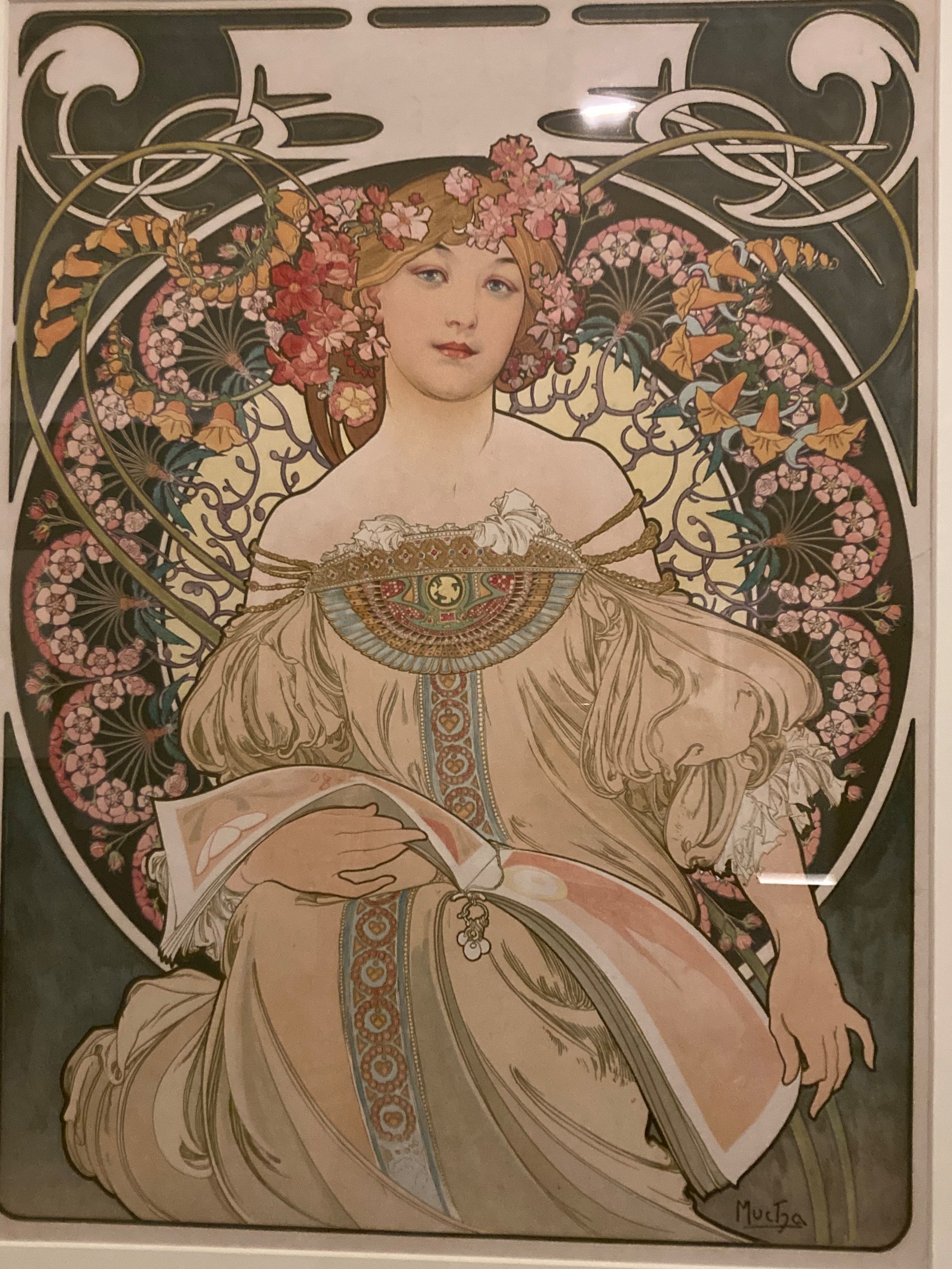
Daydream Alphonse Mucha, 1897.

Art Nouveau in Florence

November 13, 2023 by Joanne Bartram in #florence, Florence, Italian art architecture, Italy travel

 Classic art is everywhere in Florence.   It’s there in intimate chapels and majestic cathedrals, in museums small and large, in civic buildings and Medici palaces. Outside there are fountains, sculptures, fabulous doors, and art tucked above doorways.  It is impossible to be in Florence and not encounter classic art.

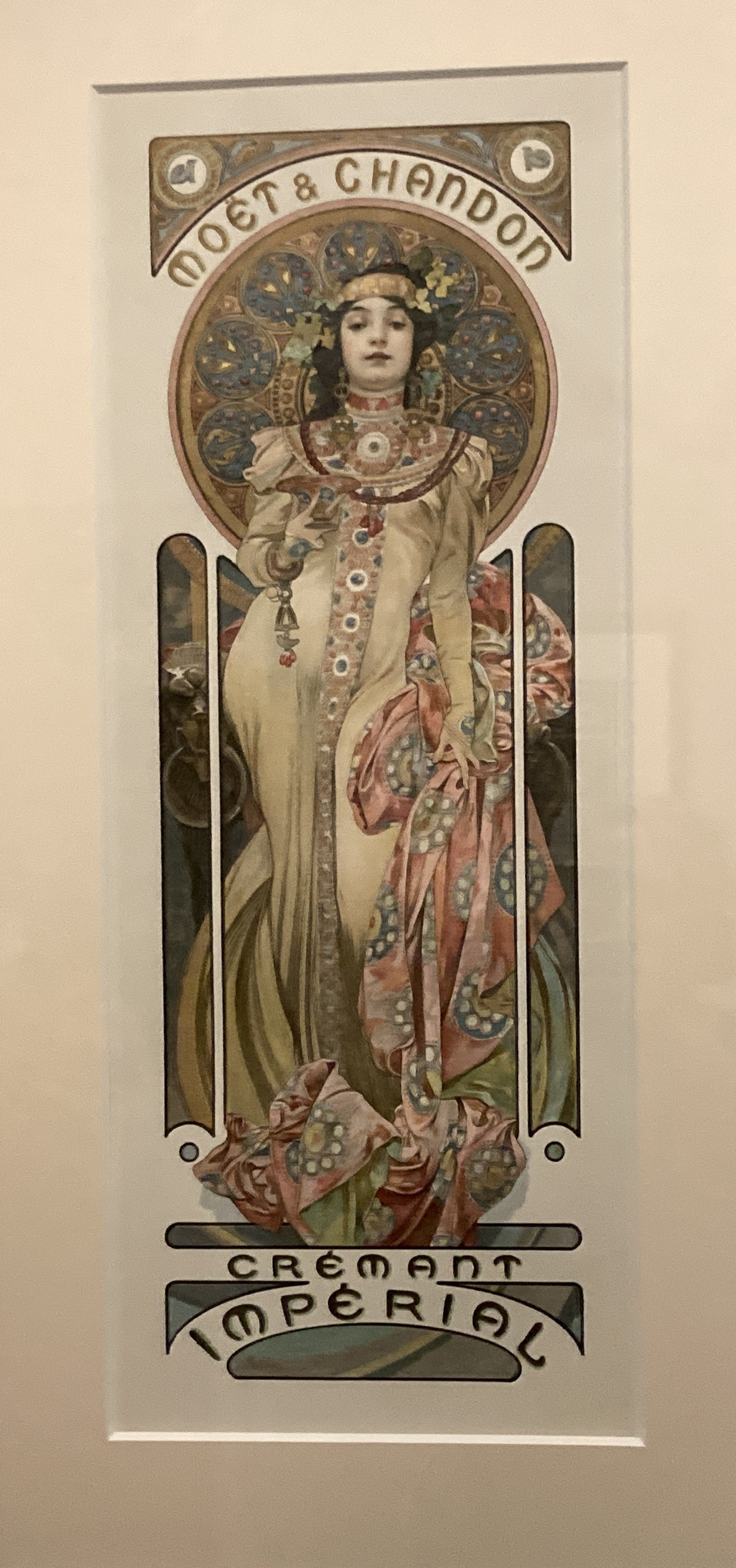
 In addition to the classics, it is not unusual to find more contemporary art in the city, both in galleries and as temporary exhibits.   One such exhibit, currently on display in the museum of the Ospedale degli Innocenti, features the works of Alphonse Mucha.

 Mucha worked in Paris in the years just before and after 1900 - the Art Nouveau period.  He worked primarily as an illustrator and graphic designer but also with photography, painting, and jewelry design.  He remains one of the most influential and well-known Art Nouveau artists (though he never described himself with that label).

Mucha created theater posters and programs, magazine and book illustrations, and advertising designs.  His work from that period include the many theater posters he designed for plays starring Sarah Bernhardt.

IMG_6428.jpeg
IMG_6432.jpeg

A Mucha illustration advertising beer


Women are the subjects of Mucha’s illustrations - young, flawless, and dressed in beautiful clothing. No classic goddesses here - these are lively and sensuous ladies.

Mucha surrounds his female subjects with arches, circles, and curves.  Flowers appear in many ways – in the background, as hair decorations, and as intricate border designs.  The colors are beautiful, - soft, warm, complex, floral. 

D5DD5C97-9D3A-47B5-ADB5-BB769613CEF8_1_201_a.jpeg
33DC8C43-230E-46E2-A914-60C2CC732CF9.jpeg
5850AD7F-8318-41E4-AD87-4EEAB180B3D6.jpeg

The exhibit in Florence has several components, including multimedia experiences. At the beginning is a short film, in Italian with English subtitles, plus a timeline. Together, they set the stage for viewing Mucha’s work. 

The poster display begins with his Bernhardt theater posters – large works with fabulous costumes unique to each play.  

Moving through the exhibit you find advertising posters, other forms of advertising (perfume bottles, boxes, menus, fans), and decorative posters.

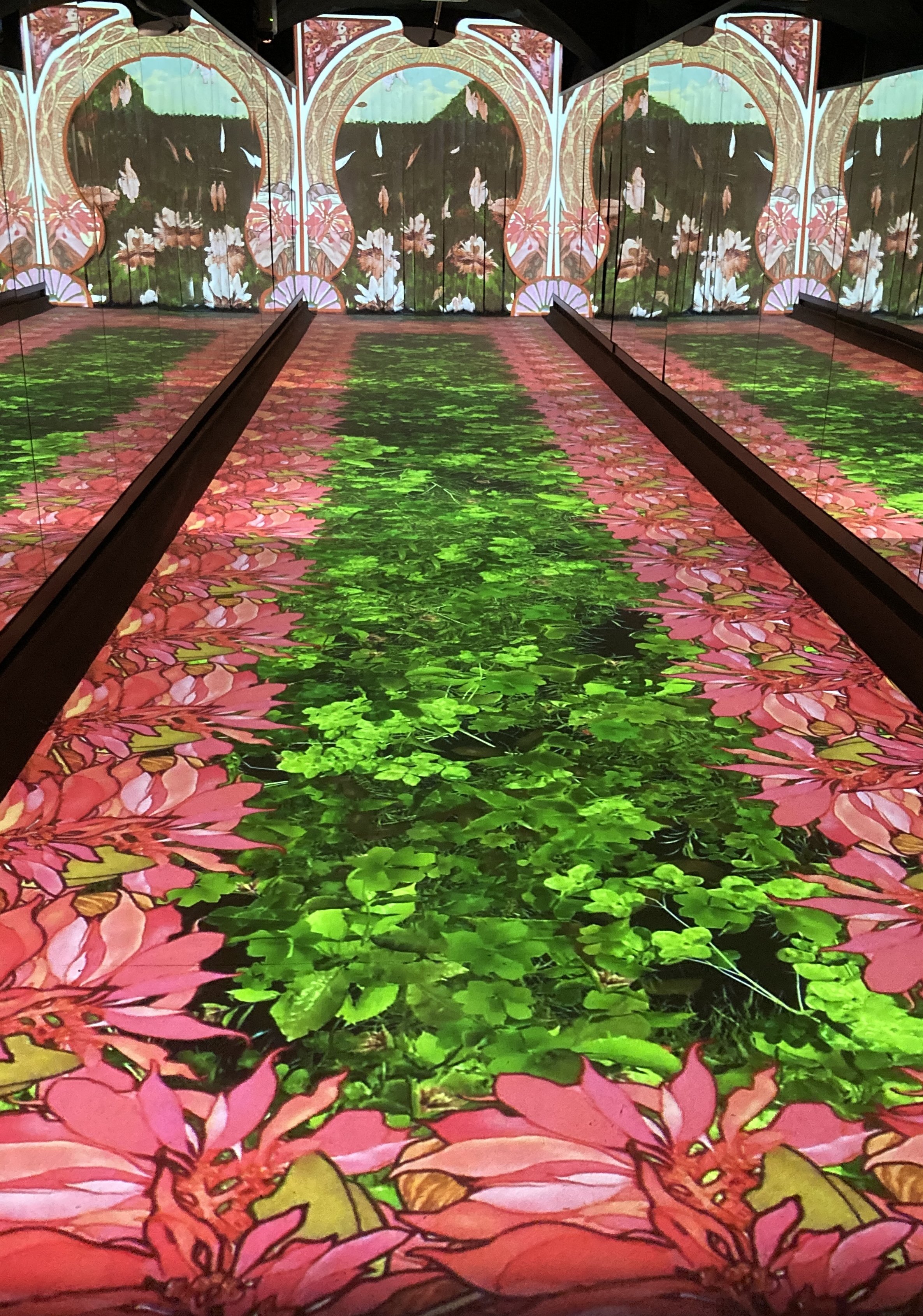
One fascinating part of the exhibit is an immersive experience. A long hallway, flanked by mirrors, filled with ever-changing projections of Mucha’s floral designs. The flowers shift and change creating explosions of color. At the far end are large projections of his works.  It’s a visually beautiful experience that puts the viewer right in the middle of a Mucha illustration. (I’ll post a short video clip on the Two Parts Italy Facebook page).

B63203D4-EED1-4A00-9679-62B3043D2241_1_201_a.jpeg
7D617F84-41A9-434A-ADD5-74A7F60B1AAF.jpeg
377D486C-EA50-4E79-9E4B-1EEC514CB6E4_1_201_a.jpeg

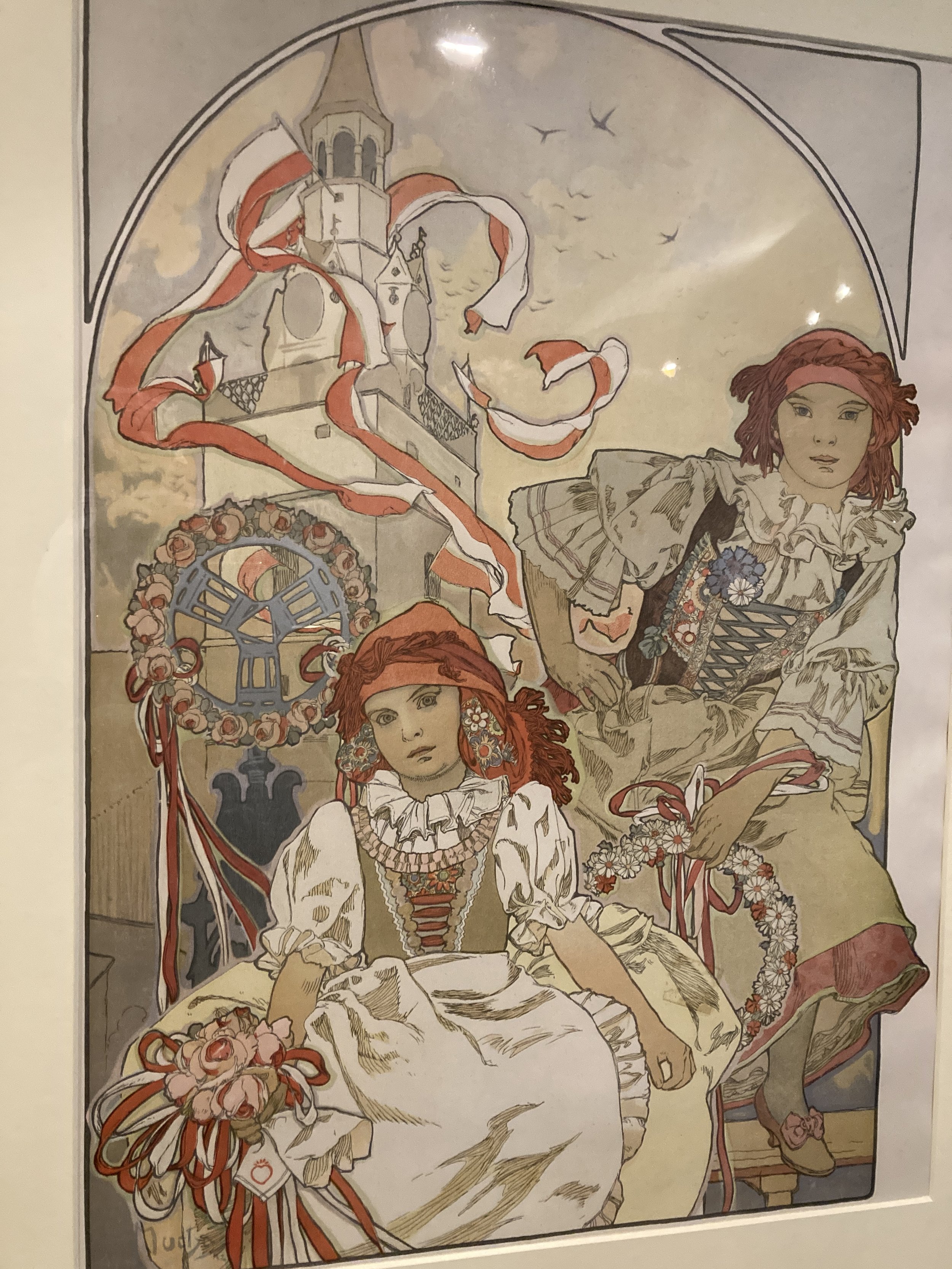
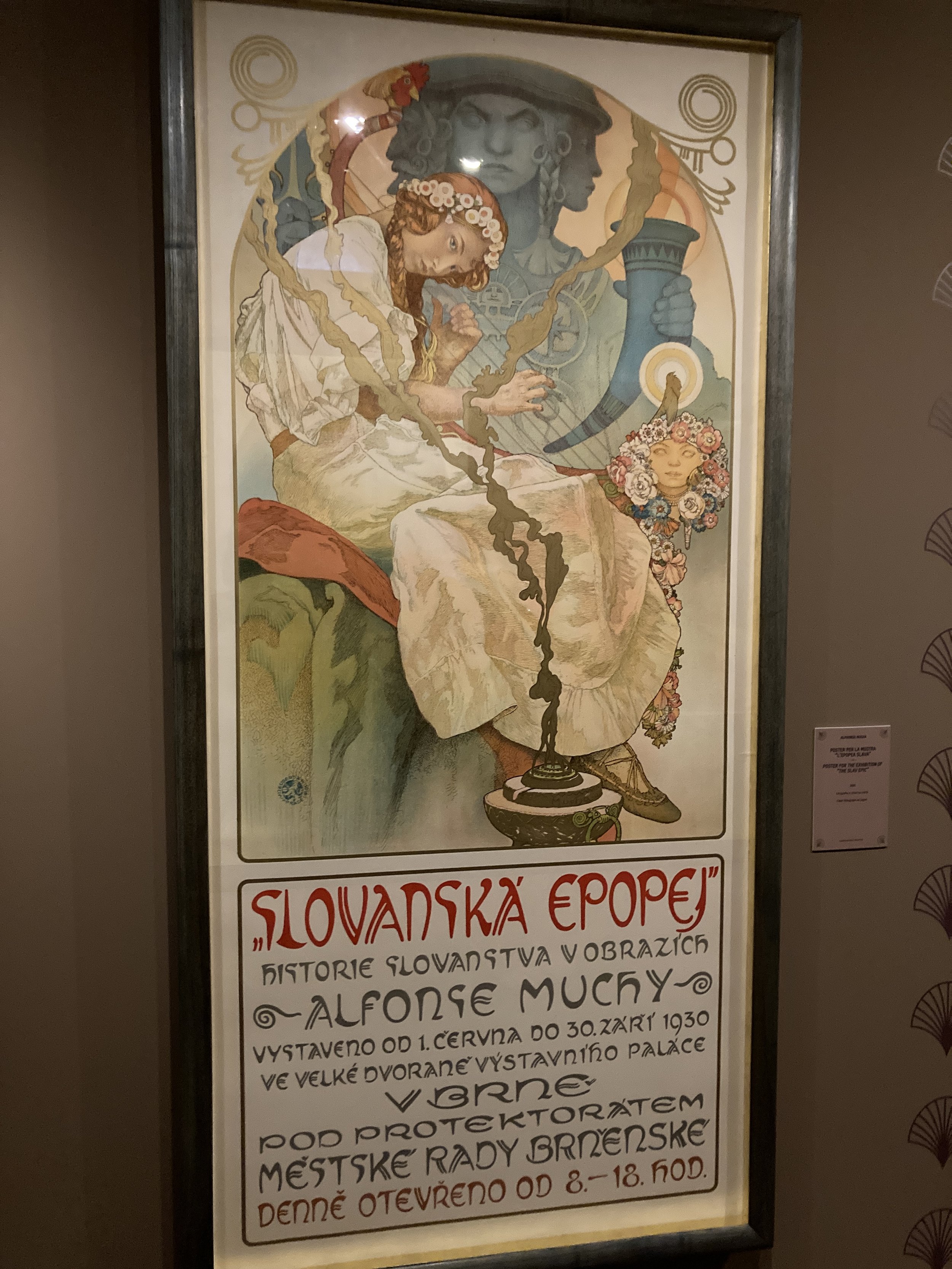
 Not all of Mucha’s works were of beautiful and serene women dressed in alluring clothing.   His posters also reflect his commitment to all Slavic peoples, their customs and their struggles.

86C208A2-540C-4734-B9C1-F4B72226ECE4.jpeg
F4063B9A-57E3-44D3-A689-F861A48985EB.jpeg
58D2EF50-324D-449E-BA40-87707E144E56.jpeg

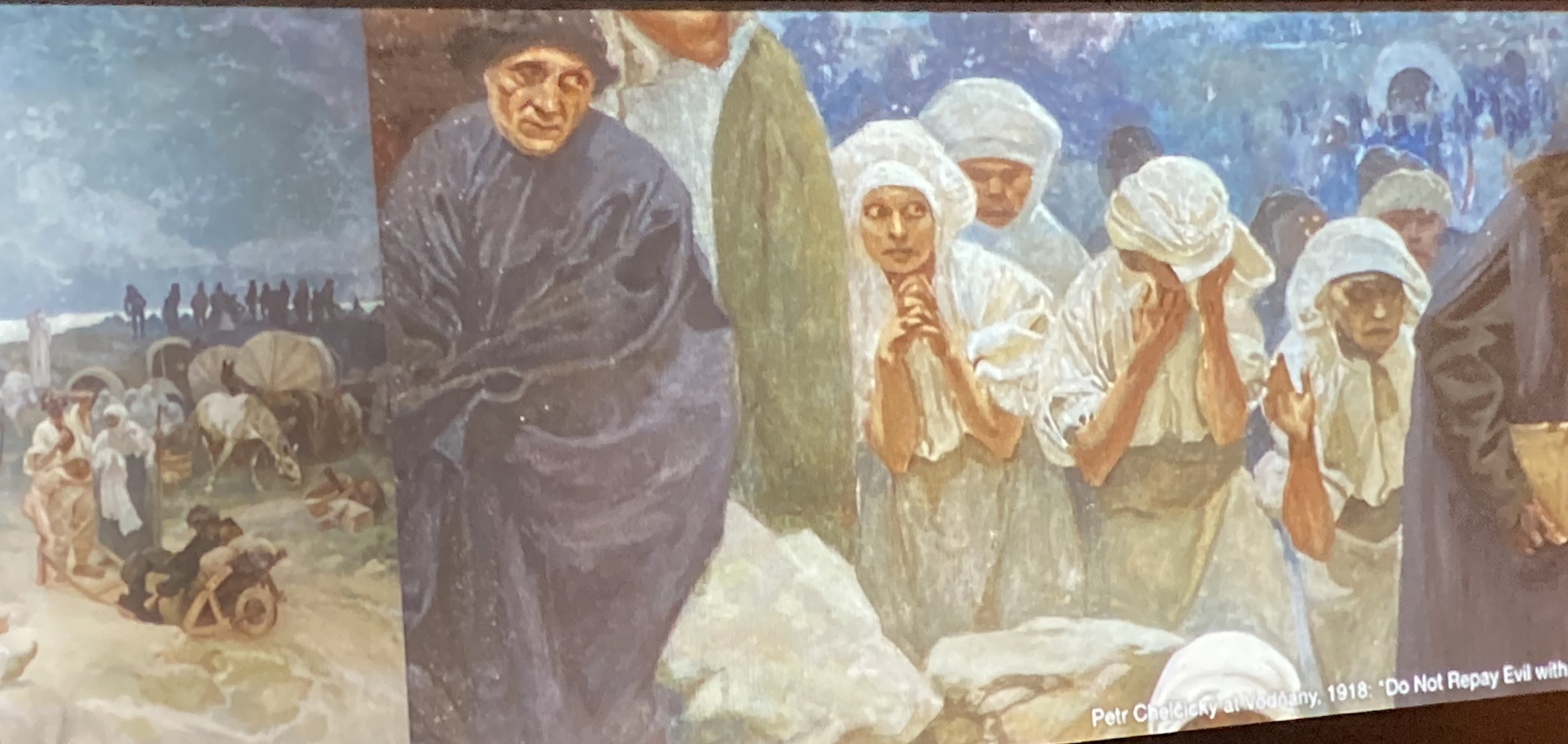
Mucha considered his most important work to be his Slav Epic, a series of huge paintings telling the history of the Slavic people.  The project was completed over 18 years and then donated to the city of Prague.

Panel from the Slav Epic

Mucha’s political beliefs, commitment to the independence of the Slavic people, and participation in the Czech Freemasons led to his arrest by the Nazis in 1939.  He was in his 70’s at the time of his arrest and, even though he was released after a few weeks, he died of pneumonia shortly after.  The Nazis also removed his Slav Epic works and they remained hidden for many years.  They are now on display in Prague. Reproductions of several panels are included in the exhibit in Florence.

 The Mucha exhibit will be in Florence through April 7, 2024.  The museum is open daily from 9:30 am to 7 pm with some exceptions (be sure to check on-line for changes to this schedule). A not-to be-missed experience for those who are interested in Art Nouveau.


November 13, 2023 /Joanne Bartram
Mucha, Alphonse Mucha, Mucha exhibit Florence, Art Nouveau, #artnouveauinflorence
#florence, Florence, Italian art architecture, Italy travel

One of Peccioli’s alleys, looking out to the Valdera.

A Walk Through Peccioli

October 09, 2023 by Joanne Bartram in #italytravel, Hill Towns Italy, Italy travel, Tuscany

Tuscany is dotted with hill towns, including several that are close enough to visit as a day trip from my home base in Lucca.  Barga and Montecatini Alto are easily reachable by train or bus.  Others, including Montecarlo, Collodi, Volterra, and San Gimignano, are an easy car ride away.  I’ve been lucky to spend time in each over the years I’ve been in Lucca but there are still so many hill towns left for me to explore!

 On a recent outing, arranged by The Tuscan Wanderer, we drove through the Valdera, the Valley of the Era River, as we returned to Lucca after a visit to a winery in the town of Terricciola.  This is not a region that I’ve visited before, and it requires a car, so I was pleased to join this group adventure.

Peccioli, viewed from the modern terrace suspended over the edge of town.

The Era River runs between Volterra and Pontedera in the Province of Pisa.  At Pontedera the Era joins the river Arno as it flows towards the sea.  High above the river valley lies the small hilltop village of Peccioli, easily spotted from a distance by the tall bell tower of its church.  How fortunate that this little hill town was one of our destinations! 

Peccioli’s most recognizable landmark, the campanile of the church of San Verano, can be seen from a distance down in the valley.

 Peccioli, like so many of Tuscany’s hill towns, has a Medieval layout and a long history of territorial wars as Pisa and Florence battled for control of the town.  Built in the 11th century around a now ruined castle, Peccioli has an historic center with a central piazza, an ancient church, and a series of narrow streets and small alleys. 

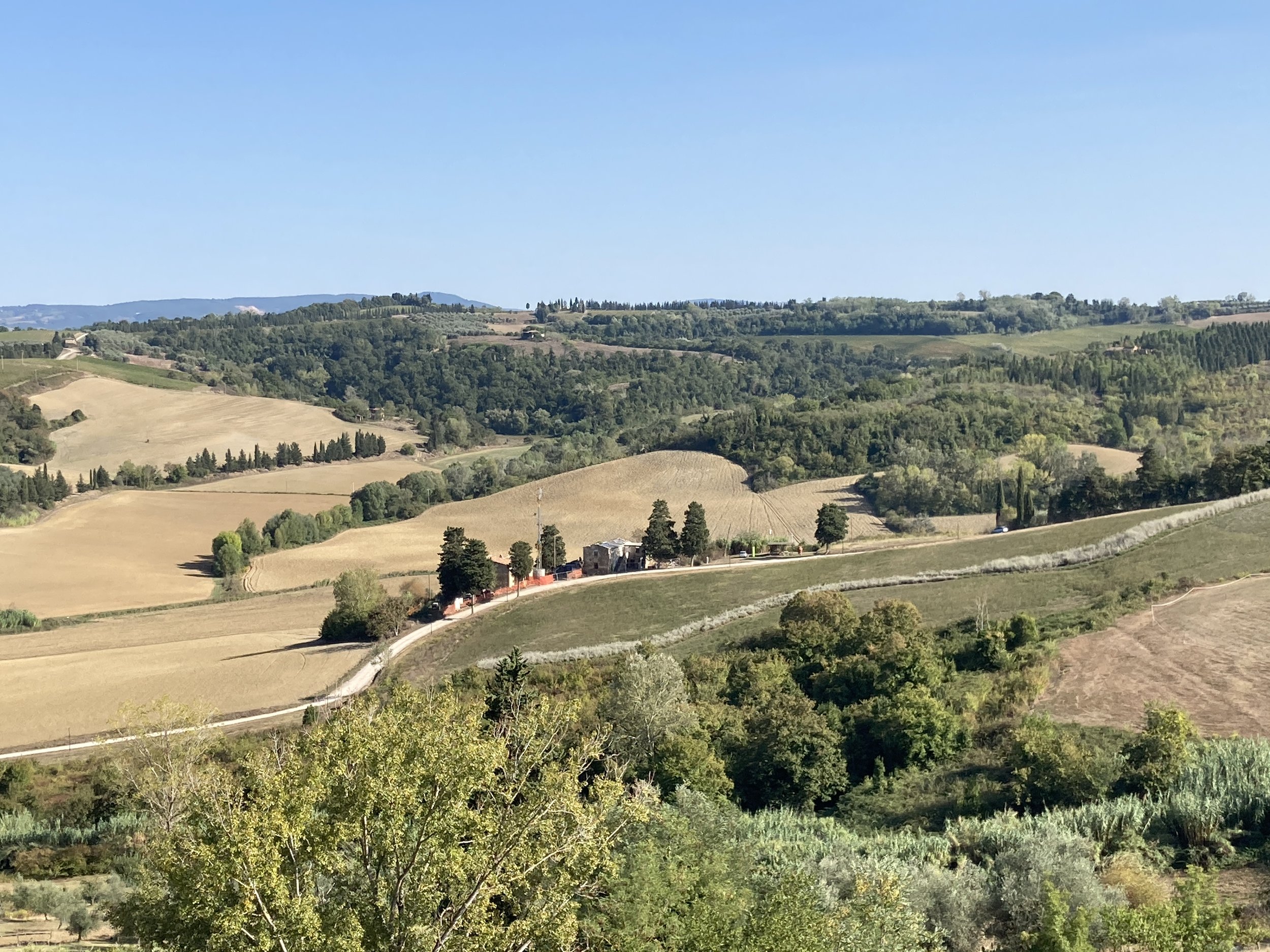
 Like most hill towns, there are great views. In Peccioli the vistas are down to the valley from one side of town and out onto Tuscan hillsides and farmland from the other side.  But much as Peccioli has in common with other Tuscan hill towns, it also has its own unique character.

What gives Peccioli its special flavor is the series of contemporary art installations found throughout town. 

Artists from around the world have created works of art and architecture specifically designed for display in Peccioli.  The contrast between the ancient and the modern is intriguing and lots of fun.

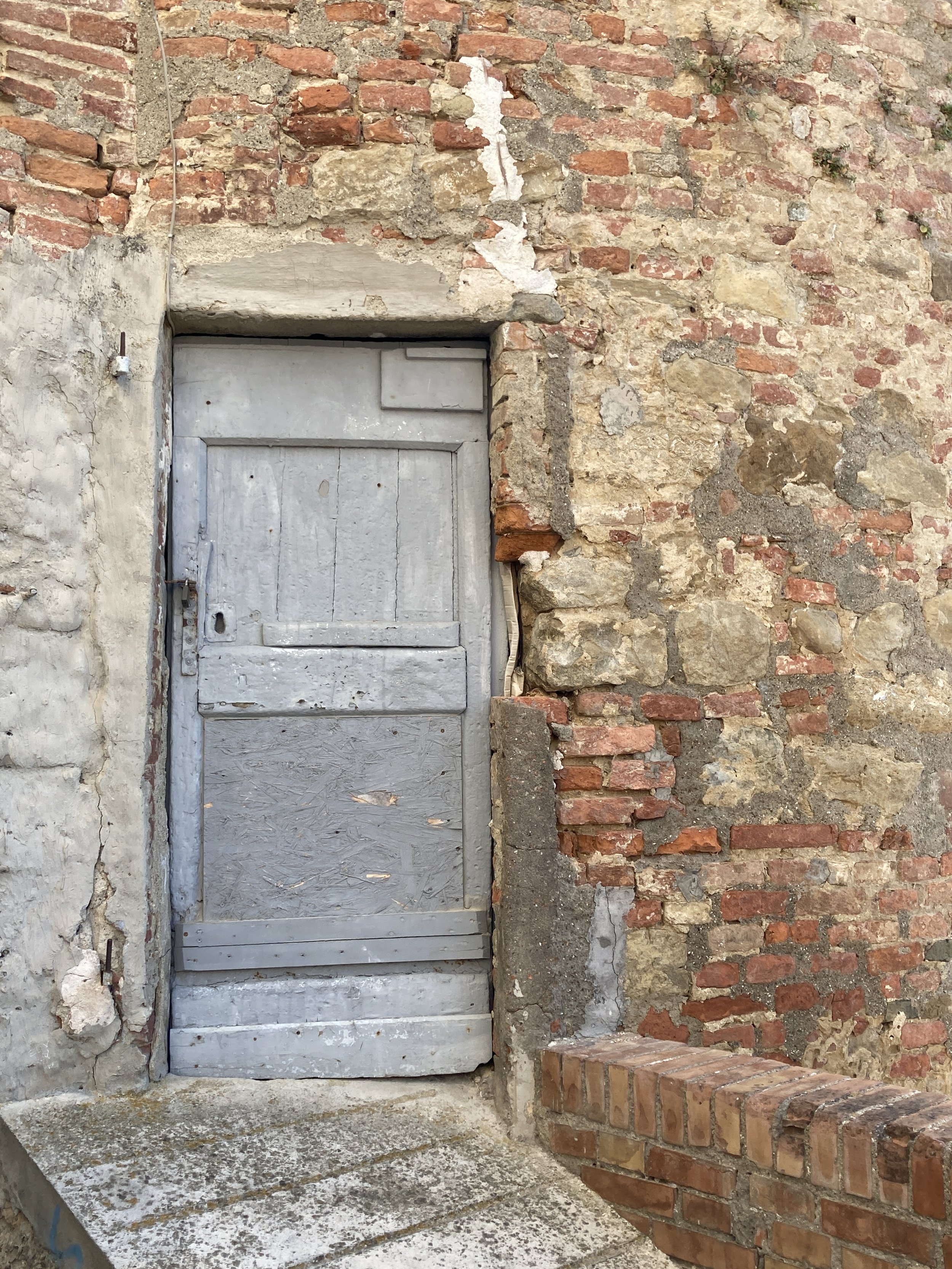
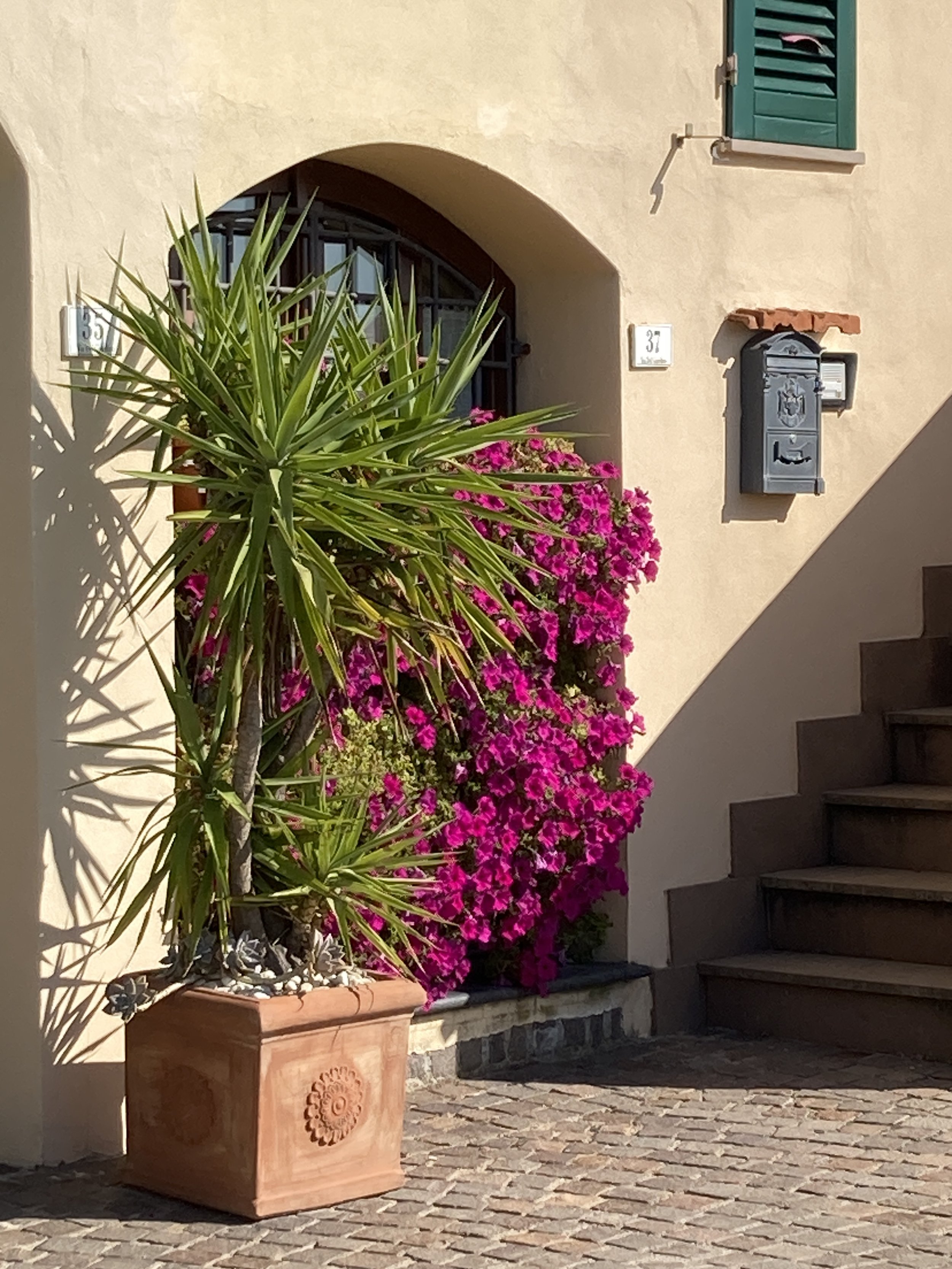
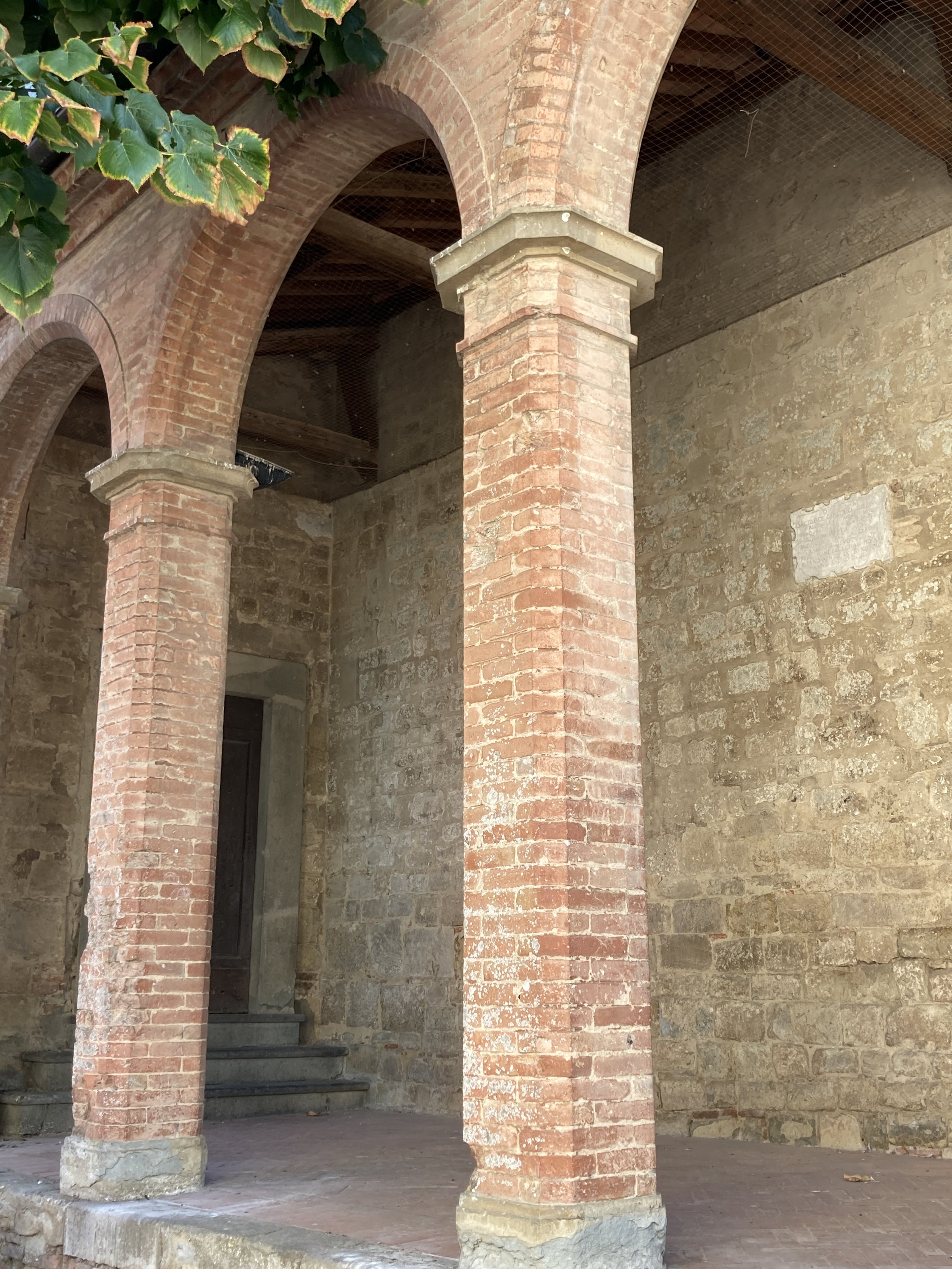
Throughout town are old doors, ancient brick structures, and houses fronted by pretty flowerpots mixed in with the more contemporary art pieces.

D36AF191-A104-4A8D-A238-18E895973E69.jpeg
C4001E63-9160-4571-9702-D656F86712A2.jpeg
01F2E731-033D-4B8F-B0FC-E412A8611B59.jpeg

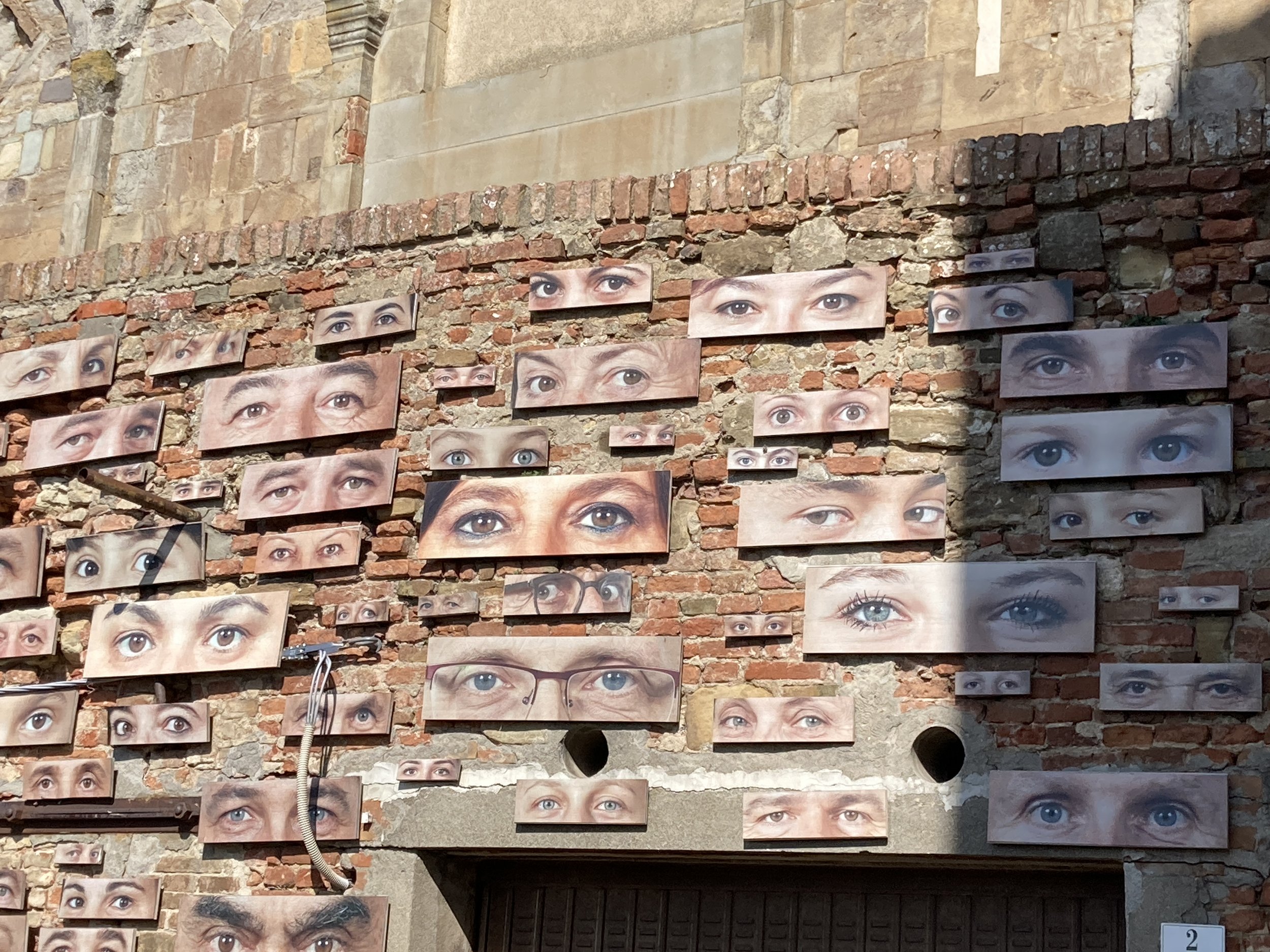
 Along an old brick wall are hundreds of photos of eyes, an installation called the Squardo di Peccioli.  The artist, Vittorio Corsini, photographed the eyes of Peccioli’s residents for his work.

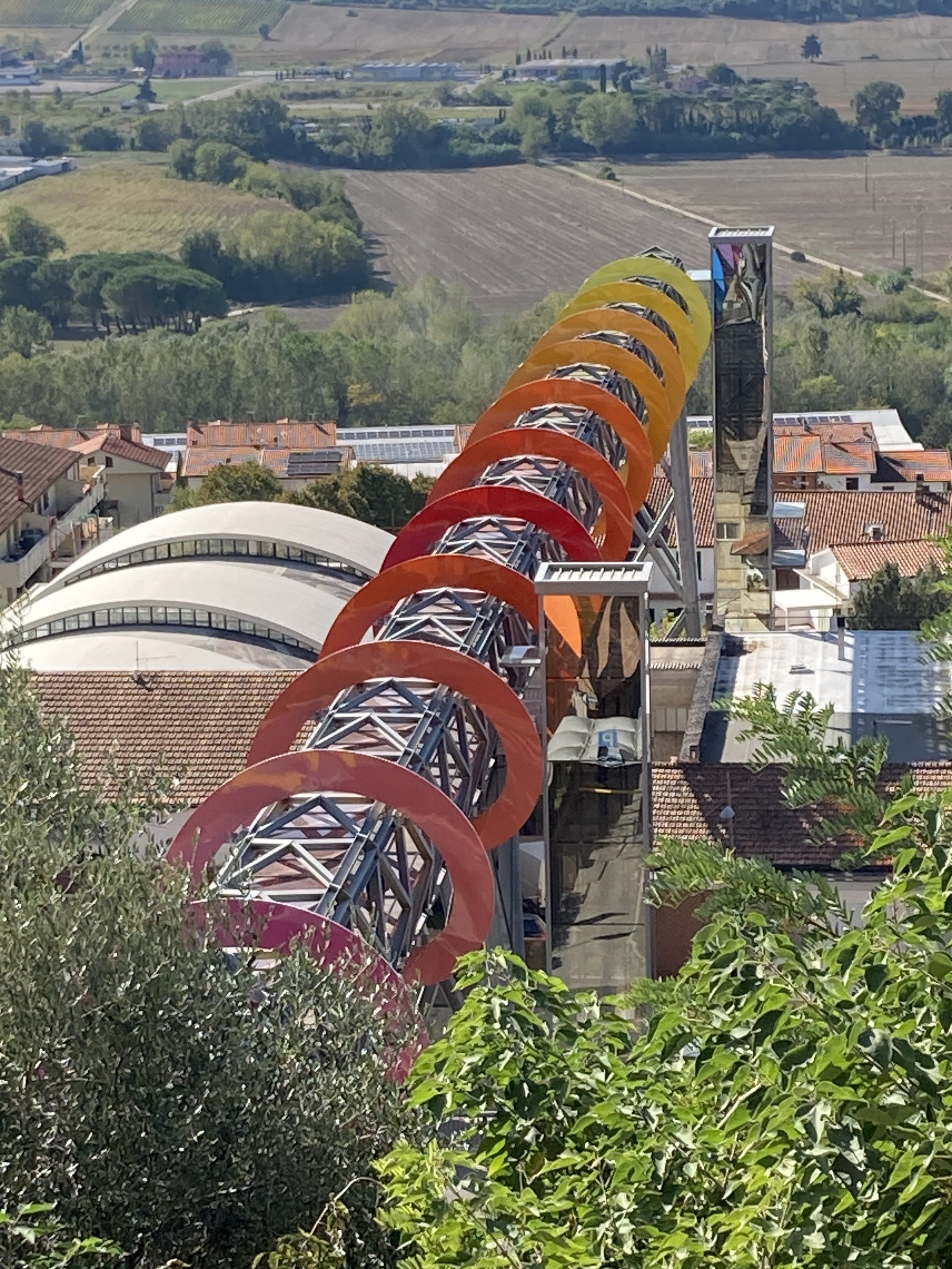
A sky bridge connects the historic center with an elevator down to the newer parts of town below in the valley.  Titled Endless Sunset, the work by Patrick Tuttofuoco spirals around the walkway with a ribbon of color.  It turns what might be an ordinary bridge into a work of art.

 A large terrace designed by architect Mario Cuninella juts out from the edge of town, giving long views to the farmland and hills surrounding the town – a classic Tuscan view.

Our time in Piccioli was brief, a short detour on the drive between Terricciola and Lucca.  There are many more art installations to explore, museums to visit, and an historic center with shops and cafes in which to linger.  I am looking forward to a return visit.

October 09, 2023 /Joanne Bartram
Piccioli, Italy Hill Towns, Tuscany
#italytravel, Hill Towns Italy, Italy travel, Tuscany
  • Newer
  • Older

Powered by Squarespace