Two Parts Italy

Exploring Italy, travel, and living a flavorful life

  • Blog
  • About This Blog
  • Start Here
  • Recent Posts
  • Archives by Topic
  • Subscribe
  • Contact me

Spring in Pietrasanta: Art, Philosophy, and Giraffes

May 16, 2022 by Joanne Bartram in #lucca, Italian art architecture, Italian culture, Italy travel, Italy, Tuscany

Pietrasanta has everything a small town in Italy should have - beautiful scenery, a lively main piazza, historic buildings and statues, a lovely church, cafes, and good food. And art. It is the art that draws me back time after time.

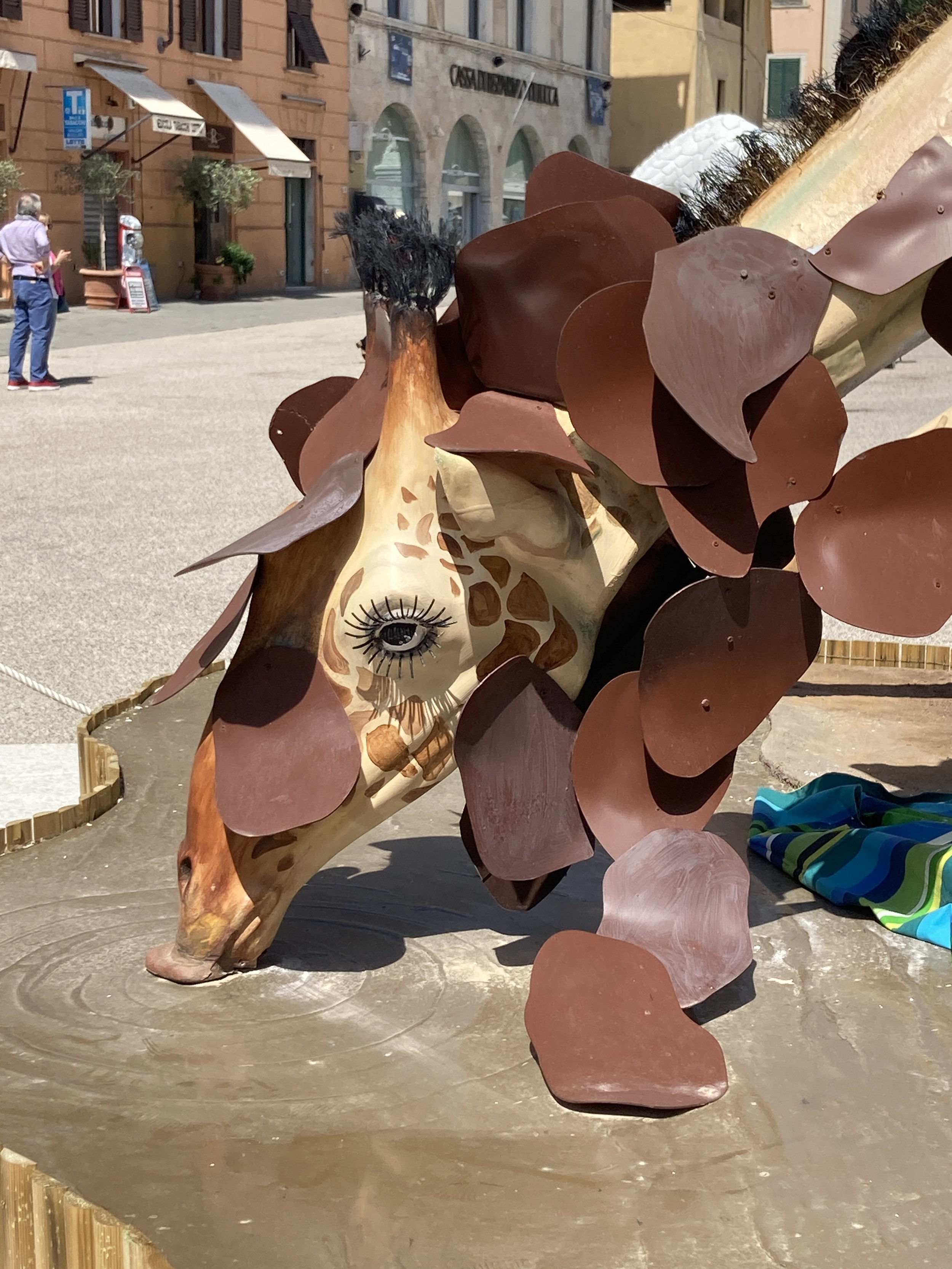
One of many whimsical giraffes that can be seen throughout Pietrasanta this month.

Visiting is easy as it is just an hour-long train ride from my home in Lucca. Unless of course, as in my most recent visit, there is an interruption on the tracks, train delays, an extra change of trains, a track in a tiny station with no signage, and you hop on the wrong train and have to double back. But don’t let that discourage you! My friend and I laughed it off and eventually arrived to spend a lovely day in Pietrasanta.

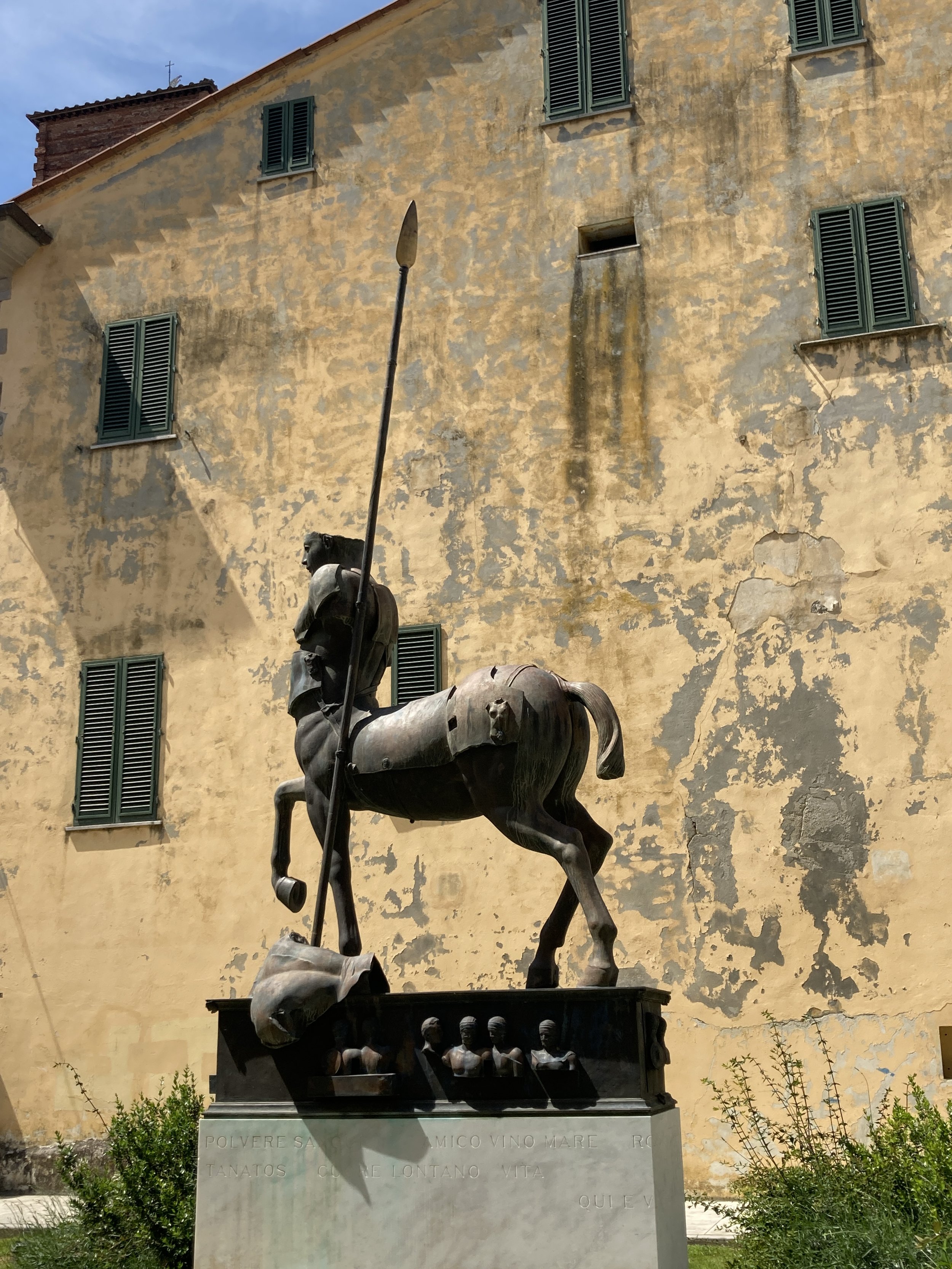
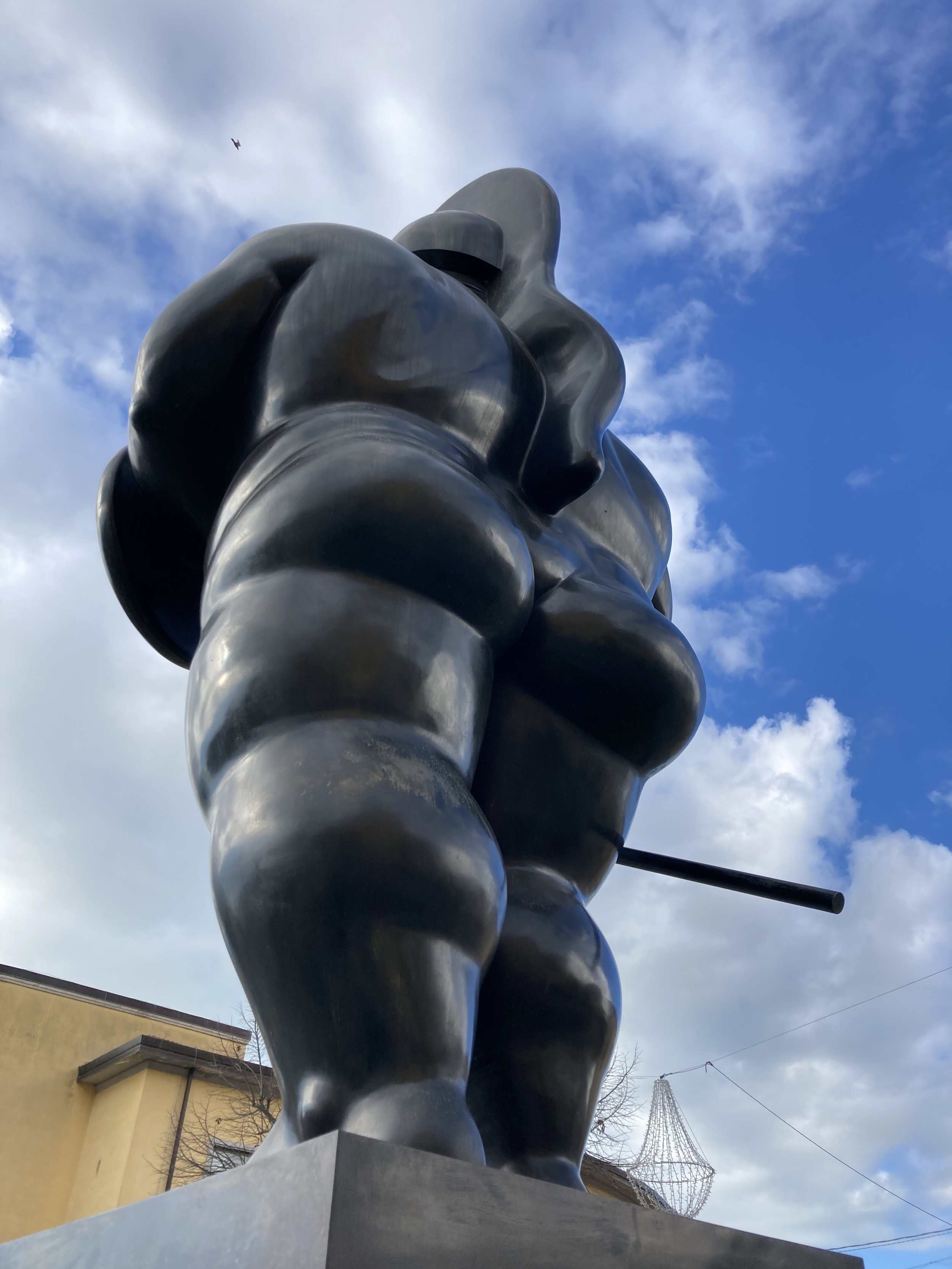
Famous as a center of sculpture (the marble quarries of Carrara are nearby), the town has permanent outdoor installations of bronze and marble sculptures, from smaller pieces to Botero’s massive bronze warrior (below).

CC1D846C-D0C6-4EB9-98AD-96C87DFFC193_1_201_a.jpeg
5853D5E2-CBB7-4A7E-9C0E-F90E3295F19A.jpeg
C95C05B5-2B06-4416-84BA-41EE353B441E.jpeg

In addition to these permanent works, Pietrasanta hosts temporary exhibits which fill the main piazza and nearby spaces (as well as some indoor spots) with an ever-changing display of works by contemporary artists.

The current exhibit, in place until June 5th, features the artistry of Sandro Gorra. Gorra’s background is in commercial art where he worked as an illustrator and creative director for advertising campaigns. That was his work. Today, he concentrates on his art which includes sculpture, illustrations, and a sort of philosophical short poetry which accompanies his works. And then there are his giraffes.

Gorra says that this piece, made from 4 tons of marble, is one of his favorites. A loving mother giraffe tending to her baby.

Why giraffes? According to a published interview with Gorra, the giraffes serve as a parable, representing man’s desire for superiority. A giraffe towers above, looking down on everyone. Each one is unique in his spotted form.

This begs the question - without those spots, what would the giraffe be? Anonymous! Naked!

Change - a predictable part of life - in progress.

Change is inevitable and the spots on Gorra’s giraffes do indeed change. They fade away, they fall off, new ones appear. In fact, during my visit, two men, one looking suspiciously like the artist himself (or was that just my imagination?) were busy painting new spots on two of the giraffes. This would be consistent with Gorra’s view that change is to be expected and that irony is a part of the human (and giraffe) condition.
Alongside the works of art are illustrated phrases, providing an intriguing look into the artist’s mind and bits of his philosophy. I enjoyed these sprigs of wisdom just as much as the sculptures. Both made me smile, both made me think. Isn’t that the best part of art?

Here are some examples (any mistakes in translation are entirely my fault).
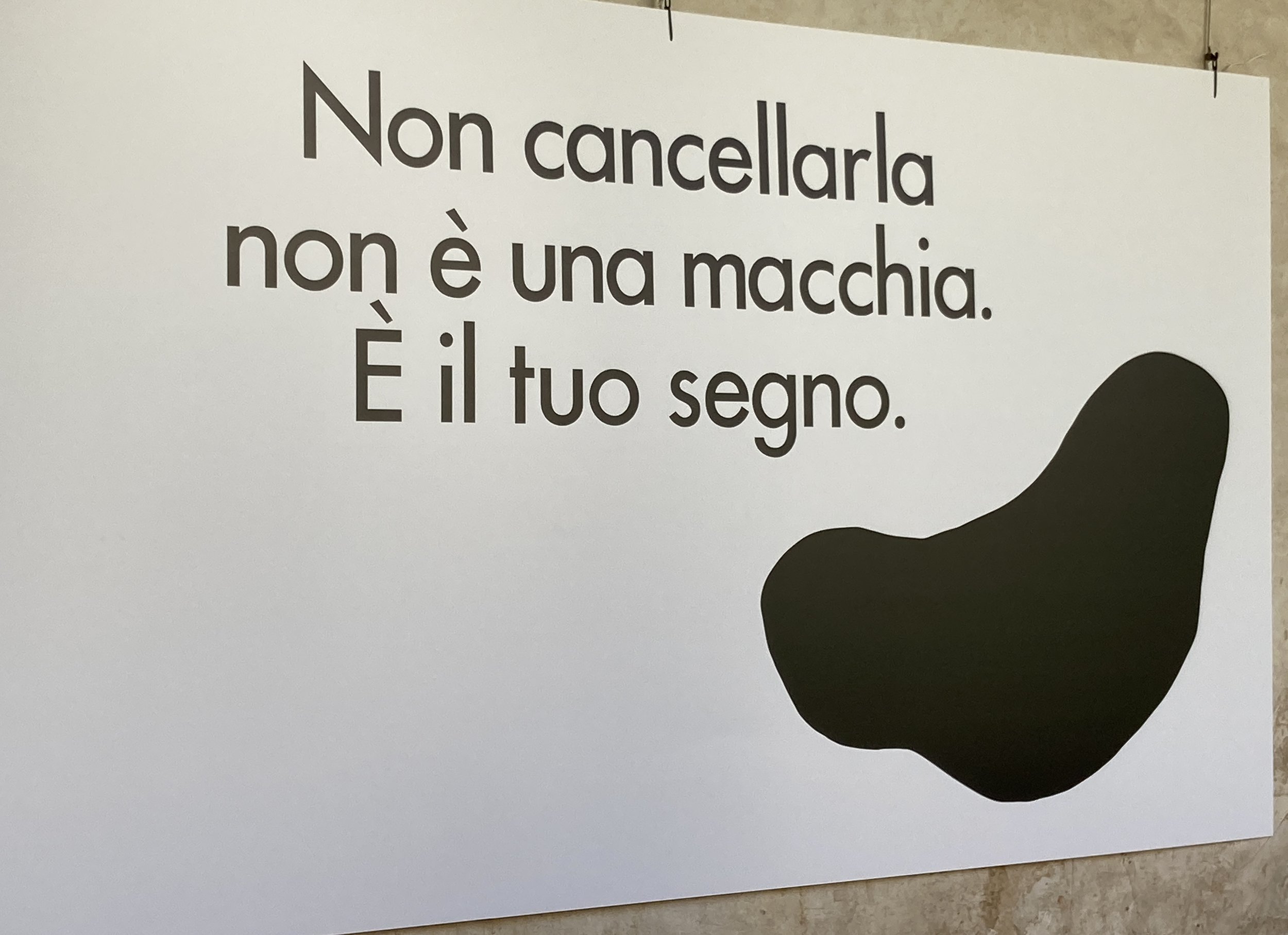
Don’t erase it, it is not a stain. It is your sign.

Ideas are always around, but if you don’t notice them they go away

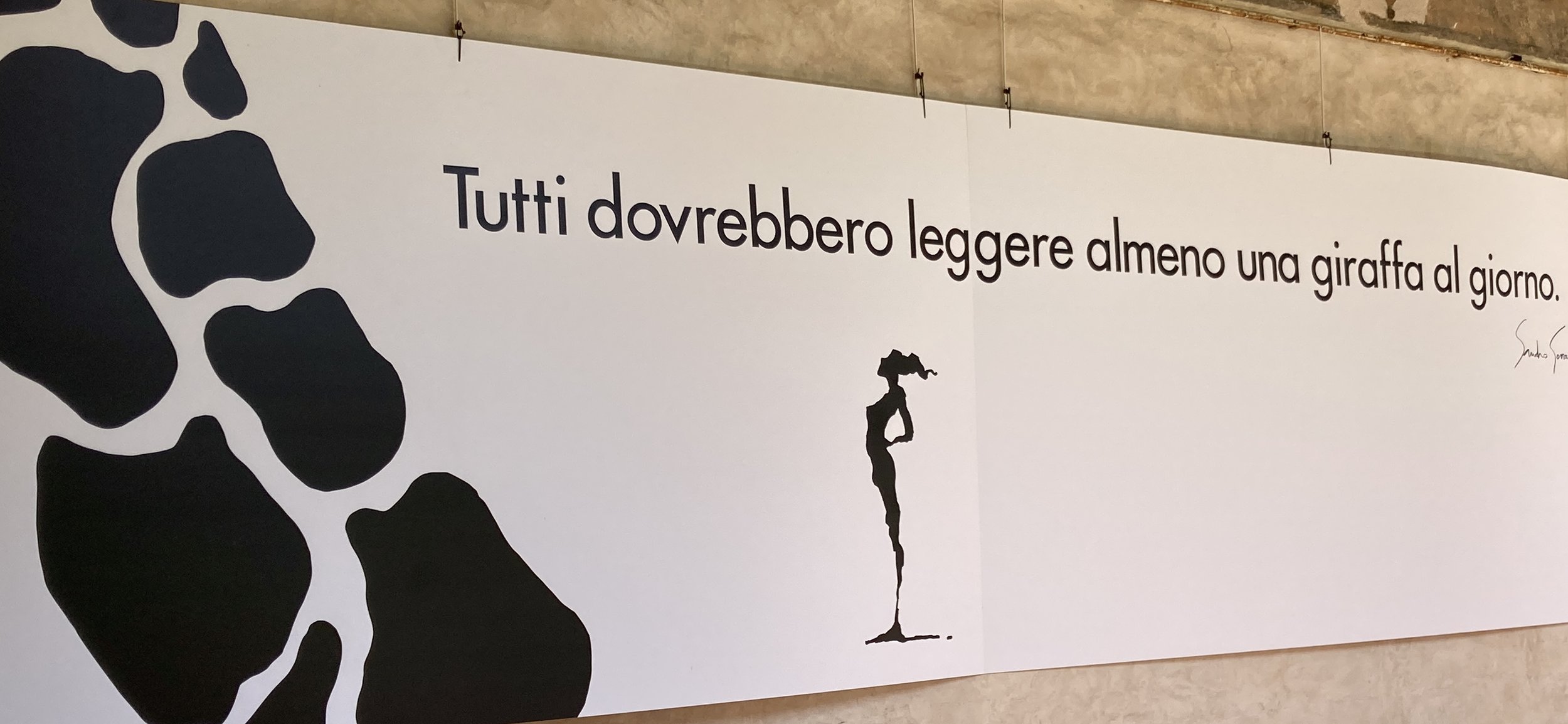
And my favorite one of all - it just may become my personal mantra:

Everyone should read at least one giraffe a day.
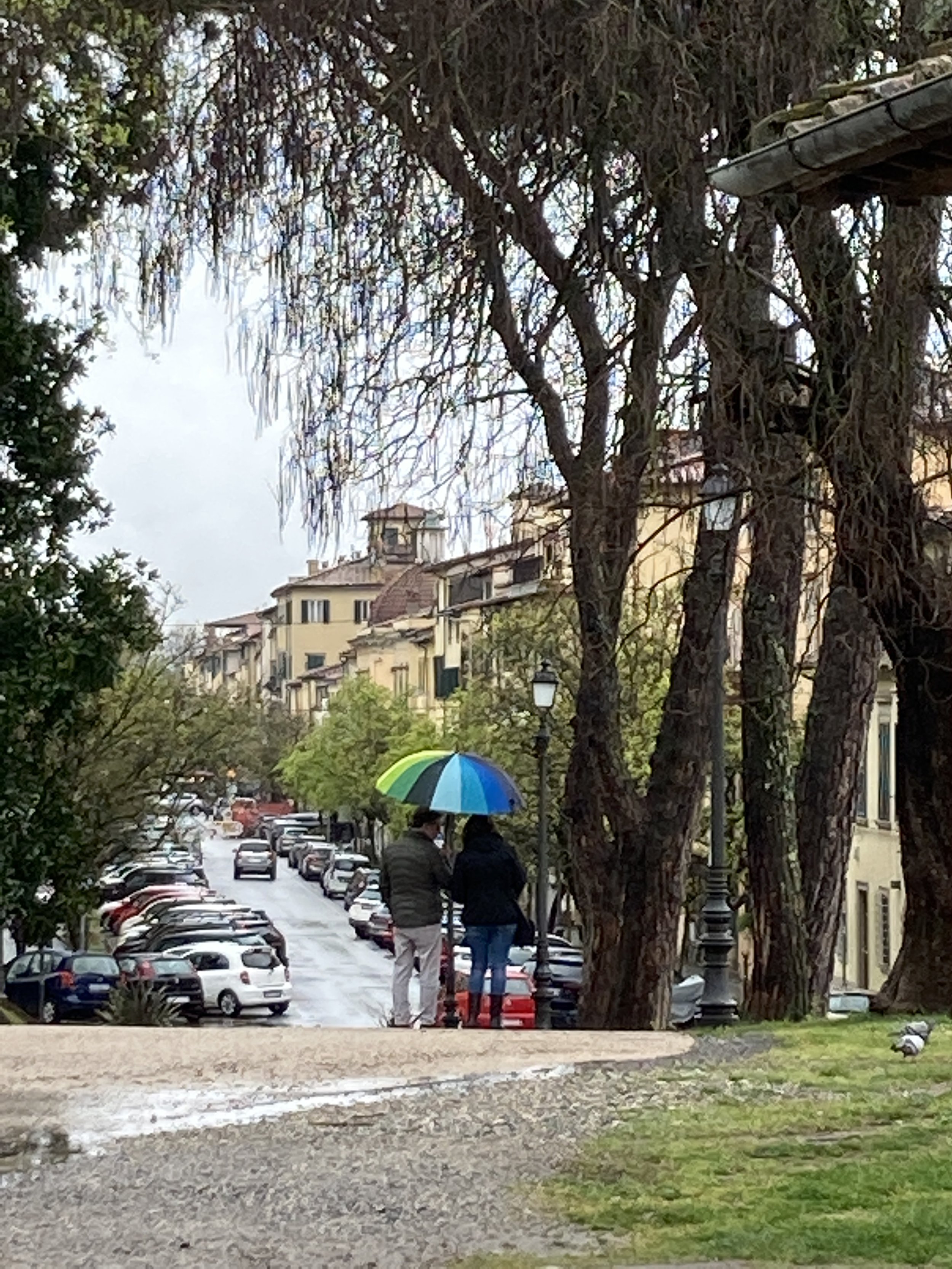
A day in Pietrasanta is always a joy. Sipping a cafe in the Piazza del Duomo. Strolling through the piazza and the Chiostro di Sant’Agostino. A quick visit to the beautiful Duomo. Wandering the side streets. A quick stop at the Misericordia Chapel to see Botero’s Heaven and Hell frescoes. A relaxed lunch at a favorite spot. Add in Gorra’s giraffes and the day is just perfect!

May 16, 2022 /Joanne Bartram
Pietrasanta, Sandro Gorra, Contemporary Italian Art, #italy, #artitaly, #sandrogorra
#lucca, Italian art architecture, Italian culture, Italy travel, Italy, Tuscany

A Lucchese April

April 11, 2022 by Joanne Bartram in #lucca, #springintuscany, Festivals Italy, Garden Festivals Italy, Italian culture, Italian gardens, Italy travel, Living in Italy

April can be a fickle month here in Lucca. After a few warm days in late March, the kind of days that almost trick you into packing away the winter sweaters, April barged in with colder days, wind, cloudy skies, and rain. The rain is much needed after a dry winter, so I won’t complain. And if the saying is true, and April showers really do bring May flowers, then Lucca should have a most colorful May.

This stand of white wisteria was an early bloomer this spring

Despite the early April chill, the days are growing longer, the first leaves have appeared on the trees, and the first blossoms throughout town hold the promise that warm spring weather will soon arrive.

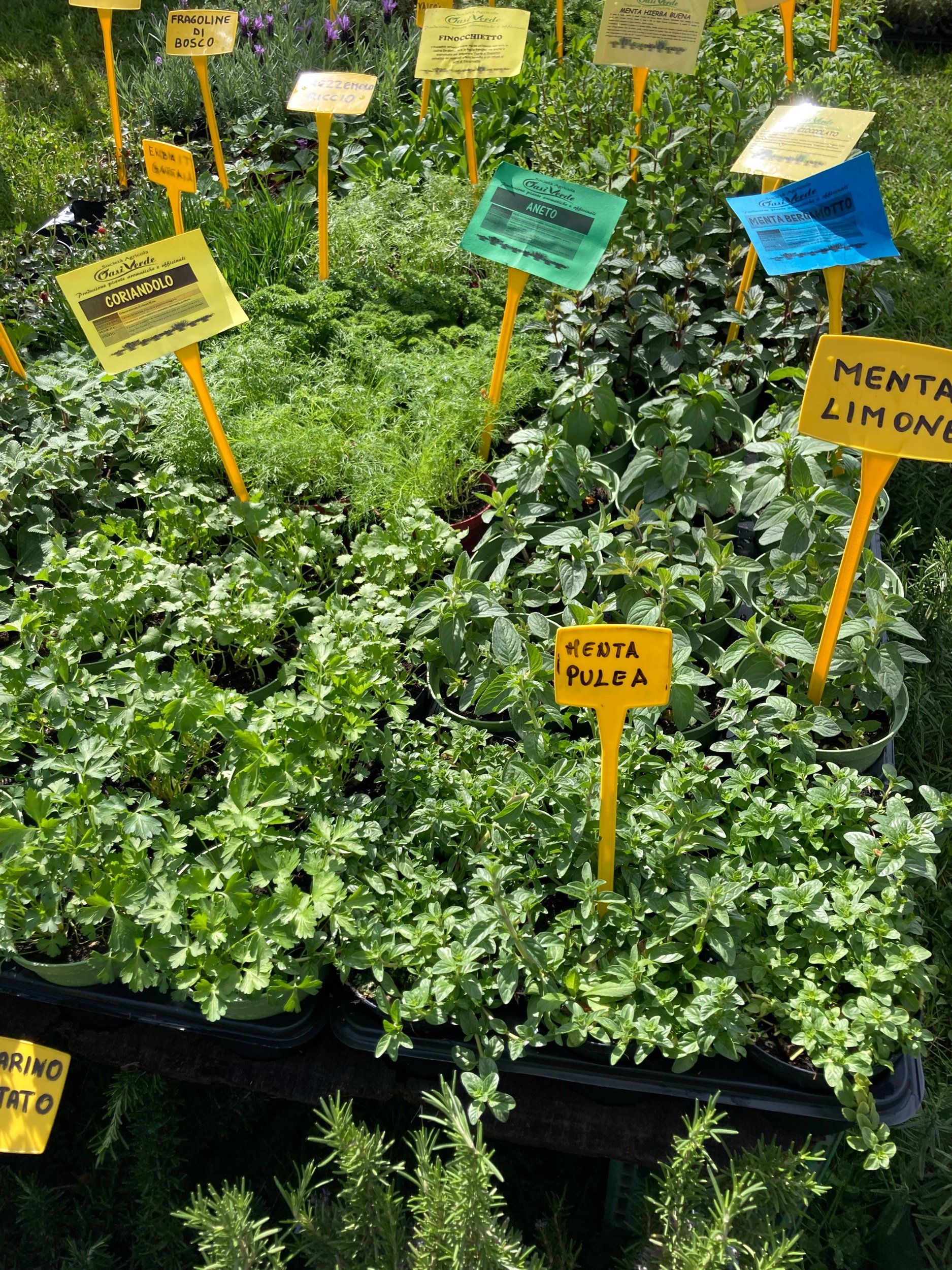
Verde Mura is the perfect place to buy pots of herbs for the garden.

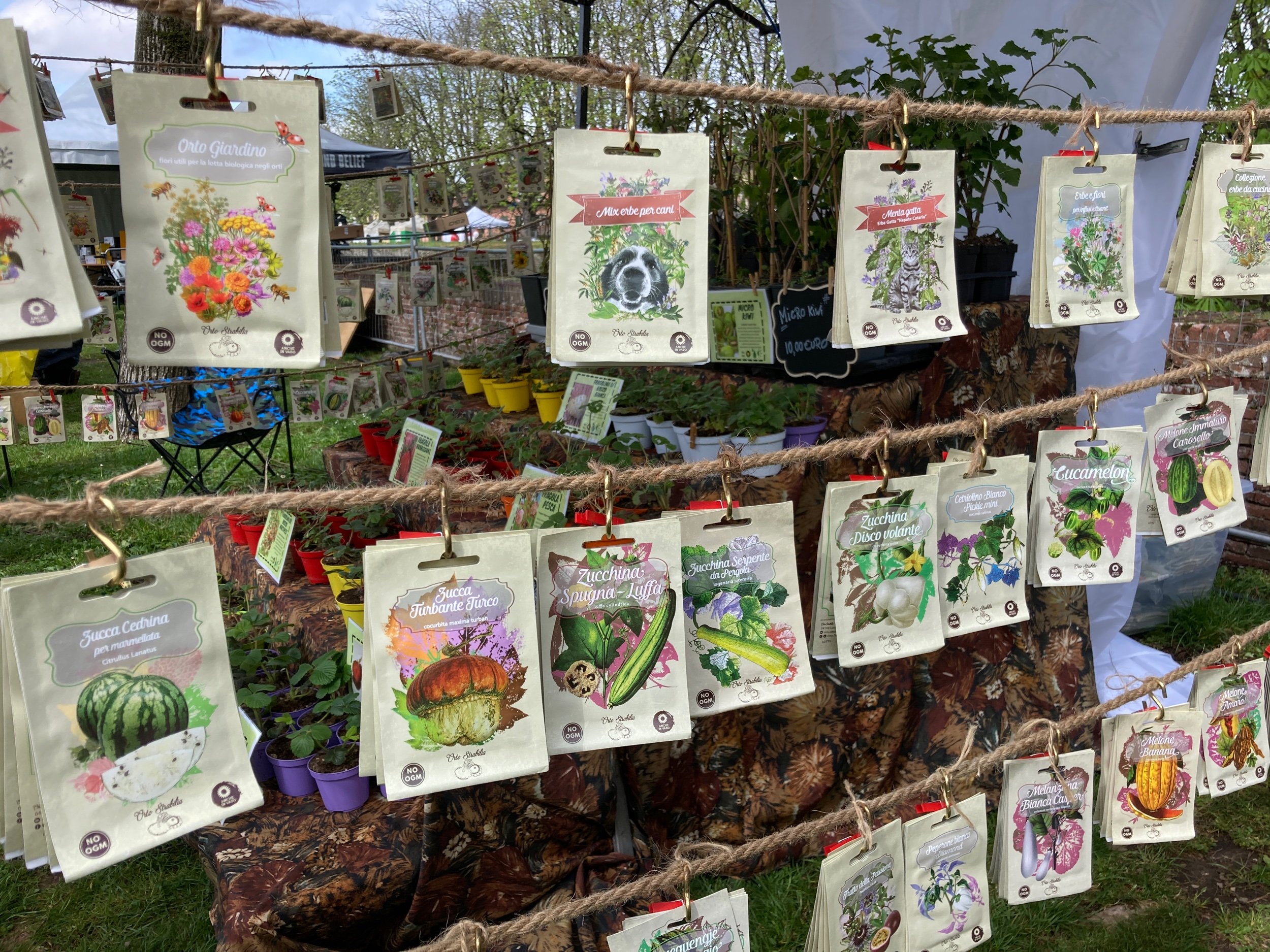
Perhaps the best harbinger of spring is the return, after a two year COVID-related pause, of Lucca’s spring garden festival - the Verde Mura. This wonderful event showcases all things needed to plant and tend a garden. It doesn’t matter if your garden is just a few pots on a terrace, a couple of window boxes, or a large orto (vegetable garden), the Verde Mura has what you need. The festival takes place up on the walls that surround Lucca’s centro storico (historic center) which means that the views are part of the fun.

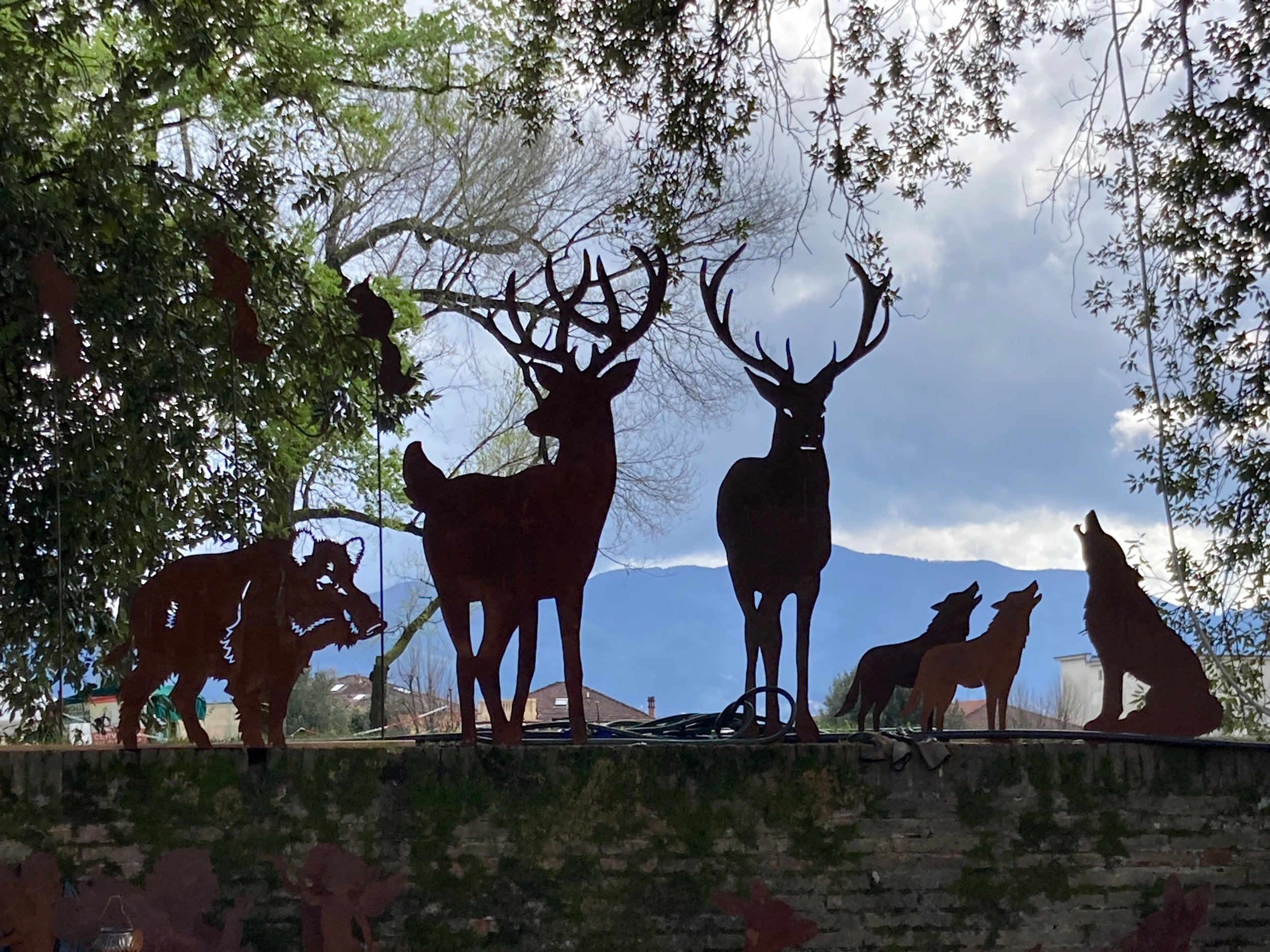
Garden art at Verde Mura

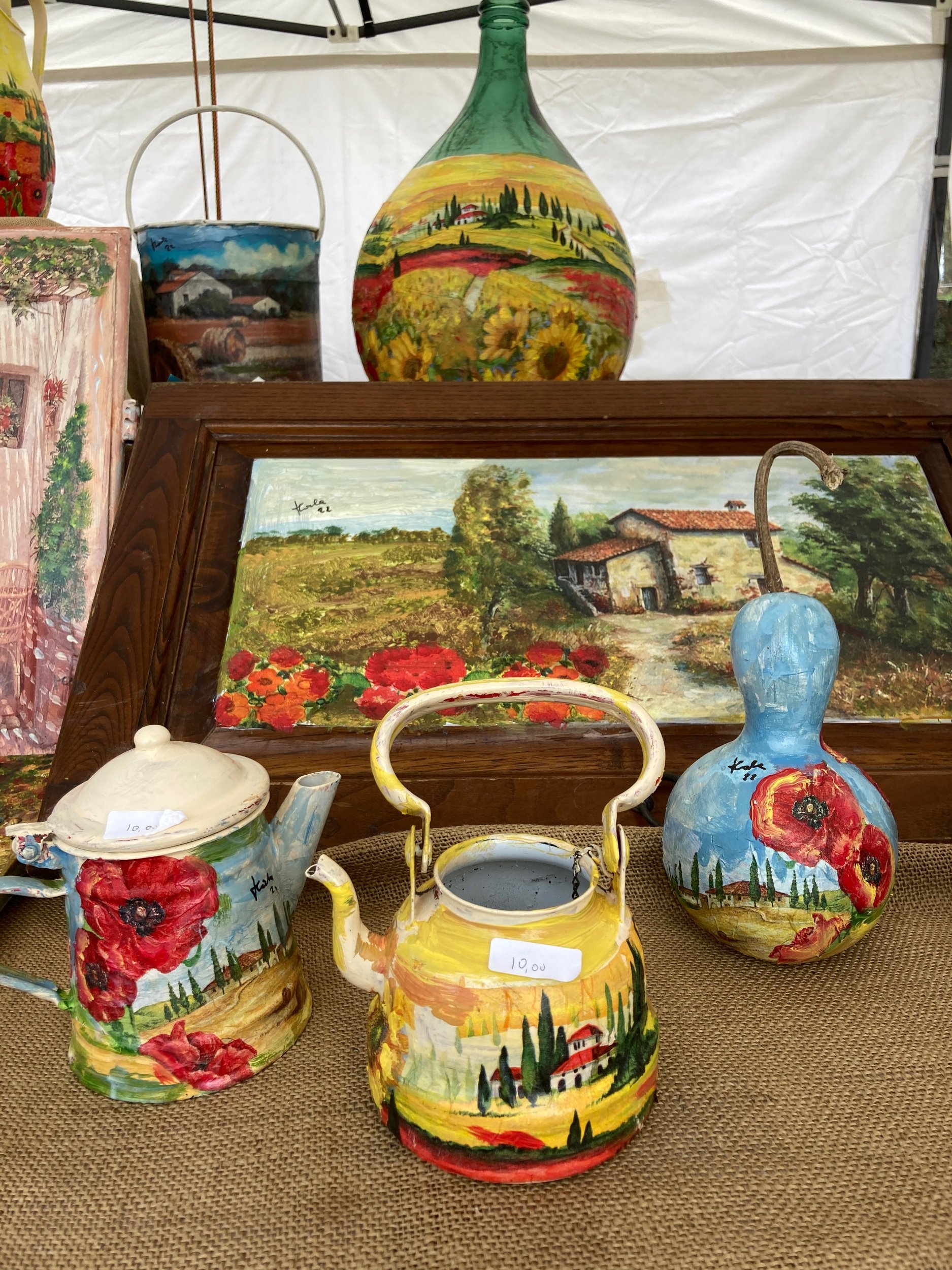
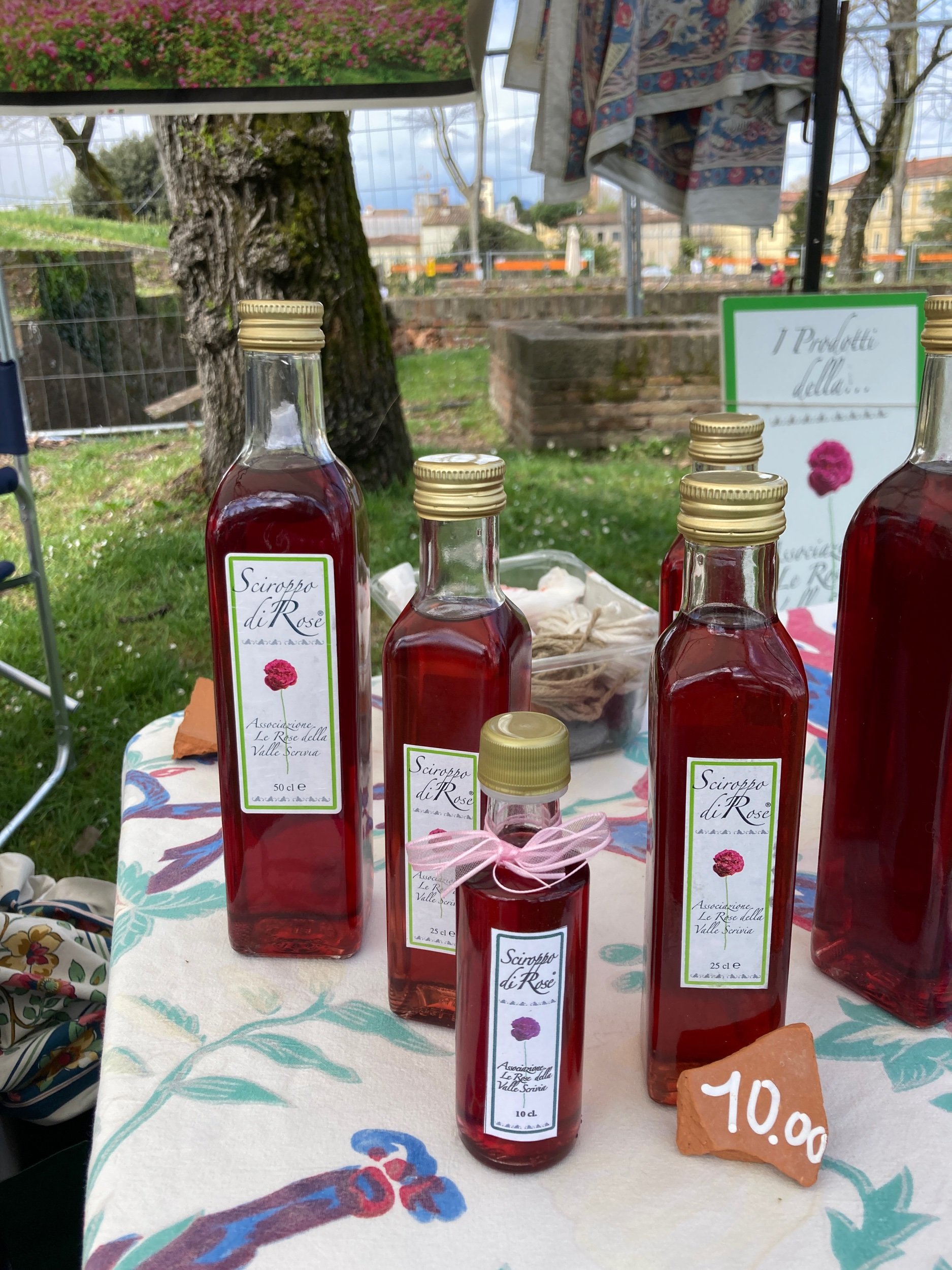
Local gardeners pull wagons through the many booths, collecting everything from rose bushes to fruit trees to annual flowers and herbs. Need a tractor? Well, Verde Mura has just the one. Same with shovels, clay pots, bug sprays, fertilizer, seeds, and outdoor grills. In addition to these garden necessities, this is the place to find whimsical garden art, herbal products (soaps, teas, spices, syrups), fragrant spices, and a variety of crafts.

IMG_5343.jpeg
IMG_5337.jpeg
IMG_5349.jpeg
IMG_5271.jpeg

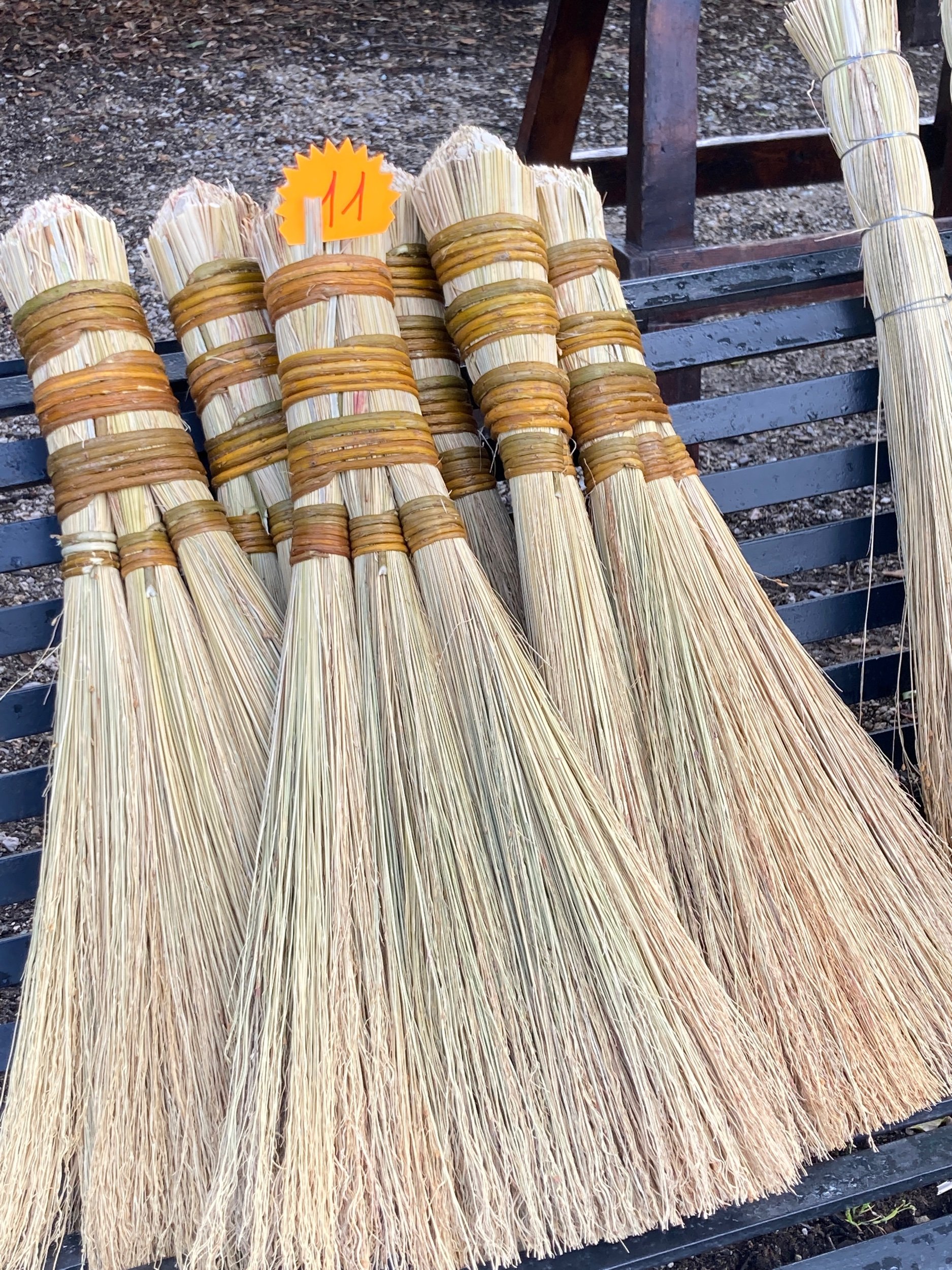
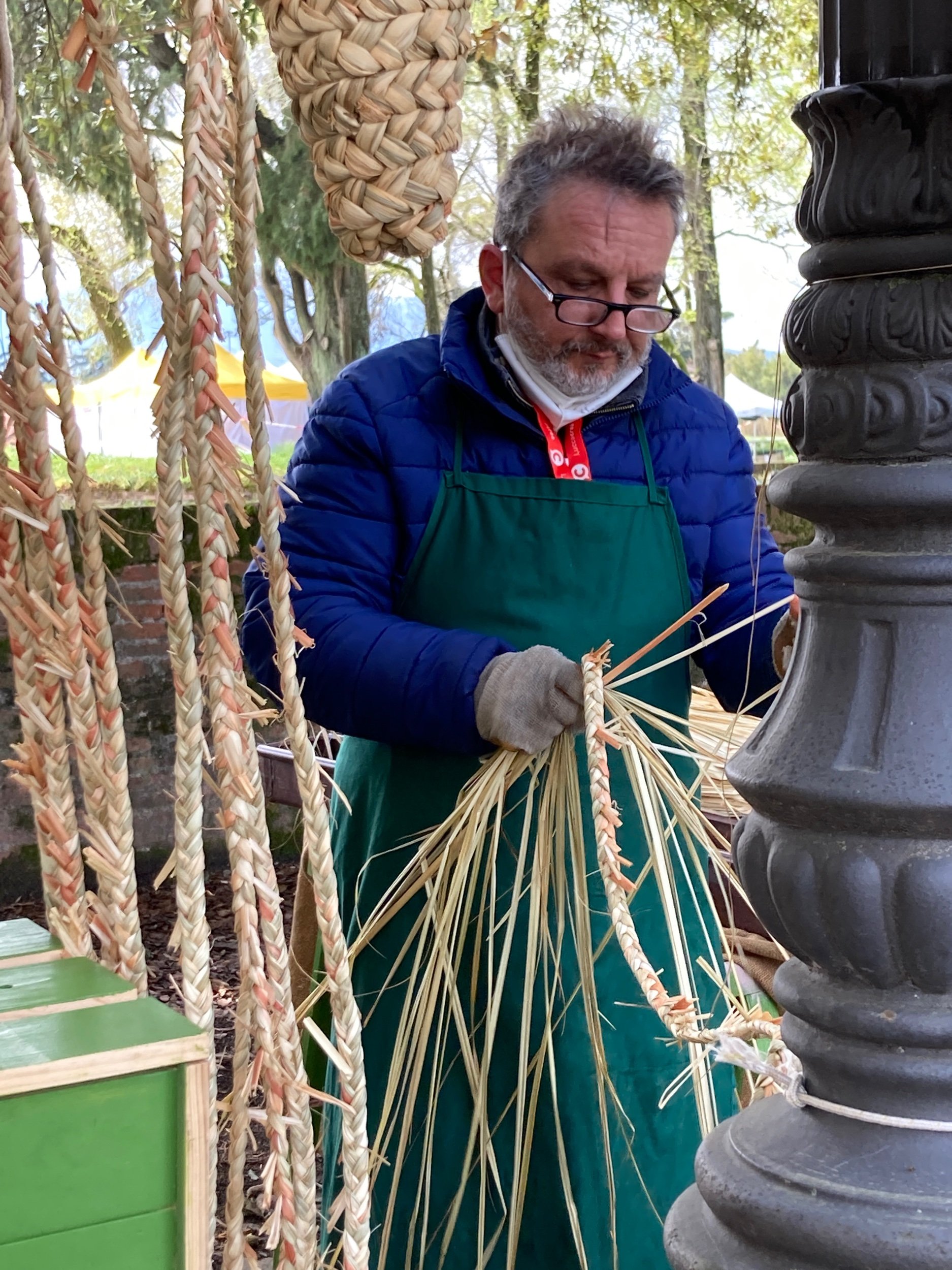
It is always fun to see traditional craftsmen at work; I especially love watching the basket weavers and broom makers.

IMG_5352.jpeg
IMG_5296.jpeg

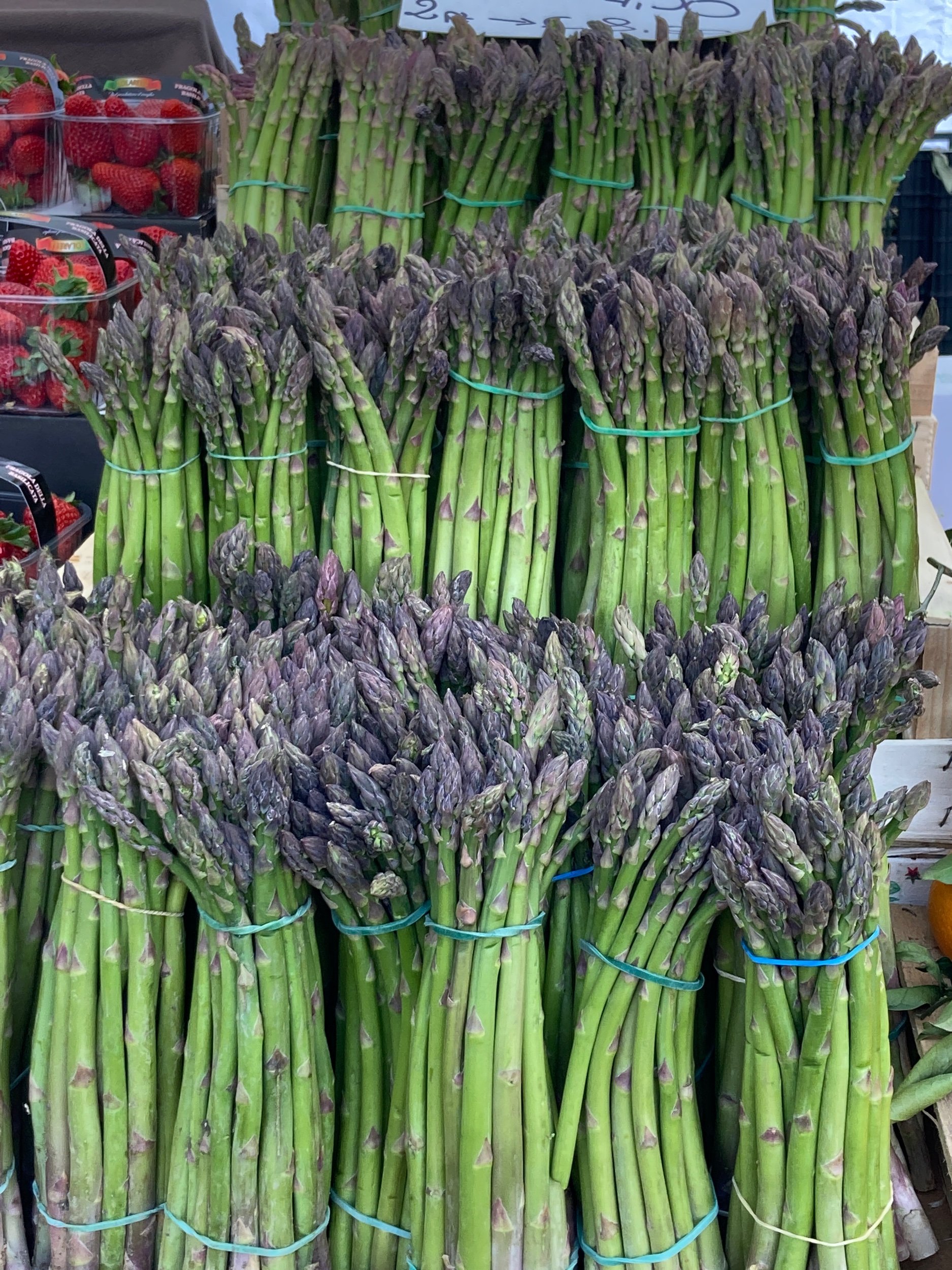
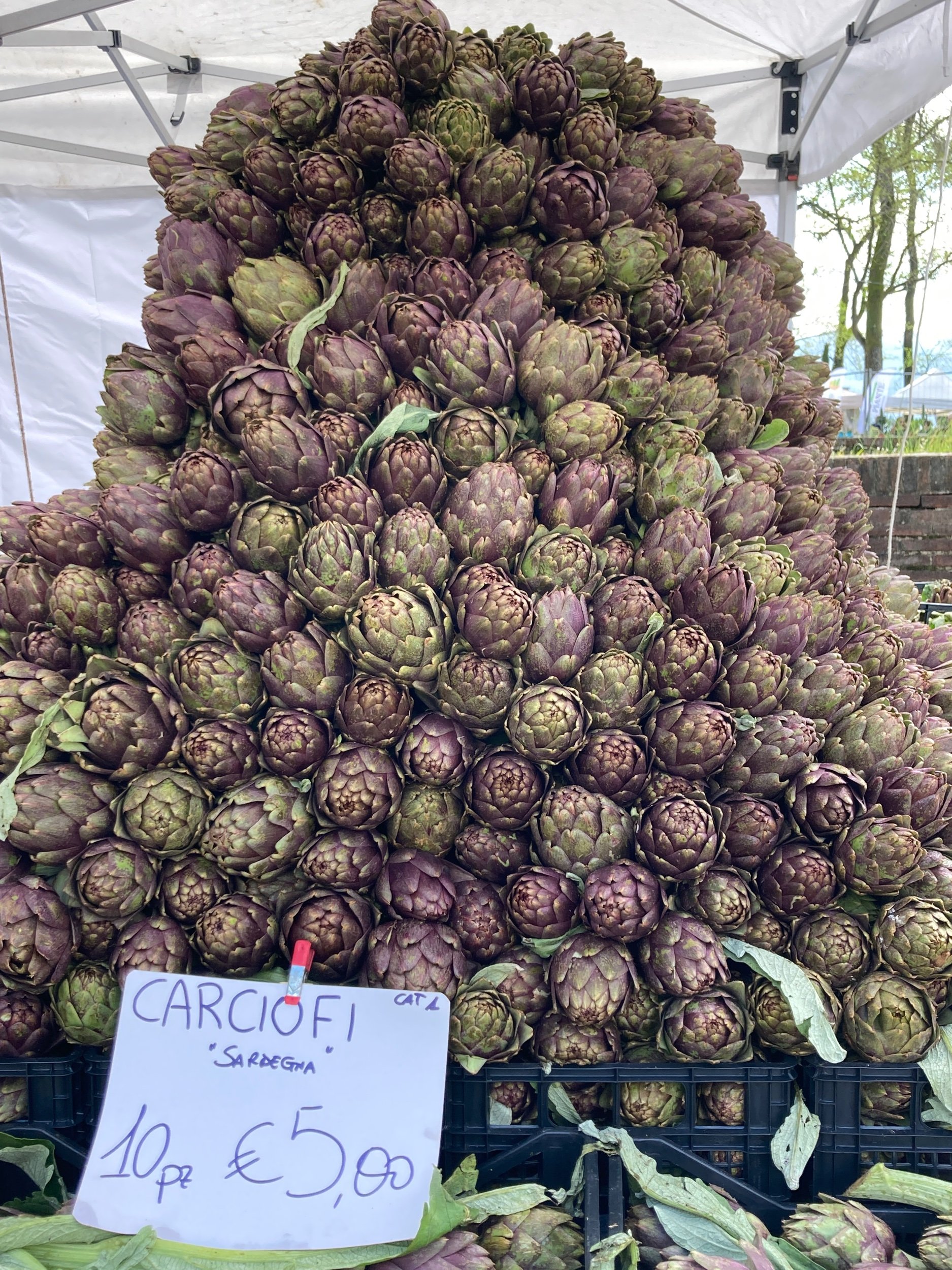
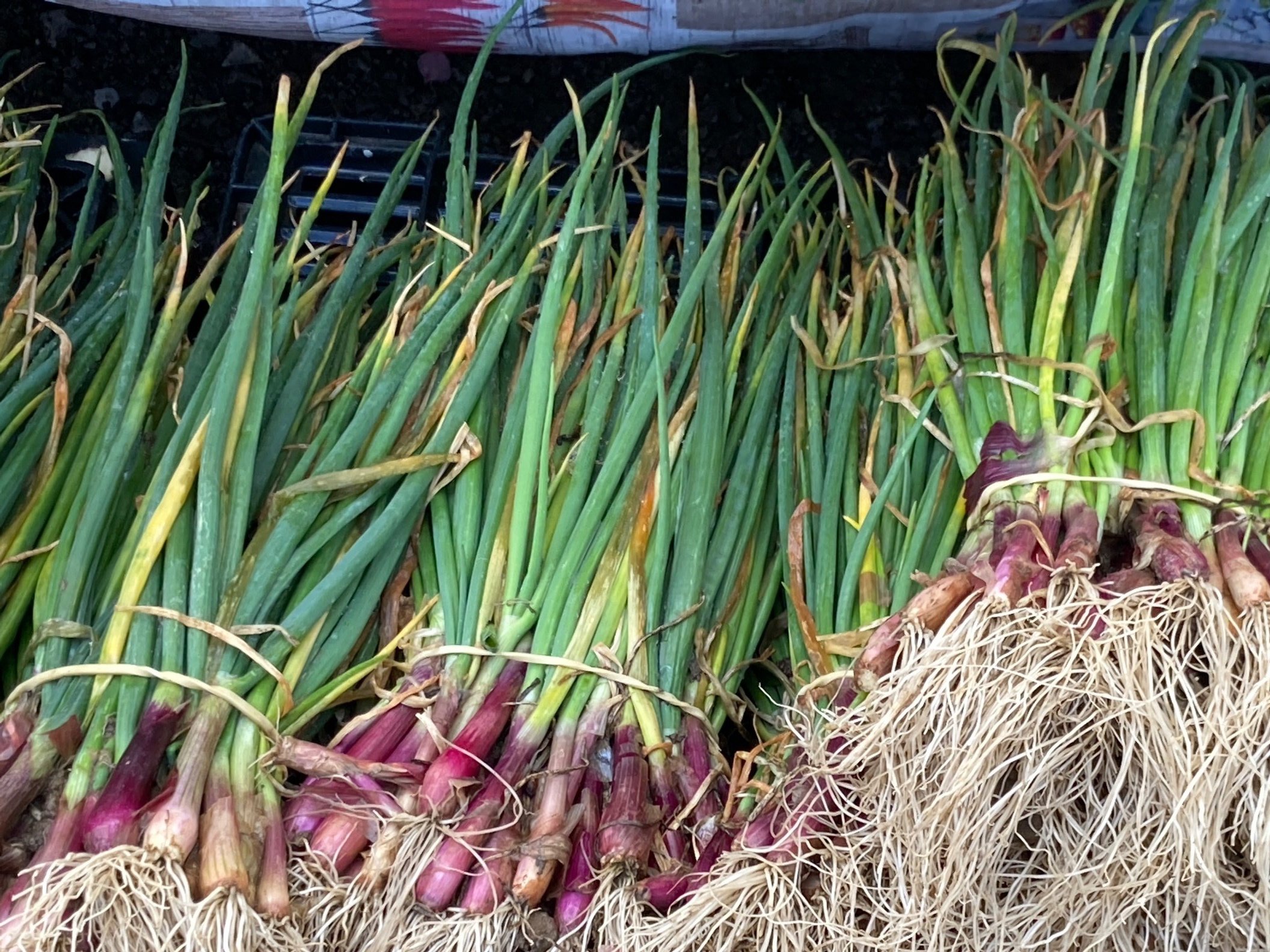
Of course there was food (this is Italy after all). In addition to booths serving coffee and sweets there were plenty of vendors of local meats, cheeses, honey, pasta, and breads - most offering an assaggio (a taste). One booth had mounds of beautiful spring artichokes, bundles of aspargus, pretty Tropea onions and ripe strawberries from the south of Italy.

IMG_5313.jpeg
IMG_5312.jpeg
IMG_5306.jpg

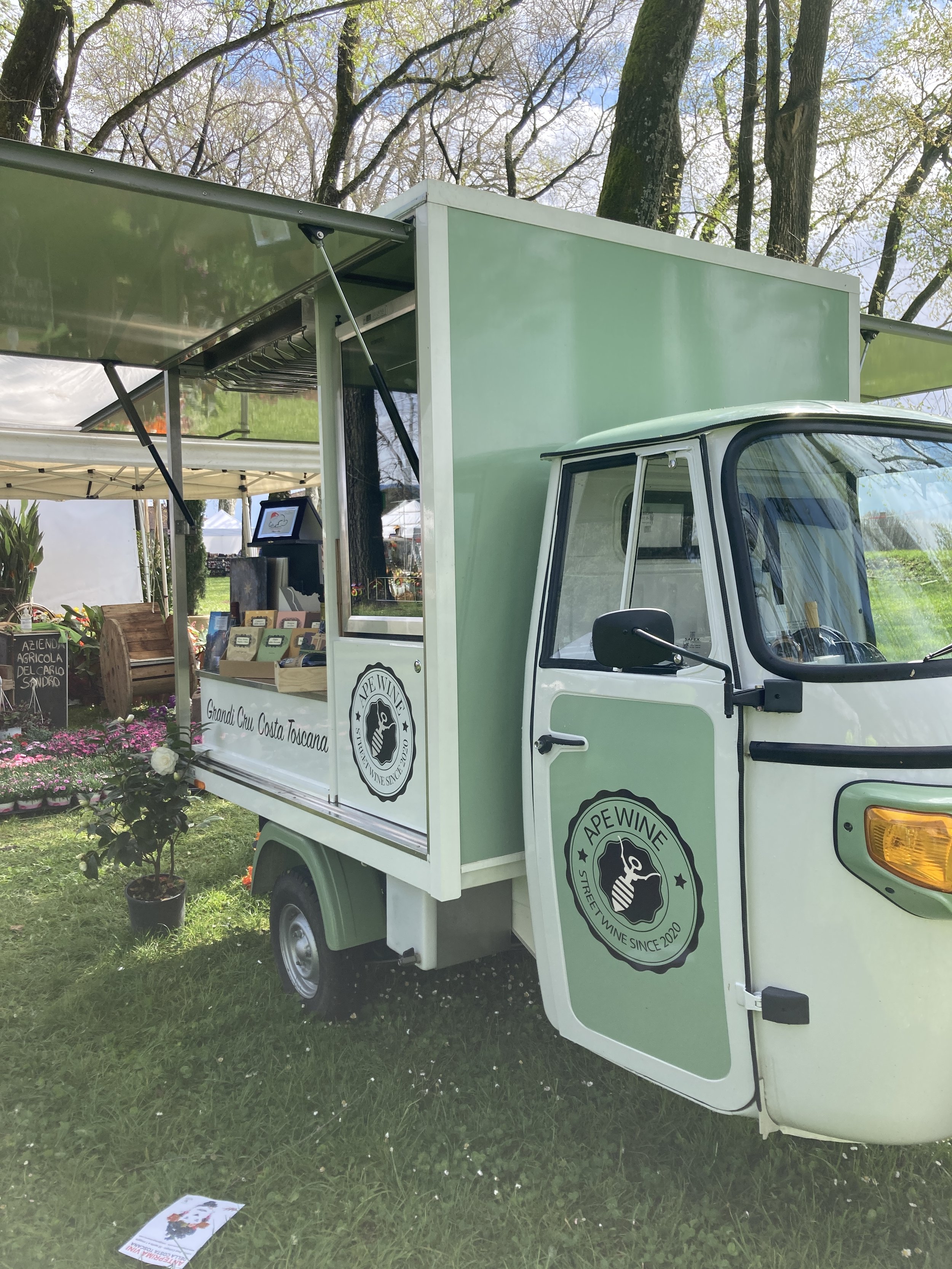
There was even the cutest little wine truck!

A break in the rain allowed for a slow morning wander through the many booths and displays of plants.

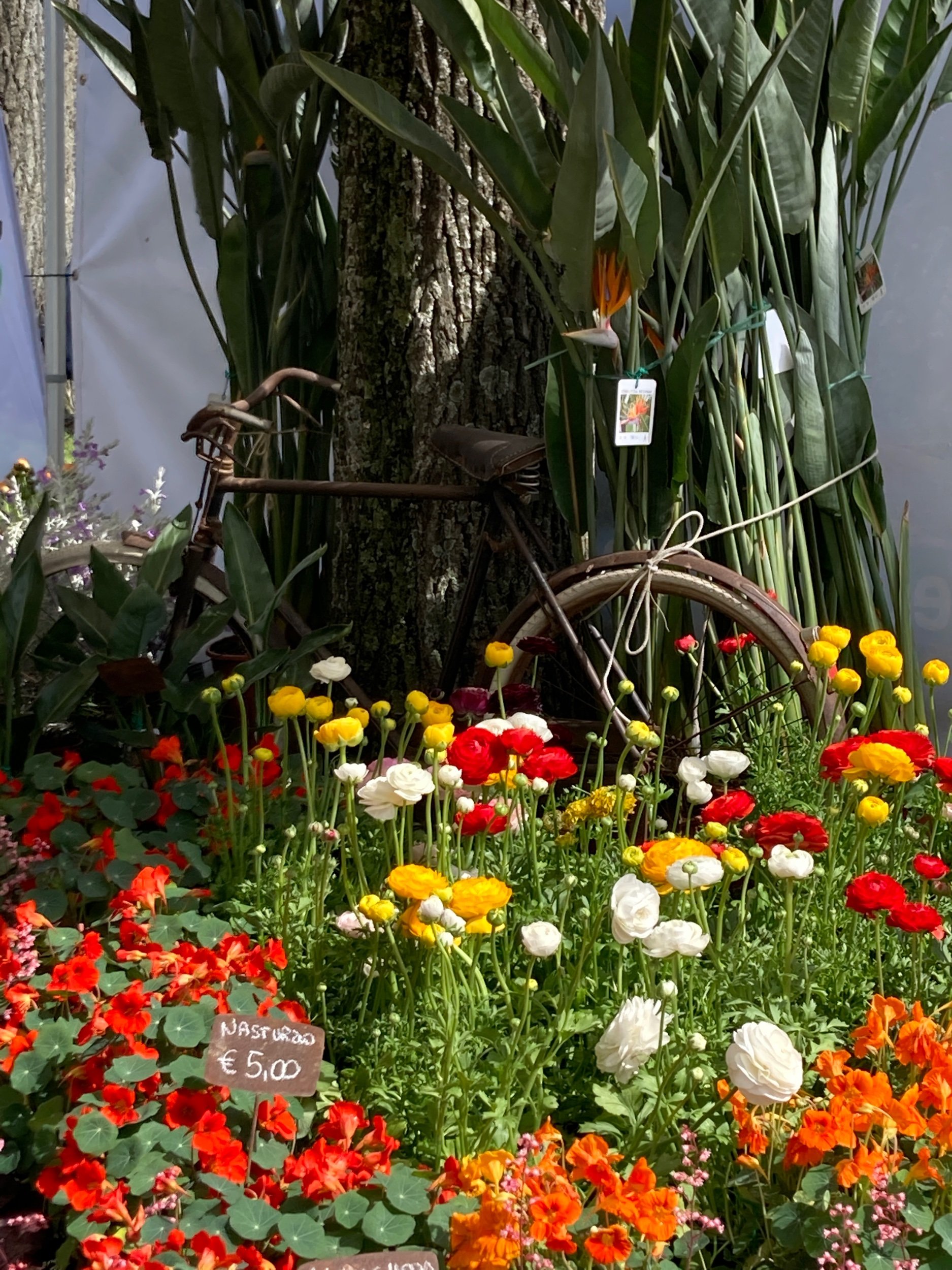
I came home with some herbs which are now happily planted in my window boxes as well as a colorful bouquet of ranunculi for my apartment.

I may have needed a warm coat, a scarf, and a hat against the chill but there was still a hint of spring in the air. I am looking forward to seeing the season unfold.

IMG_5321.jpeg
IMG_5324.jpeg
April 11, 2022 /Joanne Bartram
Italian festivals, Italian Garden, Verde Mura, #tuscany, #Lucca
#lucca, #springintuscany, Festivals Italy, Garden Festivals Italy, Italian culture, Italian gardens, Italy travel, Living in Italy

The daily market in Padova

A Morning in Padova's Market

March 21, 2022 by Judy Giannnettino in #italytravel, Italian culture, Italian markets, Italy travel, #padua

When I first visited Italy, nearly 30 years ago, I hoped to attend a cooking class.  I had been studying Italian cookbooks (especially those by Marcella Hazan) and wanted more than anything to cook in Italy, using local ingredients, with a teacher who could show me how to make authentic Italian dishes.  Unfortunately, the cost of the week-long classes just did not fit my budget.  Instead, I came to Italy determined to taste regional dishes, shop local markets, and take lots of notes.  Or, as someone said to me, “So, you’re going to Italy to eat?”  Well, yes.  That pretty much summed up my intention.

My first bite of prosciutto with melon was a revelation!

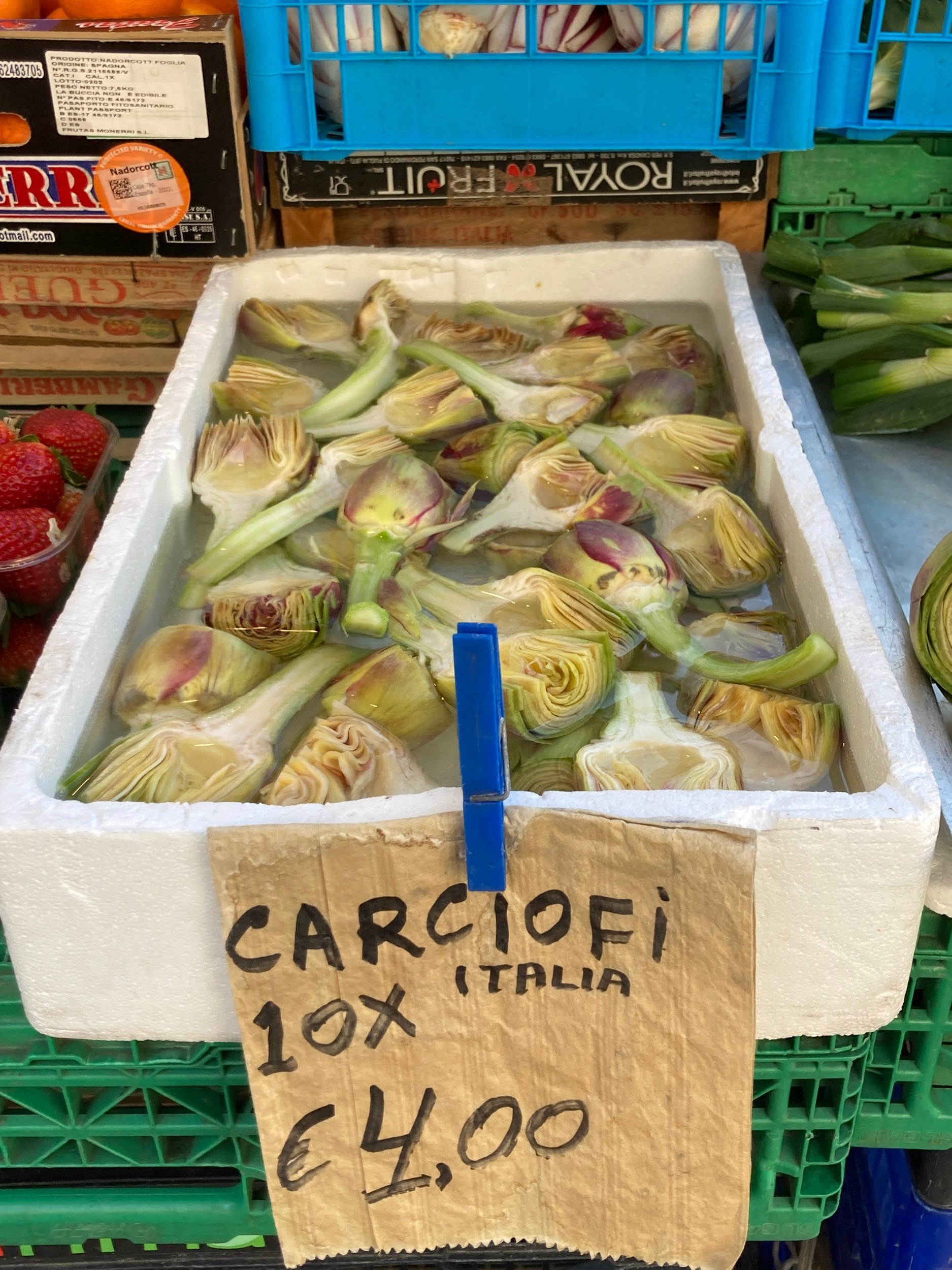
 I learned so much on that trip, in large part through food experiences.  Restaurant dining introduced me to many dishes – sweet melon wrapped in salty proscuitto, a delicate risotto with saffron, fish straight from the lake, tiny wild blueberries atop gelato, pasta fatto a mano (homemade). The flavors and preparation methods were enlightening.  As good as the restaurant meals were, it was the Italian markets which really enchanted me.  Fresh produce artfully displayed, pan-ready trimmed artichokes floating in lemon water, perfectly ripe melons.  I marveled at the fishmongers in Venice who arranged their products in photo-worthy displays and at the shops in Florence filled with hanging legs of prosciutto, a vast array of cheeses, and cases of colorful filled pastas.  How I longed for a kitchen on that trip!

Fresh pasta at the Sant’Ambrogio market in Florence

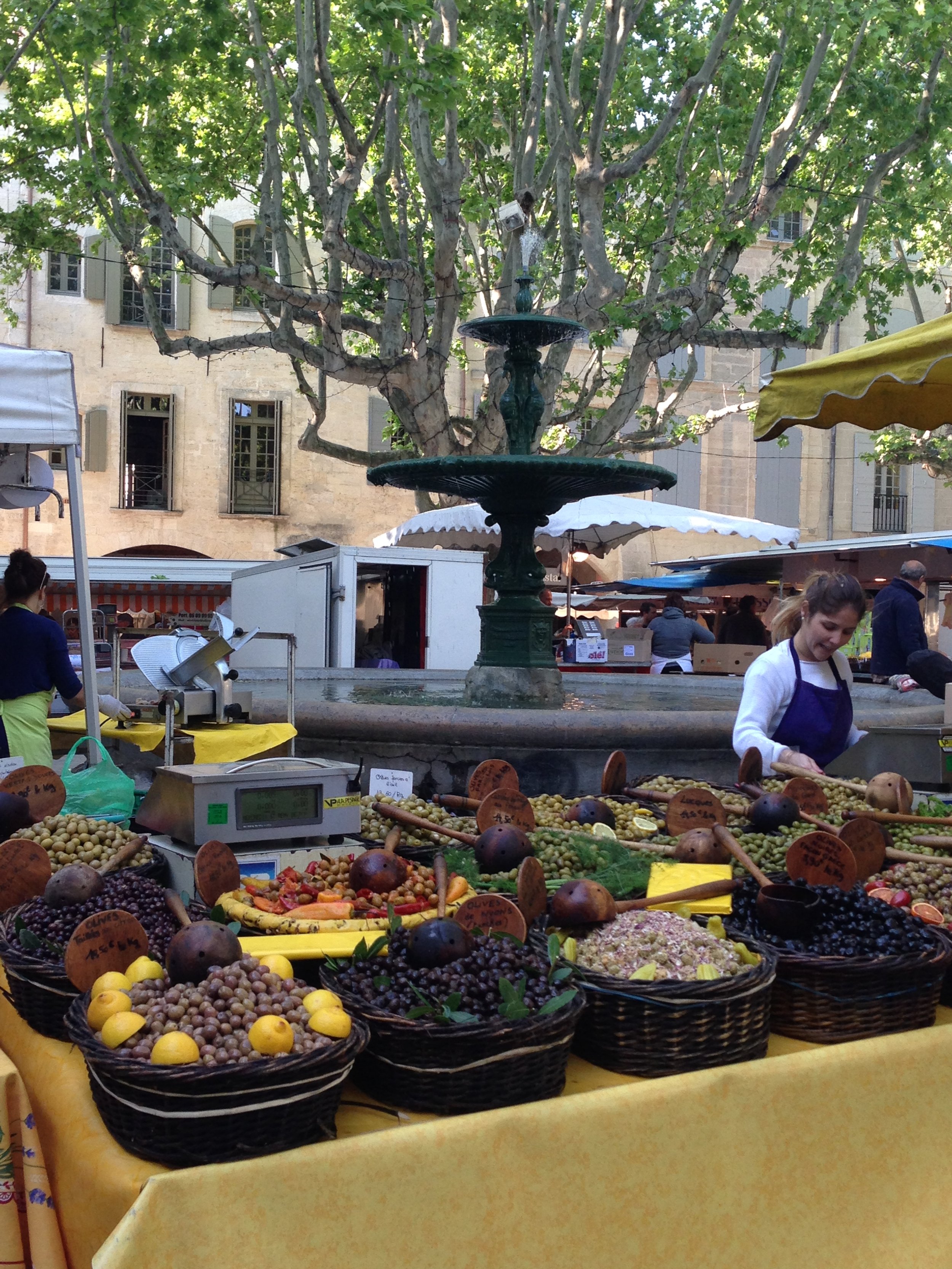
 Since that time I have sought out markets whenever, and wherever, I’ve traveled.  They form some of my most vivid travel memories.  The best ones are the “mamma’s markets”, catering to locals rather than tourists.  Two of my favorites over years of travel are the weekly market in Uzes France (oh those olives!) and the Sant’Ambrogio market in Florence.   

Italy is not the only country with fabulous markets. This one in Uzes, France is among my favorites.

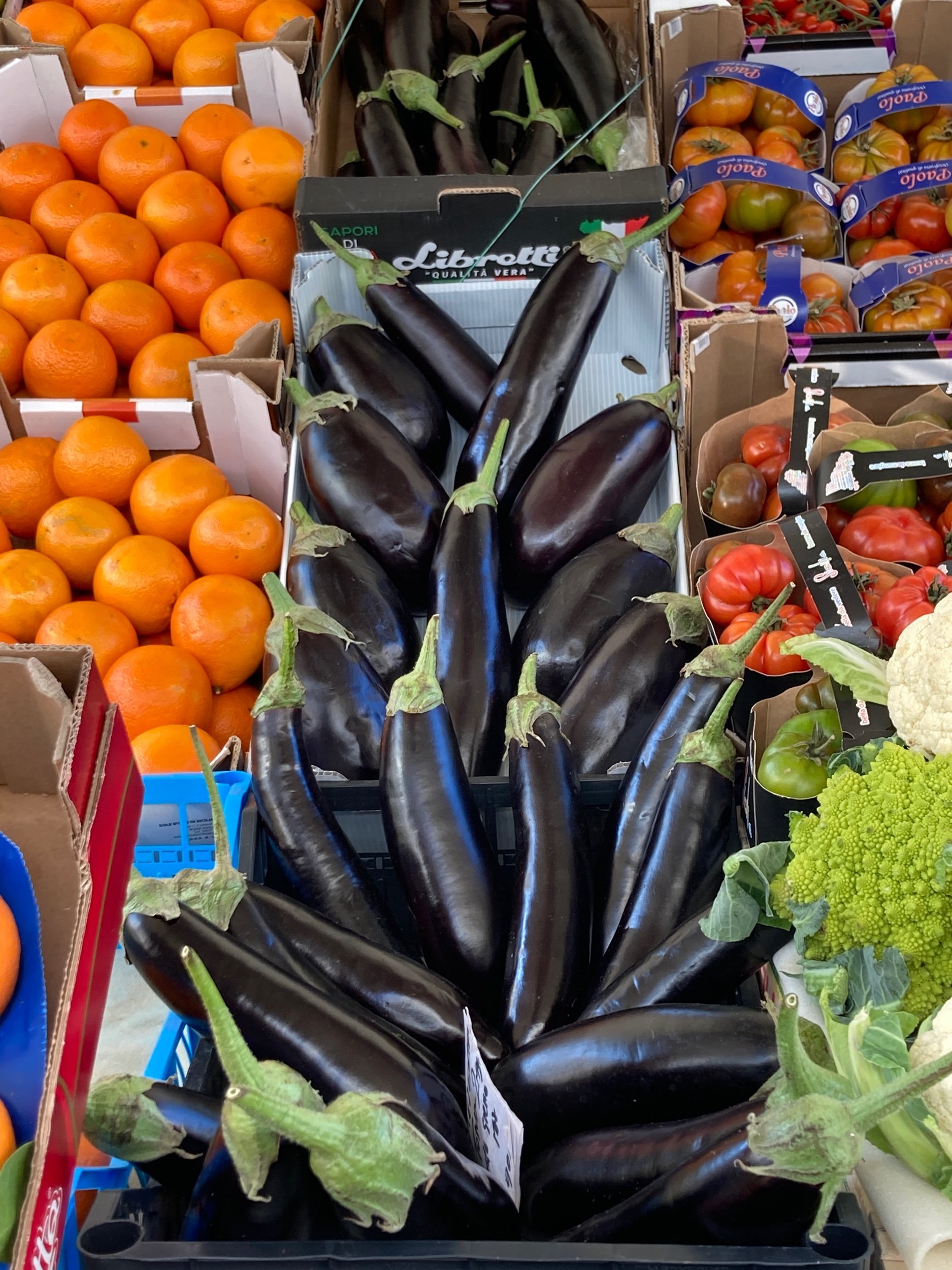
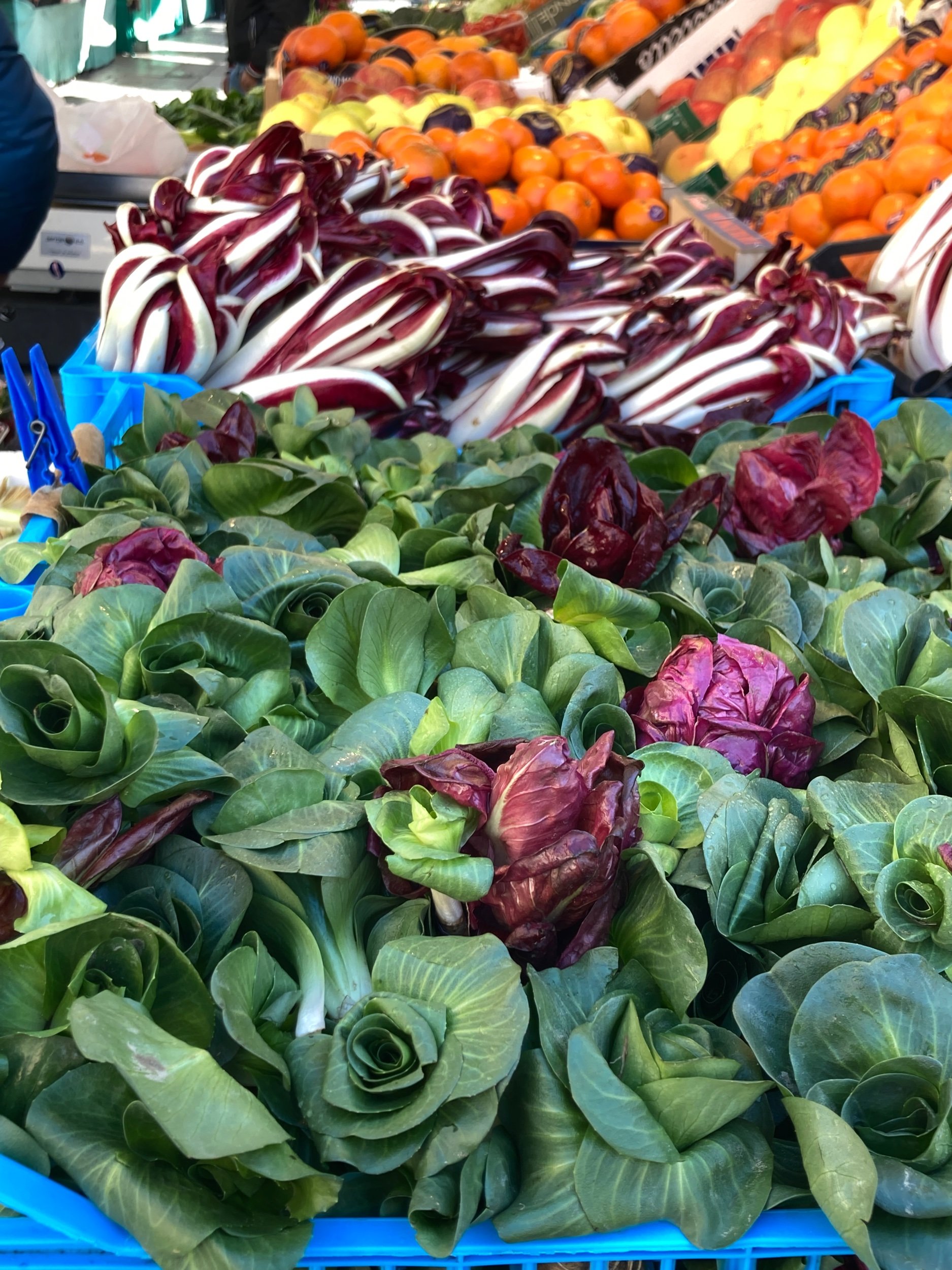
 My most recent market experience was in Padova (Padua) where I was delighted to find a fabulous daily market.  The outdoor market, centrally located in Piazze delle Erbe and Piazza della Frutta, was a wonderland of fresh fruits and vegetables.  Multiple vendors set up stalls each morning filled with just about everything a cook could desire -  baskets of bright lettuces, mounds of greenish-purple artichokes, piles of vibrant oranges, rows of tomatoes in different shapes and sizes, fat stalks of asparagus, dark purple eggplants, dried beans, herbs, and even flowers.  

IMG_5027.jpeg
IMG_5036.jpeg
IMG_5043.jpeg
IMG_5030.jpeg

Spending a morning there was a joy.  In the afternoon the market stalls disappeared and the piazza became a social hub of cafes, bars and casual restaurants. 

Beautiful blossoms in the Padova market

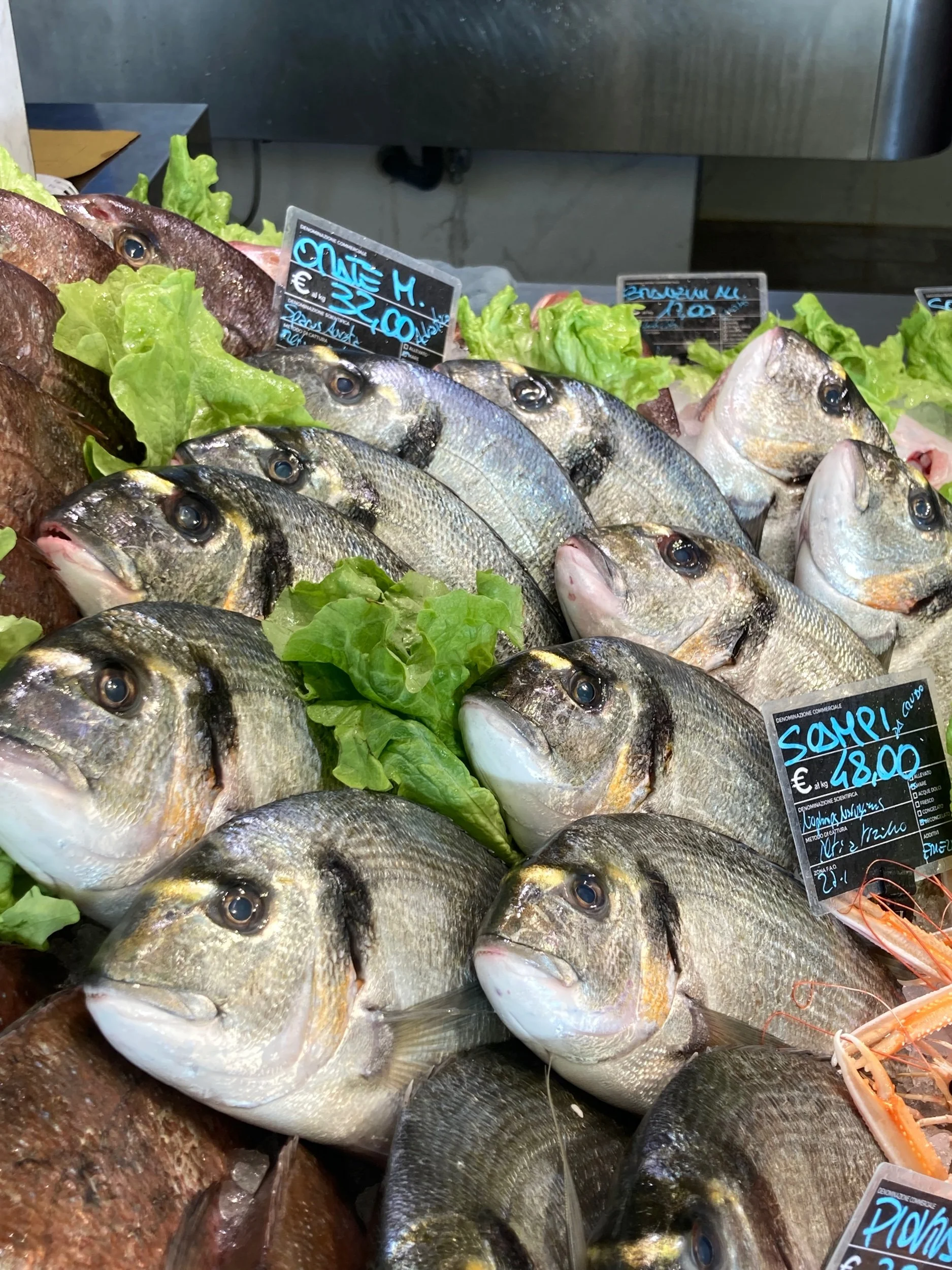
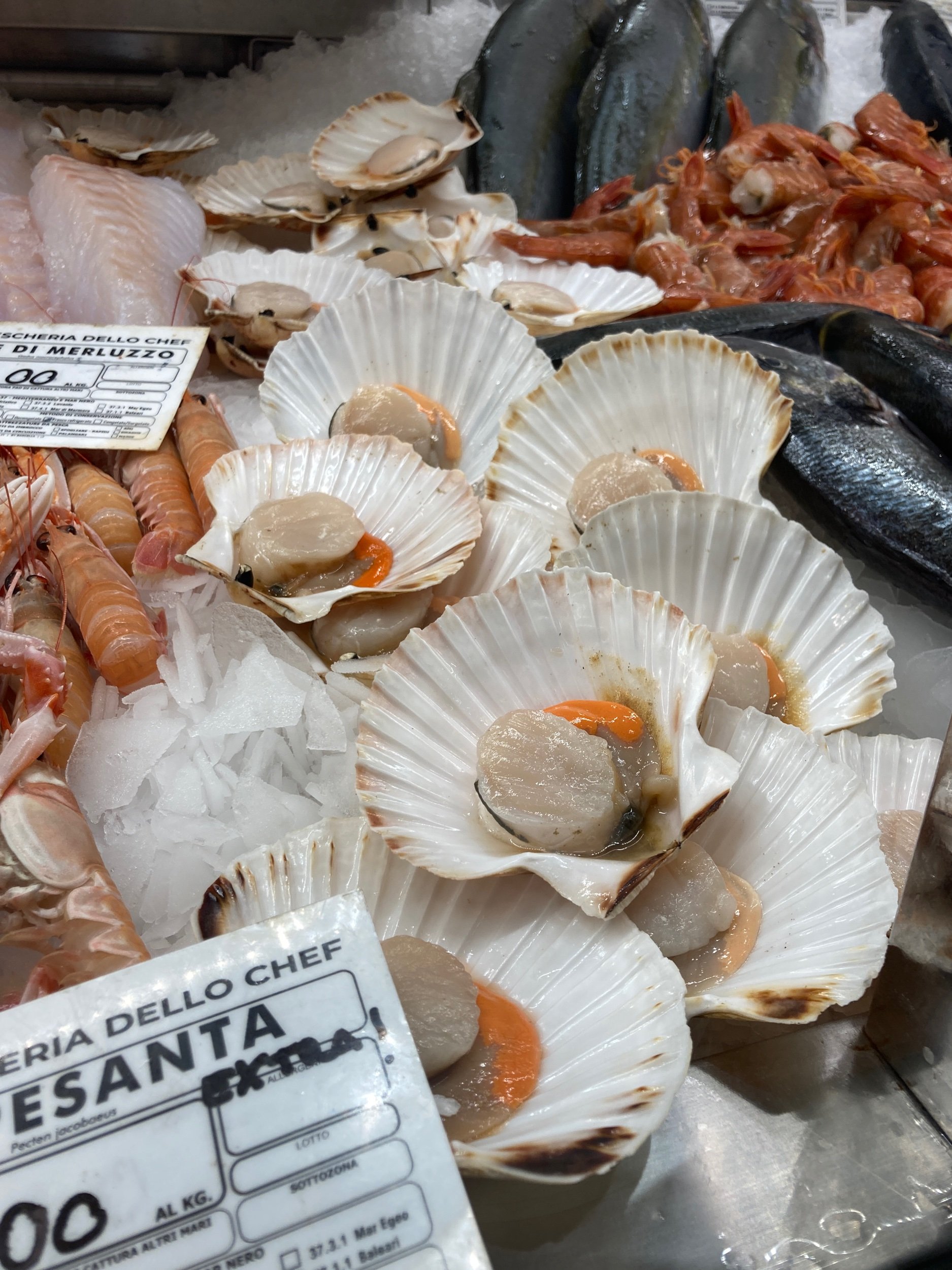
 In addition to the outdoor market stalls, an adjoining indoor market lies beneath the Palazzo della Ragione.  The culinary fun continued here with a host of shops selling fish, meats, prosciutto, bread, pastries, cheeses, and a variety of prepared foods.  There was even a rare sight in Italy – a “to go” coffee bar.   

IMG_5047.jpeg
IMG_5064.jpeg
IMG_5075.jpeg
IMG_5079.jpeg
IMG_5082.jpeg
IMG_5071.jpeg

There is so much to appreciate in Padova – stunning frescoes, historic churches, architecture, historical buildings, parks (I will get to all of these in another post) but never underestimate the power of a good market to add a fun experience when exploring a new city. 

March 21, 2022 /Judy Giannnettino
Padova, Padua
#italytravel, Italian culture, Italian markets, Italy travel, #padua

The Castle of Torrechiara, near Langhirano

Tasting Parma Part Three: Prosciutto di Parma

February 14, 2022 by Joanne Bartram in food, Italian culture, Italy travel, Parma, Traditional product Italy

The town of Langhirano serves up two special things. The first is the Castle of Torrechiara which I saw off in the distance on my way to the even bigger attraction - a salumificio, a place where prosciutto (along with other pork products) is produced. The castle is by far the prettier of the two attractions, but it is the production of prosciutto that really defines this town set in the hills near the city of Parma. And prosciutto is what I came to see on this, the final stop on my tour of the foods of Parma.

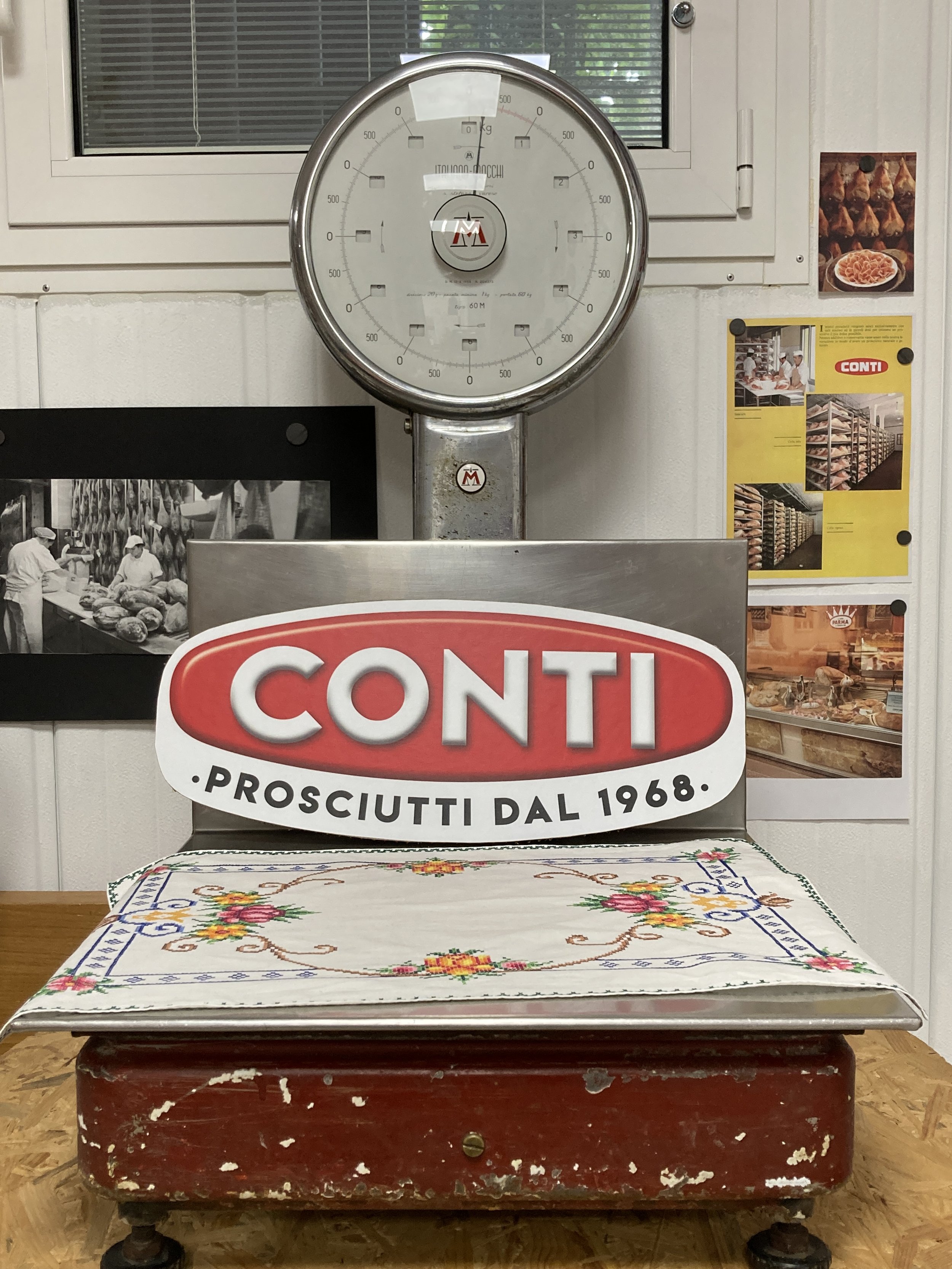
The first thing I learned during my visit to the Salumificio Conti was to never, ever refer to the product produced here as simply “prosciutto”. Prosciutto is a generic term for a non-smoked, air-dried ham either crudo (raw) or cotto (cooked). It is produced in several regions and is not a protected product name. The delicacy produced in this family owned salumifico is anything but generic. It is known by its full name - Prosciutto di Parma. This special, high quality type of prosciutto crudo is only produced in this region and under strict regulation. It is a controlled process, a quality tested end-product, and bears a DOP designation (in English its PDO, Protected Designation of Origin). Calling it plain old proscuitto just won’t do!

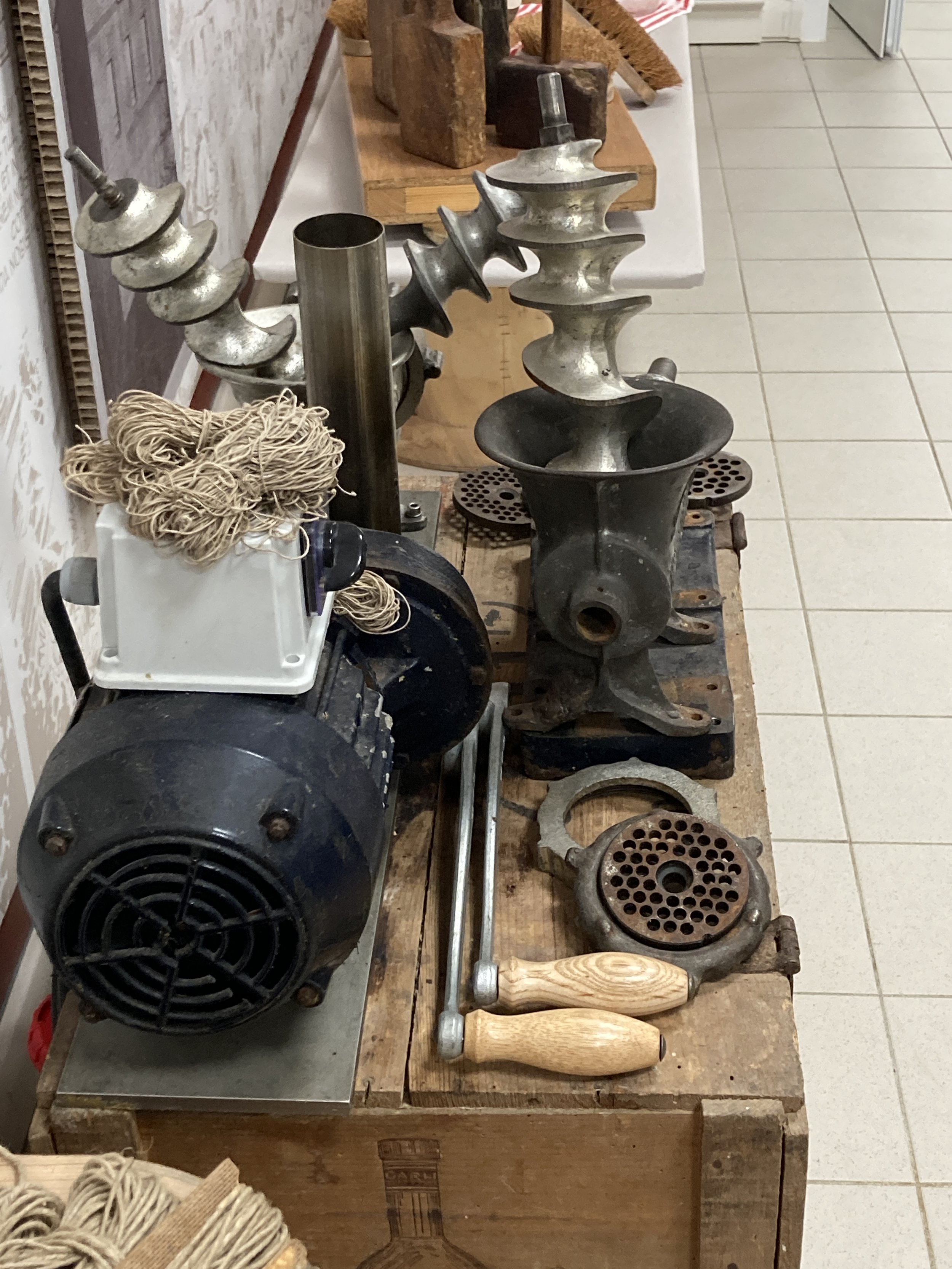
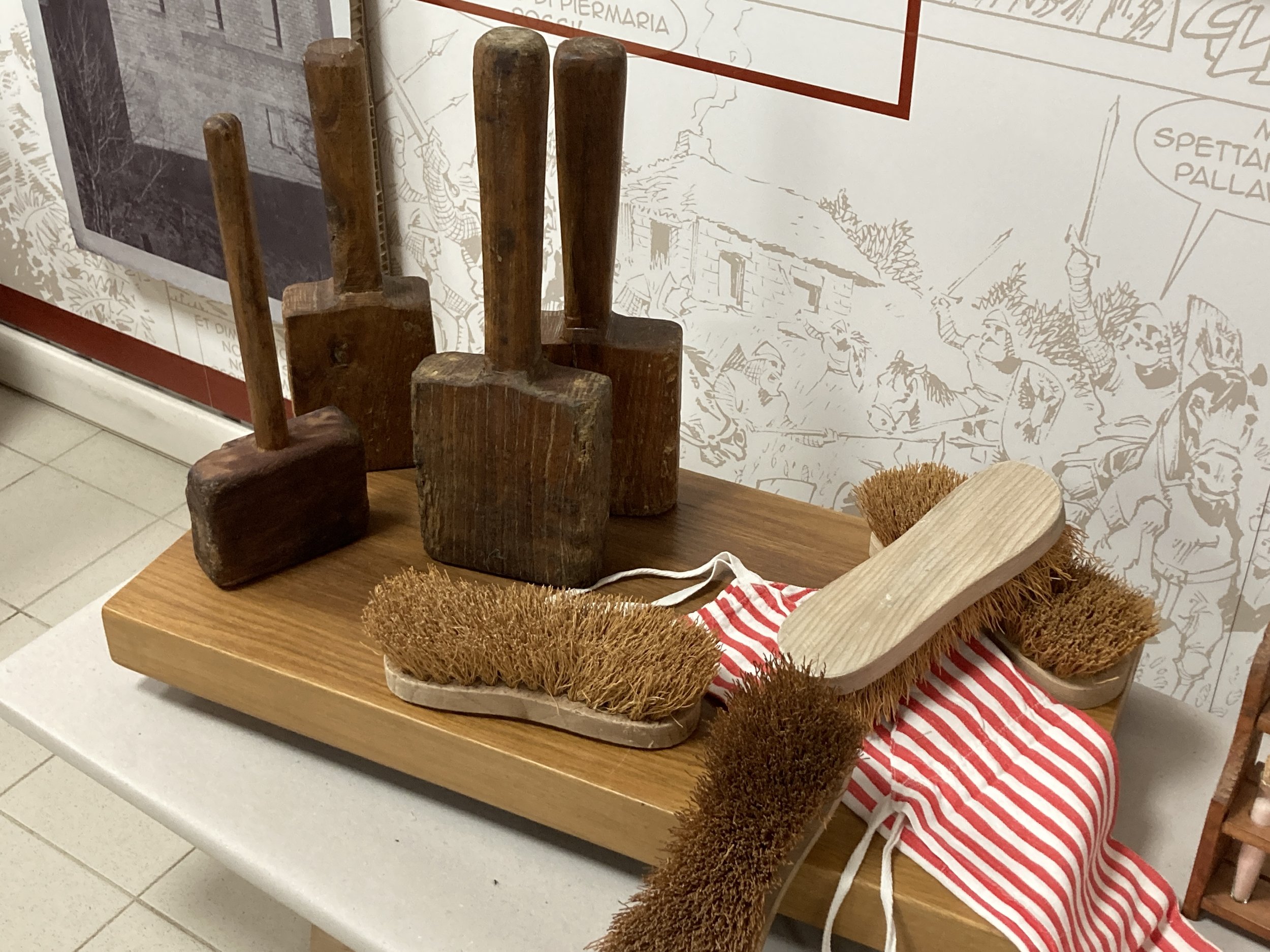
First, a little bit about the Salumificio Conti. The Conti family came to this part of Italy some 200 years ago, working the land and raising animals. In 1968, two of the Conti brothers founded the salumificio and learned the process of curing ham. Today the family does not raise the pigs themselves, they buy the hind legs of specially bred pigs (the types of pigs are part of the DOP regulations). Today the production is completely run by the women of the family, Mariangela and her three daughters, Michaela, Francesca, and Daniela. They do everything from minding the storefront, giving the tours, providing the tastings, and supervising the handling of the meat from raw hind leg to finished product. I have to think that their touch makes the meat ever so much tastier. To learn more about the history of the salumificio, there is a small museum on site with photos, old tools, and a timeline of the evolution of this family business.

F92C6228-8572-4D85-B959-270888E1E3B6.jpeg
87F197CD-3170-40EA-86BF-0ADF41A539FB.jpeg
1F9FC5FC-28C7-4CBA-BEB0-9AAF3B017021.jpeg
8BC63270-6540-4C86-BB3E-CF3898D25EB9.jpeg

The hills around Langhirano have a microclimate that contributes to the unique flavor of Prosciutto di Parma.

So, just what makes Prosciutto di Parma so special? Of course, it begins with the pigs (with apologies here to my vegetarian friends). Not just any pig will do. These are Italian born and bred pigs who are monitored from birth and must be at least 9 months old, weighing around 160 kg before they can begin to become Prosciutto di Parma. Each is even tattooed with the “parma crown”. They are fed a specific diet, which includes the whey that is a by-product of the production of parmesan cheese (another famous local product). This contributes to the flavor of the finished product, which is deeper in flavor and less sweet than other types of prosciutto.

Another factor is that this is a completely natural product. Salt is the only seasoning used in producing Prosciutto di Parma. There are no additives or preservatives added to the meat. In fact, our tour guide emphasized that the magic combination was pig + salt + sea breezes + time. It sounds simple enough, but the process is still quite involved.

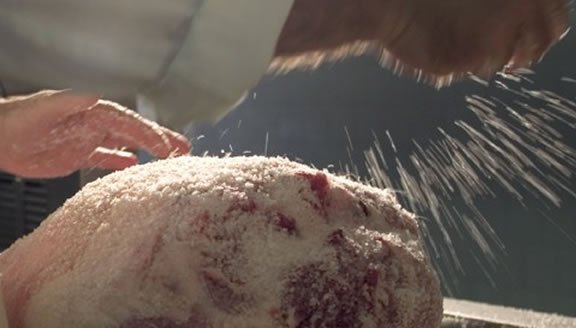
Sea salt is the only seasoning added to the raw pork (photo from Conti website)

The hind legs arrive at the facility and are weighed. If too large, they are used for other products (such as Culatello and Fiocco, both of which have added spices and different methods of production). Next, the legs receive a good massage with sea salt crystals. Originally done by hand, today there is a machine for this part of the process. The next step in the curing process is cold storage in high humidity. The legs are first laid flat, to provide a bigger surface for salt absorbtion and to give the classic flattened shape. Later, they are hung in the same cold storage for 60-90 days.

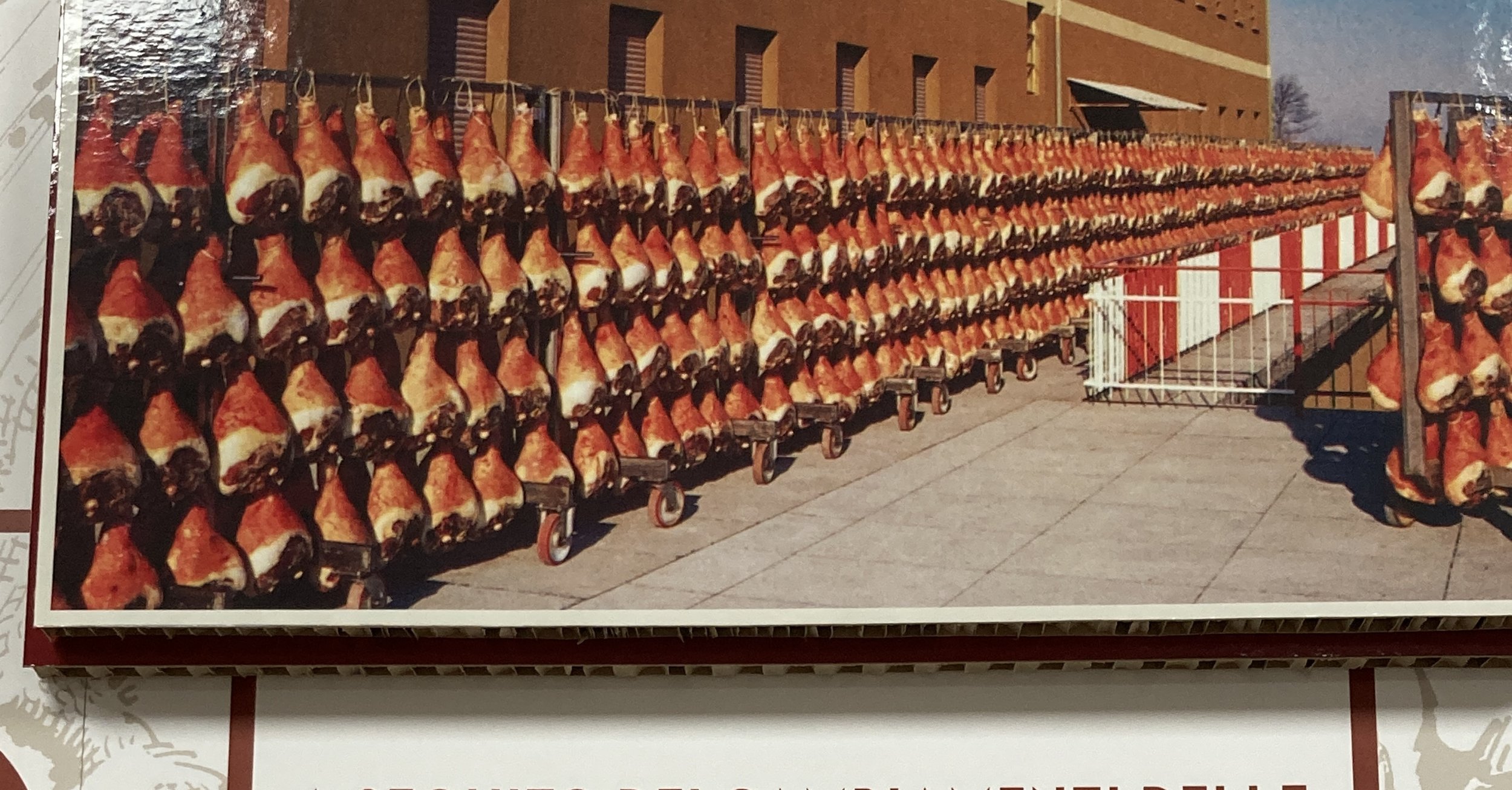
Next, comes the sea breeze part. The legs are hung from large wooden frames in a low humidity environment for several months. In the past they were actually outside on the roof top so as to catch the sea air. Health regulations prevent that open air drying these days, but the drying rooms have screens to let in the sea breeze. It’s an essential part of the process!

Outdoor aging to catch the sea breeze the way it was done in the past. Today this step in aging is done indoors with screens to let in the sea air.

The white coating on the cut end of the leg is the sugna, it prevents the meat from drying out and keeps it soft.

The legs are coated in sugna, a mixture of lard, salt, pepper, and rice flour).

The purpose of this mixture is to seal the meat and soften the cut surface. It is not absorbed and does not contribute to the flavor.

Last step - to the aging cellar. Here the meat rests for at least 12 months.

At the end of the period of aging, an inspector from the local consortium arrives to certify the meat. What an interesting process that is!

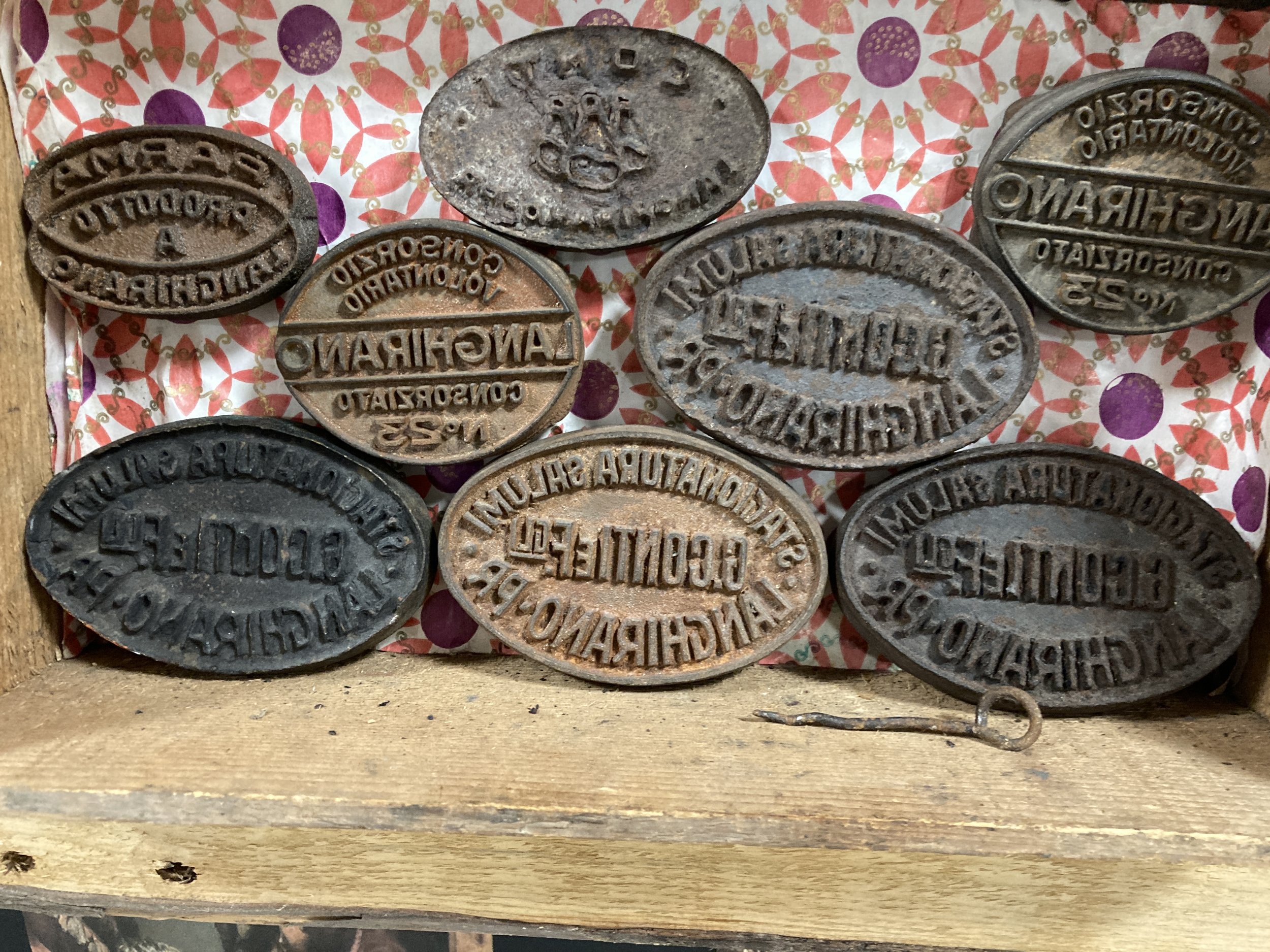
A needle like device made from the bone of a horse is used to puncture the prosciutto in several places. This type of bone picks up scent easily and the inspector sniffs the bone to determine if the meat has spoiled or is good. If it passes inspection it is branded with the Parma Crown and the number assigned to the producer.

This aged Prosciutto di Parma is branded with the Parma Crown, signifying it has passed inspection.

During the long process of aging, the producer is never quite sure how much of the meat produced will be good. This factor contributes to the cost of DOP certified Prosciutto di Parma.

After the tour we were treated to a tasting which included both Prosciutto di Parma (silky, almost buttery smooth, and exquisitely flavorful) along with some of the other pork products produced at Conti (delicious). Of course there was some wine too!

My Parma food tour was arranged by the company Get Your Guide. It was a well organized and fun way to see three places in a single day and learn about the production of Parmigiano Reggiano (Part One of this 3 part post) and Aceto Balsamico (Part Two). Of course Parma has much more to offer than just food. Look for more of Parma in future posts.

Contacts:

Salumificio Conti website: contiproscuitti.it

Get Your Guide website: getyourguide.com. (there’s also a helpful app)


February 14, 2022 /Joanne Bartram
Prosciutto di Parma, #prosciutto, salumeria, italian proscuitto
food, Italian culture, Italy travel, Parma, Traditional product Italy

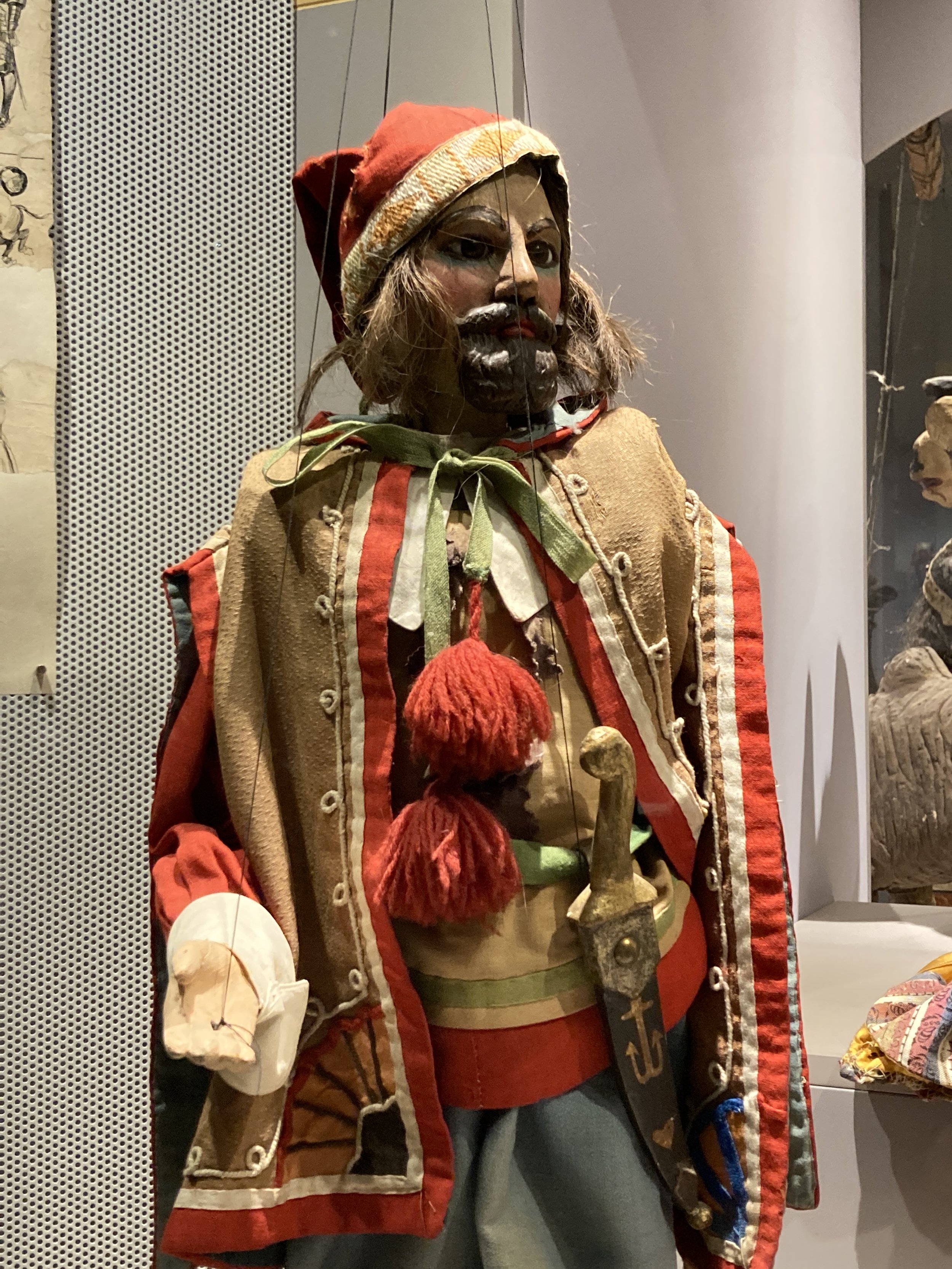
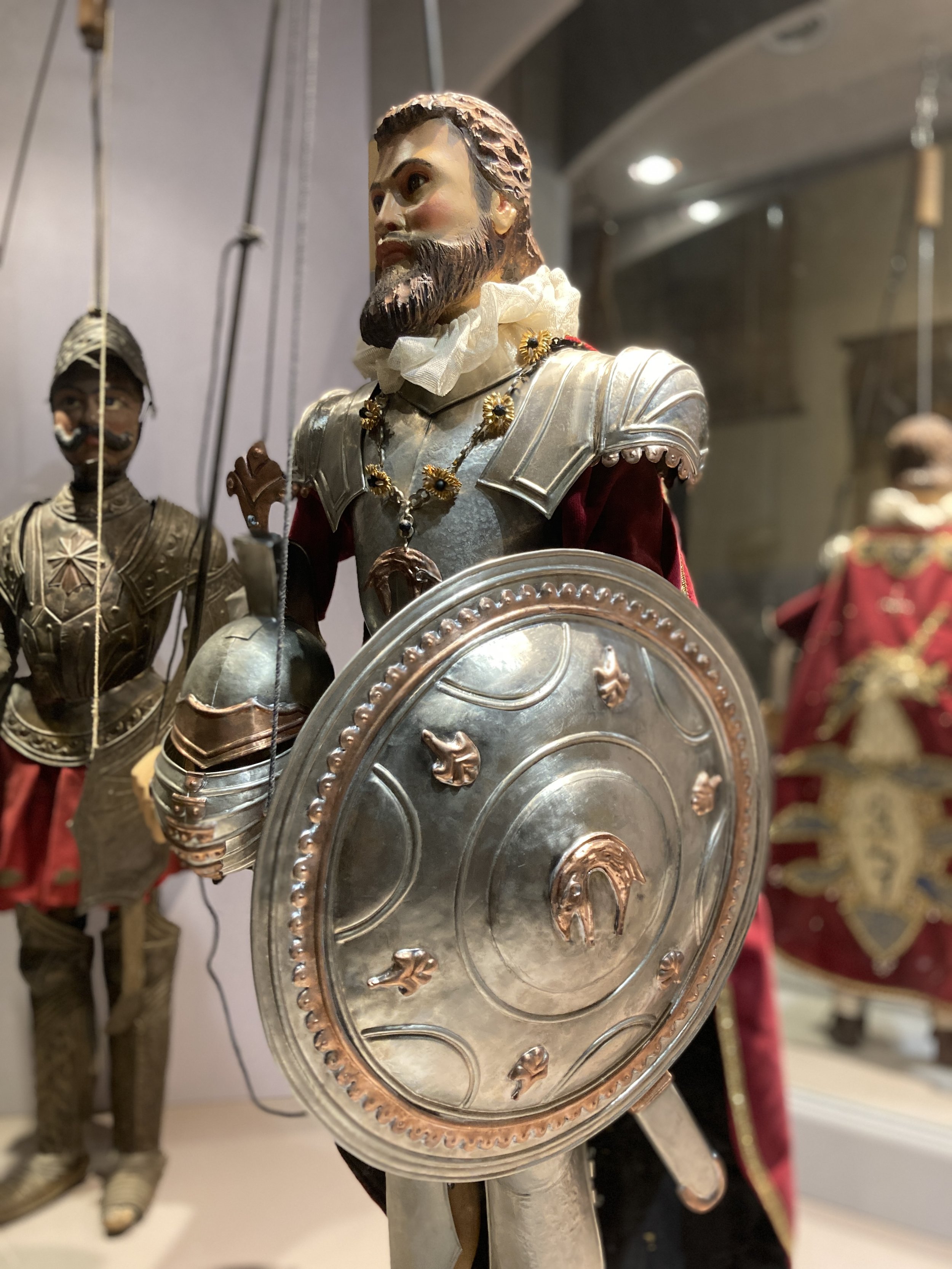
These marionettes were among the largest in the collection. Such detail!

A Quirky Attraction in Parma - The Puppet Museum

January 24, 2022 by Joanne Bartram in #italytravel, Family Travel, Italian culture, Italy travel, Museums Italy, Parma

There is so much to like about Parma, Italy. Let’s start with the food - Parmigiana, Prosciutto di Parma, all those filled pastas. Lambrusco wine. There are wonderful piazzas to enjoy, a gorgeous city park, the Palazzo Pilotta with its group of fabulous museums. My guidebooks listed a host of “must-sees”. However, one of my first stops in Parma was to an off-the-beaten path rather quirky place that was not listed in any of my guidebooks - Il Castello dei Burattini Museo Giordano Ferrari (The Castle of the Puppets, Museum Giordano Ferrari). Sometimes, the less known little places are the most enchanting. And enchanted is just how this small museum feels.

Puppetry was a popular theater format in the days before radio, TV, and movies. Puppets existed as far back as Ancient Greece and Rome. Throughout Italy the golden age for puppet theater was the 18th and 19th centuries. The burattini (or pupi) were used to tell stories ranging from religious to tragic to comedic. Performances included opera and Shakespeare and even some fairly scandalous content. Puppet theatre was enjoyed across social classes and age groups. A visit to the Castello dei Burattini makes this history come alive.

5A475CBC-D612-45F2-8AC7-F94D958E1291.jpeg
F55CA73B-8403-4E0B-9C42-2370FCCCD84F.jpeg
E1D03C43-6730-491C-AD24-5CE22C1F8205.jpeg

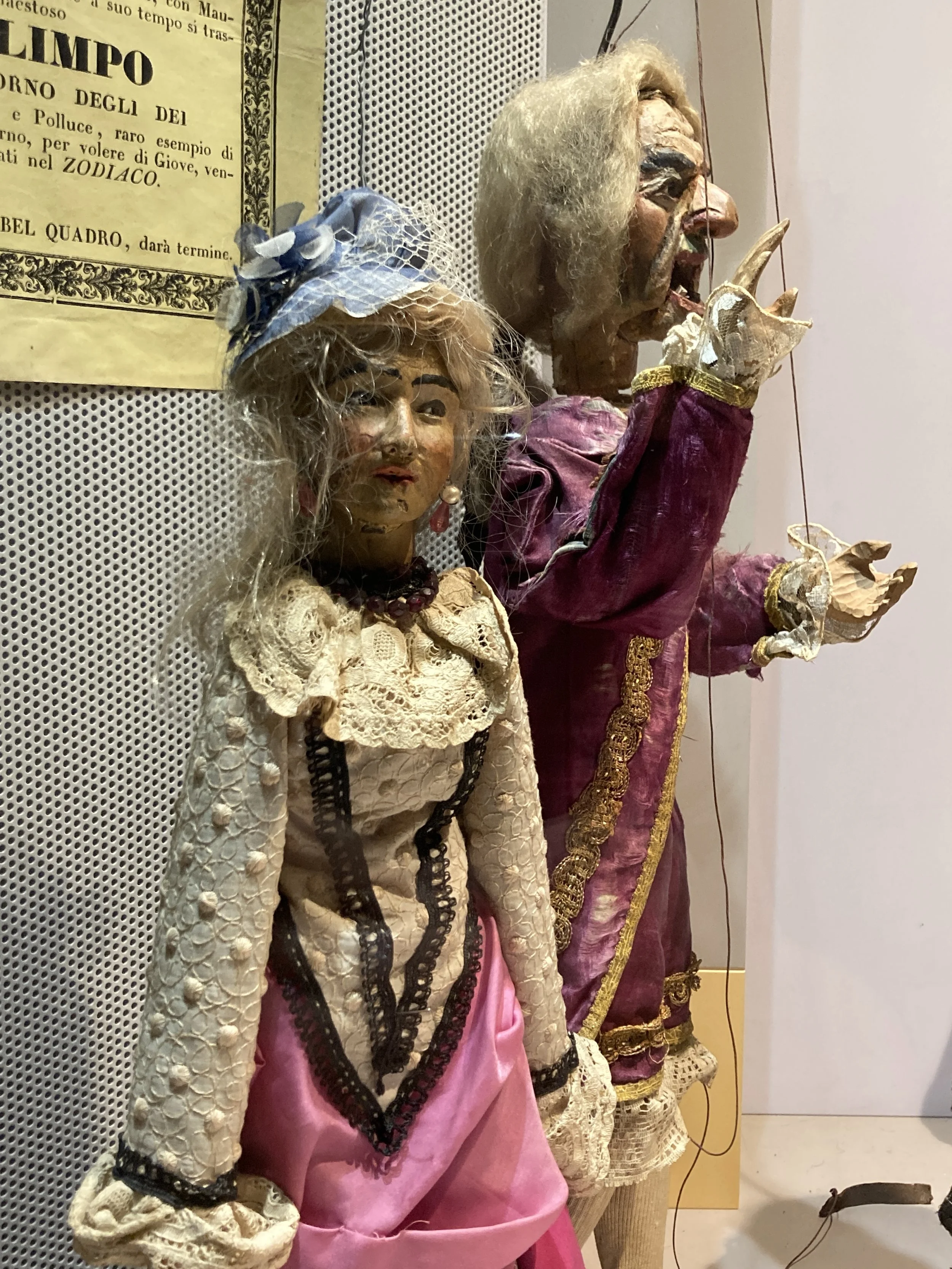
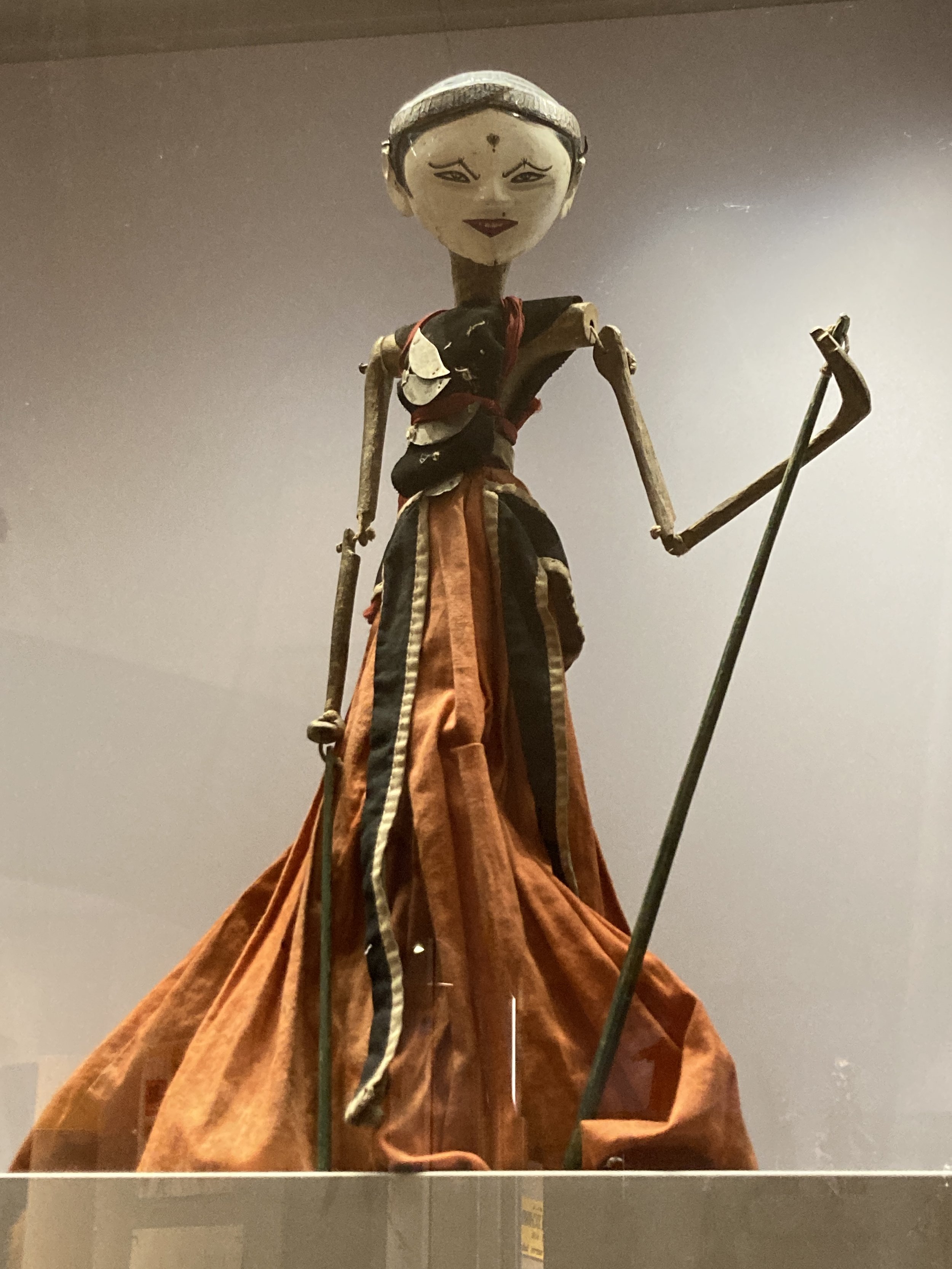
The museum’s collection includes carved puppet heads, marionettes (puppets controlled by strings or rods), and hand puppets. They range from very old to modern muppet-like characters.

8C3E5AB3-5A81-4913-B13C-01075043A502_1_201_a.jpeg
181E8F30-B23C-45EB-A3F4-0648952D1898.jpeg
18523E2C-5E37-4E30-A844-679C883BC1B5.jpeg

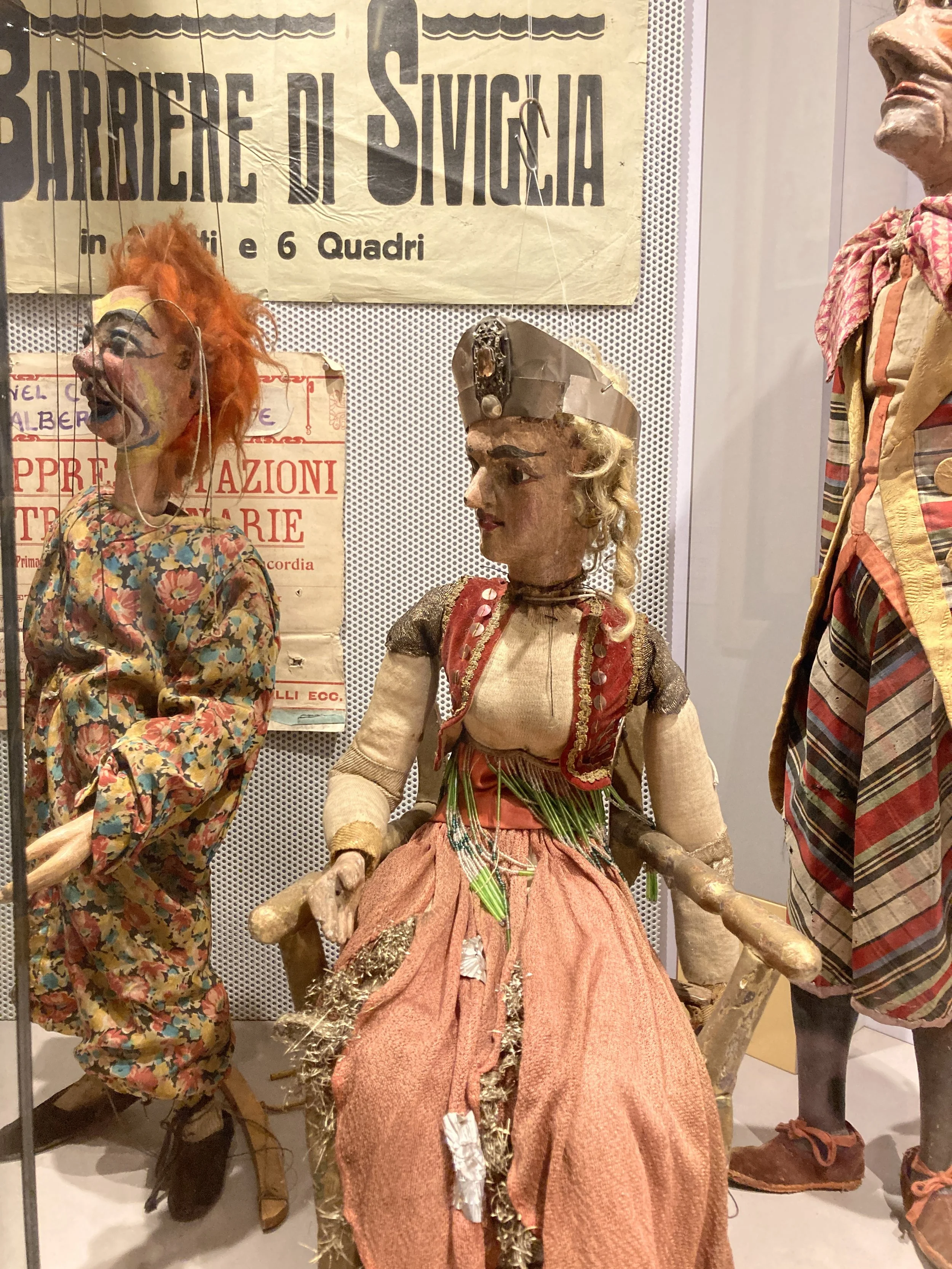
All the typical characters from Italian puppet theater are represented in the Castello dei Burattini - princes and princesses, villains, devils (there were lots of devils!), ghosts, monsters, servants, merchants, workers, society gents and ladies, priests, and policeman. There are knights in armor and sultans and animals. The faces are amazingly expressive and the elaborate costumes are fascinating.

4A629BC6-16B3-4554-B64A-7C04337CF715.jpeg
0FE957D7-5235-4CEF-8393-3E12DACA66A3.jpeg

The collection showcases the work of the Ferrari Company, a multi-generational puppeteering family from this area. Their involvement with puppets goes back to the late 1800’s and continues today. In addition to being a professional puppeteer, Giordano Ferrari collected the stories of puppet theaters throughout Italy and amassed this vast collection of burattini. Eventually, the city of Parma acquired the collection and, in 2002, the museum was established.

In addition to the puppets, the displays also include video presentations of puppet shows, fabulous old posters advertising the shows, scripts for the performances and - from time to time - live puppet shows which delight the many children who attend and their parents (along with the occasional tourist).

CA2EC622-E21D-45C4-95AB-80C0B0023EC5.jpeg
E0663A21-453C-47D9-AAB3-9C297FB57777.jpeg
13921006-B474-467D-A2FB-C8CE853863D7.jpeg

Admission to the museum is free. The enchantment is worth a lot!
Castello dei Burattini. Strada Macedonio Melloni 3 VA, Parma

website: www.castellodeiburattini.it


January 24, 2022 /Joanne Bartram
Parma, parma italy, #Parma, Italian Puppet Theater
#italytravel, Family Travel, Italian culture, Italy travel, Museums Italy, Parma
  • Newer
  • Older

Powered by Squarespace